

PRE-LOADING CHIPS IN POKER
A TELL OF STRENGTH
Some poker tells occur only after a player acts. Others appear before the action ever reaches them. One of the more subtle examples is pre-loading chips, the habit of quietly preparing chips for a bet or raise while another player is still making a decision.
In many cases, this isn’t a deliberate attempt to reveal information. Instead, it reflects something more important: the player has already decided what they’re going to do. Their hands simply begin preparing before it’s officially their turn to act. As with all poker tells, this behavior should never be viewed in isolation, but when it represents a consistent pattern, it can provide valuable insight into an opponent’s intentions.
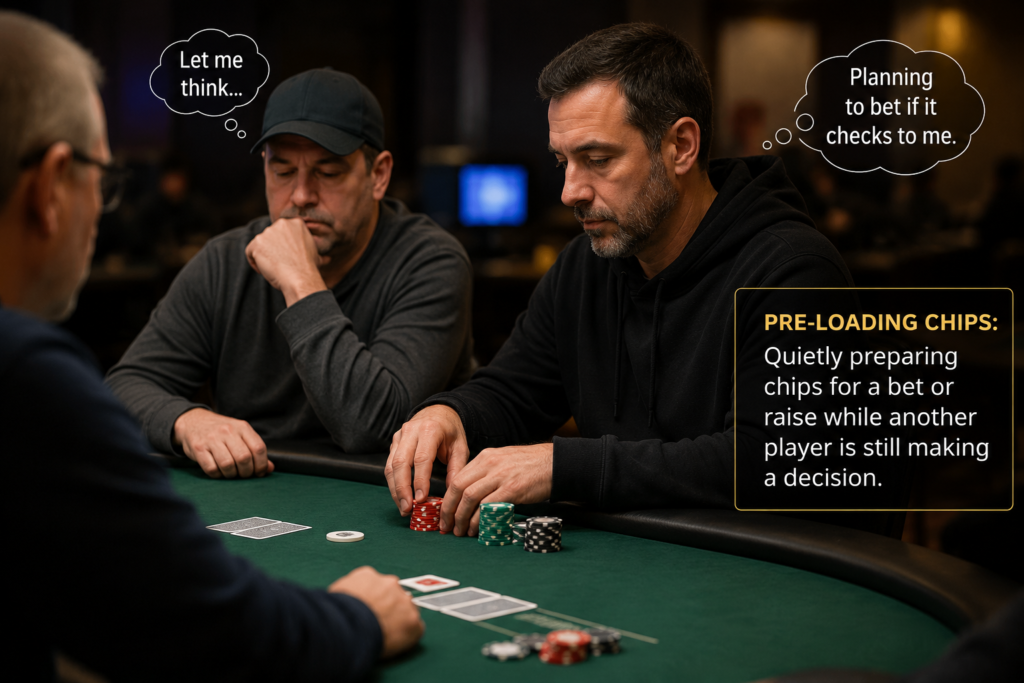
In this article, we’ll examine what pre-loading chips looks like, why players often do it without realizing it, and when this waiting-for-action tell is most likely to provide meaningful information.
WHAT PRE-LOADING CHIPS LOOKS LIKE

Pre-loading chips occurs when a player begins preparing chips for a bet or raise before the action reaches them. Rather than waiting until it’s their turn, they quietly organize, separate, or stack the chips they expect to use while another player is still thinking or acting.
The behavior is usually subtle. A player may cut out a small stack of chips, move higher denomination chips closer together, or position a potential bet in front of their stack without actually placing it into the pot. In many cases, they aren’t even aware they’re doing it because their attention is focused on the hand rather than their own behavior.
One of the easiest ways to spot this tell is to resist acting immediately when the action reaches you. Instead, take a brief moment to observe the players who are still waiting behind you. While your decision should never be delayed unnecessarily, a short pause often provides an opportunity to notice whether someone has already begun preparing chips before it’s their turn to act.
Not every player who organizes chips before acting is revealing useful information. Some players simply handle their chips out of habit, while others constantly shuffle or rearrange their stacks regardless of the situation. As with any poker tell, the behavior becomes meaningful only when it represents a consistent pattern or a noticeable change from that player’s normal routine.
THE DECISION COMES BEFORE THE ACTION
The important observation isn’t that a player is pre-loading their chips. It’s that they’ve often already made their decision before the action reaches them.
Poker decisions don’t always occur the instant a player acts. In many situations, especially in straightforward multi-way pots, players decide whether they’re going to bet, raise, call, or fold while the action is still several seats away. Once that decision has been made, it’s natural for the body to begin preparing for what comes next.
That’s why some players quietly organize or separate chips before it’s their turn. They’re not necessarily trying to send a message or deceive anyone. More often, they’re simply preparing to carry out a decision their mind has already reached.
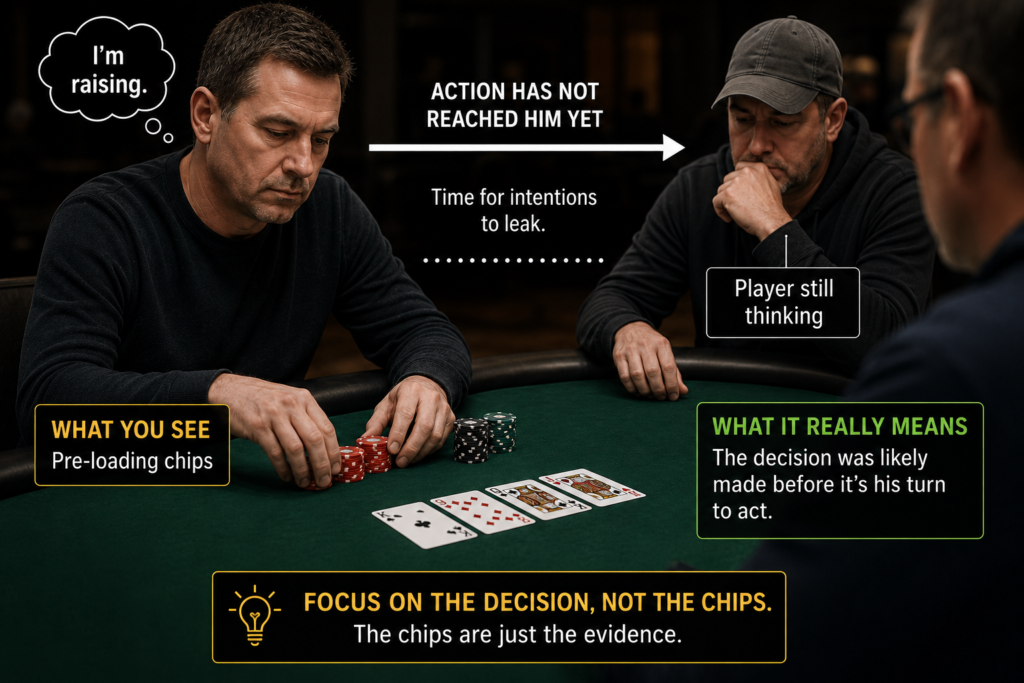
This is an example of a broader principle found in many poker tells: behavior often follows an internal decision before the action itself occurs. The physical movement isn’t the tell, it’s the outward expression of a thought process that’s already taken place.
Of course, not every player who prepares chips early is revealing useful information. Some players routinely organize their stacks throughout a hand, while others simply like to be prepared before the action reaches them. That’s why this tell becomes most valuable when it represents a consistent pattern or a noticeable departure from a player’s normal behavior.
WHEN PRE-LOADING CHIPS IS MOST RELIABLE
Like most poker tells, pre-loading chips isn’t equally reliable in every situation. It tends to occur in multi-way pots where several players are still waiting to act. The more time players have between making their decision and taking their action, the greater the opportunity for their intentions to begin leaking through subtle chip movements.
Although this tell can occur on any betting street, it’s often most noticeable in loose, multi-way pots where several players remain in the hand. Once a player has decided to bet or raise, there may be several opponents who must act before it’s their turn. That waiting period creates an opportunity for subconscious preparation to occur, causing the player to quietly organize or separate chips before the action reaches them.
Context also matters. In many live cash games, it’s perfectly normal for players to hold calling chips in their hand before the preflop action reaches them, particularly in loose games where several players are expected to call. When that behavior is common throughout the table, it loses much of its value as a tell. What you’re looking for isn’t simply a player touching chips, you’re looking for behavior that stands out from what’s normal for that particular situation.
WHEN PLAYERS REALIZE THEY'VE GIVEN SOMETHING AWAY
Occasionally, you’ll see something even more revealing. A player may begin stacking or separating chips, then suddenly realize they’ve done it too soon. Rather than leaving the chips where they are, they may casually begin riffling them, place them back on top of their stack, or otherwise try to make the movement appear routine. It’s almost as though they caught themselves revealing information and instinctively tried to erase the evidence.
This doesn’t necessarily make the tell more reliable, nor should it be interpreted as proof of a particular hand. However, it often suggests that the original movement wasn’t simply random chip handling. Instead, it may indicate that the player recognized they had unintentionally revealed their intentions before the action reached them.
As with every poker tell, the most meaningful observations occur when the behavior fits the situation and represents a consistent pattern rather than an isolated action.
AVOID JUMPING TO CONCLUSIONS
Pre-loading chips can provide useful information, but it should never be viewed as proof that a player intends to bet or raise. Like every poker tell, it represents one observation—not a conclusion.
Some players naturally organize chips throughout a hand, while others simply prefer to prepare before the action reaches them. That’s why it’s important to compare the behavior to the player’s normal routine and consider the circumstances in which it occurred.
The strongest observations occur when several pieces of evidence point in the same direction. Sometimes pre-loading chips is accompanied by other behaviors that support the same conclusion, thereby naturally increasing your confidence in the read. If the behavior conflicts with everything else you’ve observed, it’s often best to trust the broader context rather than the tell itself.
If you’d like to learn more about how different forms of chip handling can reveal information, see our article on Defensive Chip Handling In Poker, where we examine another way players unintentionally communicate their intentions through their chips.

CONCLUSION
As we’ve discussed, one of the easiest ways to spot this tell is to avoid acting the moment the action reaches you. Instead, take a few extra seconds to observe the players who will be acting behind you. If someone has already made a decision, they may unintentionally reveal it before it’s their turn through subtle changes in how they handle their chips.
The same principle applies whenever the betting changes before the action reaches those players. If a raise occurs after the initial bet, watch the players who still have cards in front of them. Their immediate reactions to the new information can sometimes reveal just as much as the actions they eventually take.
Poker tells often appear in the brief moments before a player acts. By slowing down, observing carefully, and making a habit of watching players who are still waiting their turn, you’ll begin noticing information that many players never see.