

THE POKER META GAME
THE HIDDEN LAYER STRONG PLAYERS USE TO WIN MORE MONEY
Poker is played on two levels. The first is obvious: cards, ranges, pot odds, bet sizes, and math. The second is invisible but far more powerful. It is the shifting landscape of perception, pressure, emotion, timing, and psychological momentum that surrounds every hand. This hidden layer is the meta-game in poker.
Most players don’t study it. Many don’t even notice it. Yet they are inside it every time they sit down. And that is the key truth that separates good players from great ones: you are in the meta-game whether you realize it or not. There is no opting out. The only question is whether you are an active participant or a passive target.

EXPLOITING THE META-GAME IN POKER!
The meta-game exists because poker is a game of incomplete information, and we instinctively try to fill in the gaps. We read tone, tension, rhythm, confidence, hesitation, and the emotional residue from the last pot. Players make decisions based not only on the cards, but on what they believe those cards represent in the context of everything that came before. Whether those beliefs are accurate or not doesn’t matter. The meta-game still shapes the outcome.
This article pulls back the curtain on that hidden layer. It explains what the meta-game actually is, why it exists, how it influences every strategic decision, and how you can use it to win pots long before the cards ever hit the felt. Poker has always rewarded players who think beyond the hand in front of them. Understanding the meta-game lets you control not only your own strategy, but the psychological environment the entire table must operate in.
Welcome to the real game, the one happening above the cards, inside the players, and beneath every decision you make.
WHAT THE META-GAME ACTUALLY IS (AND WHY IT EXISTS)
The meta-game in poker is the continuous, invisible negotiation of perception, emotion, timing, and expectation that influences every decision at the table. It is not a strategy, and it is not psychology alone. Instead, it is the field where human behavior and strategic pressure collide and reshape each other in real time. The meta-game determines how your actions are interpreted, how opponents respond, and whether your decisions achieve the results you intend.
It exists because poker is played with incomplete information. No one sees your cards, your exact range, your motives, or your emotional state. Players try to close those gaps using intuition, experience, bias, fear, memory, and whatever fragments of information they can collect. The moment someone tries to interpret your action, a meta-game interaction begins. The moment someone adjusts their strategy based on what they believe about you, the meta-game deepens. And the moment they react emotionally rather than logically, the meta-game becomes the dominant force at the table.
EVERY DECISION CREATES ANOTHER LAYER
Understanding this layer is essential because every decision in poker is filtered through it. A bet is never just a bet. A raise is never isolated from history. A check carries meaning beyond the single moment. Opponents make decisions based not only on odds, equity, and math, but on how they feel about the situation, how they perceive you, and what they believe is happening beneath the surface. When the meta-game tilts in your favor, mediocre hands become profitable. When it tilts against you, even strong hands lose value.
The meta-game is always running because players are always reading, reacting, guessing, projecting, and interpreting. Whether their interpretations are accurate or wildly off-base does not change its power. The meta-game exists because people exist, and people bring emotion, memory, bias, and instinct into every hand they play. In other words, the meta-game is not something you choose to engage with. It is the environment that poker creates the moment two players sit down and decide to compete.
Most low-stakes players never think about the meta-game, and many don’t even realize it exists. They play emotionally, reactively, and moment to moment, believing the game begins and ends with the cards in front of them. But their lack of awareness does nothing to remove them from the meta-game. Their tendencies, pacing, frustrations, calling habits, and betting patterns still generate the same psychological and strategic signals they would if they understood exactly what they were doing.
And that is why players who do understand the meta-game have such a massive advantage in lower-stakes games. The unaware still participate. They just participate unconsciously, and predictably.
WHY THE META-GAME MATTERS MORE THAN THE CARDS
Most players believe poker is governed primarily by the strength of their hands. They measure success through cards dealt, flops hit, and showdowns won. But that framework overlooks the reality that the majority of pots never reach showdown at all. Most decisions, fold, call, bet, raise, are shaped long before the cards have a chance to prove anything. And that is where the meta-game exerts its greatest influence.
The meta-game matters more than the cards because it controls how players interpret the story you present. If your image suggests strength, opponents relinquish pots you had no business winning. When your timing creates doubt, even mediocre hands force folds. If your table presence generates pressure, players collapse under situations where they should fight back. The cards become secondary to perception, and perception becomes the true currency of the game.
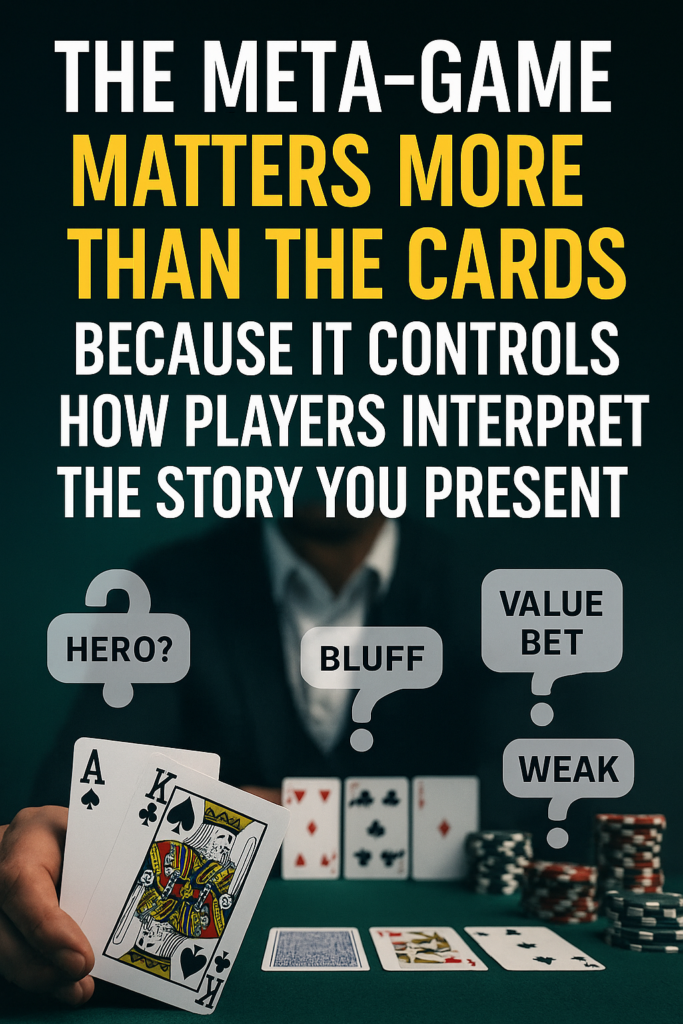
THE META-GAME IS THE CONTEXT THAT GIVES STRATEGY ITS MEANING
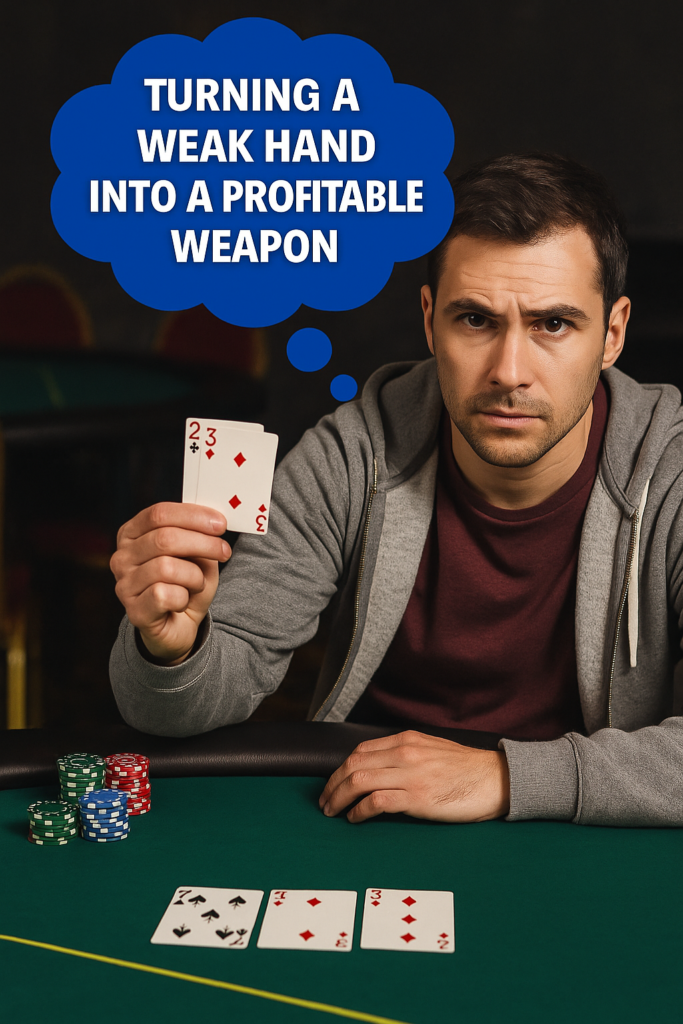
A player who understands the meta-game can turn weak hands into profitable weapons, while a player who ignores it can turn premium holdings into losses. This is not theoretical; it is the structure of live poker itself. Decisions are rarely made in a vacuum. They are made within a context shaped by recent history, emotional undercurrents, momentum swings, and the expectations players bring to the table. A simple continuation bet gains or loses value not only because of the board, but because of how the bettor has been behaving across the last twenty minutes.
In this sense, the meta-game is not a supplement to strategy, it is the environment that gives strategy meaning. A raise is interpreted differently depending on who makes it. A check from one player signals weakness, while the same check from another generates suspicion. Identical actions can carry opposite meanings purely because of the meta-game surrounding them. The cards don’t change, but the outcomes do.
When you recognize this, poker becomes far more than a series of disconnected hands. It becomes a shifting psychological landscape where awareness creates advantage and blindness creates unnecessary risk. The players who consistently win are not the ones who get the best cards. Good players are the ones who understand why a marginal hand becomes profitable in one moment and unplayable the next. They are the ones who notice tension when others miss it, who sense fatigue when others overlook it, who interpret silence when others ignore it. They understand that the meta-game isn’t a layer on top of poker. It is the layer that determines everything else.
THE COST OF MISREADING THE META-GAME
Most players lose money not because they misplay their cards, but because they misread the environment. When the meta-game turns against them, they continue playing a strategy that no longer fits the circumstances. When it shifts in their favor, they fail to capitalize. They act as though the game is static, when in reality it is fluid. And because they never learn to interpret these invisible shifts, they become prisoners of the cards instead of players of the game.
Understanding the meta-game frees you from that limitation. It allows you to see the real forces driving action, the emotional pressures beneath the surface, and the strategic opportunities hiding inside every decision. You are no longer reacting to cards. You are shaping the environment in which cards gain or lose value.
.
UNDERSTANDING THE META-GAME ALLOWS YOU TO SEE THE REAL FORCES DRIVING THE ACTION!
THE TWO ENGINES OF THE META-GAME
The meta-game is powered by two forces that operate simultaneously at every table: the psychological engine and the strategic engine. These forces are always interacting, shaping how your decisions are received and how your opponents respond. When players understand both engines and how they influence each other, the game begins to reveal patterns that most players never recognize.
.
THE PSYCHOLOGICAL ENGINE
THE STRATEGIC ENGINE
The psychological engine is the undercurrent that runs inside the players themselves. It includes their fears, confidence levels, emotional state, tilt trajectories, insecurities, risk tolerance, frustration, ego, and their desire to win back what they just lost. These internal forces bleed into their decision-making whether they intend it or not. A player who feels ignored may suddenly fight for every pot. And player who feels targeted may retreat. A player who feels invincible may overextend. None of these reactions come from the cards. They come from the psychological engine driving the meta-game beneath the surface.
The strategic engine works alongside it, shaping how actions are interpreted within the structure of poker. It includes perceived ranges, past history, bet sizing, table image, tempo, line consistency, stack leverage, and the rhythm of aggression or restraint. These elements create a framework for how your decisions are understood. A large bet from one player may be seen as strength; the same bet from another may be seen as desperation. A check may invite aggression from one opponent and caution from another. Strategy always exists inside perception, not outside it.
THE MERGER - PSYCHOLOGY MEETS STRATEGY
The meta-game emerges in the space where these two engines overlap. Psychology shapes how strategy is interpreted. Strategy shapes how psychology responds. A tilted player becomes more vulnerable to pressure; a confident player becomes more resistant. A mismatch between emotional state and strategic discipline creates leaks. A player with a solid strategy but fragile mindset becomes predictable. A player with strong emotional control but poor strategic understanding becomes timid. The most dangerous opponents are the ones who synchronize both engines, because they can adjust the psychological and strategic environment at will.
Most players never learn to see these engines separately. Often, they will notice the aggression but not the frustration behind it. They see the check-raise but not the emotional shift that caused it. They notice the sizing but not the story the sizing tells. This blindness leaves them reacting to hands rather than navigating the meta-game. But once you understand how these two engines operate, the table becomes far easier to read. You begin to see not just what players are doing, but why they are doing it, and what they are likely to do next.
The meta-game is simply the constant interaction between these two forces. Every pot, every bet, every hesitation, every sigh, every snap call, every delayed raise, all of it is shaped by the intersection of psychological pressure and strategic interpretation. Once you can see the engines driving those actions, you stop guessing and start understanding. And the moment you understand, you gain an advantage that has nothing to do with the cards.
THE CORE COMPONENTS OF THE META-GAME
The meta-game may appear abstract from a distance, but when you break it down into its essential components, it becomes far easier to recognize at the table. These components are not theories. They are lived forces that shape every decision players make, even when they believe those decisions are based solely on their cards. The meta-game gains structure through five primary elements: table dynamics, momentum shifts, player image, emotional leaks, and adaptation speed. Together, they form the environment in which all strategy takes place.
.
TABLE DYNAMICS
MOMENTUM
Table dynamics are the emotional temperature of the table. Some tables feel tight and cautious. Others feel loose, restless, chaotic, or impatient. These moods develop through the collective behavior of the players, not through any single hand. A table recovering from a big clash has a different energy than a table that has been folding for ten minutes straight. These shifts influence how your bets are received and how much resistance you will face, often more than the actual ranges involved. A good player senses when the table wants action and when it wants relief, and adjusts accordingly. A poor player treats every table the same and pays the price.
.
Momentum is the movement of psychological and strategic pressure. It changes hands constantly. When you win two pots in a row, your bets are interpreted differently than when you’ve lost three. A player who has just been bluffed becomes more reactive. A player who has just scooped a big pot becomes more confident, sometimes too confident. Momentum is subtle, but it determines who has permission to apply pressure and who does not. When you learn to recognize momentum shifts, you sstop forcing plays into resistance and begin seizing opportunities the moment the table becomes vulnerable.
PLAYER IMAGE
EMOTIONAL LEAKS
ADAPTATION SPEED
Player image is the lens through which opponents view your decisions. You may see yourself one way, but they see something entirely different. Your last few hands, your bet sizing tendencies, your posture, your speed, your mood, all of these contribute to the story they believe about you. Whether that story is accurate doesn’t matter. What matters is that it shapes their reactions. If they see you as disciplined, your bluffs work more often. If they see you as reckless, your value bets get paid. You do not need to control your image perfectly; you only need to understand how others currently interpret you.
Emotional leaks are the small signals that betray the true state of a player. They are not tells in the traditional sense, but patterns of behavior born from emotional residue. A frustrated player becomes impatient. A fearful player becomes passive. Bored players become reckless. A tilted player becomes predictable. These leaks shape their strategy long before they consciously choose their actions. Emotional leaks are the bridge between psychology and strategy — when you notice them, you begin to predict behavior with surprising accuracy.
Adaptation speed determines who stays ahead and who falls behind. The table changes every few minutes. Momentum shifts, dynamics shift, mood shifts, image shifts. Most players adjust too slowly or not at all. They continue playing a strategy that matched the table ten minutes ago, unaware that conditions have changed. Strong players adapt faster than the table realizes, and in doing so, they control the direction of the meta-game. Weak players cling to static patterns and wonder why the same plays stop working.
THE TOTAL STRUCTURE
These components form the structure of the meta-game. They are present in every session, whether players acknowledge them or not. Once you learn to recognize them, the table becomes far more transparent. You begin to understand why certain decisions succeed or fail, why some players collapse under pressure, and why others remain steady no matter how turbulent the action becomes. The meta-game stops being an abstract concept and becomes the most practical tool you have.
HOW TO READ THE META-GAME IN REAL TIME

Reading the meta-game in real time begins with understanding that poker is not a sequence of isolated hand,it is a continuous conversation. Every player contributes to that conversation through their pace, their posture, their emotional residue, their reaction to wins and losses, and their shifting expectations about how the table should behave next. None of this appears in the cards. None of it appears in a solver. But all of it shapes the context in which every decision is made.
RECOGNIZING TABLE RHYTHM AND MOMENTUM SHIFTS
The first skill is learning to read table rhythm. Every table has a pace, and that pace tells you what the next pot is likely to look like before the cards are even dealt. When the table has folded quickly for several orbits, the collective mindset leans toward caution. When the last few pots have been large and emotional, the table leans toward volatility. A passive rhythm invites pressure. A chaotic rhythm warns against it. If you pay attention to the rhythm rather than the randomness of individual hands, you begin to sense whether the next pot is likely to gather strength or collapse early.
Momentum functions like gravity at the table. A player who wins accumulates psychological weight; a player who loses becomes lighter and easier to push. Reading momentum allows you to interpret actions as emotional echoes rather than isolated choices.
.
READING EMOTIONAL TONE AND PLAYER STABILITY
UNDERSTANDING YOUR IMAGE - BEFORE YOU USE IT
RECOGNIZING ADAPTATION SPEED ACROSS THE TABLE
Next is emotional awareness. A player who loses a big pot carries that emotional residue forward; no one resets cleanly. Some tighten up. Some loosen up. Others begin reacting too quickly. You detect this not by staring at their hands or eyes, but by noticing their breathing, pacing, chip-handling, tone, and the way they occupy their space. These micro-shifts signal how stable or unstable they are, and instability drives the meta-game more than most players realize.
Reading the meta-game also means reading your own image, but here, image is still observational. You must detect how others are interpreting you at this exact moment. Have you appeared tight? Reckless? Detached? Intense? Your opponents’ perception, accurate or not, shapes how they react to your decisions. Before you can use that information strategically, you must first understand it.
Some players adjust instantly after a confrontation. Others need several hands. Some never adjust at all. Reading adaptation speed allows you to map who is drifting, who is anchored, and who is actively processing the game around them. Fast adjusters require subtlety; slow adjusters allow repetition. Non-adjusters allow prolonged exploitation—but again, recognition comes before action.
SEEING THE TABLE, NOT JUST THE HAND
These observational layers create situational clarity. You are not looking for a tell. You are looking for the truth of the moment. Is the table fatigued? Energized? Defensive? Tilted? Optimistic? Is a player protecting a stack or chasing a loss? These environmental truths define the meta-game far more than your hole cards.
Sherlock Holmes once told Dr. Watson, “You see, but you do not observe.” Most poker players make the same mistake. They see the action but miss the forces shaping it. When you begin to observe in the Holmesian sense,quiet, detached, deliberate, the entire meta-game becomes visible. What once looked chaotic becomes predictable. And once predictable, it becomes usable.
Reading the meta-game is not about guessing, it is about noticing what others ignore.
HOW TO USE THE META-GAME TO WIN MORE POTS
Using the meta-game to win more pots is not about playing more hands or bluffing more aggressively. It is about choosing the right moment,moments when the emotional tone, table rhythm, and expectations of your opponents lean in your favor. When you understand how these forces operate, you begin to recognize opportunities that have nothing to do with your cards and everything to do with the environment surrounding the hand.
One of the most reliable applications of the meta-game is knowing when to attack passive tables and when to withdraw from volatile ones. A passive table grants you the freedom to apply steady, controlled pressure. A volatile table punishes unnecessary risks, because players are acting emotionally rather than strategically. Winning without strong cards depends on sensing when the collective mindset is open to pressure and when it will fight back.
USING YOUR TABLE IMAGE AS A STRATEGIC WEAPON
HARNESSING MOMENTUM TO INCREASE FOLD EQUITY AND VALUE
You also use the meta-game by understanding what your current image allows you to do. If you have been patient and selective, your bets gain credibility, increasing your fold equity and giving you control over uncontested pots. If you have been active, aggressive, or visibly involved in recent confrontations, the table expects you to continue pushing the pace. In those moments, your value bets are far more profitable because players “don’t believe you.” The meta-game rewards players who understand how their image is being interpreted in the moment—and who act before their opponents adjust.
Momentum is a powerful force in live poker. When you win a pot, large or small, the table subconsciously credits you with competence. Your next bet carries weight because players perceive you as “running good.” When you lose a pot, the opposite happens: your bets receive more skepticism. Timing your aggression with momentum allows you to generate folds with marginal hands and extract value with strong ones. Most players never consciously recognize these shifts. Strong players capitalize on them.
EXPLOITING EMOTIONAL LEAKS WITHOUT RISKING YOUR STACK
STAYING ONE STEP AHEAD THROUGH ADAPTIVE TIMING
Emotional leaks create some of the clearest opportunities to win pots without premium holdings. A frustrated player becomes impatient and overreacts to pressure. A fearful player folds too often. A bored player enters pots recklessly. A tilted player becomes predictable. When you identify these emotional states, you apply pressure precisely when that opponent is least capable of resisting. You are not exploiting their cards—you are exploiting their vulnerability. The cards matter less than the emotional landscape you are navigating.
The strongest use of the meta-game comes from adjusting faster than the table can track. Most players cling to one gear for too long. They bluff until caught, then shut down. They tighten up until noticed, then loosen abruptly. When you shift gears just before others expect it, you stay ahead of their assumptions. You attack when they are preparing to defend. Or you retreat when they expect you to push. You enter pots at moments when no one is positioned to challenge you. This timing is not guesswork—it is the natural result of reading the meta-game correctly.
THE META-GAME NEVER OVERRIDES THE MATH
None of this replaces the math. The meta-game does not give you permission to bluff in losing spots or to force plays that violate probability, equity, or sound fundamentals. It simply tells you when mathematically correct decisions gain additional value and when mathematically marginal decisions lose it. A profitable bluff is still profitable because the numbers support it; the meta-game only increases the likelihood that your opponent folds. A value bet is still value because the ranges demand it; the meta-game determines how often it gets paid. The strongest players use the meta-game to enhance good mathematical decisions—not to justify bad ones.
HOW THE META-GAME PUNISHES PLAYERS WHO DON'T UNDERSTAND IT
Players who ignore the meta-game don’t just miss opportunities—they walk into traps they never see coming. They sit down believing poker is nothing more than cards, ranges, and maybe a bit of “feel.” Because they don’t recognize the shifting layers of momentum, pressure, image, or emotional leakage around them, they consistently misread situations that a more aware player sees clearly.
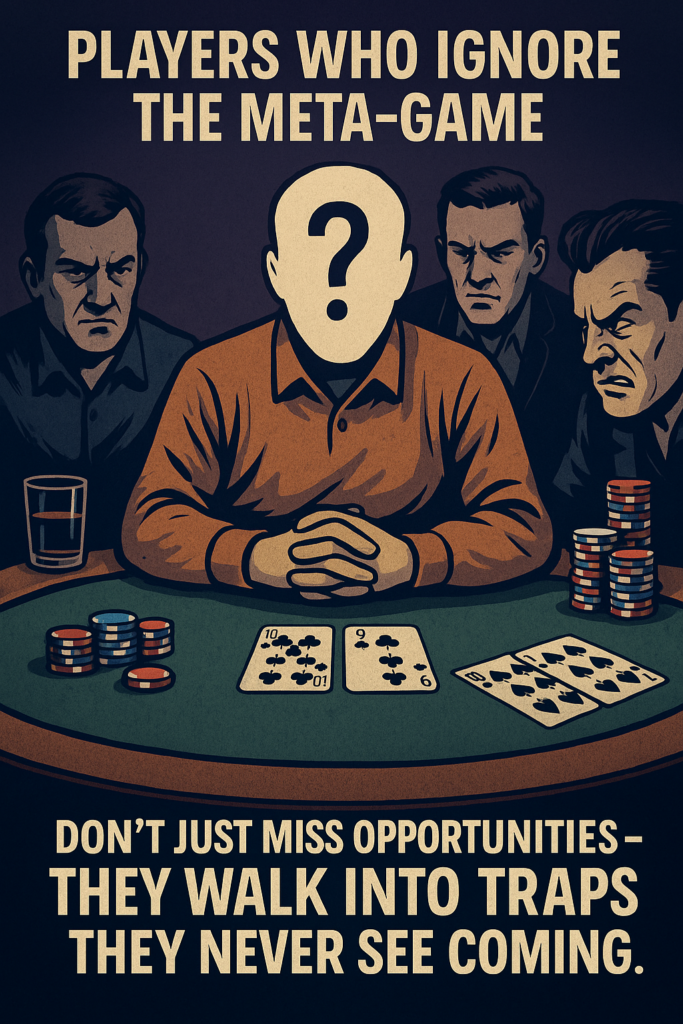
A player who doesn’t understand the meta-game calls when he should fold, assuming the pot odds are enough,without realizing the table dynamic makes his opponent’s bluff frequency nearly zero. He bluffs into players who have already shown they’re frustrated and sticky, or tries to steal pots from players who just won a showdown and are now psychologically anchored to calling. He pays off river bets because “the math says I should sometimes call,” never recognizing that the specific opponent, in this specific state, on this specific runout, almost never bluffs.
PLAYING BLIND WHILE EVERYONE ELSE PLAYS WITH FULL INFORMATION
The unaware player becomes predictable, not because he chooses predictable lines, but because he fails to see how others perceive him. He does not recognize when his image has drifted from “tight” to “weak,” or from “aggressive” to “reckless.” He assumes his opponents view him the way he views himself. They never do. And so he makes decisions in a vacuum,while everyone else is making decisions using the full picture.
Most costly of all, the player who ignores the meta-game misinterprets cause and effect. He believes he is losing because of bad luck, bad cards, or bad beats, never because of invisible pressures he is creating for himself. This player feels he is being targeted because opponents “don’t respect him,” when the truth is simpler: the table has already mapped out his emotional patterns, timing, and fear points. He is playing one game. Everyone else is playing two.
You cannot avoid a game you are already in. You can only participate blindly or participate deliberately. The meta-game punishes the blind—not out of malice, but because poker rewards those who perceive reality more clearly.
HOW TO ACTIVELY INFLUENCE THE MEAT-GAME (WITHOUT PLAYING BAD POKER)
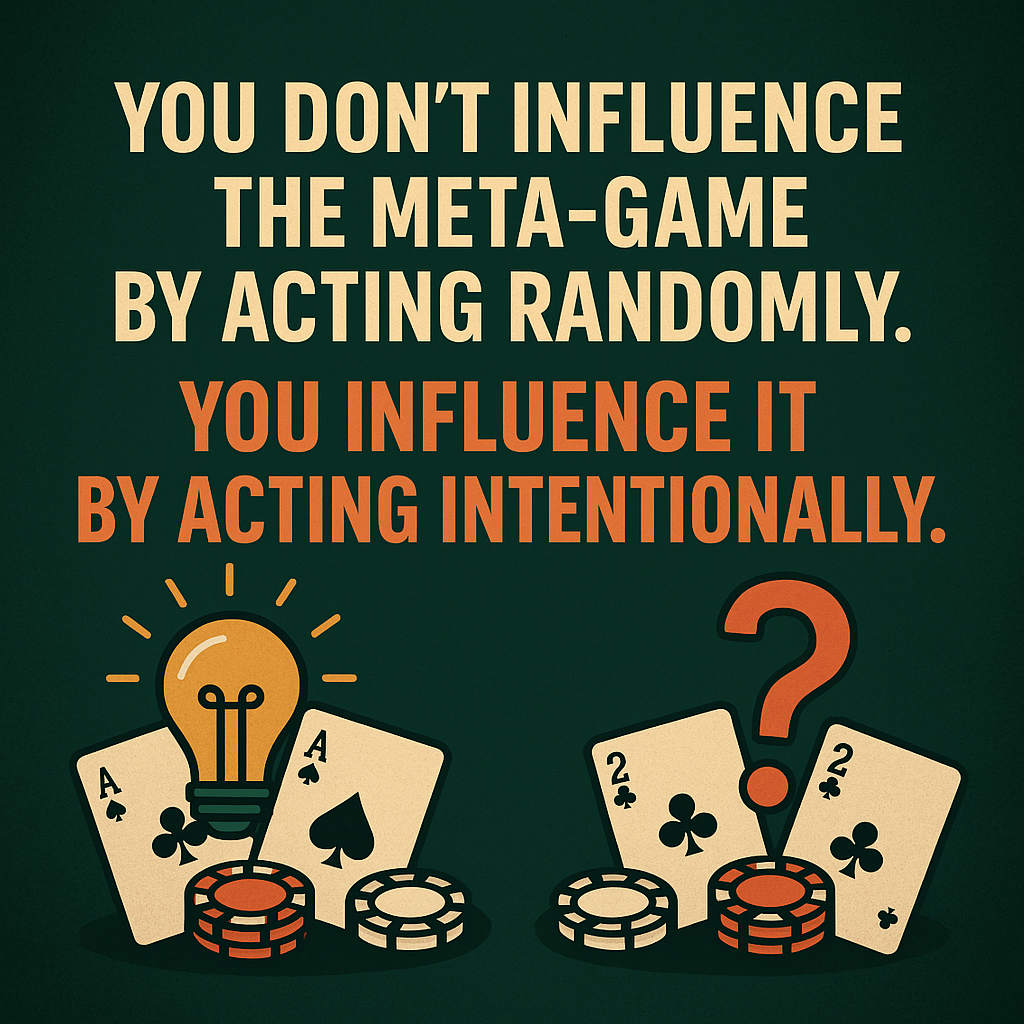
You don’t influence the meta-game by acting randomly. You influence it by acting intentionally. The players who manipulate a table successfully are not guessing, improvising, or “mixing it up for balance.” They are anchoring every decision to correct mathematical play, then adjusting the presentation of those decisions to shape how opponents respond.
The key is this: the math must always remain intact. You cannot create an image worth exploiting if you burn money in the process. A strong image, tight, aggressive, unflappable, unpredictable, works only when it remains built on fundamentally profitable decisions. Once you begin deviating into negative EV behavior just to appear “dangerous,” you aren’t influencing the meta-game; you’re feeding it ammunition to use against you.
THE FIRST STEP - INFLUENCE THROUGH STRATEGIC CLARITY
HOW YOUR IMAGE QUIETLY REWRITES THE TABLE'S EXPECTATIONS
Influencing the meta-game begins with clarity of line. When you choose a sizing, when you choose to check, when you choose to raise, each decision communicates something about your perceived range, whether you intend it or not. The goal is to develop consistency that is strategically sound, but flexible enough that opponents cannot map your entire game from limited observation.
A player who understands the meta-level will sometimes choose a line that is not his “default,” but still remains mathematically viable. For instance, a well-timed overbet on a scare card may be slightly higher variance but still correct against certain tendencies. A delayed c-bet may create more fold equity on later streets without sacrificing expected value. A rare bluff may capitalize on a read that has nothing to do with solver ranges and everything to do with human psychology.
But none of this is improvisation. It is the deliberate use of correct options—moves that already exist within profitable poker—to sculpt how opponents interpret you. You are not bending the math; you are framing it.
Once your table image begins working on your behalf, everything sharpens. Your value bets get paid. Your bluffs succeed more often. And your raises generate more respect. Players fold hands, they should call and call hands they should fold, not because you manipulated them directly, but because the story of who you are at the table has been quietly rewritten in their minds.
The sophisticated player does not fight the meta-game. He guides it. He threads correct decisions together in a way that shapes how others respond, creating an environment where profitable spots occur more frequently and with less resistance. And because he never abandons mathematical foundations, he can step into or out of any image without collapsing his strategy.
The result is a style of play that feels effortless to the opponents who can’t see beneath the surface,and inevitable to the player who can.
BUILDING YOUR OWN META-GAME AWARENESS SYSTEM
Mastery of the meta-game begins with a shift in how you see the table. Most players walk into a poker room and focus only on cards, positions, and bet sizes. A meta-game player arrives with a wider lens. They scan the room the moment they sit down, absorbing the atmosphere the way a pilot checks wind conditions before takeoff. Nothing dramatic or theatrical, just quiet, consistent attention.
The first skill to develop is the ability to read the emotional temperature of the table. Every poker game has a collective tone, even if players don’t speak a word. Some tables feel loose and energized. Others feel cautious and compressed. Some feel tense because one player is unraveling. Some may feel light because players are laughing and relaxed. Once you learn to identify these shifts, you will see that the “mood” of the table often predicts action more accurately than ranges can.
A strong meta-game player also tracks individual emotional arcs, who is rising, sinking, or fighting the cards, and who is flowing with them. You learn to watch posture and pace, not for Hollywood tells, but for changes in rhythm. The relaxed player becomes rigid. A player who was chatty goes silent. A player who never defended suddenly starts calling everything. These changes are more revealing than any board texture.
READING RESPECT PATTERNS, COLLAPSE POINTS AND YOUR SHIFTING IMAGE
Another layer of awareness comes from noticing what the table respects and what it doesn’t. Some tables fold immediately to large continuation bets. Others treat every c-bet as a challenge. Some tables give automatic credibility to tight players. Others ignore table image completely and respond only to bet size. When you understand which lines carry weight in the current game, you stop guessing. The table begins telling you exactly what will work.
You must also learn to recognize the early signs of collapse, your own and others’. A player who was composed ten minutes ago may now be uncomfortable, irritated, impatient, or embarrassed. Look for the subtle ways frustration reveals itself: chips handled differently, bets made faster, glances that linger too long at the pot. These micro-shifts reveal who is likely to overplay the next hand, who is bluffing on emotion, and who is mentally stepping out of the game.
Finally, you build an ongoing awareness of how the table sees you. Not how you see yourself, but how you are perceived. This is the part most players never check. Your image is always shifting, whether you want it to or not. A long stretch of folding creates a tight aura that you can weaponize. A big pot you just won inflates your threat level. A failed bluff drops it. Meta-game mastery means recognizing these shifts in real time and using them to sculpt profitable responses.
The goal is not perfection. The goal is habit. When you approach each session with the intention to observe, evaluate, and adjust, you begin to build a personal meta-game awareness system that sharpens every other aspect of your strategy. Over time, this habit becomes second nature, and you will find yourself making decisions that feel intuitive—but are actually rooted in the deep, silent signals the table constantly broadcasts.
THE META-GAME DECIDES MORE THAN THE CARDS EVERY WILL
The longer you play this game, the more you realize that technical skill alone doesn’t separate winners from everyone else. Math matters. Ranges matter. Discipline matters. But none of it reaches its full power unless you understand the invisible conversation happening above the cards. The meta-game determines who controls the pace, who gets paid, who gets folds, and who dictates the emotional flow of the table.
You are already participating in it,whether you intend to or not. Every decision you make feeds into the collective psychology of the game. Every reaction you show, every adjustment you avoid, every pattern you repeat becomes part of the story your opponents are reading. Players who win long term are not just good card players; they are good interpreters of the environment. They win the meta-game first, and the pot second.
When you begin paying attention to momentum shifts, emotional arcs, table tone, power centers, and image dynamics, the game opens in a way most players will never experience. Decisions become clearer. Opportunities appear earlier. Mistakes from others become predictable instead of surprising. The table stops feeling chaotic and starts feeling readable.
That is the true advantage of mastering the meta-game: you stop reacting to poker and start shaping it.
If this deep dive gave you something to think about, share it. And if you want more advanced strategy breakdowns like this, built on psychology, mathematics, and real-world table dynamics, make sure you’re subscribed to the PokerRailbird Substack.