

THE HIDDEN COST OF POKER VARIANCE
WHEN YOUR EDGE DISAPPEARS IN LIVE GAMES
In many live cash games, particularly those in which five or six players routinely see the flop, the structured dynamics that typically govern optimal poker strategy begin to break down. Raises frequently fail to thin the field, marginal hands continue without hesitation, and most pots develop into multiway situations that often reach showdown.
In these environments, the correct strategic adjustments are well understood. Hand selection tightens, positional awareness becomes critical, and decisions focus on pot odds, equity calculations, and probability rather than impulse or participation. Marginal spots are avoided in favor of situations with a sound mathematical foundation.

Even so, the observed results often fail to reflect the quality of those decisions. Losses accumulate not only across individual sessions but over extended stretches of play, even when the underlying approach remains disciplined and consistent.
This persistent gap leads to an inevitable question: If the decisions are correct according to probability and expected value, why do the results diverge so significantly and for so long?
THE STANDARD RESPONSE AND ITS LIMITATIONS

The most common answer is familiar: “You’ll win in the long run.” This statement reflects a fundamental principle of poker mathematics. Decisions with positive expected value (+EV) should, when repeated over a sufficient number of trials, produce net profit, as expectation represents the probability-weighted average outcome.
The response, however, depends on an underexamined concept: poker variance. Poker variance measures the statistical difference between expected value (the theoretical long-term average) and actual realized results. It accounts for why +EV decisions can, and frequently do, produce negative outcomes in finite samples, sometimes repeatedly.
More importantly, the phrase “the long run” is rarely defined with any precision. It refers to no specific number of hands, sessions, or hours. It functions as an assumption that, given enough repetitions, observed results will converge on expectation. The critical practical question is whether that convergence occurs within any timeframe relevant to actual play.
This article examines the issue factually. It does not question whether poker is beatable in theory. Instead, it addresses:
- Why correct decisions do not guarantee observable positive results over finite periods.
- How poker variance in live multiway games can obscure a genuine edge.
- The imprecise nature of “the long run” when applied to real-world conditions.
WHAT EXPECTED VALUE ACTUALLY REPRESENTS
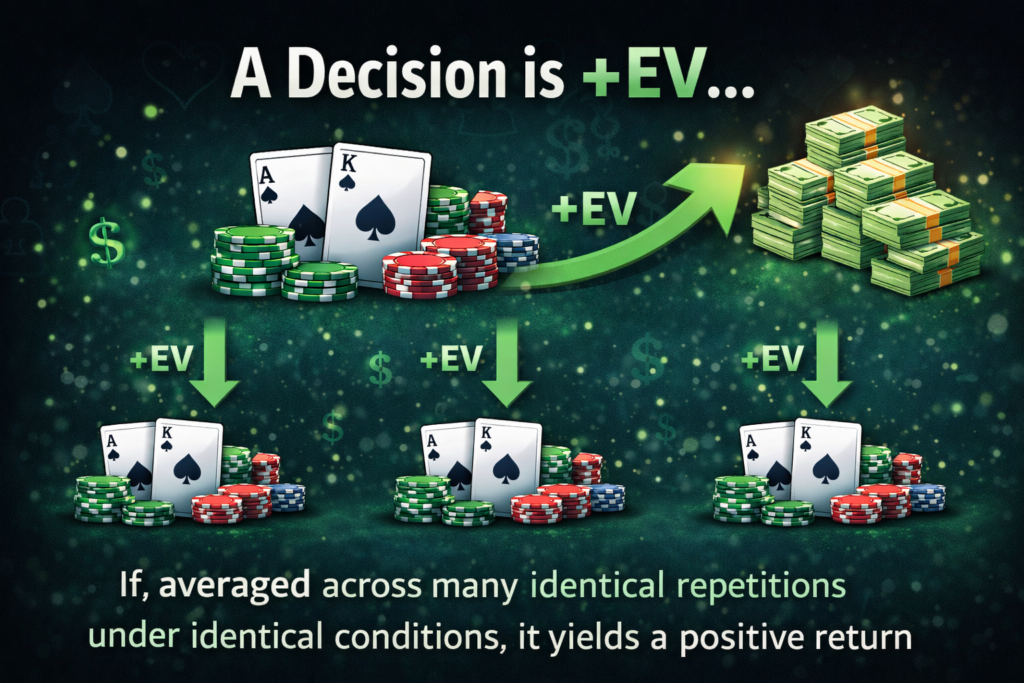
Expected value lies at the core of modern poker strategy. A decision is +EV if, averaged across many identical repetitions under identical conditions, it yields a positive return. This principle drives the analysis of equity, pot odds, and probabilistic outcomes, and it underpins the belief that consistent, correct decision-making leads to profitability.
A crucial distinction is often overlooked: expectation is theoretical; results are observed. Expected value describes the average outcome that would occur across an infinite number of trials. Actual results reflect the specific cards, runouts, and opponent actions in any single hand or finite sample.
A +EV decision can produce losses, sometimes multiple consecutive losses, without contradicting the mathematics. This occurs because of poker variance: the natural spread of outcomes around the expected mean. Incorrect decisions can likewise produce wins in small samples. The gap between expectation and results is not an error; it is a statistical feature of the game.
POKER VARIANCE: THE MECHANISM THAT SHAPES ALL RESULTS
Poker variance is not a rare disruption. It is the mechanism through which every poker outcome is delivered. No decision escapes its influence; every hand, session, and sequence of play passes through it.
Consider a simplified decision that wins 70% of the time and loses 30% of the time. In expectation, the decision is clearly profitable. Over a large number of repetitions, wins will predominate. Yet sequences of two, three, or even five consecutive losses remain possible and occur with calculable probability. These sequences are not failures of the model; they are poker variance expressing itself in small samples. The underlying expected value remains unchanged.

HOW POKER VARIANCE INCREASES IN MULTIWAY POTS
In tighter, more structured games, where fewer players see each flop and ranges are narrower, poker variance tends to be more contained, and outcomes cluster more closely around expected probabilities. In loose, multiway live cash games, the dynamics shift markedly:
- More players see each flop, distributing equity across wider ranges.
- Pots proceed to later streets more frequently.
- The number of possible runouts and independent improvement paths expands dramatically.
These conditions increase variance substantially. Mathematically sound hands lose more often than their raw equity suggests because equity realization, the extent to which a hand converts its equity into actual wins, declines in multiway pots. Strong holdings must contend with multiple opponents, each holding independent drawing chances and continuing with wider ranges.
Variance accumulates across hands and sessions. A single loss is inconsequential; a sustained sequence can appear to contradict the underlying mathematics. In reality, the expected value has not shifted—the sample size has simply been insufficient for convergence to occur.
In lower-variance environments, alignment between expectation and results can emerge over relatively smaller samples. However, in high-variance multiway games, convergence typically requires far larger samples, often extending well beyond practical observation for live players.
SIGNAL VS NOISE: WHEN THE EDGE BECOMES DIFFICULT TO DETECT

In any probabilistic system, results emerge from two interacting components:
- Signal: the underlying edge created by correct decisions and positive expected value.
- Noise: the random fluctuations driven by poker variance.
When the signal is strong relative to the noise (larger edge, fewer variables, lower volatility), results tend to reflect decision quality more clearly over manageable samples.
In many live cash games, the situation reverses. Multiway action expands the range of possible outcomes, amplifying noise. The signal from superior decision-making persists, but it becomes harder to isolate amid the variability. Over finite periods, the results of a skilled player enduring negative variance can be statistically indistinguishable from those of a player without a meaningful edge.
Theoretically, given enough repetitions, the signal emerges as noise averages toward zero. In practice, two factors limit observability:
- The magnitude of noise (poker variance) is often large relative to the edge, particularly when multiway pots compress individual equities and impair realization.
- The number of hands required for reliable convergence increases with higher standard deviation.
Standard deviation (typically measured in big blinds per 100 hands) quantifies this volatility. In online 6-max games, it commonly ranges from roughly 75–110 bb/100. In live multiway environments, with larger pots, deeper stacks, and looser play, it is frequently higher. For a modest edge of 2–5 bb/100, statistical confidence that results reflect true skill often requires tens to hundreds of thousands of hands. At live rates of approximately 30–50 hands per hour, this translates to thousands of hours of play
Thus, the existence of an edge does not ensure its visibility in observable results within any defined practical timeframe.
THE PRACTICAL REALITIES IN MULTIWAY ENVIRONMENTS
The standard theoretical model assumes conditions that do not always match live game dynamics. In structured, low-multiway pots, ranges are narrower, outcomes more predictable, and equity realization more consistent. In loose multiway live games, common in many cash environments, equity is distributed across multiple players, each with independent chances to improve. This compresses the effective strength of any single hand and multiplies the possible runouts.
Even hands holding clear equity realize that equity less efficiently. Overcards appear more frequently relative to the field, draws proliferate, and opponents often continue with wide, inelastic ranges that disregard proper price or probability. While these opponent tendencies are -EV for them individually, they collectively elevate volatility for all participants.

As a result:
- The practical edge may be smaller than raw theoretical calculations indicate.
- Poker variance exceeds the levels assumed in many standard models.
- The sample size needed to observe the edge reliably increases.
From the player’s perspective, the experience remains consistent: decisions are based on available information, ranges, equity, and odds, yet results diverge repeatedly. This divergence does not demonstrate that the model is flawed or that the decisions are incorrect. It reflects the amplified effects of poker variance and reduced equity realization under specific game conditions.
THE HARD TRUTH ABOUT EXPECTATION AND OBSERVATION
Correct decision-making generates positive expected value when the model’s assumptions hold. Poker variance explains the short- and medium-term divergences between expectation and results. Positive expectation, however, provides no guarantee that observed results will align with it within any particular finite period.
Over a sufficiently large number of trials, a player with a genuine edge is overwhelmingly likely to show profit. Simultaneously, it remains mathematically possible, though increasingly improbable, for negative divergence to persist for extended stretches. These statements are compatible: the former describes asymptotic (long-run) behavior; the latter describes finite-sample reality.
In high-variance multiway environments with modest edges and imperfect realization, such divergence can endure longer than most players anticipate. Observable results alone cannot reliably distinguish skilled play experiencing negative variance from play without a meaningful edge over practical timeframes.
A precise statement is therefore:
Correct decisions produce positive expectation.
Poker variance governs how—and over what duration—that expectation manifests in observed results.
There is no fixed or guaranteed point at which the two must visibly converge.
This is not a defect in probability theory. It is an inherent limitation of how the theory is experienced in finite play.
THE RESOLUTION: WHAT CAN BE EVALUATED DIRECTLY
When results cannot reliably indicate decision quality in the short or medium term, due to the intervening effects of poker variance, game structure, and insufficient sample size—the focus must shift to what is directly controllable and evaluable: the decision process itself.
Each action can be assessed according to the information available at the moment, the relevant ranges, equity calculations, pot odds, and the expected value of the available options. These factors exist independently of the eventual outcome. A decision that is +EV based on those inputs remains +EV regardless of the specific runout.
Separating process from outcome is essential. Allowing results to retroactively validate or invalidate decisions distorts judgment: winning outcomes may reinforce -EV plays, while losing outcomes may prompt unnecessary changes to sound ones. In environments where poker variance can sustain divergence for prolonged periods, consistency in probability-based decision-making becomes the only stable reference point under a player’s control.
The mathematical framework of poker does not promise certainty of near-term outcomes. It supplies an objective method for identifying +EV actions. Poker variance does not invalidate the framework; it restricts the observability of its effects over shorter and intermediate horizons.
CONCLUSION: WHAT "THE LONG RUN" ACTUALLY MEANS
The familiar assertion, “You’ll win in the long run”, captures a valid principle: correct decisions yield positive expectation, and over repeated trials, results should converge toward that expectation. The statement is incomplete, however. It leaves “the long run” undefined in terms of hands or time and understates poker variance’s capacity to delay or obscure convergence, particularly in loose multiway live games.
A more accurate description is this:
Correct decisions produce positive expectation. Poker variance determines the manner and timeframe in which that expectation becomes visible in results. No predetermined threshold guarantees observable alignment.
Poker therefore offers no assurance that results will promptly confirm correct play. What it does provide is a rigorous structure for evaluating decisions on their probabilistic merits, independent of short-term outcomes. Recognizing the distinction between expectation and realization does not eliminate uncertainty, it clarifies its statistical nature.
The central fact remains: In environments with elevated poker variance and distributed equity, the gap between theoretically correct play and observable success can persist far longer than casual references to “the long run” suggest. Results ultimately arbitrate over infinite trials, but the decision process, precise, probability-driven choices, remains the only element fully under a player’s control in any given hand or session.