
THE SITUATION AND CONTEXT LAYER
POKER POSITION AND STACK SIZES
You’ve learned to evaluate your own hand (Layer 1) and to read your opponents’ ranges (Layer 2).
Now it’s time to consider the third critical piece: poker position and stack sizes, along with the broader situational context surrounding every hand.
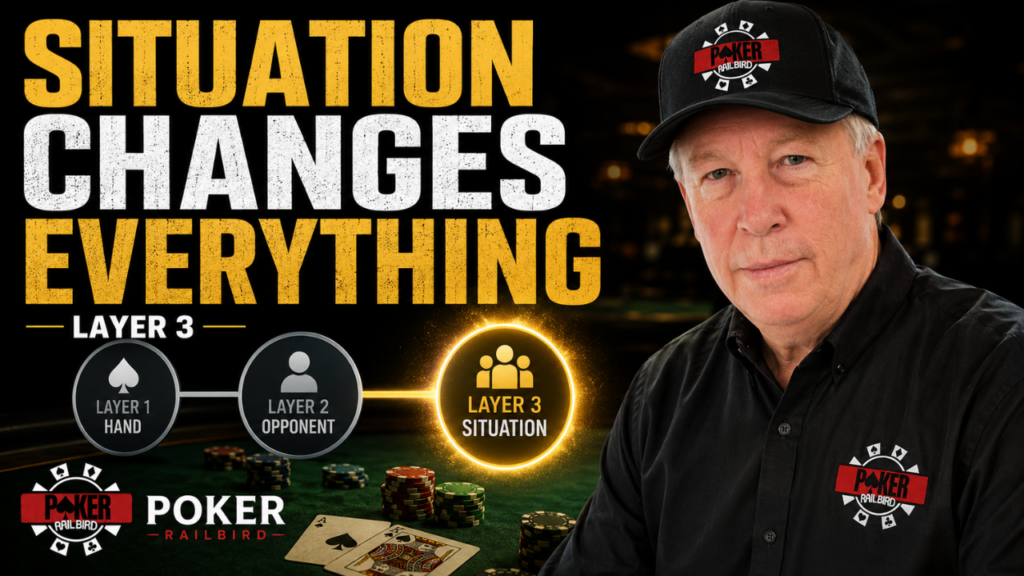
This is Layer 3 of the Poker Decision Tree: The Situation & Context Layer.
Even the best hand and the best read on your opponent can lead to the wrong decision if you ignore the situation. Poker position and stack sizes dramatically influence correct strategy. A hand that is profitable in late position with deep stacks can be a clear fold from early position with shallow stacks. The same applies to table dynamics, pot odds, number of players, and recent game flow.
In this article, we’ll explore how poker position and stack sizes (along with other contextual factors) should shape your decisions. You’ll learn how to integrate these elements with Layers 1 and 2 to make significantly better choices at the table.
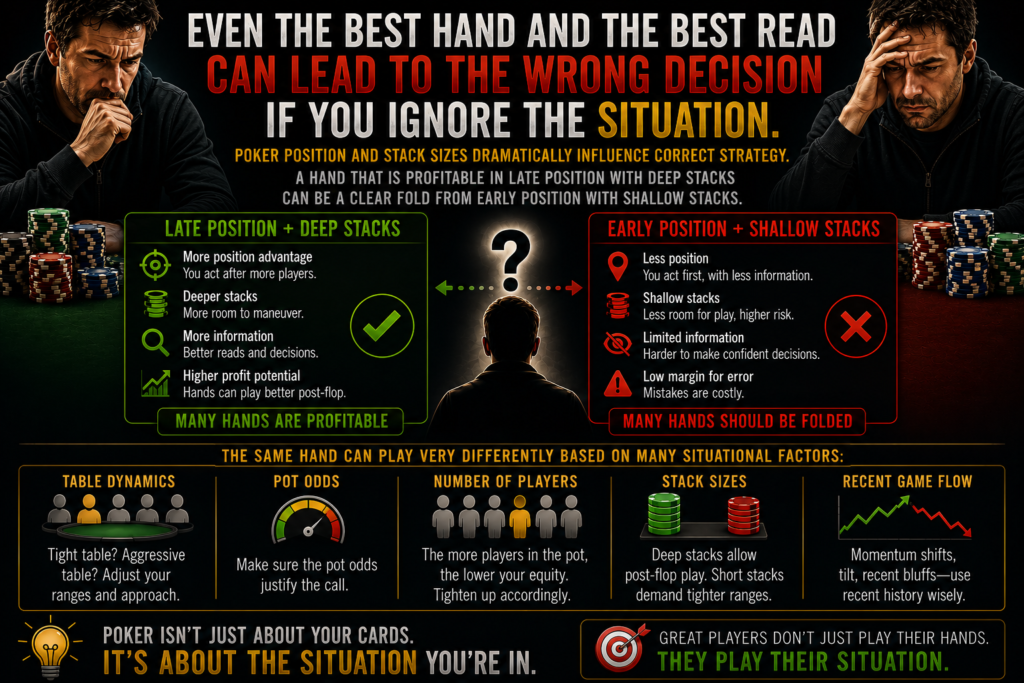
Mastering Layer 3 is what turns good players into consistently winning players. Context is often the deciding factor between a profitable play and an expensive mistake.
Let’s begin by understanding what the Situation & Context Layer actually involves.
WHAT "THE SITUATION AND CONTEXT LAYER" ACTUALLY MEAN
Layer 3: The Situation & Context Layer focuses on the external conditions surrounding every hand. While Layer 1 evaluates your hand and Layer 2 evaluates your opponent, Layer 3 asks:
What is the current situation, and how should it influence my decision?
This layer includes several critical factors that dramatically change correct strategy:
1. POKER POSITION AND STACK SIZES
Your position at the table and the effective stack sizes (yours and your opponents’) are two of the most powerful variables in poker. Position gives you information and control. Stack depth determines implied odds and commitment thresholds.
2. POT ODDS, IMPLIED ODDS, HAND ODDS AND BET SIZING
Pot odds tell you if a call is correct in the moment. Implied odds estimate how much you can win later if you hit. Hand odds (your actual probability of improving) must be weighed against both. Bet sizing, both yours and your opponents’, is a key part of this layer because it directly affects pricing and future street control.
3. BOARD TEXTURE
How coordinated or dangerous the board is dramatically changes the situation. A dry board and a wet board create completely different strategic environments.
4. PLAYER TENDENCIES AND RANGES
Understanding how loose, tight, passive, or aggressive your opponents are, along with their likely ranges based on position and previous actions.
5. TABLE DYNAMICS, GAME STRUCTURE AND TABLE IMAGE
Is the table currently loose/splashy or tight/nitty? What is the overall game structure? How have you been perceived lately (your table image)? Has there been recent aggression, big pots, or noticeable tilt?
6. SPECIAL SITUATIONS
Straddles, the number of players in the hand, and other unique game modifiers that affect decision-making.
Mastering Layer 3 means learning to see the full context of every hand. A decision that looks correct when looking only at your hand and opponent can become wrong, or much stronger, once you factor in the situation.
In the next section, we’ll examine the most common mistakes players make when evaluating situational context.
COMMON MISTAKES IN THE SITUATION AND CONTEXT LAYER
Even players who handle Layers 1 and 2 reasonably well often lose significant value because they undervalue or misread the situation. Here are the most common mistakes in Layer 3:
IGNORING POSITION AND STACK SIZES
Many players consistently play too many hands out of position, especially from early and middle positions. They fail to recognize that position and stack sizes are two of the most powerful variables in the game. Playing marginal hands out of position with shallow stacks is one of the fastest ways to leak money.
MISJUDGING POT ODDS, IMPLIED ODDS, AND BET SIZING
Players frequently call bets without properly comparing the pot odds they’re getting to their actual hand odds. They also fail to consider implied odds realistically or how bet sizing on this street affects future streets. This leads to chasing draws at the wrong price or failing to protect vulnerable hands.

FAILING TO ADJUST TO BOARD TEXTURE
Many players evaluate their hand in isolation and ignore how the board texture changes the situation. A dry board and a wet, coordinated board create completely different strategic environments. Failing to adjust to board texture leads to betting too thin for value or calling too loosely with draws.
IGNORING PLAYER TENDENCIES AND RANGES
Some players focus only on their own hand and fail to consider how loose, tight, passive, or aggressive their opponents are, or what ranges they are likely playing. This is especially costly in multiway pots where ranges can be very wide.
MISREADING TABLE DYNAMICS AND GAME STRUCTURE
Players often apply the same strategy regardless of how the table is playing. They play too loose on a tight, nitty table or too predictably on a loose, splashy table. They also fail to account for recent history, such as big pots, tilt, or changes in player mood.
STATIC THINKING ACROSS STREETS
Many players evaluate the situation only on the flop and then stop adjusting. They fail to re-assess how the turn and river cards change position, stack-to-pot ratio, implied odds, and board texture. The situation is dynamic — it evolves with every card and every action.
These mistakes all share the same root cause: treating the situation as secondary instead of recognizing that poker position and stack sizes, along with table dynamics, board texture, and bet sizing, often dictate the correct decision more than hand strength or opponent ranges alone.
In the next section, we’ll look at how to properly analyze and use situational context to make better decisions.
HOW TO PROPERLY THINK IN LAYER 3
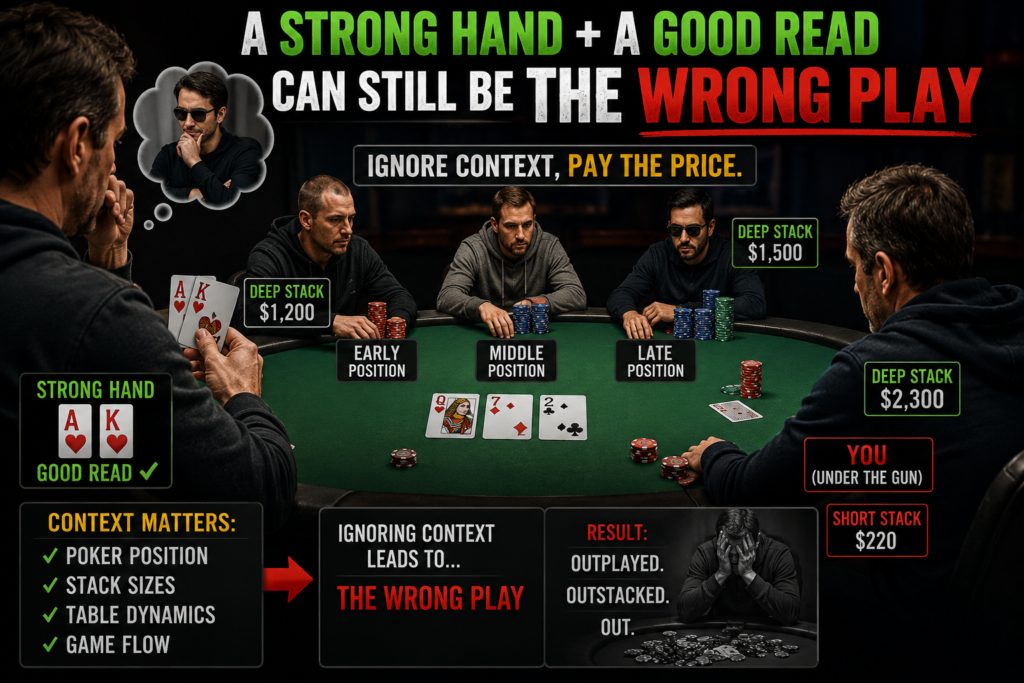
The Situation & Context Layer is where you take the information from Layers 1 and 2 and place it into the real-world environment of the hand. Even a strong hand with a good read on your opponent can be the wrong play if you ignore the broader context, especially poker position and stack sizes.
This layer is about constantly asking: “Given everything I know about my hand and my opponent, what does the current situation demand?”
PRE-FLOP SITUATIONAL ANALYSIS
Before you put any money in the pot, quickly evaluate the following factors, with special attention to poker position and stack sizes:
- Your Position: Are you in early, middle, or late position? How many players remain to act behind you?
- Effective Stack Sizes: How deep are you and the relevant opponents? Poker position and stack sizes together determine implied odds and commitment thresholds.
- Player Tendencies: Who is loose, tight, passive, or aggressive? What types of hands have they been showing down?
- Table Dynamics: Is the table currently loose/splashy or tight/nitty? Are players behind you likely to raise or call wide?
- Number of Players Already In: How many have entered the pot when action reaches you?
- Ranges: What ranges are likely from the players already in and those yet to act?
- Bet Sizing & Pot Odds: If there has been a raise, how big is it and what price are you getting?
- Recent Table History: Has there been recent aggression, big pots, or noticeable tilt?
- Your Own Table Image: How have you been perceived lately?
- Straddle Situation: Is there a straddle? Is it an UTG or Button straddle? Is the straddler known to raise their straddle frequently?
- Game Structure: Is the overall game generally tight, loose, or chaotically loose?
POST-FLOP SITUATIONAL ANALYSIS
Once the flop is dealt, the situational analysis continues and evolves. Most of the pre-flop factors remain relevant, but they must be constantly re-assessed as the hand develops, especially poker position and stack sizes:
- Relative Position: How has your position changed as players have folded?
- Current Stack-to-Pot Ratio (SPR): How does this affect commitment thresholds on this street and future streets?
- Updated Pot Odds, Implied Odds, and Hand Odds: Are you getting the correct price to continue?
- Board Texture: How coordinated or dangerous is the board? How does it interact with likely ranges?
- Updated Player Tendencies: Has anyone shown aggression or weakness on this board?
- Bet Sizing on This Street: What does the current bet size tell you?
- Number of Players Still in the Hand: How has this changed equity and implied odds?
IMPORTANT DISCLAIMER
No checklist can ever be complete. Every poker hand is unique, and every player at the table is reacting to their own personal situation. Someone may be on tilt after losing a big pot. Another player might be playing looser because they just stacked someone and are riding high. A third might be distracted after an argument or because their medication isn’t working well.
These dynamic human factors matter. Use the framework above as a solid structural foundation, but always stay alert to the specific context of the hand and table. The best players combine systematic thinking with sharp situational awareness.
When you combine strong situational awareness (Layer 3) with good hand evaluation (Layer 1) and opponent reading (Layer 2), your decision-making reaches a much higher level.
INTEGRATING LAYERS 1,2 AND 3
The real power of the Poker Decision Tree appears when you combine all three layers. Layer 1 tells you what you have, while Layer 2 tells you what your opponent likely has. And Layer 3 tells you what the situation demands.
When these three layers work together, you move from guessing to making high-quality, context-aware decisions.
Key Integrating Questions
1. How does my hand (Layer 1) perform against their likely range (Layer 2) in this specific situation (Layer 3)?
This is the central question. A strong top pair might be ahead against a tight player’s narrow range in position with deep stacks, but crushed against a loose player’s wide range out of position with shallow stacks.
2. Given poker position and stack sizes, what is the best action?
The same hand and the same opponent read can require completely different actions depending on position and stack depth. Late position with deep stacks often justifies speculative calls. Early position with shallow stacks usually demands tighter play.
3. Are the pot odds, implied odds, and board texture favorable in this context?
Even a good hand against a weak range can be a fold if the situational factors (stack sizes, position, number of players) don’t support continuing.
CONCLUSION: MASTERING THE SITUATION AND CONTEXT LAYER
Layer 3, The Situation & Context Layer, completes the first major strategic phase of the Poker Decision Tree.
While Layer 1 teaches you to evaluate your hand and Layer 2 teaches you to read your opponent, Layer 3 teaches you to understand the environment in which the hand is being played. Mastering poker position and stack sizes, along with table dynamics, pot odds, and game flow, is what turns good decisions into consistently profitable ones.
Key Takeaways from Layer 3:
- Position and stack sizes are two of the most powerful variables in poker — they often matter more than your exact hand strength.
- The situation is dynamic. You must re-evaluate context on every street as the hand develops.
- Table dynamics and recent history provide critical information that static analysis misses.
- No hand exists in isolation. The same hand against the same opponent can require completely different actions based purely on situational factors.
When you combine strong hand evaluation (Layer 1), accurate opponent reading (Layer 2), and sharp situational awareness (Layer 3), your decision-making reaches a significantly higher level. You stop playing your cards and start playing the full game in front of you.
In the next article, we will move to Layer 4: The Meta / Image Layer, where we explore how your table image, opponent perception, and meta-game considerations further shape your strategy.
The journey to elite poker thinking continues, one layer at a time.