
STRATEGIC POKER
AGGRESSION AS A TOOL
Aggressive poker strategy is often misunderstood. Many players believe winning poker simply means betting and raising more often than their opponents. While aggression is an essential part of successful poker, aggression by itself is not a strategy. It is a tool. Like every other tool in poker, its value depends entirely on when, why, and against whom it is used.
The most successful players are not necessarily the most aggressive players. They are the players who understand when aggression has the greatest chance of succeeding and when restraint produces the better long-term result. Every bet, raise, bluff, or three-bet should have a purpose based on the specific situation rather than a commitment to playing aggressively at every opportunity.
This Hub explores aggression as a disciplined strategic tool rather than a fixed playing style. Through the articles and videos in this series, you’ll learn when aggression creates profitable opportunities, when it destroys value, and how concepts such as bluffing, blockers, and other forms of strategic pressure fit within a complete live cash game decision-making process.
SERIES OVERVIEW
Aggressive poker strategy is one of the most misunderstood concepts in live cash games. Many players associate winning with constant betting, frequent bluffing, and relentless aggression. Many players associate winning with constant betting, frequent bluffing, and relentless pressure. In reality, profitable aggression has very little to do with how often you bet and everything to do with whether your aggression is supported by the situation.
Throughout this Hub, you’ll examine aggression from multiple perspectives. You’ll learn why aggression succeeds in some situations and fails in others, how bluffing and blockers fit into an overall strategic framework, and why the most profitable players know when not to be aggressive. Rather than promoting a fixed style of play, this series focuses on understanding aggression as one of several tools available to make better decisions in live cash games.
WHO IS THIS SERIES FOR?
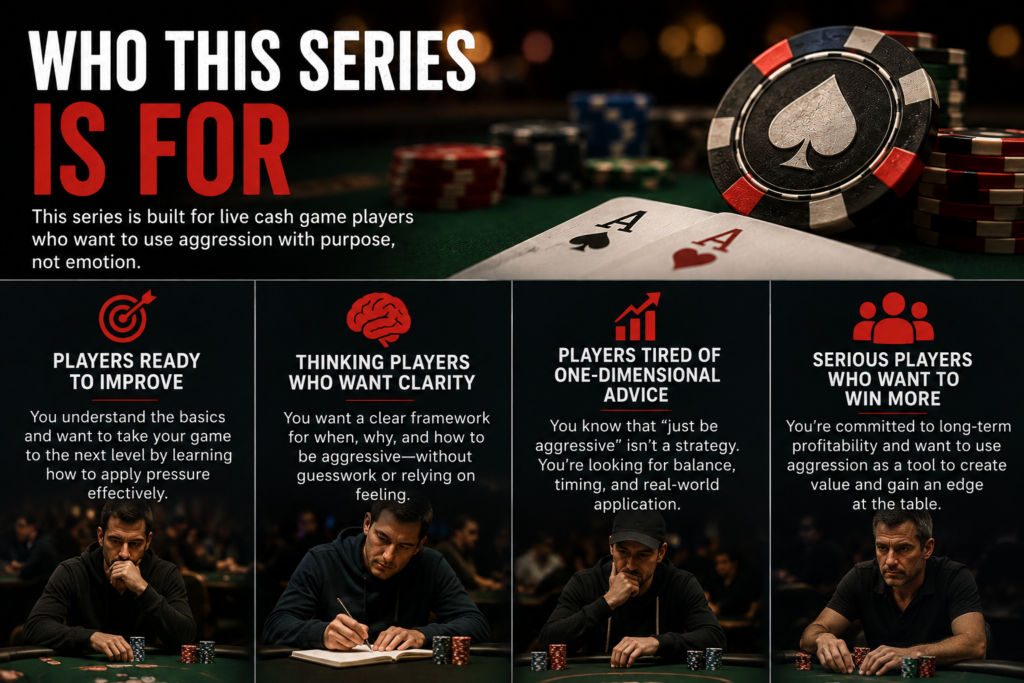
This series is designed for players who want to develop a more effective aggressive poker strategy without falling into the trap of unnecessary aggression. Whether you’re struggling with bluffing too often, missing profitable opportunities to apply pressure, or simply trying to develop a more disciplined approach to live cash games, these articles and videos provide a practical framework for using aggression more effectively.
If you’ve ever wondered when to continuation bet, when to bluff, when to apply pressure, or when checking and folding are actually the stronger decisions, this Hub will help you develop a more balanced and profitable approach.
WHAT WE'LL DISCUSS
By working through this series, you’ll learn:
- Why aggression is a tool, not a strategy by itself.
- How to build an aggressive poker strategy that adapts to different opponents and game conditions.
- When aggressive play creates profitable opportunities.
- Why excessive aggression often destroys long-term results.
- How bluffing fits within an overall strategic framework.
- How blockers influence aggressive decisions.
- Why successful aggression depends on position, opponent tendencies, board texture, stack sizes, and game conditions.
- How to recognize situations where patience is more profitable than aggression.
CORE CONCEPTS
AGGRESSION IS A TOOL
AddEVERY AGGRESSIVE ACTION NEEDS A REASON
THE SITUATION DETERMINES THE CORRECT PLAY
RESTRAINT IS SOMETHIMES THE MOST AGGRESSIVE DECISION
Aggressive Poker Strategy Begins With Purpose: Betting and raising more often do not automatically produce better results.
Every bet, raise, bluff, and three-bet should accomplish something. If you cannot explain why an aggressive action is profitable, it probably isn’t.
Opponent tendencies, position, board texture, stack sizes, previous action, and game conditions all influence whether aggression increases or decreases your expectation.
Winning players are willing to check, call, or fold when the situation demands it. The objective is not to appear aggressive, but to make the highest expected-value decision.
STRATEGIC POKER RESOURCES
WHEN AGGRESSION LOSES: THE MYTH OF CONSTANT AGGRESSION
Most poker players believe aggression is a good thing. In fact, many players believe that if some aggression is good, then more aggression must be better. This belief has become so common that many players never stop to question it. They simply assume that raising more hands, applying more pressure, and creating more action will automatically lead to better results. This way of thinking forms the foundation of what I call The Myth of Constant Aggression.
After all, aggressive players play more hands, raise more often, apply more pressure, and generally create more action at the table. From the outside looking in, they appear to be in control of the game while tighter, more disciplined players often appear passive, cautious, or even weak.
This creates an interesting assumption that exists in many poker rooms: the most aggressive player should also be the most profitable player.
AGGRESSION IN POKER: THE AIKIDO APPROACH TO WINNING
In almost every poker book, forum, or video, one mantra keeps getting repeated: “Aggression In Poker should be constant.”
“Always be aggressive. Aggression always wins.”
It’s advice born out of TV poker highlight reels, big bluffs, massive pots, players hammering the table with relentless bets until their opponents crumble. Over time, this one-dimensional idea became gospel, taught as if constant aggression is the only winning poker strategy.
But the truth is, blind aggression costs more players money than it makes them. It builds bloated pots you can’t win, pushes hands that never should have been played, and leads to tilt-fueled disasters.
Poker isn’t a game of brute force. It’s a game of timing, precision, and control.
BLOCKERS

This article breaks down poker blockers with real clarity. You will learn how blockers work, how they alter ranges, and how they shape betting lines. More importantly, you will understand the two categories of blockers that drive every decision: absolute blockers and probabilistic blockers. Most players never separate the two, and that mistake leads to major errors.
By the end of this breakdown, you will know exactly how to use poker blockers to bluff better, value-bet smarter, and navigate close decisions with far more confidence.
IS BLUFFING REALLY PROFITABLE LONG TERM?
Bluffing in poker has always carried an air of mystique. For some, it’s the ultimate weapon, a chance to win pots without a hand. For others, it’s a trap that drains chips faster than bad luck ever could. The truth lies somewhere in between.
This article takes a hard look at bluffing from both sides of the coin: being the bluffer, and being the player on the receiving end. From the bluffer’s perspective, we’ll ask: When is a bluff actually profitable long-term, and when is it just ego disguised as strategy? From the bluffee’s side, we’ll examine why players call, what psychological hooks drive those calls, and how understanding your opponents can turn their curiosity or suspicion into your profit.
FREQUENTLY ASKED QUESTIONS
WHAT IS AN AGGRESSIVE POKER STRATEGY?
Aggressive poker strategy is not about betting and raising as often as possible. It is the disciplined use of aggression when the situation supports it.
IS PLAYING AGGRESSIVELY ALWAYS THE BEST STRATEGY?
No. Aggression is one of poker’s most effective tools, but only when it fits the situation. Betting and raising simply for the sake of being aggressive often reduces profitability.
IS BLUFFING THE SAME AS AGGRESSION IN POKER?
No. Bluffing is one form of aggression, but not all aggressive actions are bluffs. Value betting, raising for protection, and isolating weaker opponents are also forms of aggressive play.
WHEN SHOULD I REDUCE MY AGGRESSION?
Aggression should be reduced whenever opponents are unlikely to fold, when multiple players remain in the hand, or when the situation favors patience over pressure. Successful players adapt their level of aggression to the conditions at the table.
DO BLOCKERS AUTOMATICALLY MAKE A BLUFF PROFITABLE?
No. Blockers are only one factor in the decision. Opponent tendencies, board texture, betting history, stack sizes, and overall context remain equally important.
DOES AGGRESSIVE POKER WORK BETTER ONLINE OR IN LIVE CASH GAME?
It depends on the player pool. Live cash games often require a more selective approach because many opponents call more frequently than online players. The correct level of aggression always depends on the specific game conditions rather than a fixed playing style.
CONTINUE BUILDING YOUR STRATEGIC FRAMEWORK
Aggression is only one part of becoming a complete poker player. The most successful players combine sound mathematical decisions, disciplined psychology, accurate hand reading, and a structured decision-making process. Continue exploring the related Hub Pages below to strengthen every aspect of your game.

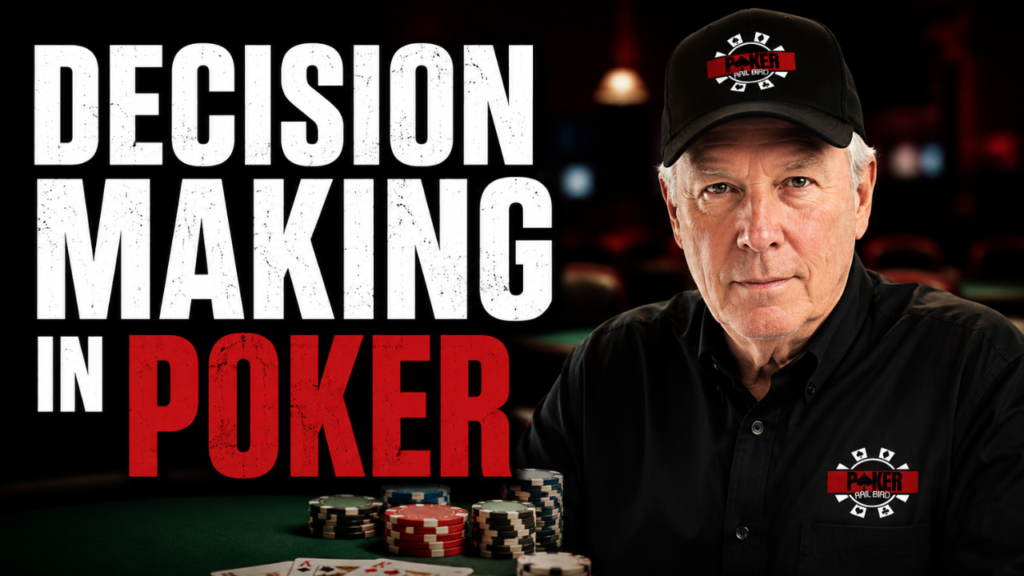
The Thinking In Layers Hub Page introduces PokerRailbird’s complete decision-making framework, showing how hand strength, opponent tendencies, table dynamics, perception, and your own mental game work together to produce consistently better decisions.
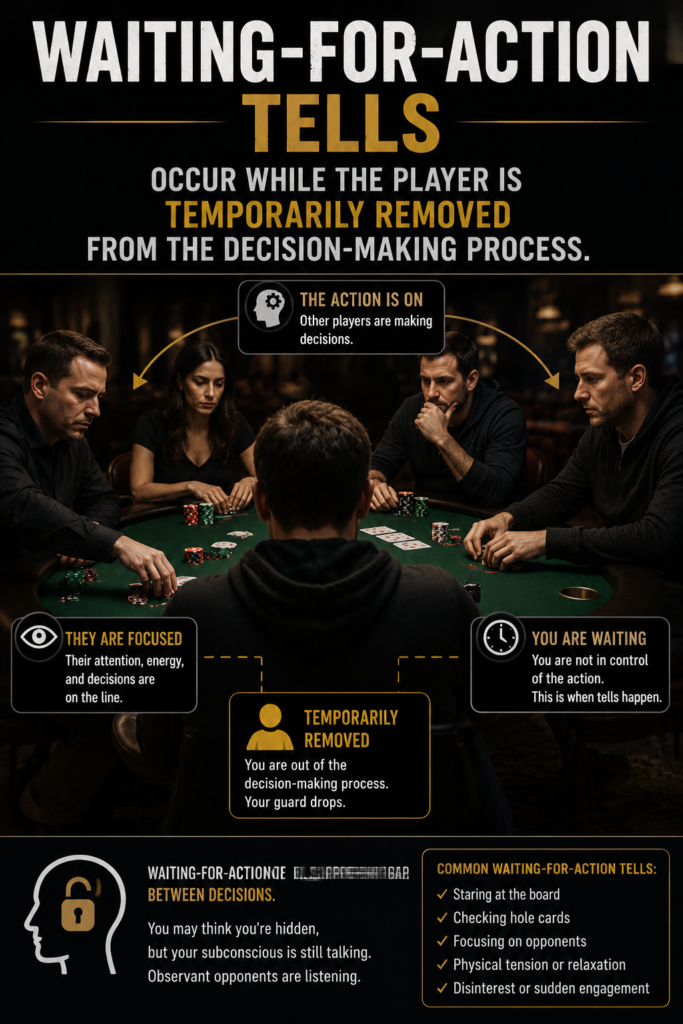
Waiting-for-action tells occur after you’ve acted but before your opponent responds, making them some of the most reliable behavioral observations in live poker. This Hub explores the most common tells of strength and weakness, explains how to interpret them within the proper context.
Decision-making in poker is the foundation of long-term success. Every hand presents a series of choices made with incomplete information, uncertain outcomes, and constantly changing circumstances.