
WHAT PLAYERS SAY WHEN BETTING IN POKER
Poker betting tells can reveal valuable information about an opponent’s hand through behaviors exhibited while making a betting decision or completing an action. These observations belong to a broader category known as During-Action Tells, which occur from the moment it becomes a player’s turn to act until that player completes the action.
During-action tells include the time a player takes to act, the physical motion of betting, and verbal or physical behaviors accompanying a bet, check, or call. Each offers a different opportunity to observe how a player behaves while committing to a decision.
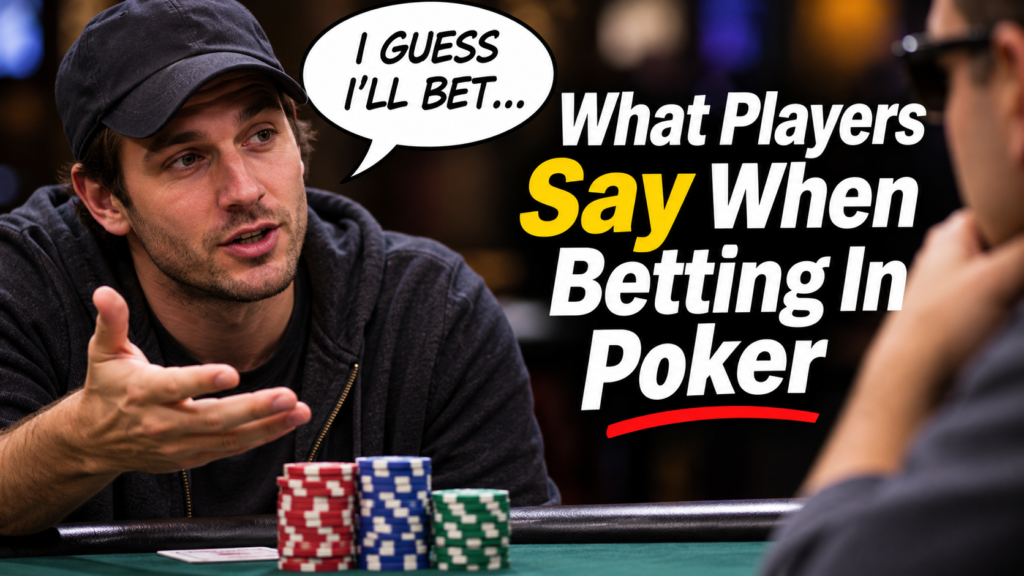
This article focuses specifically on the verbal behaviors that accompany betting actions. Unnecessary announcements, changes in vocal tone, unusual sounds, and unexpected conversation can provide clues about a player’s hand strength, particularly when those behaviors differ from what the player normally does.
ANNOUNCING A BET AND ADDRESSING THE DEALER
Most poker players make their betting actions without announcing them verbally. They place chips into the pot, and their intentions are usually clear. When a player suddenly announces “bet,” “raise,” or a specific amount when no verbal declaration is necessary, that behavior may provide valuable information about the strength of their hand.
Among the various Poker Betting Tells, unnecessary verbal announcements can be particularly revealing. Zachary Elwood identifies these announcements as a potential indication of strength. Players holding strong hands may feel more confident and comfortable drawing attention to their actions, while those holding weaker hands may be more reluctant to speak or do anything that could attract additional scrutiny.
In my experience, this tell has been particularly reliable. I’ve rarely encountered players who announce every betting action. Instead, the behavior occurs sporadically, often from players who have been betting silently throughout the session. More importantly, I cannot recall an occasion when a player unexpectedly announced an otherwise obvious bet or raise and subsequently revealed a weak or marginal hand.
For example, consider a player who has quietly placed chips into the pot for several hours. Suddenly, when facing a bet, he looks directly at the dealer and announces, “Raise, three hundred,” even though the chips he pushes forward make the action unmistakable. That departure from his normal behavior deserves attention.
LOOKING DIRECTLY AT THE DEALER
Looking directly at the dealer while announcing a bet is a related variation of this tell. Some players appear particularly deliberate when communicating their action to the dealer, speaking clearly and maintaining eye contact. Elwood associates this behavior with strength, although the precise reason players do it is less certain.
There is also an important distinction between the strength of a player’s hand when the announcement occurs and how that hand develops on subsequent streets. A player who announces a raise with a strong starting hand may eventually fold when the board becomes unfavorable. That later fold doesn’t necessarily contradict the information conveyed by the original announcement.
The key observation is the player’s decision to verbalize an action that ordinarily requires no explanation, particularly when doing so represents a noticeable change from their established behavior. When that change occurs, it may indicate that the player is holding a stronger hand than usual.
TONE OF VOICE WHEN BETTING
How a player speaks while betting can sometimes reveal more than the words themselves. Changes in tone, inflection, or vocal expression may clue you into a player’s hand strength, especially when the delivery seems inconsistent with the action.
Among Poker Betting Tells, changes in vocal tone are especially interesting because players may unconsciously attempt to communicate uncertainty or disappointment when they actually hold strong hands.
Zachary Elwood describes players who announce their bets in a sad or reluctant tone, almost as though they are disappointed about having to put money into the pot. This behavior follows the familiar principle of weak means strong, in which an apparent display of weakness may accompany a powerful hand.
QUESTIONING TONES AND FALSE UNCERTAINTY
Another variation involves players who announce their bets with a questioning inflection. Instead of confidently stating “Three hundred,” a player might say “Three hundred?” with a slight upward inflection at the end as if asking a question.
The player has already decided to bet, yet the tone suggests uncertainty about the decision. Elwood observes that this behavior is sometimes associated with strong hands, particularly among less experienced players who instinctively try to appear unsure.
For example, a player holding a very strong hand may push $300 into the pot while announcing the amount as though asking a question. The apparent uncertainty can create the impression that the player is uncomfortable committing that much money, even though the opposite may be true.
These vocal patterns are not universal. Experienced players may recognize the link between apparent uncertainty and strength and occasionally imitate it while bluffing.
The important observation is whether the player’s tone differs from their usual manner of speaking. An unexpected change toward sadness, reluctance, or questioning inflection during a betting action may provide additional information about the strength of their hand.
POKER CLACK
One of the more unusual poker betting tells is a distinctive clicking sound made with the tongue, commonly described as poker clack. Mike Caro identified this behavior in his writings on poker tells and associated it with players holding strong hands.
The sound resembles a brief “tsk-tsk,” produced by releasing the tongue from the roof of the mouth. It is similar to the sound someone might make when expressing sympathy or disappointment over another person’s misfortune.
In poker, a player may make this sound while preparing to bet or raise, creating the impression that something unfortunate has happened or that the situation is disappointing. According to Caro, however, the behavior is strongly associated with players who are pleased with the strength of their hands.
Zachary Elwood agrees with Caro’s observation, reporting that the behavior has consistently indicated strength in the instances he has encountered. However, he also emphasizes that poker clack is relatively uncommon, appearing primarily among inexperienced players and only occasionally in higher-stakes games.
The significance of poker clack lies in the contrast between the sentiment the sound appears to communicate and the strength of the player’s actual hand. What sounds like disappointment may instead accompany confidence.
Because this behavior is uncommon, players may go through many sessions without encountering it. Nevertheless, recognizing the sound and understanding its reported association with strong hands provides another potentially useful observation when evaluating an opponent’s betting behavior.
MAKING SPEECHES BEFORE OR DURING A BET
Some poker players become unusually talkative when preparing to bet or while placing chips into the pot. They may explain their decision, comment on the situation, or offer an unsolicited justification for the amount they are betting. This behavior can reveal hand strength, especially when the player is normally quiet.
Among Poker Betting Tells, unexpected speech is often associated with strength. Zachary Elwood observes that players who are comfortable talking during a betting action are frequently more relaxed than those who remain silent. That willingness to speak may indicate confidence in their hand.
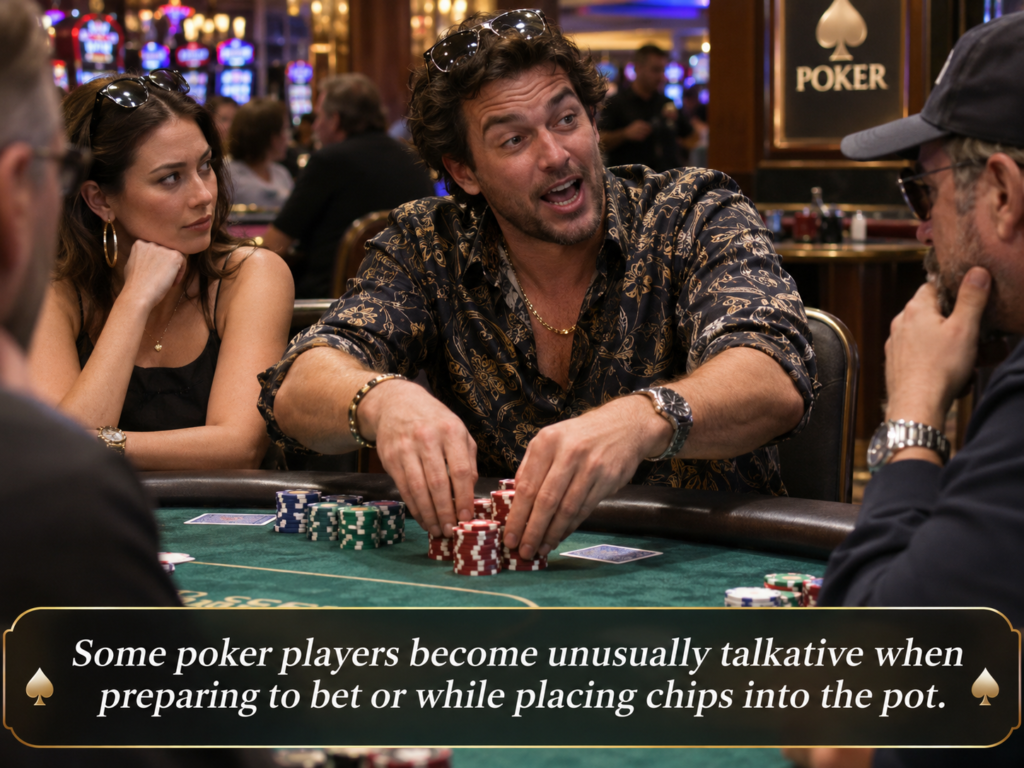
For example, consider a player who has been relatively quiet throughout the session. When the action reaches him, he begins explaining why he is making a substantial bet, even though nobody has asked for an explanation. His sudden willingness to talk may be more revealing than the explanation itself.
WHEN THE SPEECH MATTERS MORE THAN THE WORDS
The content of a player’s speech can sometimes distract opponents from the more significant observation: the player has chosen to speak at a moment when he would ordinarily remain silent.
A player might complain about the board, express reluctance about betting, or attempt to justify an unusually large wager. Regardless of what the player says, the unexpected speech may reflect greater confidence than the words suggest.
This distinction is especially important when observing players who regularly engage in conversation. A naturally talkative player who keeps talking during a bet may reveal little. However, when a normally quiet opponent suddenly becomes conversational while committing money to the pot, the change deserves attention.
The significance of this tell comes from the relationship between the player’s established behavior and the unexpected speech accompanying the betting action. Recognizing that departure can help identify situations in which an opponent may be holding a stronger hand than their words suggest.
CONCLUSION
Poker Betting Tells involving verbal behavior can provide valuable information about an opponent’s hand strength during the betting process. Unnecessary announcements, changes in vocal tone, distinctive sounds, and unexpected speeches may reveal confidence or strength that a player has not otherwise demonstrated.
Although these behaviors differ, they share an important characteristic: players sometimes communicate information through speech without realizing it. A normally quiet opponent who suddenly announces a raise, adopts a questioning tone, or begins explaining a bet may be providing information worth considering.
The most useful observations often come from recognizing changes in an individual player’s established behavior. Understanding these tendencies lets attentive players incorporate verbal betting tells into their interpretation of an opponent’s actions, alongside other information available during a hand.