

AUTOMATIC CARD SHUFFLERS
VS
HAND SHUFFLING
Automatic card shufflers have become common in live poker rooms, but how do they compare with a dealer shuffling cards by hand? Which method produces a more thoroughly randomized deck, and how much does each affect the number of hands dealt per hour?
In more than 30 years of playing casino poker, I’ve watched thousands of manual shuffles. Typically, the dealer performs three or four riffles, strips the cards, cuts the deck, and begins dealing. But is that enough to properly randomize all 52 cards?
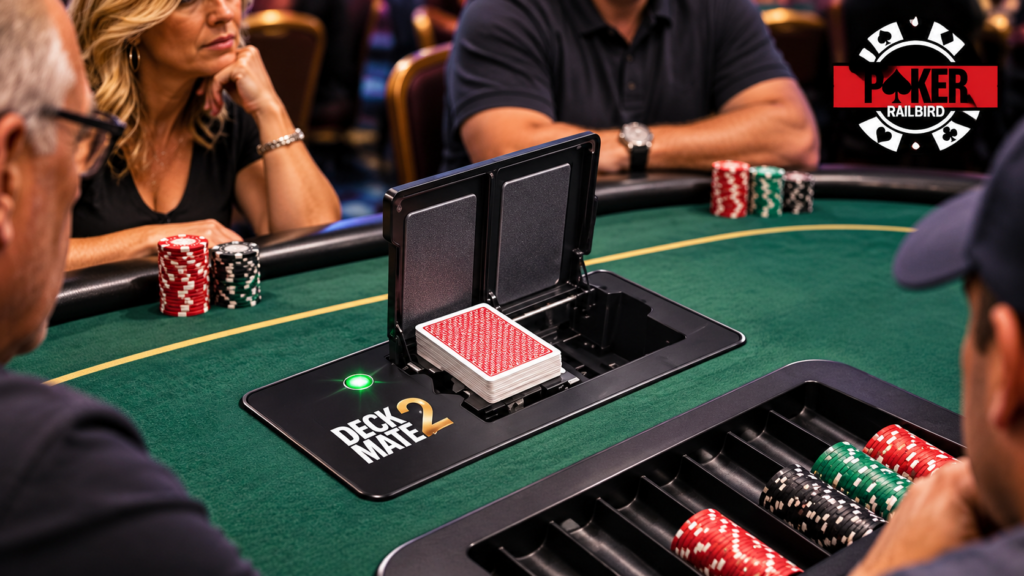
I’ve also witnessed the problems that can occur with automatic card shufflers. During one game I was playing, two decks were discovered containing only 47 and 50 cards. Seven missing cards were eventually recovered from inside the machine, and at least one hand had already been dealt from the 50-card deck before the problem was discovered. Experiences like this raise legitimate questions about deck integrity and the safeguards designed to protect the game.
To understand which method performs better, we’ll examine the mathematics of card randomization, how manual and automatic shuffling procedures work, how to detect missing or duplicate cards, and how each method affects the pace of live poker.
The objective is to determine which approach provides the most reliable shuffle while allowing players to spend more time playing poker.
WHAT CONSTITUTES A "PROPERLY SHUFFLED" DECK?
A standard 52-card deck has approximately 8 × 10⁶⁷ possible arrangements, an almost unimaginable number.Proper randomization means that every possible arrangement has an equal probability of occurring, regardless of the order of the cards before shuffling. The challenge is ensuring that the shuffling process sufficiently eliminates patterns and relationships carried over from the previous arrangement.
HOW MAY 'RIFFLES' DOES IT TAKE?
In 1992, mathematicians Dave Bayer and Persi Diaconis published a landmark study titled Trailing the Dovetail Shuffle to Its Lair. Their research established that approximately seven properly executed random riffle shuffles are required to bring a 52-card deck reasonably close to a uniform distribution. After only three or four riffles, the mathematical model shows that substantial structure remains from the deck’s previous order.
The distinction is important because a deck can appear thoroughly mixed while retaining patterns that are not readily visible. During a riffle shuffle, the dealer divides the deck into two packets and interleaves the cards. Although their positions change, the cards within each packet retain their relative order during that individual riffle. Repeating the process gradually breaks down those relationships, increasing the randomness of the resulting deck.

The seven-riffle finding is a mathematical benchmark, rather than a requirement that every casino dealer perform seven shuffles. It also does not mean a deck becomes perfectly random after the seventh riffle. The research examined a specific mathematical model of random riffle shuffling, while actual casino procedures often include additional steps, such as stripping and cutting the deck.
These findings raise an important question for our comparison: How effectively do conventional dealer procedures and automatic card shufflers eliminate the residual patterns left by previous hands?
HOW DEALERS MANUALLY SHUFFLE CARDS
When automatic card shufflers are unavailable, either because the poker room does not use them or a machine is temporarily out of service, dealers must shuffle the cards between hands. Although procedures vary among casinos and card rooms, one commonly used sequence consists of three riffle shuffles, a strip or box, and a final cut.
The procedure typically follows this order: riffle, riffle, strip, riffle, cut. Some dealers perform a fourth riffle, but the three-riffle sequence is widely documented in professional poker dealing.
During a riffle shuffle, the dealer divides the deck into two approximately equal packets and interleaves the cards as they are released onto the table. The effectiveness of this process depends partly on how evenly the cards are interleaved. A well-executed riffle distributes cards throughout the deck, while an uneven riffle can leave larger groups of cards together.
The strip, sometimes called a box, involves removing small packets of cards from the top of the deck and placing them into a new stack. This rearranges groups of cards without individually interleaving them. The dealer then performs another riffle before cutting the deck. The cut relocates a portion of the deck but preserves the order of cards within each portion.
Some procedures also include washing the cards, which involves spreading them face down on the table and mixing them by hand. This is commonly performed when introducing a new deck or opening a game, rather than before every hand.

SPEED AND CONSISTENCY OF MANUAL SHUFFLING
An experienced dealer can complete the standard shuffle-and-cut sequence in seconds. However, the time required varies with the dealer’s skill, experience, and execution. There is no reliably established industry-wide average for the duration of a manual poker shuffle.
Consistency presents another consideration. Although dealers may follow the same prescribed sequence, their techniques are not necessarily identical. The number of cards released together during a riffle, the size of the packets removed during a strip, and the precision of each movement can vary from one dealer to another.
These differences matter because following the same procedure does not guarantee that every deck receives an identical degree of randomization.
Manual shuffling also requires the dealer to complete the entire process between hands. Unlike automatic systems that prepare another deck while a hand is being played, manual shuffling occupies time that would otherwise be available for dealing.
How much that additional time affects the number of hands played per hour is an important part of our comparison.
HOW AUTOMATIC SHUFFLERS OPERATE
Automatic card shufflers use mechanical systems controlled by electronic random-number generators to rearrange playing cards. Unlike manual shuffling, which relies on repeated riffles and the dealer’s technique, these machines use computer-generated instructions to determine where individual cards are placed within the deck.
One widely used example is the DeckMate 2, manufactured by Shuffle Master. Instead of repeatedly splitting and interleaving the deck, the machine uses a system of rollers and a movable storage rack to redistribute the cards.
HOW THE CARDS ARE RANDOMIZED
When a deck enters the DeckMate 2, its random-number generator (RNG) assigns a position in the storage rack to each card. The machine then feeds the cards individually into those assigned positions, moving the rack as necessary to place each card.
Once all the cards have been processed, they are collected into a single deck in their newly established order. The machine follows computer-generated placement instructions, producing a new arrangement during each shuffle cycle.
The randomization process is also subject to independent testing. Gaming Laboratories International’s GLI-29 standards require the combined electronic and mechanical systems to produce outcomes that meet statistical requirements for randomness, independence, and unpredictability. These evaluations help establish whether the equipment performs as intended.
THE TWO-DECK SYSTEM
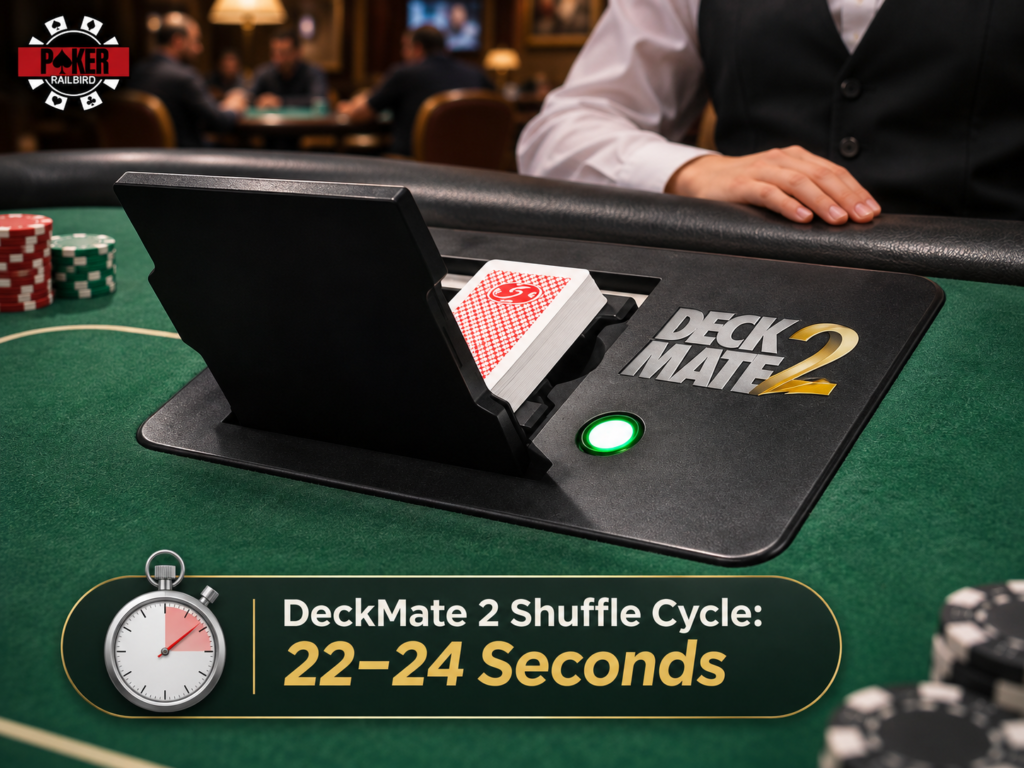
One of the greatest practical advantages of automatic card shufflers is the ability to prepare a deck while another hand is being played.
Most poker tables equipped with these systems use two separate decks, commonly distinguished by different-colored card backs. The shuffler processes one deck at a time, but the two decks alternate between the machine and the dealer.
While the dealer uses one deck to conduct a hand, the machine shuffles the other. When the hand ends, the dealer collects the cards, exchanges the decks, and begins the next hand using the already-shuffled deck.
The DeckMate 2, for example, has a manufacturer-specified shuffle cycle of approximately 22–24 seconds. Because that cycle normally takes place while the other deck is in use, the dealer generally does not need to stop between hands and wait for the shuffling process to finish.
The result is a more continuous flow of play, with less time devoted to preparing cards between hands.
Modern machines may also incorporate card-counting and optical recognition systems that inspect the deck during each shuffle. The specific capabilities depend on the model, and we’ll examine their importance when discussing deck integrity.
The combination of computer-controlled randomization, consistent mechanical execution, and overlapping shuffle cycles provides the foundation for comparing automatic shuffling with traditional dealer procedures.
HANDS PER HOUR: THE EFFICIENCEY COMPARISON
One of the most noticeable differences between manual shuffling and automatic card shufflers is the amount of time spent preparing the next hand. Even a relatively brief delay between hands becomes significant when repeated throughout an extended poker session.
An experienced dealer can complete a conventional manual shuffle and cut in approximately 10–20 seconds, although individual performance varies. A dealer who performs additional riffles to achieve more thorough randomization generally takes longer. Regardless of how quickly the dealer works, the game must stop while the cards are shuffled.
By comparison, the DeckMate 2 completes its shuffle cycle in about 22 seconds. That may seem slower than manual shuffling, but the important distinction is when the shuffle takes place. With two decks in rotation, the machine prepares one deck while the dealer conducts the current hand. By the time the hand ends, the next deck is usually ready.
HOW MANY ADDITIONAL HANDS CAN BE DEALT?
A typical nine-handed live Texas Hold’em game deals approximately 25–30 hands per hour, although the actual number varies considerably.
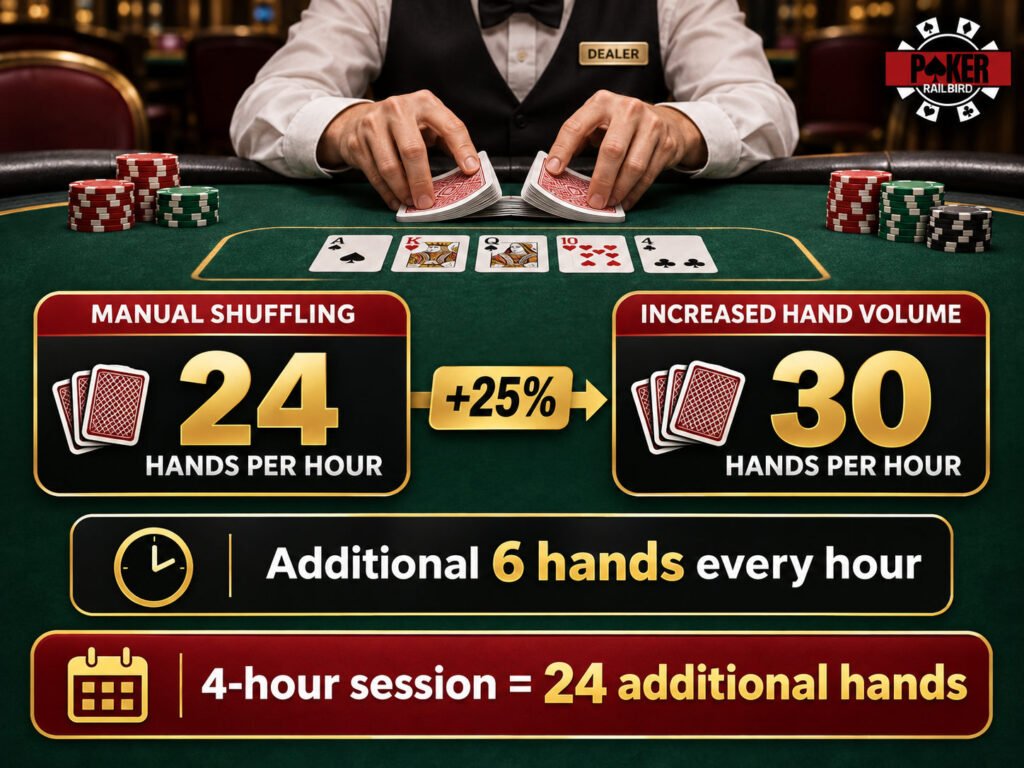
A 2009 report published in Global Gaming Business estimated that automatic shufflers increased the number of hands dealt per hour by approximately 25%. While this is an older industry estimate rather than a guaranteed improvement, it illustrates the potential advantage.
Consider a table averaging 24 hands per hour with manual shuffling. A 25% increase would produce 30 hands per hour, an additional six hands every hour. Over a four-hour session, that represents 24 additional hands played.
The actual increase depends on more than the shuffling procedure. A table where most players fold before the flop can complete hands considerably faster than one regularly involving multiple callers, large pots, and lengthy decisions. Dealer efficiency, chip handling, pot calculations, and time spent resolving disputed action also affect the pace of play.
An automatic shuffler eliminates much of the downtime of preparing the next deck, but it cannot eliminate delays caused by player decisions or the normal mechanics of dealing and settling a hand.
WHAT DOES THIS MEAN FOR PLAYERS?
For players, the primary advantage is straightforward: more time spent playing poker and less time waiting for cards to be shuffled.
Additional hands create more opportunities to participate in favorable situations, although they also increase the number of hands exposed to the game’s normal variance. In games where the house collects a rake from individual pots, more hands can also mean more rake collected over the same period.
The efficiency advantage is especially noticeable over longer sessions, when small time savings between hands add up to more playing opportunities.
While the precise increase in hands per hour varies by table, automatic shufflers offer a practical advantage by shuffling while the game continues.
QUALITY AND CONSIDTENCY OF RANDOMIZATION
Understanding how cards are shuffled is only part of the comparison. The more important question is whether the resulting deck is sufficiently randomized and whether the process consistently achieves that result.
With manual shuffling, a dealer may follow the same prescribed sequence every hand, but the actual distribution of cards depends on how they execute those movements. Even when the dealer performs the procedure correctly, the resulting deck may retain statistical relationships from its previous arrangement.
Research provides evidence of this limitation.
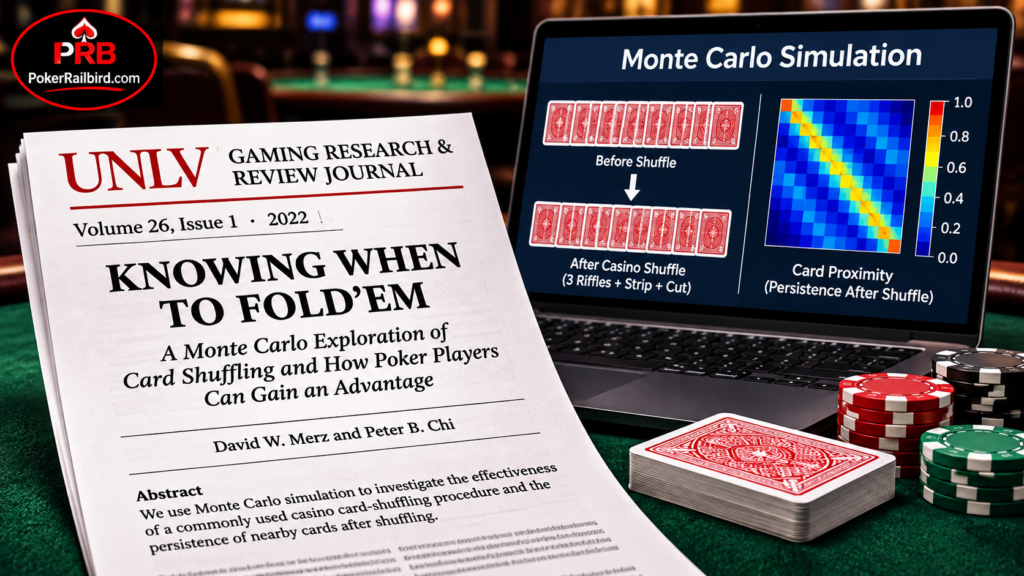
A 2022 study published in the UNLV Gaming Research & Review Journal examined a commonly used casino-shuffling procedure through computer simulations. Researchers David Merz and Peter Chi found that cards originally positioned near one another were more likely to remain relatively close together than would be expected in a uniformly randomized deck.
A subsequent 2026 study by Michael Alexeev and Peter Chi investigated whether adding a wash shuffle improved the results. Although washing improved the distribution of individual card positions, the simulated procedure still exhibited deficiencies in separating groups of cards that began close together.
These findings suggest that conventional manual procedures may not always achieve the level of randomization players assume. However, the studies examined mathematical and simulated procedures, rather than establishing that every casino dealer produces the same results.
COMPARING THE TWO METHODS
Automatic card shufflers eliminate much of the variation associated with individual dealer techniques. Their advantage is that they execute a controlled mechanical process whose randomization performance can be evaluated independently.
Consistency alone, however, does not guarantee randomness. A machine could consistently produce inadequately randomized decks if its design or operation were deficient. This is why testing the entire shuffling system matters.
The available evidence favors properly tested automatic shufflers for producing consistent, verifiable randomization. The mathematical research identifies potential shortcomings in conventional manual procedures, while independent equipment testing provides a way to evaluate machine performance.
That does not establish that every automatic shuffler outperforms every dealer. It does, however, provide a reasonable basis for preferring properly tested automatic systems when shuffle quality and consistency are the primary considerations.
DECK INTEGRITY AND MECHANICAL RELIABILITY
A properly randomized deck means little if it contains missing, extra, duplicate, or damaged cards. Every standard Texas Hold’em hand depends on a complete 52-card deck containing exactly one of each rank and suit. When that composition is compromised, the game’s probabilities change.
Both manual shuffling and automatic card shufflers depend on proper deck verification, but their capabilities differ significantly.
CARD COUNTING VS. CARD RECOGNITION
When a dealer manually shuffles, the cards can be counted and visually inspected. However, counting 52 cards does not establish that the deck contains all 52 correct cards. A deck could contain two aces of spades and no ace of hearts, for example, while still totaling exactly 52 cards.
Modern automatic shufflers may provide a more comprehensive verification process.
The original Deck Mate primarily counted the total number of cards. Its successor, the DeckMate 2, introduced optical card recognition that identifies cards by rank and suit during each shuffle.
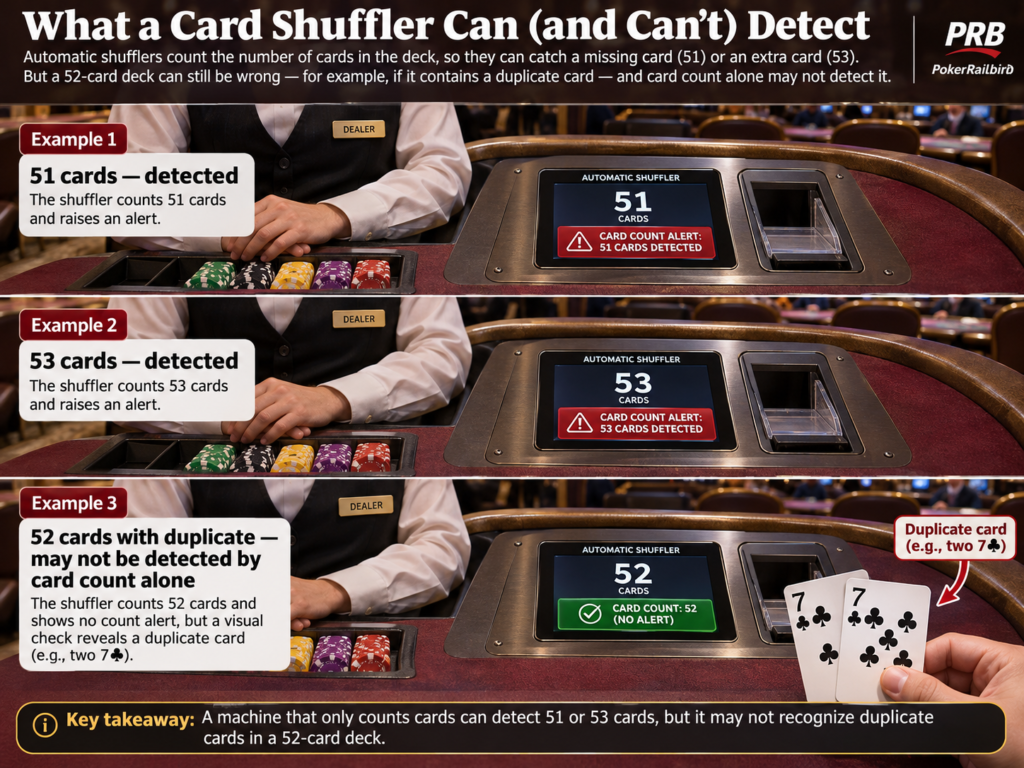
According to the manufacturer’s technical documentation, the DeckMate 2 can identify missing, extra, and unrecognized cards and display the results on its touchscreen. This allows the machine to verify both the number of cards and the deck’s composition.
That distinction is important. A machine that counts cards can detect a 51- or 53-card deck but may not recognize duplicate cards in a deck containing exactly 52. A properly functioning rank-and-suit recognition system can identify those discrepancies.
However, not every automatic shuffler provides the same capabilities, and some recognition features can be disabled. A machine’s presence does not necessarily mean every card is verified by rank and suit.
WHEN VERIFICATION FAILS
I’ve personally seen problems with automatic shufflers that show why these safeguards matter.
In one game I was playing, two decks were found to contain only 47 and 50 cards. In another, a deck contained 53 cards, including two identical seven-of-clubs cards. The shuffler displayed a count of 53, but the duplicate was discovered only after the cards were manually separated by suit.
These experiences raise two separate concerns: whether the equipment can identify an irregularity and whether the people responsible recognize and act on that information before the deck is returned to play.
They also demonstrate why verification capabilities should not be confused with guarantees. Without knowing the specific equipment and its configuration, an isolated incident cannot establish whether a recognition feature malfunctioned, was unavailable, or was not enabled.
SECURITY VULNERABILITIES: WHEN THE DECK ORDER IS EXPOSED
Mechanical failures and incomplete decks are not the only concerns involving automatic card shufflers. Their electronic systems can also introduce security vulnerabilities.
In August 2023, researchers from cybersecurity firm IOActive demonstrated that a DeckMate 2 could be compromised through its software. Working with a machine obtained for testing, they used its USB connection to alter the firmware and gain access to the internal camera used for card recognition.
The researchers demonstrated that they could determine the complete order of the cards after shuffling and transmit that information wirelessly to a nearby device. Someone receiving that information could potentially identify opponents’ hole cards and anticipate upcoming community cards, gaining an enormous advantage at the poker table.
Importantly, the researchers did not demonstrate that they could force the machine to arrange cards in a predetermined order. Their confirmed finding concerned unauthorized access to the shuffled deck’s sequence.
31 Defendants, Including Members and Associates of Organized Crime Families and National Basketball Association Coach Chauncey Billups, Charged in Schemes to Rig Illegal Poker Games
The manufacturer, Light & Wonder, disputed the practical implications of the research, emphasizing that the demonstration was conducted in a laboratory rather than on a regulated casino floor.
More recently, an October 2025 federal indictment alleged that modified shuffling machines had been used in illegal private poker games to reveal card information to participants involved in a cheating scheme. Those allegations concern deliberately altered equipment and should not be treated as evidence that ordinary casino shufflers are routinely compromised.
The distinction matters because a deck can be thoroughly randomized and still present a serious security risk if someone gains unauthorized knowledge of its order.
PROTECTING THE INTEGRITY OF THE GAME
Manual shuffling avoids dependence on electronic detection, but it introduces its own limitations. Dealers can inadvertently overlook damaged cards, miscount a deck, or fail to recognize that a card from another deck has been mixed in.
Automatic systems equipped with comprehensive card recognition offer an important advantage by inspecting the deck during the shuffle cycle without requiring the dealer to examine every card individually. However, their electronic components and software must also be protected against unauthorized access or modification.
Both methods depend on appropriate procedures when an irregularity is discovered. A warning or incorrect card count provides little protection if it is overlooked and the deck remains in play.
For players, the objective is the same regardless of how the cards are shuffled: every hand should begin with a complete, properly randomized deck containing the correct 52 cards, with no unauthorized party having advance knowledge of their order.
Automatic card verification can add an extra safeguard, but maintaining game integrity ultimately requires reliable equipment, appropriate security measures, and attentive human oversight.
PLAYER PREFENCES AND TOURNAMENT PRACTICES
Despite the advantages of automatic card shufflers, poker players do not universally agree on which method they prefer. Some favor the speed and consistency of mechanical shuffling, while others are more comfortable watching a dealer shuffle the cards by hand.
Personal experience often influences these preferences. Players who have witnessed automatic shuffler malfunctions may question the machines’ reliability, while those who have experienced poorly executed manual shuffles may have greater confidence in automated systems.
WHAT POKER PLAYERS PREFER
To gauge player preferences, PokerRailbird conducted a YouTube Community Poll asking whether players favored automatic card shufflers, manual dealer shuffling, or had no preference.
With 32 votes recorded, the results were:
- 34% preferred Automatic Card Shufflers
- 47% preferred Manual Shuffling by the dealer.
- 19% had no preference.
Manual shuffling received the largest share of votes, leading automatic shufflers by 13 percentage points. The results suggest that a substantial portion of participating players remain more comfortable with traditional dealer shuffling, despite the potential advantages of automated systems.
However, the poll represents a small, self-selected group of PokerRailbird viewers rather than a statistically representative sample of poker players. These results reflect personal preferences and cannot establish which method produces better randomization or greater efficiency.
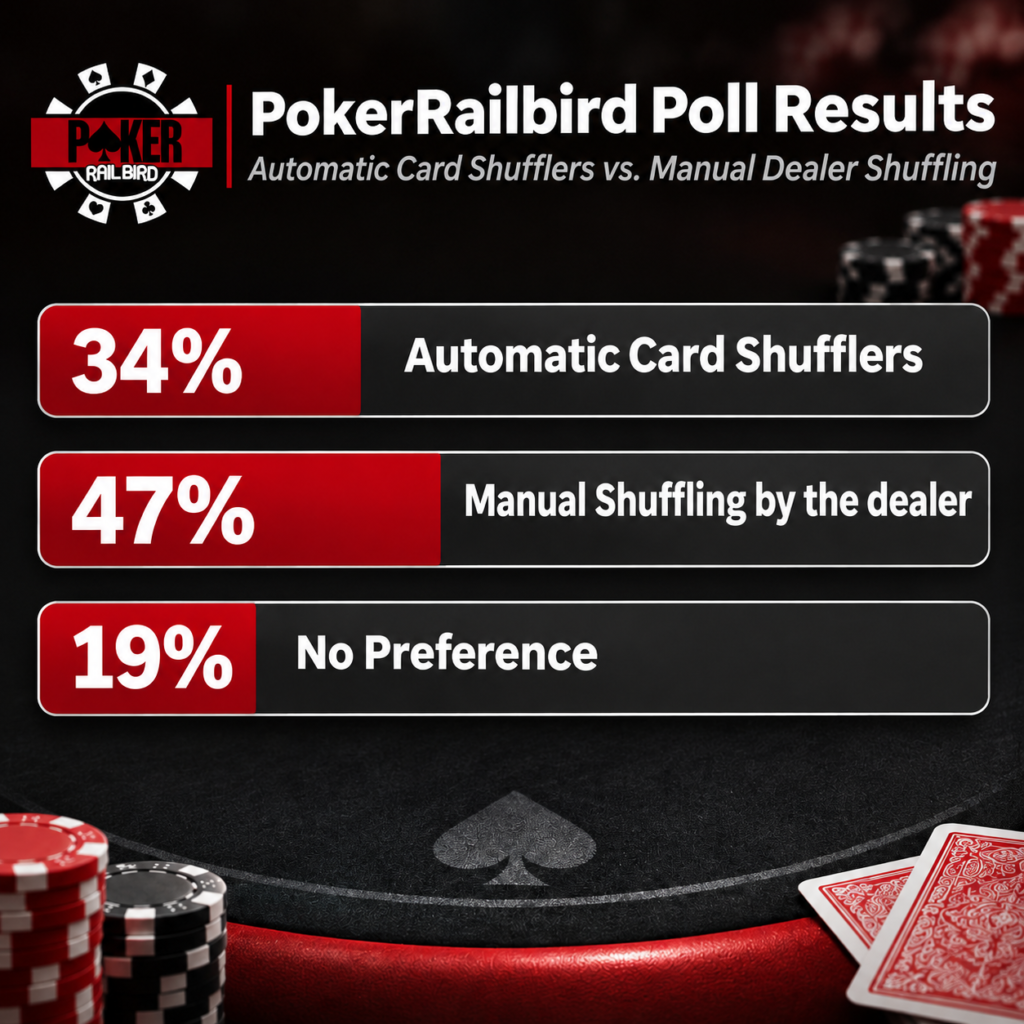
Nevertheless, the findings demonstrate that player preferences remain divided, with manual shuffling currently holding the advantage among those who participated.
MANUAL AND AUTOMATICK SHUFFLING IN TOURNAMENTS
PREFERENCE VERSUS PERFORMANCE
Shuffling procedures also vary in tournament poker. Some events use automatic shufflers, while others rely on dealers to shuffle cards manually.
Automatic shufflers are not limited to cash games. For example, the 2019 World Series of Poker installed 100 DeckMate 2 machines in its Amazon Room specifically for tournament play.
The distinction matters because tournaments operate under timed blind levels. The number of hands completed during each level depends partly on the pace of dealing, making shuffle efficiency relevant to tournament players as well.
However, tournament conditions differ considerably among venues and events, and neither shuffling method is universally employed.
Player confidence is an important part of the live poker experience, but personal preferences do not establish which method produces a better shuffle.
A player may prefer manual shuffling because the entire process is visible, yet visibility does not guarantee thorough randomization. Likewise, an automatic shuffler may inspire confidence because it uses computerized randomization, but that alone does not establish that every machine performs equally well.
The more meaningful comparison comes from examining the actual quality of randomization, the consistency of the process, and the time required to prepare each deck.
Those differences are measurable, regardless of which method an individual player prefers.
CONCLUSION
The available evidence favors properly tested automatic card shufflers in several areas that matter to live poker players: consistent randomization, faster play, and, in machines equipped with card recognition, additional protection against incomplete or incorrectly constituted decks.
Manual dealer shuffling remains an established method, but mathematical research raises legitimate questions about whether conventional casino procedures provide sufficient randomization. The effectiveness of manual shuffling also varies with the dealer’s technique, while a properly functioning automatic shuffler follows a consistent process that can be independently tested and evaluated.
The efficiency advantage is equally important. By preparing one deck while another is in play, automatic shufflers reduce wait time between hands. Over an extended session, those savings can translate into substantially more hands dealt, although the actual improvement depends on the pace and characteristics of the game.
I’ve personally witnessed serious problems involving automatic shufflers, including incomplete decks and duplicate cards. Those experiences have reinforced my belief that accurate card verification and attentive supervision are essential. Even sophisticated equipment provides limited protection when irregularities go unnoticed or warnings are ignored.
Despite those experiences, I prefer automatic card shufflers. The combination of consistent mechanical randomization, independently evaluated performance, and greater playing efficiency provides meaningful advantages over conventional manual procedures.
Ultimately, every player deserves a complete, properly randomized deck and a game conducted with reasonable efficiency. Based on the available research and my own experience, properly tested automatic shufflers offer the stronger overall approach, provided their safeguards are used and the people responsible for the game remain attentive.