

LOOKING AT YOUR HOLE CARDS
A TELL MOST PLAYERS MISS
Looking at your hole cards may seem like one of the simplest actions in poker, yet information often begins flowing around the table long before the first bet is made.
Information often begins flowing around the table before the action ever starts. As the dealer distributes the cards, many players are already looking at individual cards as they arrive, then looking again once both cards have been dealt. During those first few moments, reactions begin to appear, habits emerge, and subtle clues can sometimes reveal more than the player intended.

Some players glance quickly at their cards and immediately return their attention to the table. Others continue staring for several seconds, as though they are searching for something they hoped to find but did not. Although the differences are often subtle, they can occasionally provide clues about what is happening inside a player’s mind.
A SMALL BEHAVIOR WITH POTENTIAL MEANING
As with all poker tells, caution is required. A single behavior rarely proves anything by itself. Fatigue, distraction, inexperience, poor eyesight, or simple habit can all produce similar actions. The goal is not to assume that a player has a particular hand because of one observation. Instead, the objective is to recognize patterns, understand tendencies, and incorporate that information into a larger body of evidence.
.
In this article, we will examine a tell that occurs during the first few seconds of a hand: the tendency of some players to spend more time looking at weak hole cards than strong ones. We’ll discuss why this behavior occurs, why its usefulness varies from player to player, and how developing better card-viewing habits can help you avoid giving away information of your own.
Perhaps more importantly, we’ll explore why those first few moments before the action begins may offer one of the best opportunities to observe your opponents while they are still focused entirely on themselves.

WHY PLAYERS OFTEN STARE AT WEAK HOLE CARDS
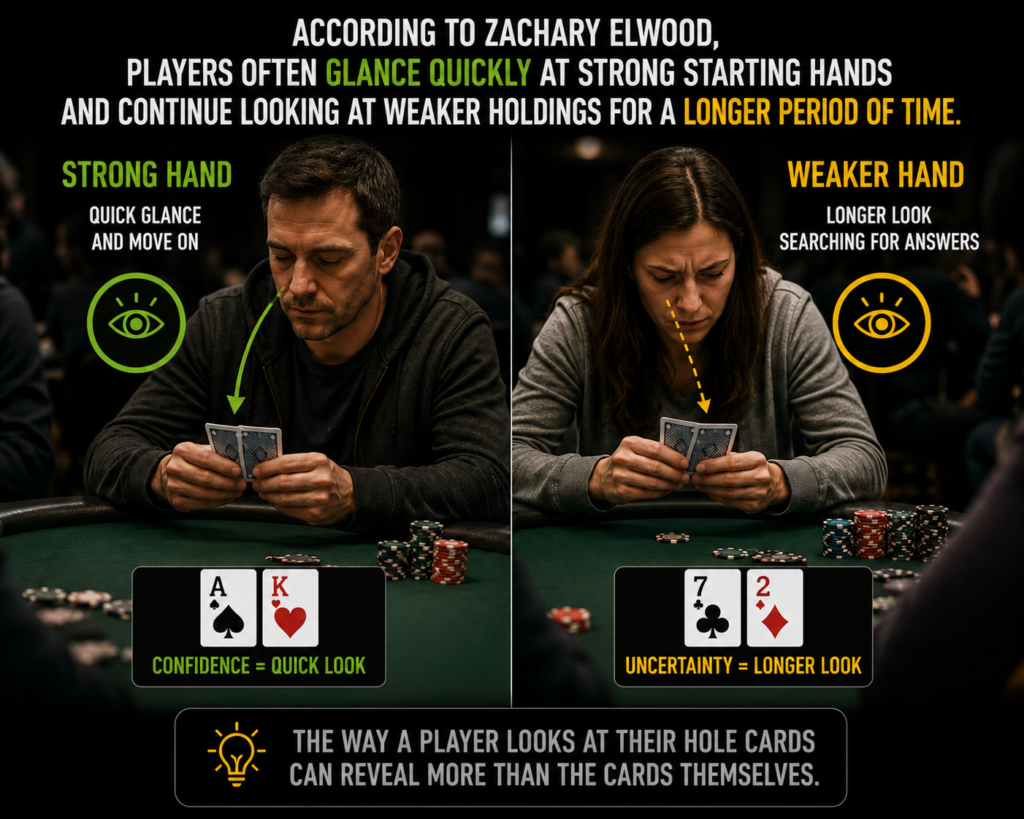
One of the more interesting observations in poker tells literature is that many players appear to spend more time looking at weak hole cards than strong ones. According to Zachary Elwood, players often glance quickly at strong starting hands and continue looking at weaker holdings for a longer period of time.
At first glance, this may seem backwards. Conventional wisdom suggests that players would spend more time studying good cards and less time looking at bad ones. In practice, however, the opposite often occurs.
WHY THIS BEHAVIOR OCCURS
Part of the explanation may lie in what players are trying to accomplish when they first look at their cards. A strong starting hand frequently answers the question immediately. Pocket aces, pocket kings, ace-king suited, and other premium holdings require very little additional evaluation. The player recognizes the hand, understands its value, and moves on.
Weak hands often create a different reaction.
When a player looks down and finds a marginal or unplayable holding, there can be a tendency to continue searching for something redeeming. Perhaps the cards are suited, or they are connected. Perhaps there is some reason to continue. In many cases, the extra time is not spent evaluating strength so much as looking for a reason not to fold.
Some players also appear to linger on weak hands because disappointment naturally holds attention longer than satisfaction. A player who receives a premium hand often obtains the information they were hoping to find and quickly shifts their attention elsewhere. A player who receives a poor hand may continue staring simply because the result was not what they wanted.
This tendency is not universal, nor should it be treated as proof of anything. Some players naturally take longer to view their cards. Others routinely double-check suits, ranks, or both. Certain players stare at every hand for the same amount of time regardless of its strength. Even when the behavior is genuine, the difference may only be a second or two.
Nevertheless, repeated observation of the same player can sometimes reveal patterns. Over time, you may discover that a particular opponent consistently glances quickly at playable hands while spending more time examining weaker holdings. When that pattern appears repeatedly, the behavior becomes more meaningful than any single occurrence viewed in isolation.
LIKE ALL TELLS: THIS TELL HAS LIMITS
As all poker tells, this observation becomes dangerous when it is treated as certainty rather than possibility.
One of the most common mistakes players make when studying tells is assuming that a particular behavior always means the same thing. Human behavior rarely works that way. The same action can have multiple causes, many of which have nothing to do with the strength of a player’s hand.
A player may stare at their cards because they did not see them clearly the first time. Another may be tired after a long session and require an extra moment to process what they are holding. Someone unfamiliar with poker may need additional time simply to determine whether a hand is playable. Poor eyesight, distraction, habit, uncertainty, or even boredom can produce behavior that looks identical to the tell being described.
Deliberate deception must also be considered. Although most players spend far less time acting than they imagine, some do attempt to manipulate the information they reveal. A player who understands this tell may intentionally stare at a strong hand longer than usual or glance quickly at a weak one in an effort to create a false impression.

PATTERNS MATTER MORE THAN INDIVIDUAL ACTIONS
This is why experienced players rarely rely on a single observation. Instead, they look for patterns that repeat over time. One prolonged look at a player’s hole cards means very little. Five similar reactions observed over several hours may begin to tell a different story.
Individual tendencies matter as well. Some players are remarkably consistent in the way they view their cards. Others vary from hand to hand regardless of what they are holding. Before assigning meaning to any behavior, it is important to understand how that particular player normally acts.
Ultimately, the value of looking at your hole cards as a tell does not come from certainty. Its value comes from adding another piece to the puzzle. When combined with betting patterns, timing, physical behavior, previous observations, and player tendencies, it may contribute useful information. Standing alone, however, it should be treated as little more than an interesting possibility.
The strongest poker reads are rarely built from one clue. More often, they emerge when multiple pieces of information begin pointing in the same direction.
DEVELOPING BETTER CARD-VIEWING HABITS
CONSISTENCY IS THE KEY

One of the simplest ways to reduce the information you reveal at the poker table is to develop a consistent routine for looking at your hole cards.
Many players unknowingly vary their behavior based on what they are holding. A premium hand may receive only a quick glance before their attention shifts elsewhere. A marginal hand might be examined longer. Suited cards may receive a second look. Connected cards may receive a third. Over time, these small differences can create patterns that observant opponents may notice.
Consistency helps eliminate those patterns.
Rather than changing your behavior based on the strength of your hand, strive to view your cards the same way every time. Use a similar motion. Spend roughly the same amount of time looking. Avoid unnecessary double-checks that occur only with certain types of holdings. The objective is to make the process of looking at your cards appear the same whether you are holding pocket aces or seven-deuce offsuit.
Most players devote very little attention to this aspect of the game. Yet many of the strongest live players develop routines that remain remarkably consistent regardless of whether they are holding pocket aces or seven-deuce offsuit.
OBSERVATION BEFORE INFORMATION
Another habit worth considering is delaying your own look at the cards.
Many players immediately focus on their hand as soon as the first card arrives. By the time the deal is complete, they are already thinking about whether they want to enter the pot, how they might play the hand, and what they hope to accomplish if they connect with the board.
During those same moments, however, valuable information may be available elsewhere.
As players view their cards, reactions often occur before they have an opportunity to conceal them. Some glance briefly and return their attention to the table. Others continue staring. Some appear interested. Others appear indifferent. While none of these behaviors prove anything by themselves, they can provide useful observations when viewed repeatedly over time.
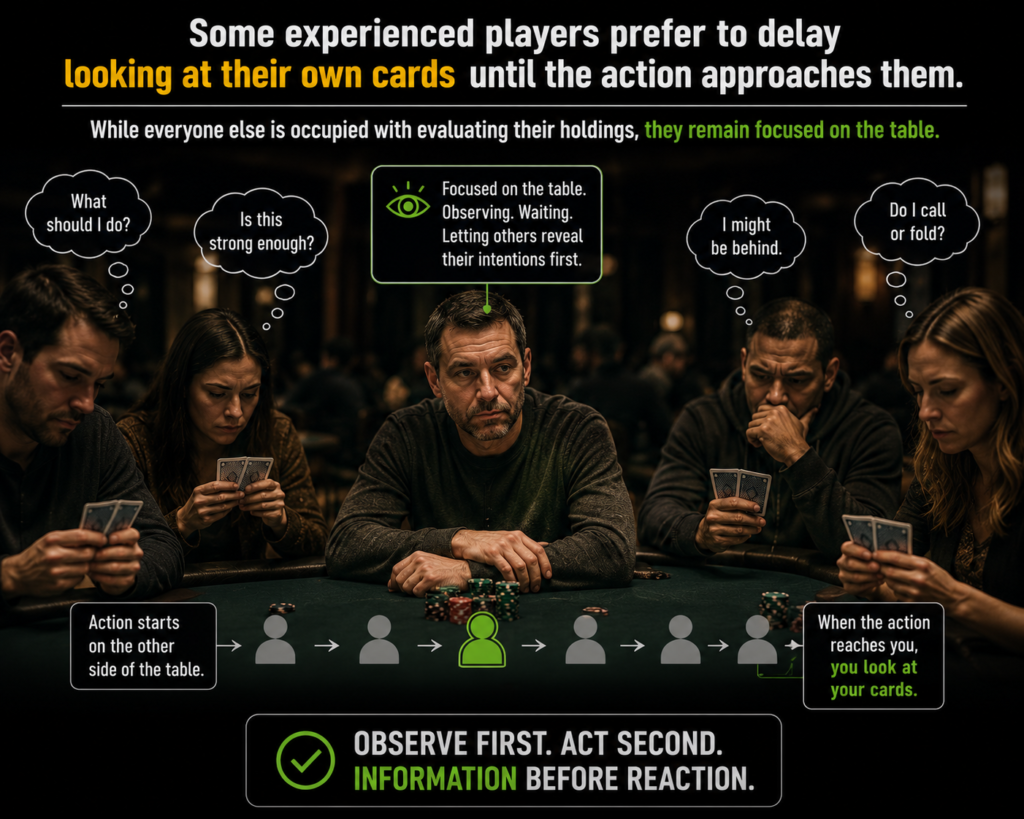
For that reason, some experienced players prefer to delay looking at their own cards until the action approaches them. While everyone else is occupied with evaluating their holdings, they remain focused on the table.
This approach offers two potential benefits. First, it allows you to gather information that might otherwise be missed. Second, it reduces the likelihood that your own reactions become part of the information available to others.
Whether you choose to adopt this habit or not, the broader lesson remains the same. Poker rewards observation. The more attention you devote to your opponents, the more opportunities you create to learn something useful before a single chip enters the pot.
PUTTING IT ALL TOGETHER

Like many poker tells, the true value of this observation lies less in certainty than in awareness.
Looking at your hole cards is something every player does hundreds of times during a session, yet few give much thought to the information they may be revealing in the process. Small differences in timing, attention, and behavior often go unnoticed by the person displaying them, even though those same actions may be visible to an observant opponent.
That does not mean you should assume a player has a weak hand simply because they spend an extra second looking at their cards. Human behavior is far too complex for conclusions that simple. What it does mean is that seemingly insignificant actions can sometimes become meaningful when viewed as part of a larger pattern.
More importantly, this tell serves as a reminder that observation begins long before the first bet is made. Many players become so focused on their own cards that they miss valuable information available during the earliest moments of a hand. While attention is directed inward, opportunities to observe opponents often pass unnoticed.
Developing consistent habits when looking at your hole cards can help reduce the information you provide to others. Some players choose to make observation part of that routine by delaying their look until the action approaches them. Doing so may create opportunities to observe reactions that would otherwise be missed while still maintaining a consistent approach from hand to hand.
In the end, that may be the most important lesson of all. Poker is not simply a game of cards. It is a game of information. The more effectively you gather it, and the less carelessly you give it away, the better equipped you become to make profitable decisions.