

STARING AT BAD BOARD CARDS
A TELL HIDDEN IN PLAIN SIGHT
Staring at bad board cards is one of the more subtle poker tells you may encounter at the table.
When the flop, turn, or river is dealt, every player receives new information at the same time. Some players glance at the board and quickly shift their attention elsewhere. Others remain focused on the cards for several extra seconds, as if they are still searching for something they hoped to find.
At first glance, this behavior may seem insignificant. After all, every player needs to look at the board. Yet many experienced observers have noticed that some players tend to remain fixated on the board when the new card does not help their hand.
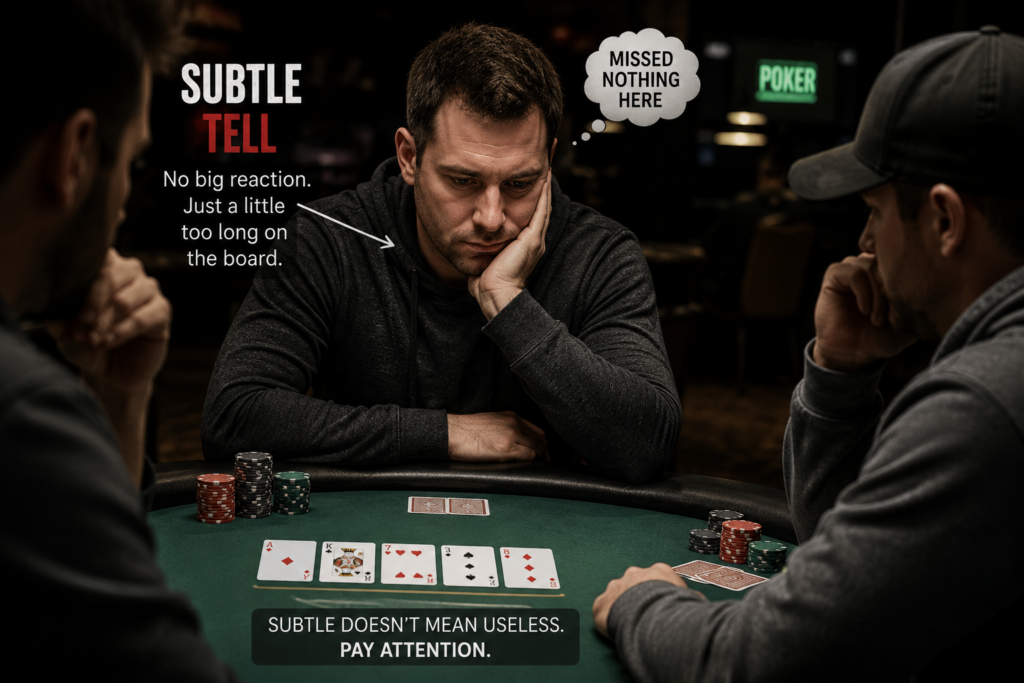
Does staring at bad board cards actually indicate weakness?
Sometimes.
Like many poker tells, the answer is not found in a single observation. The real value comes from understanding why the behavior occurs and whether a consistent pattern develops over time.
In this article, we’ll examine what staring at bad board cards looks like, why it may occur, and how to determine whether it is providing meaningful information or simply a harmless habit.
WHAT IS THE TELL

Staring at bad board cards is a relatively simple tell to identify.
The behavior occurs when a player continues looking at the flop, turn, or river after the new card has been dealt and revealed. Rather than briefly viewing the board and shifting their attention elsewhere, the player remains focused on the community cards for several extra seconds.
The tell can appear on any street. Some players simply continue staring at the board. Others appear to study the cards intently, as though they are trying to solve a problem or find something they expected to see. In some cases, the player may even develop a slightly puzzled or quizzical expression while looking at the board.
The traditional interpretation is that the new card did not help the player’s hand. Because the player failed to connect with the board, their attention remains on the cards as they continue to evaluate the situation.
For example, imagine a player holding 8♠7♠ on a flop of A♦K♣3♥. The board completely misses their hand. Rather than immediately shifting their attention to the action or the other players, they continue staring at the flop, perhaps unconsciously searching for value that isn’t there.
By contrast, a player who flops a strong hand may quickly move beyond the initial evaluation stage. Having already found what they were looking for, their attention may shift toward opponents, stack sizes, betting decisions, or future action.
At first glance, this appears to be a straightforward tell. The reality, however, is more nuanced. Before deciding whether this behavior has value, it is important to understand what may actually be causing it.
BEFORE YOU LOOK AT THE BOARD
The moment new cards are dealt is one of the best opportunities to gather information at the poker table.
When the flop, turn, or river is revealed, nearly every player immediately shifts their attention to the board. This is understandable. New information has arrived, and everyone wants to know whether the cards helped their hand.
Yet there is an argument for doing something different.
Instead of looking at the board immediately, consider watching your opponents first.
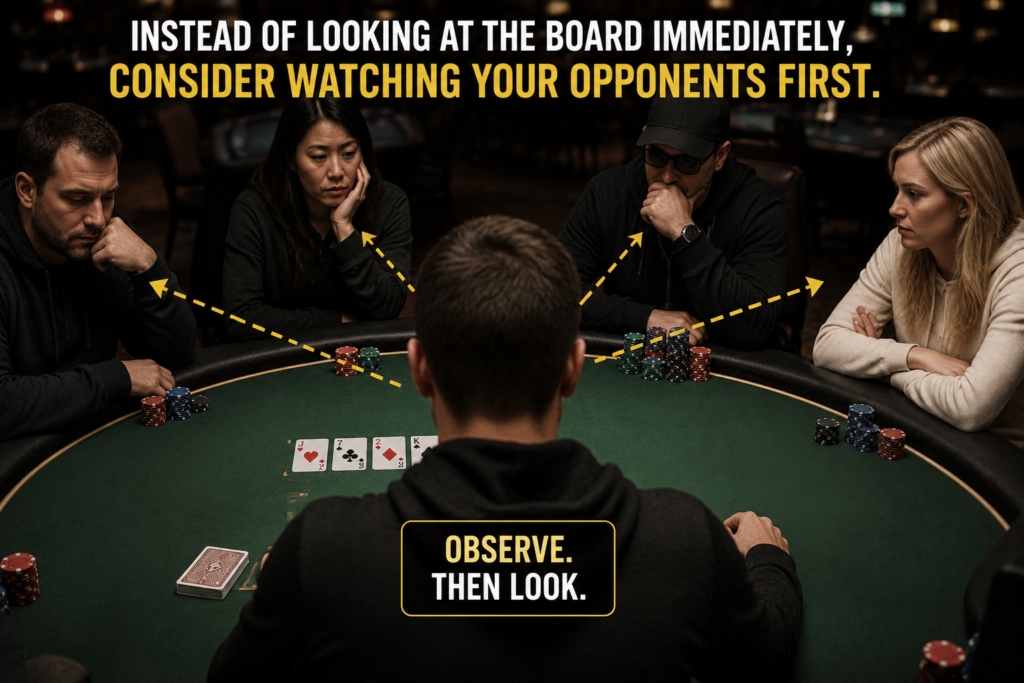
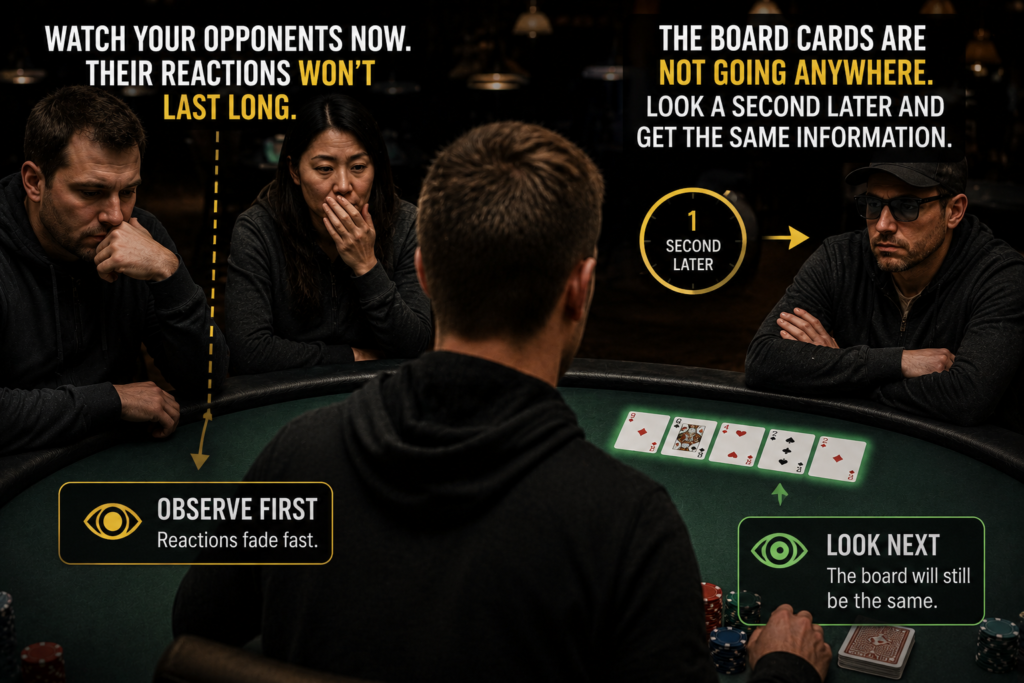
As players process the new information, they may reveal subtle reactions before they have time to consciously control them. A brief facial expression, a sudden movement, a change in posture, or an unexpected shift in attention may provide valuable information about how the new card affected them.
The board cards are not going anywhere. You can look at them a second later and receive exactly the same information. The reactions of your opponents, however, may disappear almost immediately.
WHY TIMING IS IMPORTANT
This is one reason experienced observers often pay close attention to players when new cards arrive. They understand that not all information has the same lifespan. The board will still be there a few seconds from now. An instinctive reaction may not.
There is another benefit to this approach. While everyone else is looking at the board, fewer players are paying attention to you. By delaying your own look briefly, you reduce the chance that your initial reaction will be observed by others.
The goal is not to create an elaborate routine or to turn every hand into a psychological exercise. The goal is simply to recognize that new information often produces new reactions, and those reactions can reveal valuable information to an observant player.
This brings us back to the tell itself. If players frequently reveal information through the direction of their attention, why do some players continue staring at the board while others quickly move on?
WHY THIS TELL HAPPENS
The traditional explanation for this tell is fairly straightforward.
When new board cards are dealt, players immediately begin evaluating how the card affects their hand. Some players complete that process quickly and shift their attention elsewhere. We will discuss that behavior in a future article. For now, our focus is on the players who continue staring at the board.
Why does this happen?
In many cases, the player is simply continuing the evaluation process. The new card arrived, and their attention remains focused on understanding what it means.
This does not necessarily mean the player is consciously trying to deceive anyone.
In fact, the opposite may be true.
For many players, continuing to stare at the board is simply the path of least resistance. The cards have just been dealt. They are already looking at them. Unless something causes their attention to shift elsewhere, they simply continue staring at the board while processing the information.
CORRELATION IS KEY
Like many poker tells, staring at bad board cards is not a tell that should be trusted automatically.
The behavior may indicate weakness, but it can also have other explanations. Some players naturally spend more time studying the board than others. Some are methodical by nature. Others may simply have habits that have nothing to do with the strength of their hand.
This is one reason poker tells should rarely be viewed in isolation.
A single observation provides very little information. A pattern of observations is far more valuable.
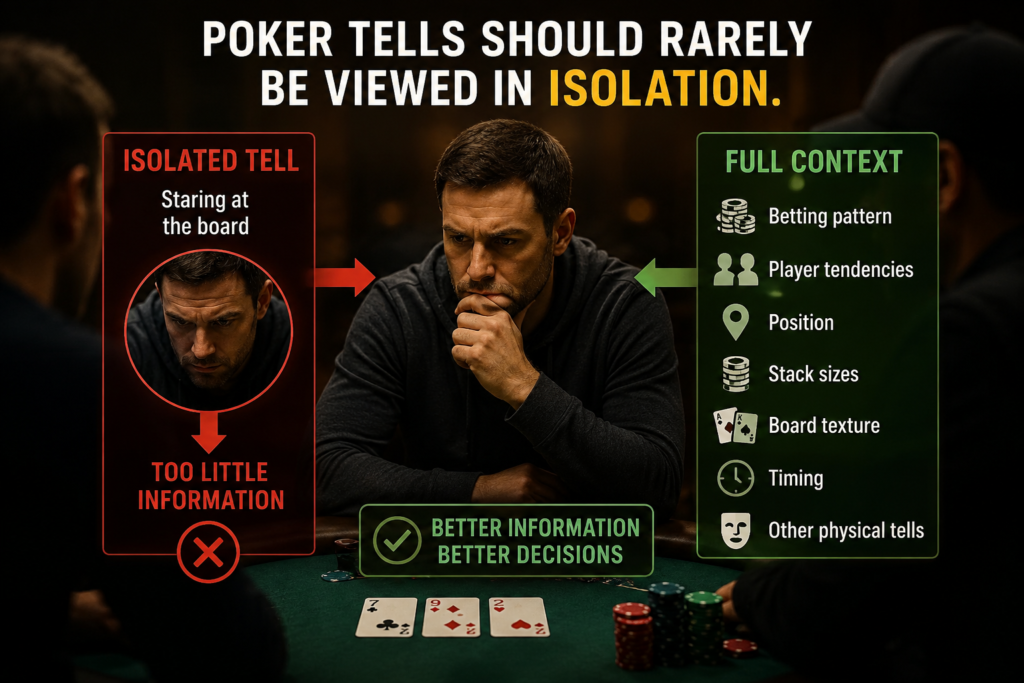
Suppose you notice a player staring at the board after one flop. That alone tells you very little. However, if you repeatedly observe the same player remaining focused on the board when they miss and shifting their attention elsewhere when they connect, the behavior begins to carry more weight.
Player experience also matters.
Less experienced players are often more likely to display instinctive reactions because they are focused on playing their own hand rather than managing their behavior. More experienced players tend to be aware that opponents may be watching them, which often leads to more consistent and controlled reactions.
This does not mean experienced players never reveal information. Everyone does. It simply means that the information may be more subtle and more difficult to interpret.
TELLS ARE SUPPORTING EVIDENCE
There is another limitation worth considering.
Even if the tell is genuine, it does not necessarily reveal exactly what a player is holding. At best, it may provide insight into how comfortable, uncertain, or confident they feel about the new board card. That is useful information, but it is not the same as knowing their hand.
This is why poker tells should be treated as supporting evidence rather than primary evidence.
The betting action, player tendencies, position, stack sizes, and board texture will usually provide far more reliable information than any single physical tell.
When a tell supports what the rest of the evidence already suggests, its value increases. When a tell contradicts everything else you know, caution is usually warranted.
FINAL THOUGHTS
This tells has value, but the bigger lesson is learning to observe attention and reactions when new information arrives.
In many cases, the behavior may simply reflect a player continuing to evaluate the new information rather than a deliberate attempt to reveal or conceal anything. Like all tells, its value depends on the individual player, the consistency of the behavior, and the context in which it occurs.
What makes this tell interesting is not the act of staring at the board itself. The more important lesson is understanding where players direct their attention when new information arrives.
When the flop, turn, or river is dealt, every player at the table is processing the same information. Some players quickly shift their focus elsewhere. Others remain locked on the board. Those differences in attention can sometimes provide insight into a player’s thought process.
The key is observation.
A single occurrence means very little. A consistent pattern may tell a different story.
As with all poker tells, this information should never replace sound strategic thinking. Betting patterns, position, player tendencies, stack sizes, and board texture remain far more reliable sources of information. However, when a tell supports the story that the hand is already telling, it can become another useful piece of the puzzle.
The next time new board cards are dealt, resist the urge to immediately focus on the cards. Instead, spend a moment observing the players around you. The board will still be there when you look. The reactions may not.