
THE OPPONENT LAYER
READING RANGES, TENDENCIES AND PLAYER TYPES
Mastering reading opponent ranges is one of the most important skills you can develop once you’ve built a strong foundation in Layer 1. After learning to accurately evaluate your own hand, the next critical step is shifting your focus outward: understanding what your opponent likely holds and what they are trying to accomplish.
This is Layer 2 of the Poker Decision Tree: The Opponent Layer.
This layer is where you move from asking “What do I have?” to asking “What does my opponent have, and what are they likely to do?” It’s where poker transitions from being primarily about cards to being a game of information, exploitation, and psychology.

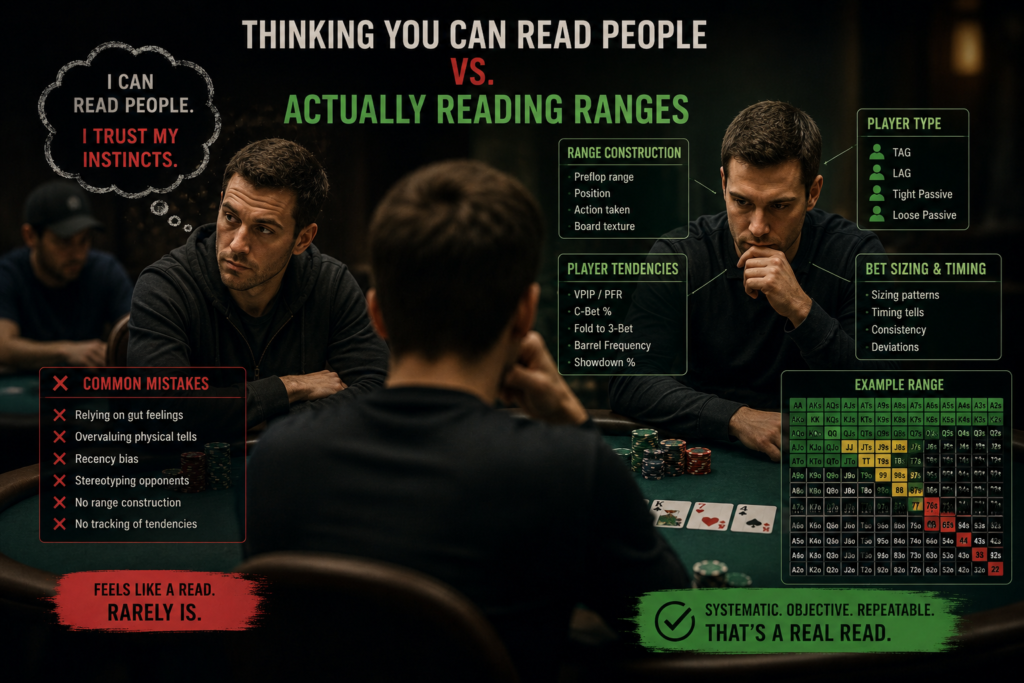
Many players think they’re good at this layer. They say things like “I can read people” or “I trust my instincts.” But in reality, very few players systematically construct ranges or track tendencies. They rely on vague impressions, recent showdowns, or stereotypes instead of disciplined observation.
In this article, we’ll break down exactly what the Opponent Layer means, why it’s so difficult to master, and how to develop a practical system for reading opponent ranges more accurately. You’ll learn how to construct preflop and postflop ranges, identify player types, analyze bet sizing, and combine that information with your Layer 1 hand evaluation to make significantly better decisions.
Layer 2 is where your edge can grow dramatically. Get this layer right, and even good Layer 1 hands become much more profitable. Get it wrong, and you’ll continue making costly mistakes against better-informed opponents.
Let’s begin by clearly defining what effective thinking in the Opponent Layer actually requires.
WHAT "THE OPPONENT LAYER" ACTUALLY MEANS
Reading opponent ranges is the second step in the poker decision tree.
Layer 2 of the poker decision tree shifts your focus outward. After evaluating your own hand in Layer 1, you now ask: “What does my opponent likely hold, and what are they trying to do?”
This is the essence of reading opponent ranges.
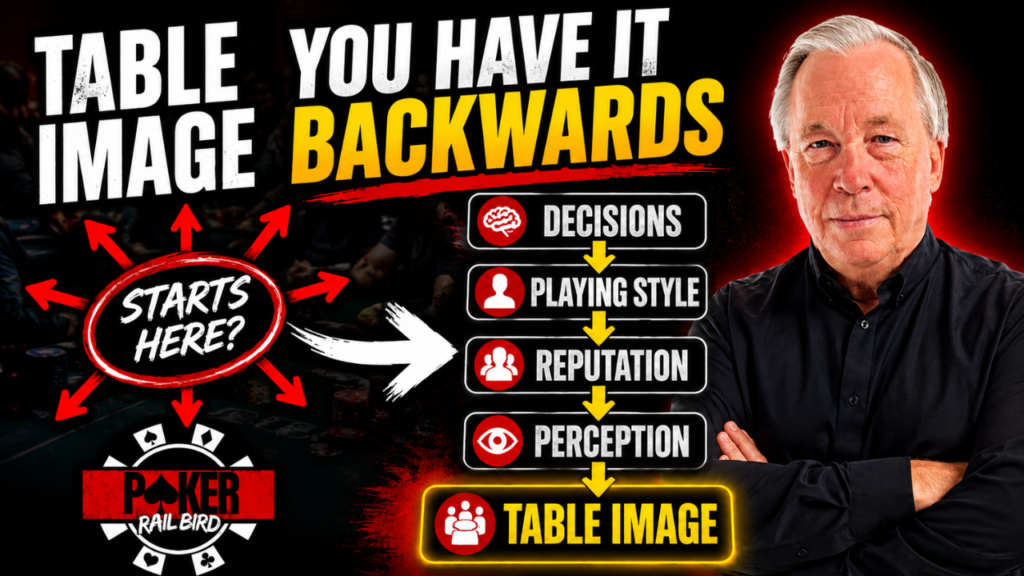

CORE COMPONENTS OF THE OPPONENT LAYER
RANGE CONSTRUCTION
PLAYER TYPE IDENTIFICATION
TENDENCY TRACKING
BET SIZING/TIMEING
Building a realistic range of hands your opponent can have based on their actions, position, and history. A tight player raising from early position usually has a much narrower range than a loose player raising from the button.
Quickly categorizing opponents:
- Tight-Aggressive (TAG)
- Loose-Aggressive (LAG)
- Tight-Passive (Rock)
- Loose-Passive (Calling Station)
Observing specific patterns:
- How often do they raise preflop?
- How often do they continuation bet?
- Do they over-fold to aggression or call too wide?
- Do they bluff frequently or mostly value bet?
Using the size of bets and the time taken to act as valuable information about hand strength and intent.
Mastering Layer 2 means moving beyond vague “reads” or gut feelings. It means developing a systematic way to narrow your opponent’s possible hands and intentions using evidence. This layer transforms poker from a game of cards into a game of people and information. It is also one of the most challenging layers to develop because it requires consistent observation and real-time adjustment.
In the following sections, we will examine common mistakes in this layer and then build a practical framework for reading opponent ranges effectively.
COMMON MISTAKES IN READING OPPONENT RANGES
Even players who understand the importance of Layer 2 often make costly errors when trying to read opponent ranges. These mistakes usually come from relying on shortcuts, emotions, or incomplete information rather than systematic thinking.
ASSUMING ALL OPPONENTS PLAY THE SAME WAY
One of the most common mistakes in reading opponent ranges is treating every opponent as if they play similarly.
This error goes beyond basic player types (TAG, LAG, etc.). You must also assess skill level and experience.
- A young, confident player who seems comfortable at the table often plays wider and more aggressively than an older, more cautious player.
- A new or inexperienced player may call too wide with weak hands but fold too easily to aggression.
- A seasoned regular usually has more disciplined ranges and better hand selection.
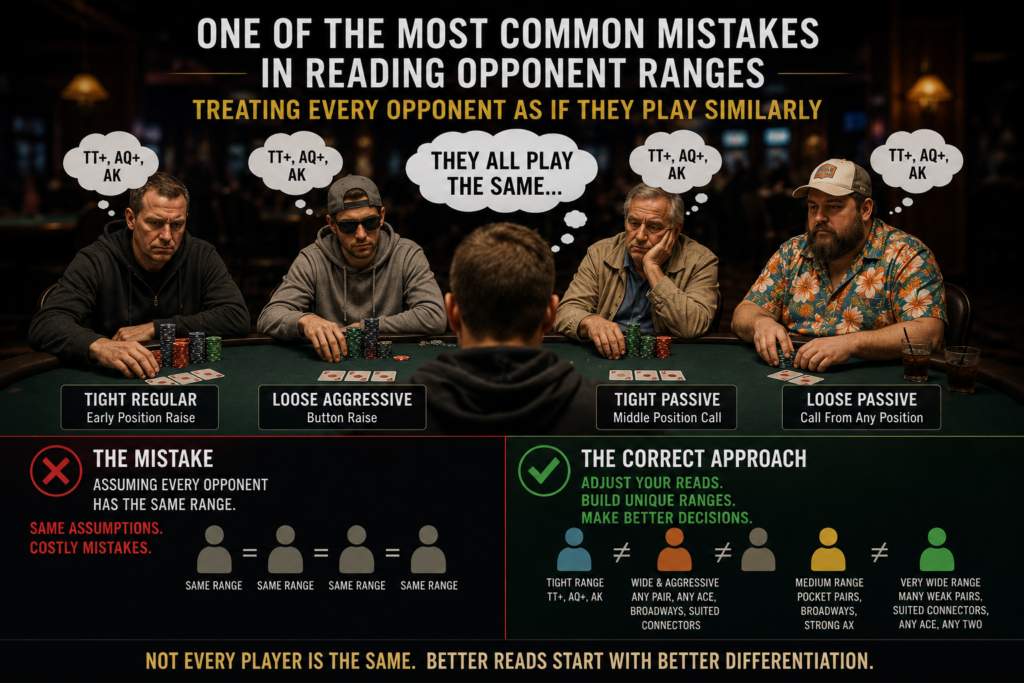
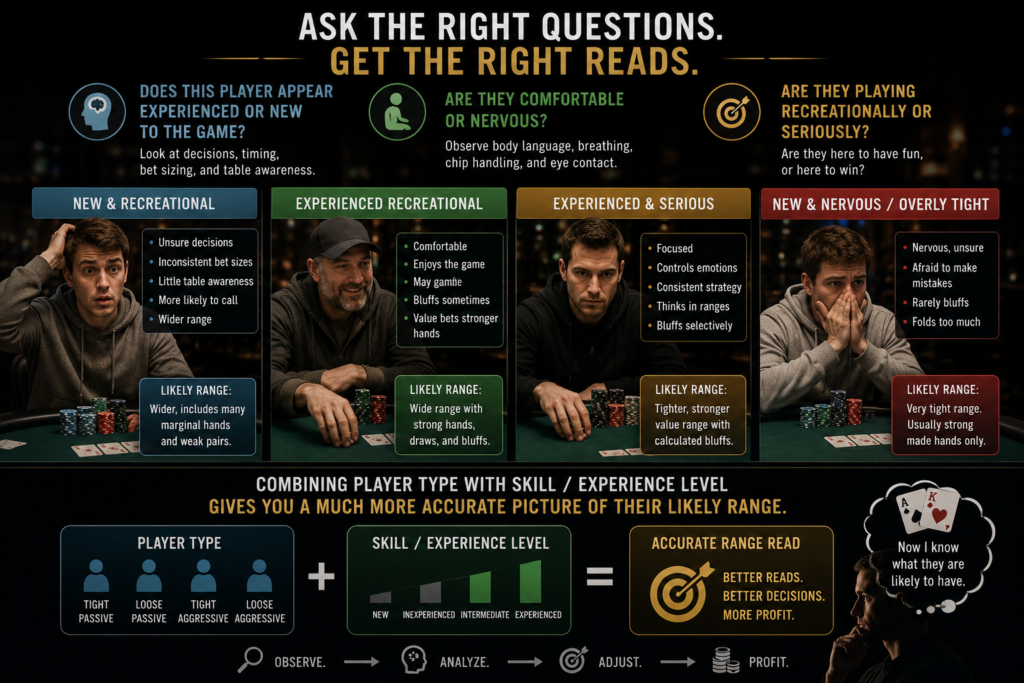
Failing to adjust for both playing style and perceived skill level leads to major misreads. The same raise from early position means something very different coming from a tight regular versus a loose tourist who just sat down.
Always ask yourself:
- Does this player appear experienced or new to the game?
- Are they comfortable or nervous?
- Are they playing recreationally or seriously?
Combining player type with skill/experience level gives you a much more accurate picture of their likely range.
OVER-RELYING ON PHYSICAL TELLS
Physical tells can provide useful information in live poker, but many players over-rely on them while under-using more consistent data such as bet sizing, timing, and positional tendencies. A stare, shaky hand, or sudden silence can mean strength in one situation and weakness in another. Without understanding a player’s baseline behavior and the specific context (waiting for action, during action, or post-action), physical tells are easy to misread or over-interpret.
The strongest approach is to treat physical tells as supplementary information rather than the primary source. Combine them with betting patterns and player tendencies for the best results.
For a much deeper exploration of poker tells, including situational categories and practical examples, read the full article:
“Reading Poker Tells: The Psychology of Live Play”
RECENCY BIAS
Players often over-adjust based on the most recent hand or even the last few hands. If an opponent just showed down a bluff, many immediately assume they are “bluffy” for the rest of the session. If they showed up with a strong hand, players suddenly treat them as tight and straightforward.
This emotional reaction is one of the most common leaks in reading opponent ranges.
Poker is a long-term game. True player tendencies are revealed over dozens or hundreds of hands, not one or two standout moments. One big bluff doesn’t make someone a habitual bluffer. One strong value hand doesn’t make them a rock. Basing your reads on recent results distorts your view of their overall range and leads to expensive misjudgments.
The correct approach is to build a player profile based on consistent patterns over time, not isolated hands. Recency bias is especially dangerous because it feels so natural. Our brains are wired to overweight recent events. Fight that instinct. Trust your longer-term observations instead.
STATIC RANGE THINKING
Some players assign a fixed range to an opponent at the beginning of the hand and never update it as the hand progresses. This is one of the most costly mistakes in reading opponent ranges.
Ranges are not static. They should be rethought on every street as new information becomes available. Board texture develops, bet sizes usually increase, and hands generally become more defined with each action.
However, ranges do not always narrow. In many cases, especially in loose, chaotic games, they can actually expand based on board texture, bet sizing, and player behavior. For example, on an 8-5-6-J board, many players would automatically think “no way they played 7-4.” But in loose, multiway games, not only did they likely play it, they may have even called a raise with it, especially if it was suited. Failing to consider these possibilities because “they wouldn’t do that” is a classic static thinking error.
The correct approach is continuous adjustment. Ask yourself on every street:
- How does this new card change their possible range?
- Does their bet (or check) make sense for the hands I previously assigned?
- Should I widen or narrow their range based on this action and the board?
Treating ranges as fixed snapshots instead of evolving pictures is one of the fastest ways to misread opponents and make expensive mistakes.
IGNORING POSITION AND STACK DEPTH
A player’s position and effective stack size can dramatically influence their range. The same player will often play much wider from the button with deep stacks than from under the gun with a short stack.
However, in chaotically loose live games, many recreational players have little to no regard for position. They will call raises with any two cards, especially if suited, remotely connected, or containing an Ace or face card, from any position. In these games, assuming “they wouldn’t play that from early position” is one of the fastest ways to misread hands.
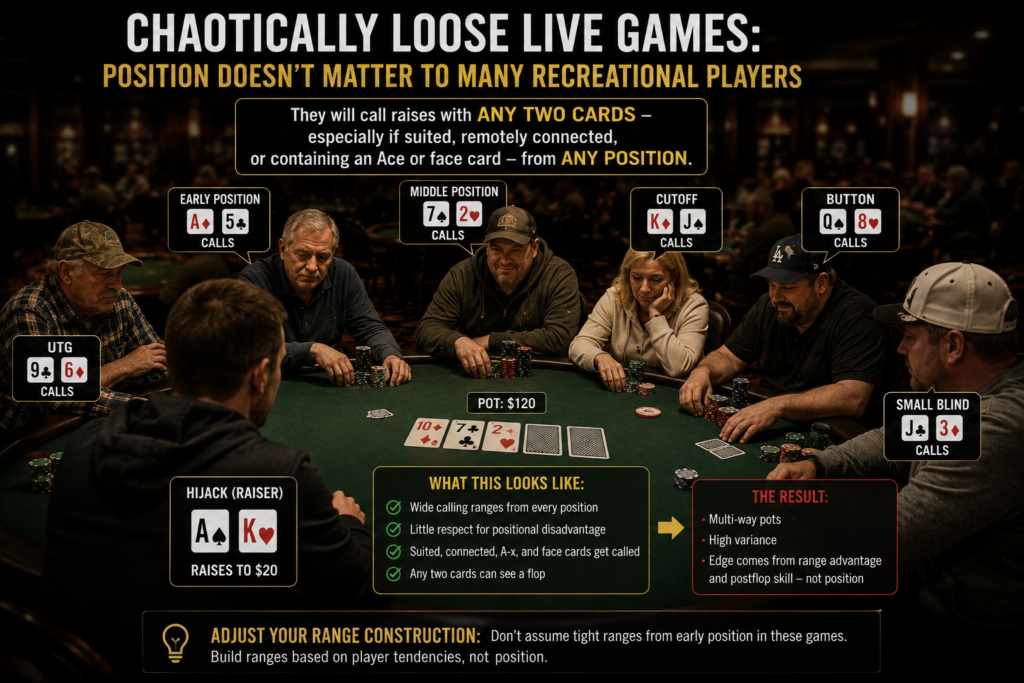
This is why player tendencies and board texture become even more important than position when reading opponent ranges. In loose, multiway pots, if the board supports a hand, you must seriously consider that your opponent could have It, regardless of where they raised or called from.
Always factor in position and stack depth when they apply, but never assume they are the dominant factor. In many live games, observed player behavior and how the board hits will give you a more accurate picture.
These mistakes all stem from the same root issue: treating reading opponent ranges as an intuitive art rather than a disciplined, evidence-based process. In the next section, we’ll look at how to properly build and narrow opponent ranges using a more structured approach.
HOW TO PROPERLY THINK IN LAYER 2
RANGE CONSTRUCTION
The most effective way to begin reading opponent ranges is to focus first on player type and observed tendencies, not just position.
Many recreational players open a wide range of hands with little regard for position. A loose player on the button may play very similarly to how they play from middle position. This is why default charts that say “Early Position = Tight Range” can be dangerous if you apply them blindly.
Instead, ask yourself:
- What type of player is this? (Tight, Loose, Passive, Aggressive)
- How wide have they been opening so far?
- Have they shown down strong or weak hands?
- Do they limp a lot, raise small, or raise big?
Only after considering player type and tendencies should you layer in position as a modifier. A tight player raising from early position usually has a strong range. The same tight player raising from the button may still be strong, but wider than from early position.This player-first approach is much more accurate in live games where many opponents do not play positionally disciplined poker.
post-flop range analysis
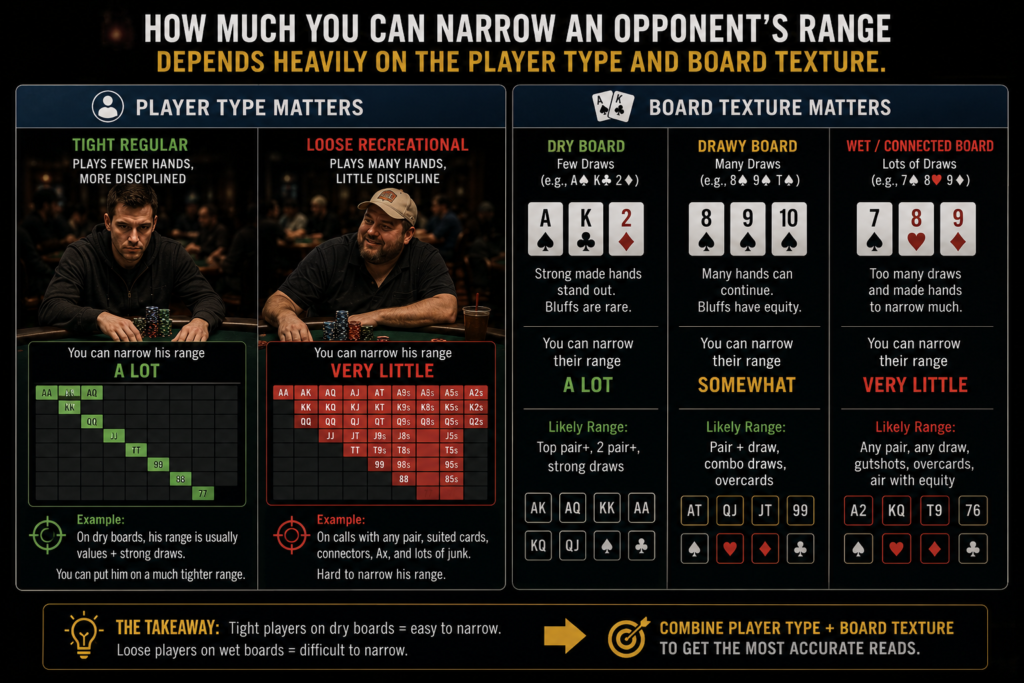
Reading opponent ranges post-flop is more challenging than preflop because ranges do not automatically tighten with every action. How much you can narrow an opponent’s range depends heavily on the player type and board texture.
Against tight, disciplined players, you can narrow their range significantly as the hand progresses. A bet on the flop and turn usually means strength. However, against loose and recreational players, especially in multiway pots, narrowing ranges is much more difficult and even range “widening” is sometimes called for.
In loose games, you must heavily rely on board texture. If the board supports a hand, you have to seriously consider that your opponent could have it, even if it seems unlikely. On an 8-5-J-6 board, for example, you cannot discount 7-4 just because “they wouldn’t call a raise with that.” In many games, they absolutely would, especially if it is suited.
This is particularly true in multiway pots with 4 to 7 players seeing the flop. When many players are involved, if the board texture makes a hand possible, it is often probable. Any two suited cards, any Ace, any face card, or any remotely connected hand becomes realistic.

Key Principle:
Always combine three factors when narrowing ranges postflop:
- Player type and observed tendencies.
- Board texture (what hands does this board support?).
- Betting/calling patterns.
The more loose and passive the game, the more you must respect the “any two cards that connect with this board” principle.
PLAYER TYPE PROFILING
One of the fastest ways to improve at reading opponent ranges is to quickly categorize players into their primary playing style. While no player fits perfectly into one box, most tend to lean toward one of four major archetypes:
- Tight-Aggressive (TAG)
- Loose-Aggressive (LAG)
- Tight-Passive (Rock)
- Loose-Passive (Calling Station)
Why Understanding Player Types Matters
Strategic Adaptation
Identifying an opponent’s style allows you to adjust your strategy to exploit their tendencies. Against a Tight-Aggressive player, you can play more speculative hands in position, knowing they will fold weaker holdings. Against a Loose-Passive player, you can value bet thinner and bluff less often.
Game Dynamics
The mix of player types at your table heavily influences how the game plays. A table full of Loose-Aggressive players creates very different dynamics than one dominated by Tight-Passive players. Recognizing this helps you choose better games and adjust your overall approach.
Self-Awareness
Understanding these styles also helps you recognize your own tendencies and table image. This awareness allows you to manage how others perceive you and avoid being exploited.
For a deeper breakdown of each style, including specific strategies to counter them, see the full articles linked below:
BET SIZING ANALYSIS
Bet sizing is one of the most reliable sources of information when reading opponent ranges. The amount an opponent bets (or checks) often reveals more about their hand strength and intent than their words or physical tells.
What Different Bet Sizes Usually Mean:
SMALL BETS (25-45% OF THE POT)
STANDARD BETS (50-75% OF THE POT)
LARGE BETS/OVERBETS (80 TO OVER 100% OF THE POT)
CHECKS
Often indicates weakness, draws, or thin value. Many recreational players use small sizes when they want to keep the pot small with marginal hands or when they are probing for information.
The most common size. This is frequently used with medium-strength hands or moderate draws. It doesn’t give away much information, but it also doesn’t apply maximum pressure.
Usually polarized, either very strong hands (nuts or near-nuts) or bluffs. In live games, overbets on scary boards are often value-heavy, especially from straightforward players.
Can mean weakness, trap, or giving up. Context (board texture, player type, and previous action) is critical here.
IMPORTANT NOTE ON BET SIZING

The patterns described above represent general tendencies seen in typical live cash games. However, in extremely loose or chaotic games, players often disregard standard bet sizing entirely. Bets may be made with little to no mathematical relationship to the pot, board texture, or hand strength. In these situations, rely more heavily on observed player tendencies, board texture, and your overall read of the table rather than expecting “normal” sizing logic to apply.
HOW TO USE BET SIZING
Effectively combine bet size with:
- Board texture (dry vs wet)
- Player type (Tight vs Loose, Passive vs Aggressive)
- Previous actions in the hand
For example, a tight player making a large bet on a coordinated board is far more likely to have a strong made hand than a loose player making the same bet on the same board.
Bet sizing tells become even more powerful when you track an opponent’s patterns over time. Does this player always bet small with draws? Do they overbet when they have the nuts? These tendencies help you narrow ranges more accurately.
For a much deeper dive into post-flop bet sizing strategy, including how to size your own bets to deny odds and maximize EV, read the full article:
“Post-Flop Bet Sizing in Live Cash Games: How to Deny Odds, Control Equity, and Maximize EV”.
INTEGRATING LAYERS 1 AND 2
The real power emerges when you combine both layers. Layer 1 tells you what you have. Layer 2 tells you what they likely have. Together, they answer the most important question in poker: “Given what I hold and what they likely hold, what is the best action?
Here is how to integrate the two layers effectively:
Key Integrating Questions
- How does my hand perform against their continuing range?
This is the core question. You combine your Layer 1 hand strength/equity with the range you built in Layer 2. - Am I ahead, behind, or drawing — and by how much?
Use realistic ranges, not just one hand. A top pair might be ahead against a tight player’s range but crushed against a loose player’s range. - What is the best action given both layers?
Does betting make sense for value or protection? Should I check to control the pot or induce a bluff?
Additional Powerful Questions
- Given the board texture, how likely is my opponent to have a strong hand vs. a draw?
- Does my hand have good playability against their range on future streets?
- Am I in a spot where I can realize my equity, or am I likely to face difficult decisions later?
IMPORTANT DISCLAIMER
No checklist or framework can ever be complete. Every hand is unique, and every player at the table is reacting to their own personal situation in that moment.
Someone may be on tilt after losing a big pot. Another player might be playing looser because they just stacked someone and are riding high. A third might be distracted after an argument on the phone or because their medication isn’t working well that day.
These dynamic human factors matter.
Use the questions above as a solid structural foundation, but always stay alert to the specific context of the hand and table. The best players combine systematic thinking with sharp situational awareness. The framework gives you direction, and real-time observation gives you the edge.
CONCLUSION: BUILDING YOUR SKILL IN READING OPPONENT RANGES
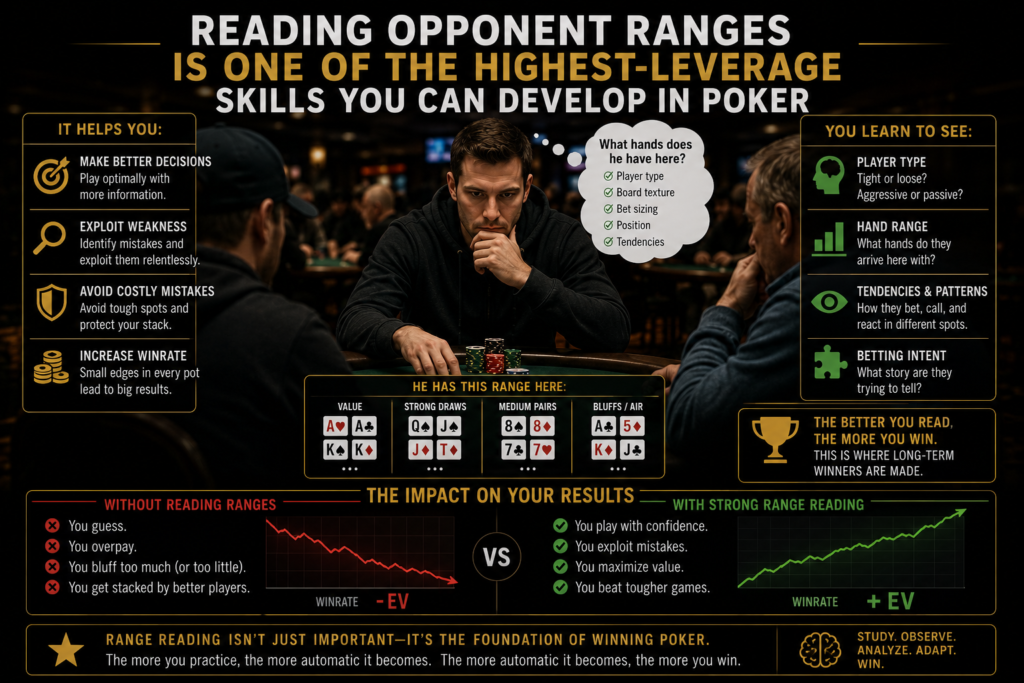
Reading opponent ranges is one of the highest-leverage skills you can develop in poker. It transforms your game from simply playing your own cards to actively playing against your opponents’ tendencies, thought processes, and mistakes.
Layer 2 of the Poker Decision Tree teaches you to move beyond vague “reads” and gut feelings. It gives you a structured, practical system for building and narrowing ranges, identifying player types, analyzing bet sizing, and combining that information with your Layer 1 hand evaluation.
Key Takeaways from Layer 2:
- Focus first on player type and observed tendencies — position is a modifier, not the main driver.
- In loose games, board texture becomes extremely important when narrowing ranges.
- Bet sizing is one of the richest sources of information available.
- The real edge comes from integrating Layer 1 and Layer 2 — knowing both what you have and what they likely have.
- No system is perfect. Always layer on real-time situational awareness (tilt, recent pots, emotional states, etc.).
Mastering Layer 2 takes consistent practice and observation. Start small — pick one or two players per session and focus on building their ranges. Over time, this skill will become faster, more intuitive, and significantly more profitable.
In the next article, we will move to Layer 3: The Situation & Context Layer, where we explore how position, stack sizes, pot odds, table dynamics, and other situational factors further shape your decisions.
The journey to elite poker thinking continues — one layer at a time.