
THE META/PERCEPTION LAYER
UNDERSTANDING POKER META STRATEGY
In the first three layers of the Poker Decision Tree, we focused on understanding reality. Layer 4 introduces poker meta strategy, a concept that examines how perception influences decision-making at the table.
Layer 1 asked the most fundamental question in poker: WHAT DO I HAVE?
At that level, the objective was to evaluate your hand strength, equity, playability, and overall value. Before any meaningful decision can be made, you must understand the hand you are holding and how it relates to the board.
Layer 2 shifted the focus outward: WHAT DO THEY HAVE?
This layer introduced opponent analysis, range construction, player tendencies, and hand reading. Rather than viewing poker as a game played in isolation, you learned to consider the likely holdings, motivations, and intentions of the players sitting across from you.
Layer 3 expanded the picture even further: WHAT IS HAPPENING?
Position, stack sizes, board texture, game structure, table dynamics, pot odds, implied odds, and other situational variables all combine to influence the correct decision. A hand cannot be evaluated properly without understanding the environment in which it is being played.
Together, these three layers create a powerful framework for decision-making. They help you understand your hand, your opponent, and the situation surrounding the hand.
However, there is another layer that many players never consciously consider.
WHAT DO THEY THINK IS HAPPENING?
This question introduces Layer 4: The Meta / Perception Layer.
Imagine that you have folded nearly every hand for the past hour. Eventually, you look down at pocket Aces and raise from under the gun. One opponent immediately gives you credit for a premium hand and folds. Another believes you are attempting to steal the blinds and decides to call. A third barely notices because they have been focused on a conversation, a television screen, or their own cards.
The same hand and the same action can produce completely different reactions because poker players do not respond to reality alone. They respond to their perception of reality.
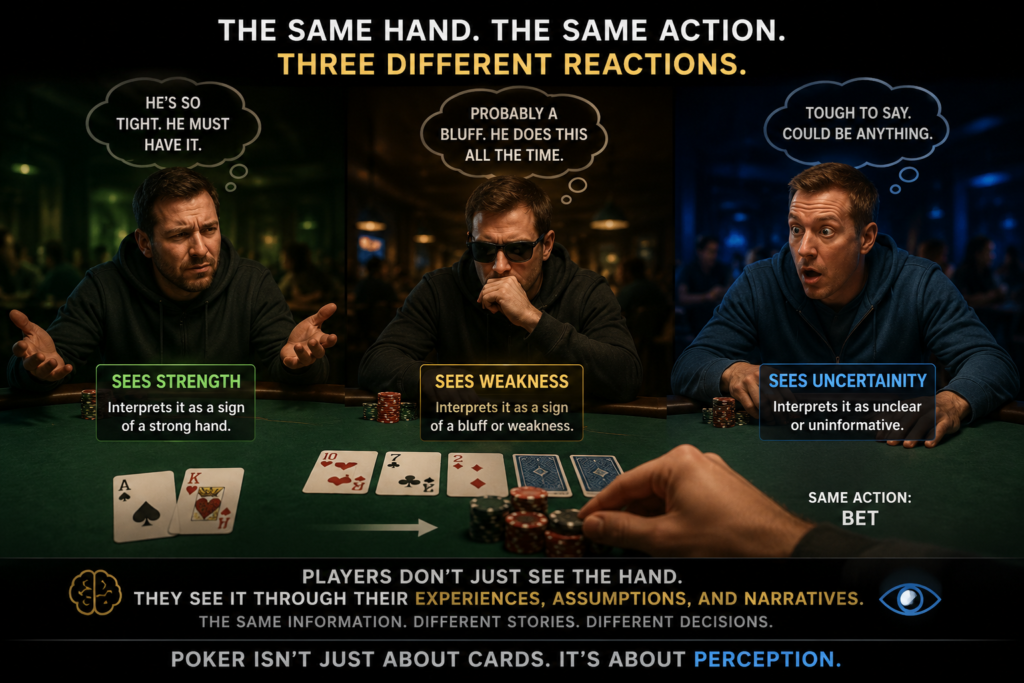
This distinction lies at the heart of poker meta strategy.
Every player at the table is constantly constructing a story about the game. They develop opinions about who is tight, who is loose, who bluffs too often, who never bluffs at all, who can be trusted, and who cannot. Some of those conclusions are accurate. Many are not. Nevertheless, those perceptions influence decisions just as powerfully as the cards themselves.
WHAT THE META/PERCEPTION LAYER ACTUALLY MEANS
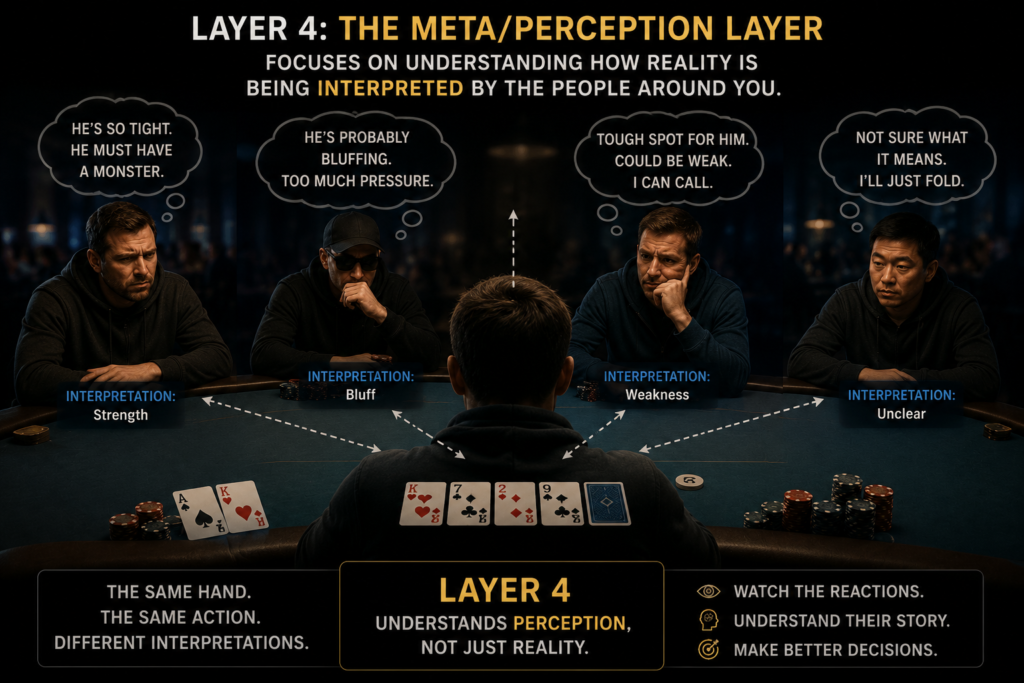
This is where Layer 4 differs from the first three layers. Layers 1 through 3 focus on understanding reality. Layer 4 focuses on understanding how reality is being interpreted by the people around you.
In this article, we will examine how poker meta strategy works, how table image develops, how perceptions are formed, and how those perceptions influence decisions at the table. Once you understand your hand, your opponent, and the situation, the next step is understanding how everyone else interprets all three.
Layer 4 of the Poker Decision Tree introduces players to one of the most important and often misunderstood aspects of advanced poker: poker meta strategy.
While the first three layers focus on evaluating objective information, Layer 4 focuses on how that information is interpreted by the people at the table. At this stage, the question is no longer limited to hand strength, opponent ranges, or situational factors. Instead, players must begin considering how their actions are being viewed by others and how those perceptions influence future decisions.
In practical terms, poker meta strategy is the study of how perception affects behavior.
Every player at the table is constantly gathering information. They observe who enters pots frequently, who folds repeatedly, who bluffs, who shows down strong hands, who appears emotional, and who remains disciplined under pressure. Over time, those observations become opinions, and those opinions begin influencing decisions.
The result is what most players refer to as table image.
DEFINING TABLE IMAGE
Your table image is the cumulative perception other players develop about your playing style, decision-making, emotional control, and overall approach to the game.
Importantly, your table image is not necessarily what you believe you are projecting. It is what your opponents believe they are observing.
A player may view themselves as selectively aggressive, while opponents perceive them as reckless. Another player may believe they are unpredictable, while the rest of the table sees them as straightforward and easy to read. In both cases, the perception held by the opponents is more important than the player’s self-assessment because those perceptions influence future actions.
Every player develops a table image whether they intend to or not. While players may influence how others perceive them, the final image ultimately exists in the minds of their opponents.
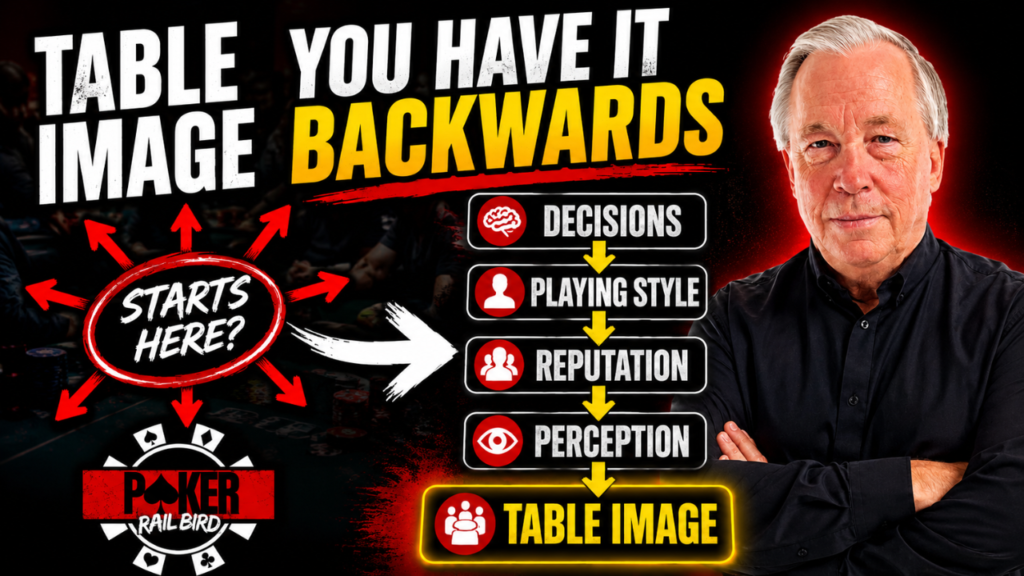
THE RELATIONSHIP BETWEEN PLAYING STYLE, REPUTATION, PERCEPTION, AND TABLE IMAGE
Many players use the terms playing style, reputation, perception, and table image interchangeably. While they are closely related, they are not the same thing.
Playing style refers to the observable patterns of behavior created by a player’s decisions.
Over time, those patterns contribute to a reputation.
Opponents then interpret that reputation through their own experiences, biases, and observations, creating individual perceptions.
Table image is the cumulative result of those perceptions.
In other words:
Decisions create playing style.
Playing style influences reputation.
Reputation shapes perception.
Perception ultimately produces table image.
Understanding these distinctions is an important part of poker meta strategy because players are not responding directly to reality. They are responding to their interpretation of reality.
For a more detailed examination of how playing style, reputation, perception, and table image interact, see:
Table Image and Player Style: Which Comes First?
That article explores the relationship between these concepts in greater depth and explains why table image is often the result of a process rather than the starting point.
FACTORS THAT INFLUENCE TABLE IMAGE
Table image is not created by a single hand or a single decision. Instead, it develops through the accumulation of observations over time.
Several factors contribute to how players are perceived.
HAND SELECTION
The hands you choose to play are often the first thing opponents notice. Players who enter very few pots are frequently viewed as tight and disciplined, while players who participate in a large number of hands are often perceived as loose and action-oriented.
FREQUENCY OF AGGRESSION
How often you raise, re-raise, continuation bet, bluff, or apply pressure contributes significantly to your image. Aggressive players are generally viewed differently than passive players, even when their overall results are similar.
SHOWDOWN HISTORY
Few things influence perception more than revealed cards.
A single memorable bluff can remain in an opponent’s mind for hours. Likewise, showing down several premium hands within a short period can create the impression that you always have a strong holding.
PHYSICAL DEMEANOR AND VERBAL BEHAVIOR
Live poker extends beyond the cards.
Your body language, emotional reactions, table talk, and overall presence contribute to how others interpret your actions. Calm, controlled behavior often creates a different impression than visible frustration or excessive conversation.
EMOTIONAL CONTROL
Players who remain composed after losing a large pot are often viewed differently than those who become visibly upset. Emotional stability influences credibility, confidence, and the willingness of opponents to challenge you.
CONSISTENCY
Perhaps the most overlooked factor is consistency.
When actions repeatedly align with previous behavior, opponents become increasingly confident in their reads. Consistent patterns help create stable perceptions, whether those perceptions are accurate or not.
SHORT-TERM IMAGE VERSUS LONG-TERM REPUTATION
An important distinction within poker meta strategy is the difference between image and reputation.
Table image is generally formed within the current session. It reflects what players have observed recently and how they currently view you.
Reputation extends beyond a single session.
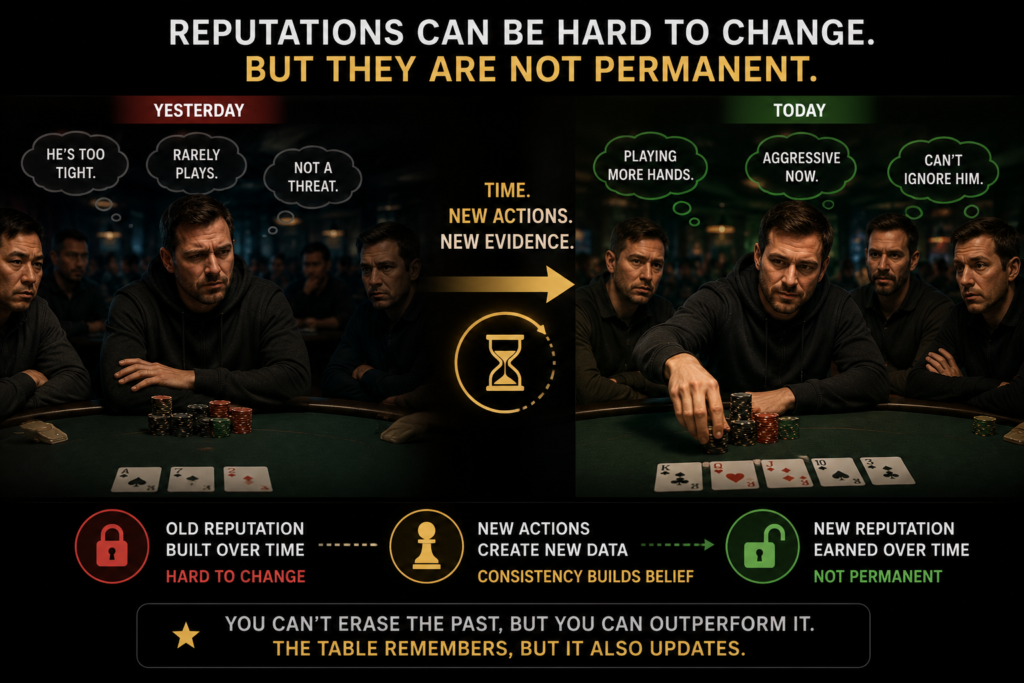
In regular games, opponents may arrive at the table with preconceived opinions based on previous encounters. Some players become known as rocks. Others become known as bluffers, gamblers, or difficult opponents. Once established, those reputations can influence decisions long before the first hand is dealt.
Although reputations can be difficult to change, they are rarely permanent. Every session provides new information, and perceptions continue to evolve over time.
LOOKING BEYOND THE FIRST THREE LAYERS
Many players never move beyond the first three layers of decision-making. They evaluate their hand, estimate an opponent’s range, assess the situation, and stop there.
The strongest players take one additional step.
They ask:
How is all of this being interpreted?
That question lies at the center of poker meta strategy.
A player’s decisions are influenced not only by the cards they hold, but also by the assumptions they make about the people around them. Those assumptions affect how they respond to bets, raises, bluffs, and value bets throughout a session.
Understanding those perceptions provides another source of information. It helps explain why different opponents often react differently to the same action and why identical situations can produce very different results.
For players willing to look beyond the cards themselves, the Meta Layer adds another dimension to the decision-making process and helps create a more complete understanding of the game.
HOW PERCEPTIONS ARE FORMED
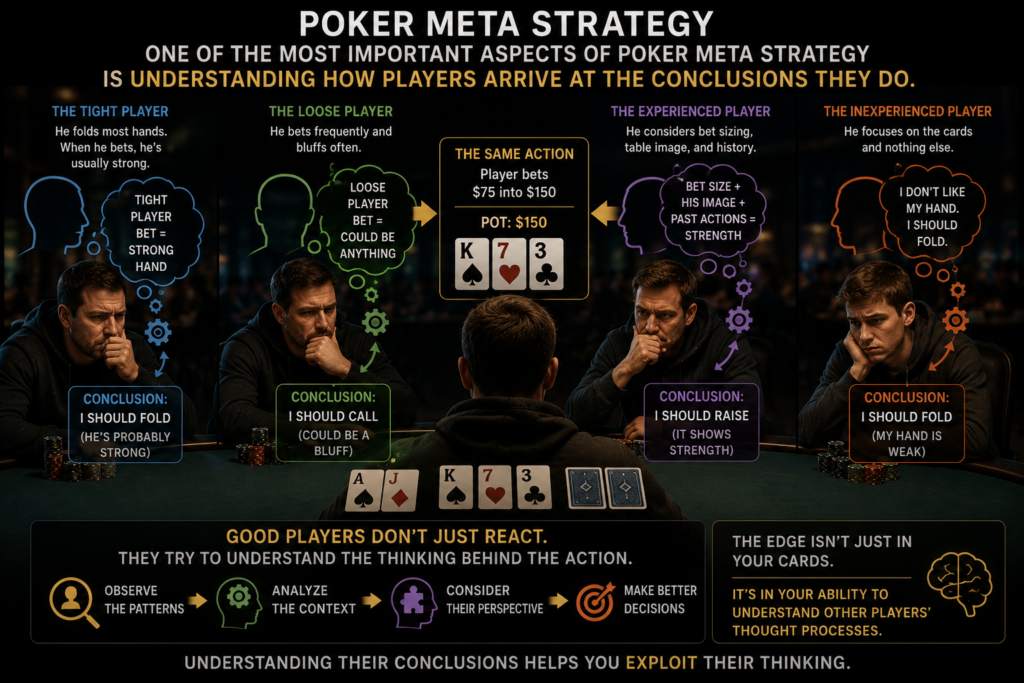
One of the most important aspects of poker meta strategy is understanding how players arrive at the conclusions they do.
Many players assume that opponents develop perceptions through careful observation and rational analysis. In reality, the process is often far less precise. Human beings are constantly filtering information, drawing conclusions, filling gaps, and constructing explanations for events they only partially understand. Poker players are no different.
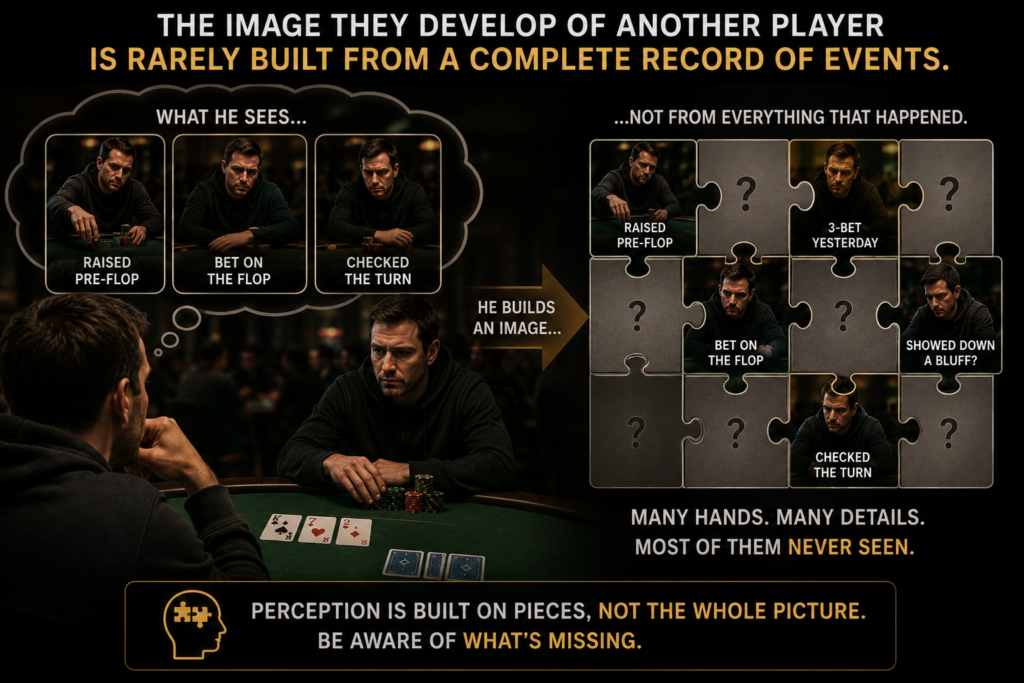
Every person at the table is attempting to make sense of an incomplete stream of information. They see some hands, miss others, remember certain events, forget many more, and interpret everything through the lens of their own experiences and biases. As a result, the image they develop of another player is rarely built from a complete record of events. More often, it is built from fragments.
Understanding how those fragments come together is an essential part of poker meta strategy because those perceptions ultimately influence future decisions.
OBSERVATION
All perceptions begin with observation.
Every action at the table provides information. The hands a player chooses to enter, the size of their raises, the frequency with which they continuation-bet, their reactions to pressure, and even their behavior between hands all contribute to the picture formed by others.
Observation alone, however, does not guarantee understanding.
Two players may witness the exact same action and arrive at very different conclusions. One player may interpret a check as a weakness, while another sees it as caution. One may view a raise as strength, while another sees it as simple aggression. The information itself remains unchanged, yet the meaning attached to it can vary significantly from one observer to another.
For this reason, poker meta-strategy is concerned not only with what players see but also with how they interpret it.
THE INFLUENCE OF SHOWDOWNS
Few events shape perception more powerfully than a revealed hand.
Most hands in poker end without complete information. Bets are made, decisions are taken, and the cards disappear into the muck. Showdowns are different because they provide certainty. Opponents finally see the hand responsible for the action.
The problem is that players often place too much weight on those moments.
A single bluff shown at showdown may leave a stronger impression than several hours of disciplined play. Likewise, a player who happens to reveal two premium hands within a short period may be viewed as extraordinarily tight, even if their overall strategy is far more balanced.
Because showdowns provide rare moments of clarity, they often become reference points that influence future decisions long after the hand itself has been forgotten.
RECENCY BIAS
Human beings naturally give greater importance to recent events.
Poker players frequently remember what happened ten minutes ago more vividly than what happened two hours earlier. A large bluff, an emotional confrontation, or a dramatic showdown can quickly become the defining memory of an entire session.
A player who has been disciplined for most of the evening may suddenly be viewed as reckless because of one memorable bluff. Conversely, a player who has shown down several strong holdings in succession may gain a level of credibility that exceeds what their overall play actually warrants.
Recent events matter, but they rarely tell the entire story.
Strong players recognize that many opponents place disproportionate emphasis on what they have seen most recently and adjust their expectations accordingly.
REPUTATION AND PREVIOUS HISTORY
Perceptions do not always begin when a session begins.
In games where players encounter one another regularly, prior experience often serves as the foundation for new observations.
A player known for excessive aggression may find that opponents continue to view them that way long after their strategy has changed. Likewise, a player with a reputation for patience and discipline may receive credit for strong hands even during periods when they are actively expanding their range.
Reputations can be remarkably persistent because people tend to interpret new information in ways that reinforce existing beliefs. Once an opinion has been formed, many players unconsciously search for evidence that confirms it while overlooking evidence that challenges it.
As a result, reputation often influences perception long before the first hand is dealt.
EMOTIONAL BIAS
Not every opinion formed at the poker table is the result of objective observation.
Emotions frequently shape the way information is interpreted.
A player who has been bluffed may begin to see bluffs everywhere. Another who has lost several large pots to the same opponent may become convinced that the opponent is unusually aggressive, difficult to read, or somehow impossible to beat. Personal frustrations, previous confrontations, and emotional reactions can all distort perception.
These distortions are rarely intentional. They occur because emotions influence attention, memory, and judgment. The result is that two players can witness the same events yet draw entirely different conclusions about what they mean.
SELECTIVE MEMORY
Perhaps the most fascinating aspect of perception is that players rarely remember everything they observe.
Instead, they remember the events that stand out.
A dramatic bluff is remembered. A routine fold is forgotten.
A large confrontation is remembered. Twenty ordinary hands are ignored.
A player who talks constantly may be remembered. A quiet, disciplined player may fade into the background.
Over time, these memorable moments begin to dominate the narrative players construct about one another. The result is a perception that may be based on only a small percentage of the information that was actually available.
Each opponent is therefore working from a different collection of memories, observations, and experiences.
THE REAL OBJECTIVE OF POKER META STRATEGY
The goal of poker meta strategy is not to control what every opponent thinks. Such a goal would be unrealistic.
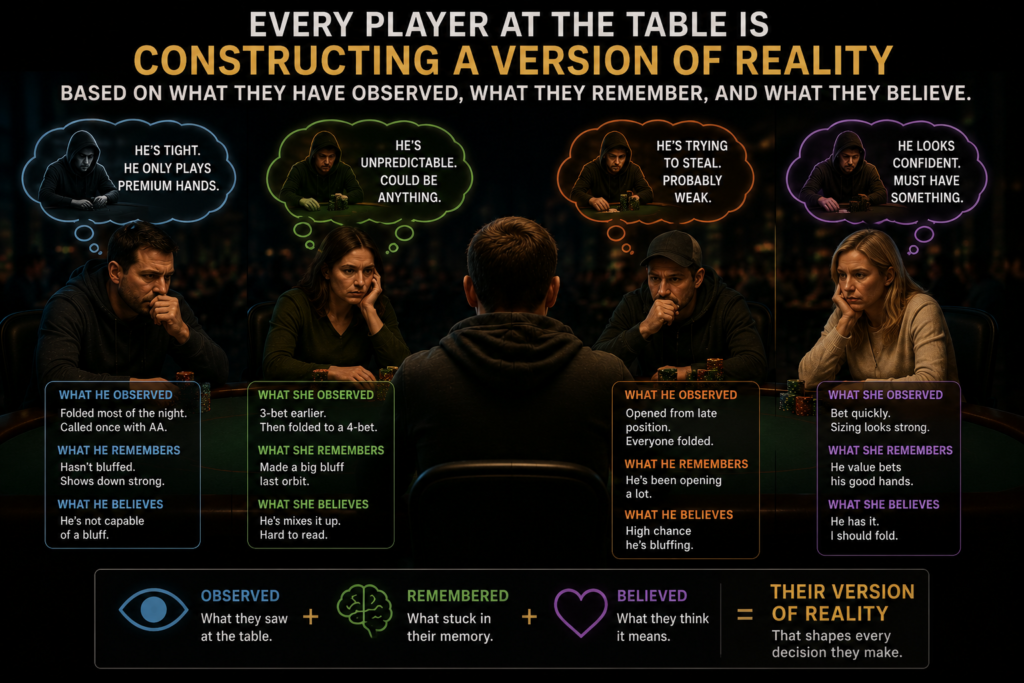
The objective is to recognize that perceptions are continually formed and influence decision-making. Every player at the table is constructing a version of reality based on what they have observed, what they remember, and what they believe.
Some of those conclusions will be accurate.
Many will not.
The strongest players understand that those perceptions exist regardless. Rather than ignoring them, they seek to understand how they are being formed and how they influence the actions of the people sitting across the table.
That understanding provides a deeper appreciation of why opponents respond as they do and lays the foundation for applying poker meta-strategy effectively.
COMMON MISTAKES IN THE META LAYER
One of the reasons poker meta strategy is often misunderstood is that it deals with interpretation rather than certainty.
Hand strength can be evaluated. Pot odds can be calculated. Position, stack sizes, and board texture can be observed directly. The Meta Layer operates differently because it concerns itself with how players interpret those facts and how those interpretations influence future decisions.
As a result, many mistakes within this layer stem from faulty assumptions about what opponents know, what they remember, and how they process information.
ASSUMING EVERYONE SEES YOU THE SAME WAY
Perhaps the most common mistake is believing that a single table image exists.
Many players speak of having a tight image, a loose image, or an aggressive image as though every opponent at the table shares the same opinion. In reality, perceptions are rarely that uniform.
An observant regular who has watched every hand for three hours is likely working with far more information than a recreational player who sat down ten minutes ago. Another opponent may base their entire opinion of you on a single memorable showdown.
For this reason, effective poker meta strategy focuses less on asking: “What is my image?” and more on asking: “How does this particular opponent perceive me?”
The answer often varies from player to player.
OVERESTIMATING HOW MUCH ATTENTION PEOPLE ARE PAYING
Many players assume that opponents are observing far more than they actually are.
At some tables this assumption may be justified. At others, many players are focused primarily on their own cards, recent results, conversations, or distractions away from the game.
Observation exists on a spectrum. Some opponents notice nearly everything. Others notice almost nothing.
Before assigning significant value to your image, it is worth asking whether the opponent you are trying to influence is paying attention in the first place.
ALLOWING ONE EVEN TO DEFINE THE ENTIRE SESSION
Another common mistake is placing too much emphasis on a single hand.
A failed bluff, a hero call, or a dramatic showdown can certainly influence perception. However, many players assume one memorable event permanently changes the way they are viewed.
In practice, perceptions are far more fluid.
New information is constantly being added. Players leave the game. New players arrive. Attention shifts. Additional hands are played.
Strong players understand that perceptions evolve throughout a session and rarely hinge on a single event alone.
IGNORING THE ROLE OF PERSONAL BIAS
Not every opponent interprets information objectively.
Some players are naturally suspicious and see bluffs everywhere. Others give excessive credit to aggression. Some remember every showdown. Others focus only on hands in which they were personally involved.
These biases influence how information is processed and often explain why identical actions produce different reactions from different opponents.
Understanding these tendencies is an important part of poker meta strategy because it helps explain why opponents frequently respond to the same situation in very different ways.
CONFUSING PERCEPTION WITH REALITY
Another mistake occurs when players begin treating assumptions as facts.
A player may believe they possess a tight image and assume opponents will fold accordingly. Another may believe they are viewed as aggressive and expect to receive action from weaker holdings.
The problem is that these conclusions often exist only in the player’s own mind.
Perceptions exist inside the minds of opponents. They are estimates, not certainties.
Successful players remain aware of this distinction and continue evaluating decisions through observation, evidence, and probability rather than assumptions.
USING IMAGE TO JUSTIFY BAD DECISIONS
Perhaps the most expensive mistake occurs when players begin making strategically unsound decisions in an effort to influence how they are perceived.
A player who has folded for an extended period may enter a marginal hand because they are concerned about appearing too tight. Another may launch a questionable bluff because they believe their image guarantees success. A third may continue with a weak holding because they want to prove they are capable of making a stand.
In each case, perception has begun driving the decision rather than informing it. This reverses the proper relationship between strategy and image.
The foundation of every profitable decision remains the same. Hand strength, opponent tendencies, position, stack sizes, pot odds, board texture, and situational factors must always come first.
Poker meta strategy should refine decisions that are already supported by sound analysis. It should never become the sole reason for making them.
Recognizing that distinction prevents one of the most common and costly mistakes in the Meta Layer.
HOW TO PROPERLY THINK IN LAYER 4
Understanding poker meta strategy is one thing. Applying it during a live session is something else entirely.
Many players recognize that table image exists, yet struggle to use that knowledge effectively. Some become overly focused on perception and begin seeing it everywhere. Others dismiss it completely and focus only on the cards. Neither approach is ideal.
The strongest players view the Meta Layer as an additional source of information. They neither become obsessed with perception nor ignore it. Instead, they incorporate it into the broader decision-making framework established by the first three layers of the Poker Decision Tree.
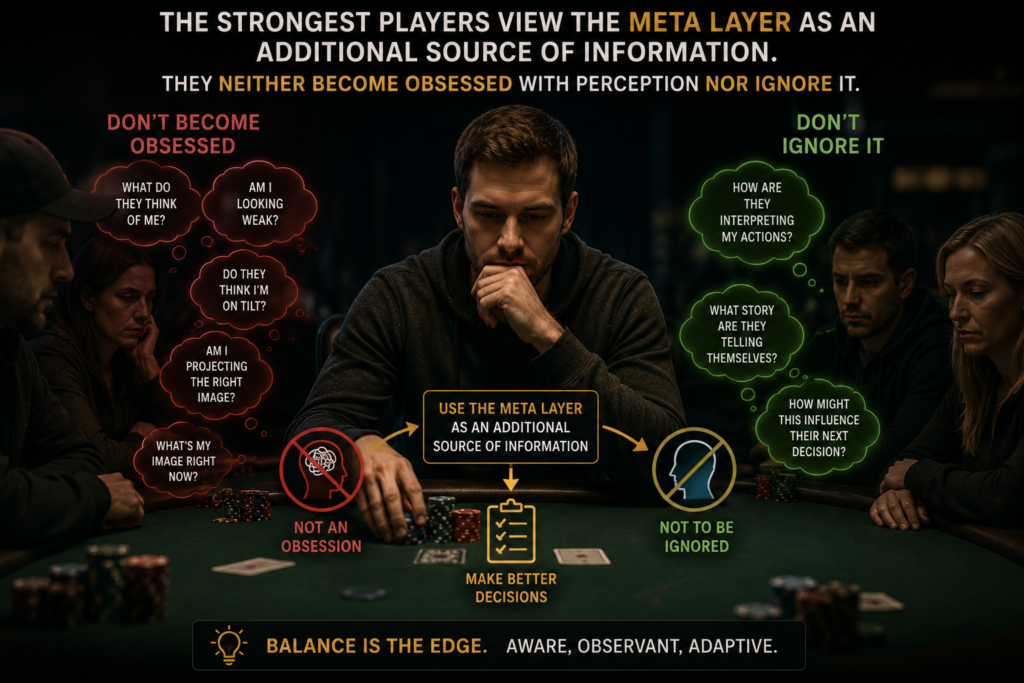
The objective is not to control what every opponent thinks.
The objective is to develop the most accurate understanding possible of how specific opponents are likely interpreting the information available to them.
STEP 1: DETERMINE WHAT YOUR OPPONENT KNOWS
Before evaluating how an opponent perceives you, determine what information they actually possess.
An opponent who has been sitting at your table for six hours has observed far more than someone who arrived ten minutes ago. Likewise, an attentive regular is likely working with a different body of information than a recreational player who only pays attention when involved in a hand.
Questions worth considering include:
- How long has this player been at the table?
- Have they seen any of my showdowns?
- Have they witnessed any significant bluffs?
- Have they observed me folding repeatedly?
- How attentive have they been throughout the session?
A player cannot form opinions from information they have never seen.
STEP 2: DETERMINE HOW THEY LIKELY VIEW YOU
Once you understand what an opponent knows, the next step is to evaluate how they are likely to interpret that information.
Two opponents can witness the same session and arrive at entirely different conclusions. One may view a long stretch of folding as a matter of discipline and patience. Another may interpret the same behavior as excessive caution.
For this reason, successful players stop thinking about image as a single, universal concept.
The more useful question is not: “What is my image?”
The more useful question is: “How does this particular opponent view me?”
That distinction often leads to a much more accurate assessment of the situation.
STEP 3: LOOK FOR GAPS BETWEEN PERCEPTION AND REALITY
Many profitable opportunities occur when an opponent’s perception differs from reality.
A player who has seen you show down several premium hands may begin assigning excessive strength to your actions. Another who remembers a failed bluff may believe you are more aggressive than you actually are.
Whether those assumptions are accurate is less important than the fact that they may influence future decisions.
Strong practitioners of poker meta strategy constantly look for these gaps because they often reveal opportunities that less observant players miss.
STEP 4: USE PERCEPTION AS ADDITIONAL INFORMATION
One of the most important principles of the Meta Layer is understanding where perception belongs within the decision-making process.
Perception is information. It is not a substitute for information.
A favorable image does not eliminate the need to evaluate hand strength. A strong reputation does not override pot odds. Opponent perception does not replace range analysis, positional awareness, stack depth, or board texture.
Instead, perception functions as another variable to consider after the first three layers have been evaluated.
When viewed properly, poker meta strategy refines decisions rather than creating them.
STEP 5: CONTINUOUSLY REASSESS
One of the biggest mistakes players make is treating perception as though it remains fixed throughout a session. In reality, perceptions evolve continuously.
Every showdown, every significant pot, every bluff, every emotional reaction, and every unusual decision provides new information. Players leave the game. New players arrive. Attention levels change.
As a result, perceptions that existed two hours ago may no longer exist. Strong players recognize these changes and adjust accordingly.
THE GOAL OF LAYER 4

The purpose of Layer 4 is not to manipulate every opponent at the table or construct elaborate psychological traps. Its purpose is much simpler.
By understanding how perception influences decision-making, you gain access to information that many opponents overlook entirely.
Most players focus exclusively on the cards. Stronger players focus on the cards and the people. The strongest players focus on both while also considering how those people are interpreting everything they see.
That additional level of awareness is where poker meta strategy begins to create a meaningful advantage.
USING IMAGE WITHOUT BECOMING CONTROLLED BY IT
One of the greatest dangers associated with poker meta strategy is allowing perception to become more important than the underlying fundamentals of the game.
Once players begin thinking about table image, it is easy to become overly focused on how others see them. Some become determined to appear aggressive. Others try to avoid looking weak. Still others become obsessed with creating an image they believe will generate future opportunities.
While these goals may seem reasonable, they can quickly lead players away from sound decision-making.
The purpose of Layer 4 is not to replace the first three layers of the Poker Decision Tree. Its purpose is to complement them.
Hand strength, opponent tendencies, position, stack sizes, board texture, pot odds, implied odds, and situational context remain the foundation of every profitable decision. Poker meta strategy provides an additional source of information, but it should never become the primary reason for entering a pot, calling a bet, or launching a bluff.
WHEN PERCEPTION STARTS DRIVING DECISIONS
A common mistake occurs when players begin making mathematically questionable decisions solely to influence how they are perceived.
A player who has folded for an extended period may decide to enter a marginal hand because they are concerned about appearing too tight. Another may attempt an unnecessary bluff because they believe their image guarantees success. A third may continue with a weak holding because they are determined to prove that they are capable of making a stand.
In each case, perception has begun driving the decision rather than informing it. This reverses the proper relationship between strategy and image.
IMAGE CAN ENHANCE A GOOD DECISION: NOT CREATE ONE
The strongest players understand that a favorable image can enhance a good decision, but it cannot transform a bad decision into a profitable one.
A player holding a mathematically inferior hand does not suddenly gain an advantage because opponents view them as disciplined. Likewise, a weak bluff does not become strong simply because a player has established credibility over the course of a session.
The underlying mathematics remain unchanged.
Poker meta strategy works best when it operates as a supporting factor rather than a primary motivation.
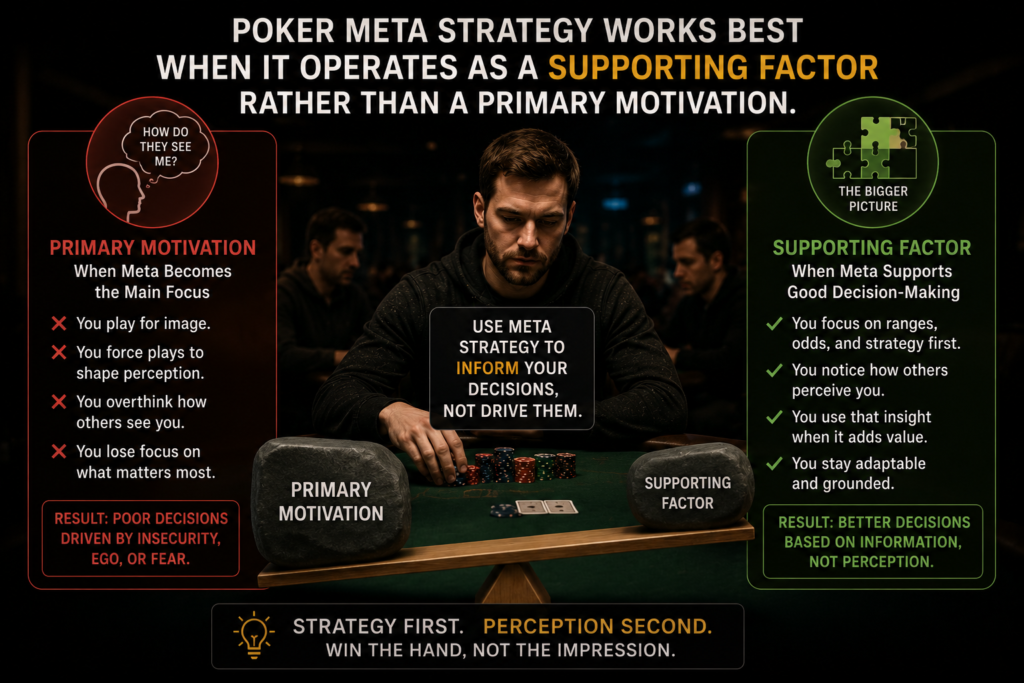
Consider a player who has folded consistently for more than an hour and is now holding a legitimate bluffing candidate in a favorable situation. Their image may increase the likelihood that opponents fold. In that case, perception strengthens a decision that was already supported by the first three layers of analysis.
Now consider the opposite situation.
The same player decides to bluff despite poor board texture, unfavorable ranges, and weak fold equity simply because they believe their tight image will carry the hand.
In this case, image is being used to justify a decision that should never have been made in the first place. The distinction is subtle but important.
Successful players do not ask: “How can I use my image to force action?” Instead, they ask: “How does my image influence the decision that already appears correct?”
THE COST OF MANUFACTURING AN IMAGE
This principle extends beyond bluffing.
Players sometimes attempt to create action by playing weaker starting hands, entering marginal situations, or deviating from otherwise profitable strategies in order to appear unpredictable. While such adjustments may occasionally succeed in changing how opponents perceive them, they often come at a cost that exceeds any potential benefit.
Image should never be purchased with negative expected value. Strong players allow profitable decisions to shape their image. Weak players often sacrifice profitable decisions in an attempt to shape it.
There is a significant difference between allowing a profitable strategy to shape your image and sacrificing profitability in an effort to manufacture one.
The first approach strengthens long-term results. The second often undermines them.
INTEGRATING LAYERS 1 THROUGH 4
The true power of the Poker Decision Tree emerges when all four layers are considered together.
Viewed independently, each layer provides useful information. Layer 1 evaluates your hand. The second layer evaluates your opponent. Layer 3 examines the situation. Layer 4 considers how those realities are being interpreted by the people involved.
The goal is not to replace one layer with another. The goal is to build a complete picture before making a decision.
A PRACTICAL EXAMPLE
Imagine you are playing in a $1/$3 No-Limit Hold’em cash game.
The session has been underway for several hours. During the past ninety minutes, you have played very few hands and have shown down only premium holdings. Several regulars at the table have likely noticed.
You look down at A♠ K♠ under the gun and raise to $20.
A loose-passive player on the button calls.
The flop comes:
K♦ 8♣ 4♠
The pot contains approximately $45.
At first glance, this appears to be a straightforward situation. However, when viewed through the first four layers of the Poker Decision Tree, the decision becomes more nuanced.
LAYER 1: WHAT DO I HAVE?
You hold top pair with top kicker.
This is a strong hand and is likely ahead of a significant portion of your opponent’s range. While it is not an unbeatable holding, it is certainly strong enough to value bet.
Layer 1 establishes the baseline strength of your hand.
LAYER 2: WHAT DO THEY HAVE?
The player on the button is known to be loose and passive. Throughout the session they have entered numerous pots and shown a willingness to call with a wide variety of holdings.
Their range may include:
- Weaker kings
- Pocket pairs
- Middle pair combinations
- Straight draws
- Backdoor draws
- Various speculative holdings
Against a range of this nature, your hand is likely ahead and capable of extracting value.
LAYER 3: WHAT IS HAPPENING?
The board is relatively dry. Stacks are deep enough to support multiple streets of betting.
You are out of position, but the flop favors the range of the preflop raiser.
Taken together, these factors support a value-oriented approach. Nothing about the situation suggests a need for unusual action.
WHAT IS PERCEIVED TO BE HAPPENING?
This is where poker meta strategy enters the picture.
Your opponent is not evaluating this hand in isolation.
They have spent the past ninety minutes watching you fold repeatedly and show down premium holdings. As a result, they may assign additional credibility to your actions.
When you continuation bet this flop, the loose-passive player is not simply evaluating the board. They are also evaluating the person making the bet.
A player who believes you only enter pots with strong holdings may fold hands that would otherwise continue. Another may become cautious with a marginal king. A third opponent may decide that challenging you without a strong holding is unnecessary.
The hand itself has not changed. The situation has not changed. What may change is how your opponent responds to those facts.
PUTTING THE LAYERS TOGETHER
Each layer contributes a different piece of information.
Layer 1 evaluates the strength of your hand.
While Layer 2 evaluates the likely holdings of your opponent.
Layer 3 evaluates the circumstances surrounding the hand.
Layer 4 evaluates how those circumstances are being interpreted.
None of these layers operate independently. The strongest decisions occur when all four are considered together.
Many players stop after evaluating the cards. Stronger players evaluate the cards and their opponents.
The strongest players evaluate both while also considering how opponents are likely interpreting everything they have observed throughout the session.
That additional level of awareness is where poker meta strategy begins creating practical value at the table.
CONCLUSION: MASTERING POKER META STRATEGY
The first three layers of the Poker Decision Tree focus on understanding the objective realities of a poker hand. They teach you how to evaluate your cards, analyze your opponents, and assess the situational factors surrounding every decision.
Layer 4 introduces a different question:
How is all of this being interpreted?
This question lies at the heart of poker meta strategy.
Every player at the table is constantly forming opinions about the people around them. Those opinions are shaped by observation, showdowns, previous experiences, emotional biases, selective memory, and countless other influences. Some of those perceptions are accurate. Many are not. Nevertheless, they influence decisions just as surely as the cards themselves.
Understanding this process provides another source of information. It helps explain why identical actions can produce different reactions from different opponents and why the same strategy may succeed against one player while failing against another.
More importantly, it reminds us that poker is not played in a vacuum. Every decision occurs within a larger environment shaped by both reality and interpretation.
KEY TAKEAWAYS FROM LAYER 4
- Poker meta strategy focuses on how players interpret information, not just the information itself.
- Different opponents often develop different perceptions of the same player.
- Table image is only one component of the broader Meta / Perception Layer.
- Table image is not something players fully control. It is the result of how individual opponents interpret the information available to them.
- Reputation, previous history, emotional bias, recency bias, and selective memory all influence decision-making.
- Perception should enhance sound decisions, not replace them.
- The strongest players evaluate not only what is happening, but also how other players are likely interpreting what they see.
When Layers 1 through 4 are combined, your understanding of the game becomes significantly more complete. Rather than focusing exclusively on cards and chips, you begin recognizing the additional layer of interpretation that surrounds every decision.
LOOKING AHEAD TO LAYER 5
The first four layers of the Poker Decision Tree have focused primarily on the external world.
You have learned how to evaluate your hand, analyze your opponents, assess the situation, and understand the perceptions that influence decision-making.
Layer 5 turns inward.
In the next article, we will examine The Self / Mental Layer and explore how discipline, emotional control, confidence, fear, self-awareness, tilt, and personal bias influence poker decisions. After all, even the most accurate understanding of hands, opponents, situations, and perceptions can be undermined by poor mental game management.
The journey through the Poker Decision Tree continues, one layer at a time.