
TABLE IMAGE AND PLAYER STYLE
WHICH COMES FIRST?
Most discussions about table image in poker begin in the wrong place. They focus on how other players perceive us, how we are viewed at the table, or how we can supposedly create a particular image. Before discussing any of those concepts, however, we must first understand something far more fundamental: playing style.
A player’s style is simply the collection of decisions and behaviors they repeatedly exhibit at the poker table. It is not what they claim to be. It is not what they want others to believe; it is what they actually do.
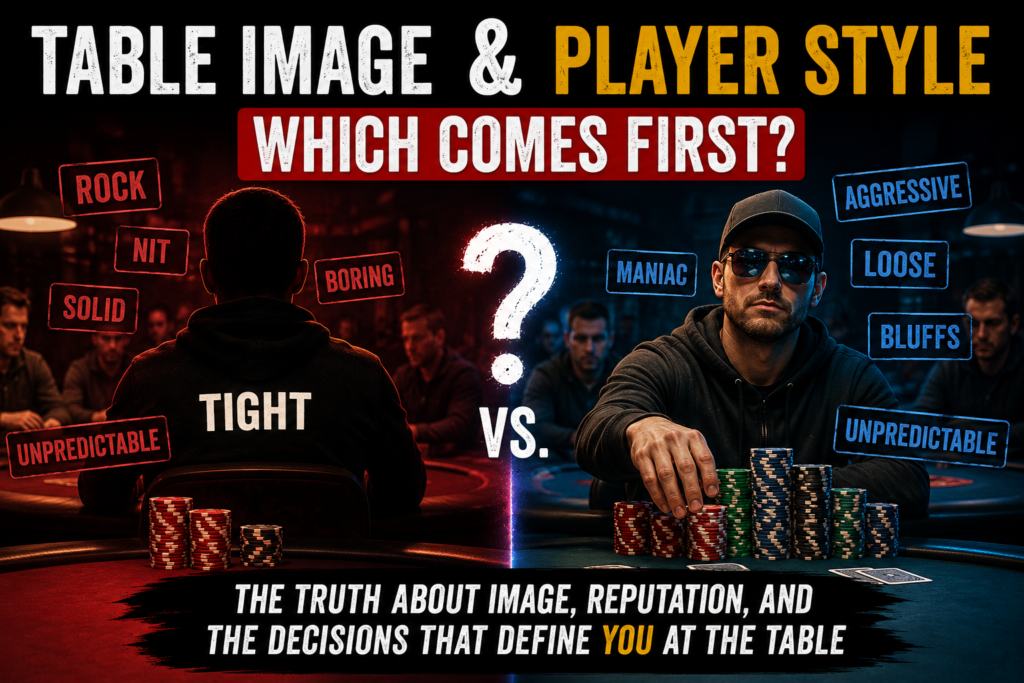
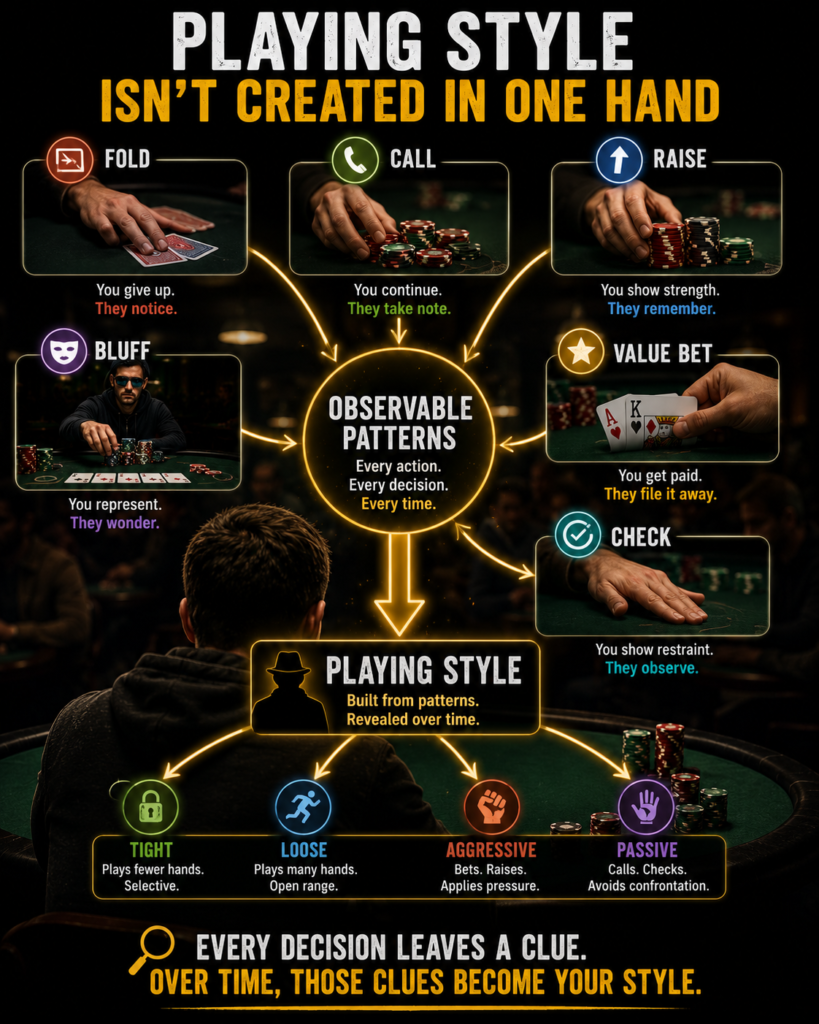
Every time you choose whether to fold, call, raise, bluff, value bet, check, or apply pressure, you are revealing elements of your playing style. Over time, those decisions form recognizable patterns. Those patterns become your style.
THE BUILDING BLOCKS OF PLAYING STYLE

At the most basic level, poker players are often categorized into four broad styles:
These categories are useful because they describe observable behavior. A tight player enters relatively few pots. A loose player enters many. An aggressive player prefers betting and raising. A passive player tends to call more often than they bet or raise.
Of course, real players rarely fit perfectly into a single category. Most exist somewhere along a spectrum. A player may be generally tight but become more aggressive in position. Another may appear loose before the flop but play cautiously after the flop. Even so, these classifications provide a useful framework for understanding how players approach the game.
Playing style extends beyond starting-hand selection and aggression frequency. It also includes factors such as risk tolerance, willingness to bluff, reaction to pressure, bet-sizing tendencies, positional awareness, and overall strategic approach. Some players consistently seek thin edges and small advantages. Others prefer lower-risk situations and wait patiently for premium opportunities. These repeated tendencies become part of their style.
The important point is that playing style is rooted in action. It is based on what a player actually does, not what anyone thinks about them. If a player enters very few pots, folds frequently, and shows down strong hands, that is their style regardless of whether others notice it. If another player constantly raises, bluffs, and applies pressure, that behavior defines their style whether the table approves of it or not.
In other words, playing style represents reality. It is the objective evidence created by a player’s decisions over time. Everything else we discuss in this article ultimately begins here.
WHAT IS REPUTATION?
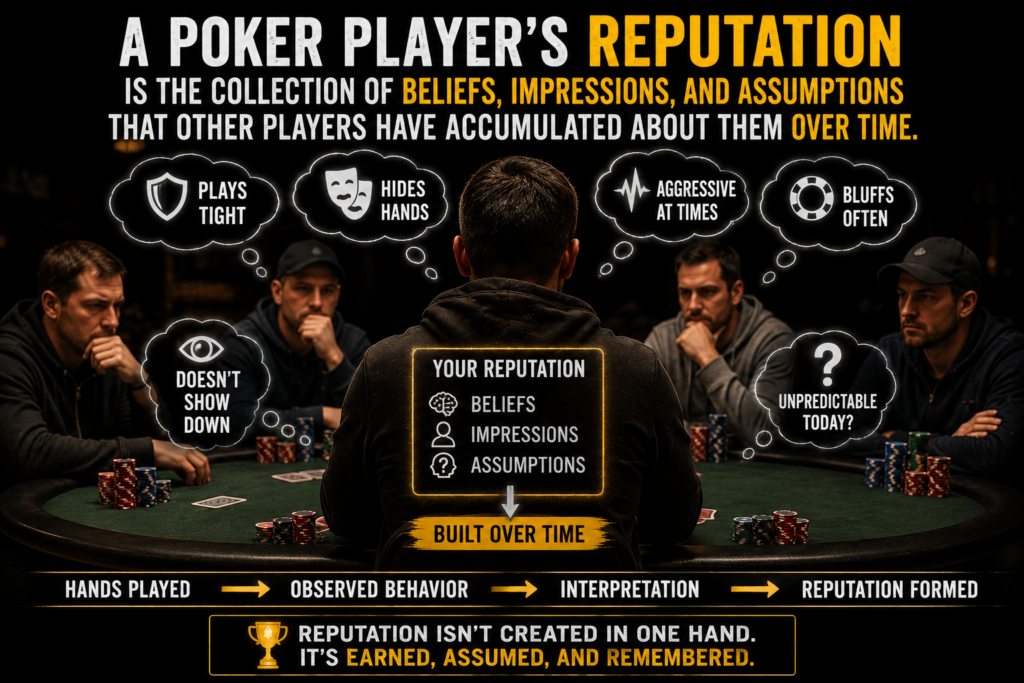
If playing style represents reality, reputation represents history.
A poker player’s reputation is the collection of beliefs, impressions, and assumptions that other players have accumulated about them over time. Unlike playing style, which is based on what a player is doing right now, reputation is based on what other players remember them doing in the past.
Every hand you show down, every bluff you reveal, every story told about you, and every session another player observes contributes to your reputation. Over weeks, months, and even years, these observations begin to form a narrative. Players start attaching labels such as “tight,” “aggressive,” “reckless,” “fearless,” or “solid.” Whether those labels remain accurate is another matter entirely.
HOW REPUTATIONS ARE BUILT
Reputations are often built from repeated observations. A player who consistently shows down strong hands may develop a reputation for being extremely tight. Another who frequently bluffs or applies pressure may become known as a maniac. In many cases, these reputations are earned because they accurately reflect a player’s long-term tendencies.
WHEN REPUTATION OUTLIVES REALITY
The problem is that reputations often outlive reality.
Consider a player who spent years playing loose and aggressive poker. After studying the game and improving their discipline, they may gradually transform into a fundamentally different player. Yet opponents who remember their earlier style may continue viewing them through the lens of that old reputation. Likewise, a player who was once extremely tight may loosen their game considerably, while other players continue assuming they only enter pots with premium holdings.
This is one reason reputations can be both valuable and dangerous. They help players make quick judgments, but those judgments are often based on incomplete or outdated information.
In live poker, reputation can become even more powerful because information spreads beyond a single table. Regular players talk. Dealers remember hands. Stories circulate through poker rooms. A player may arrive at a table carrying a reputation that was established long before the current session began.
The important distinction is that reputation is not the same thing as playing style. Playing style reflects what a player is actually doing. Reputation reflects what others believe they know about that player based on past observations. Sometimes the two align perfectly. Sometimes they are separated by months, years, or even significant changes in a player’s approach to the game.
For that reason, reputation should be viewed as historical information rather than current reality. It may be accurate. It may be partially accurate. Or it may be completely outdated. But whether it is right or wrong, reputation plays an important role in shaping how other players approach you at the table.
WHAT IS TABLE IMAGE
Most discussions about table image in poker assume that image is something a player consciously creates. Players are often told to cultivate a loose image, project strength, appear unpredictable, or establish a particular reputation at the table. While these ideas are common in poker literature, they often blur the distinction between what a player actually does and how other players view them.
Table image is not what you are.
It is not what you think you are.
It is not even what you want others to believe you are.
Table image is what your opponents currently believe about you.
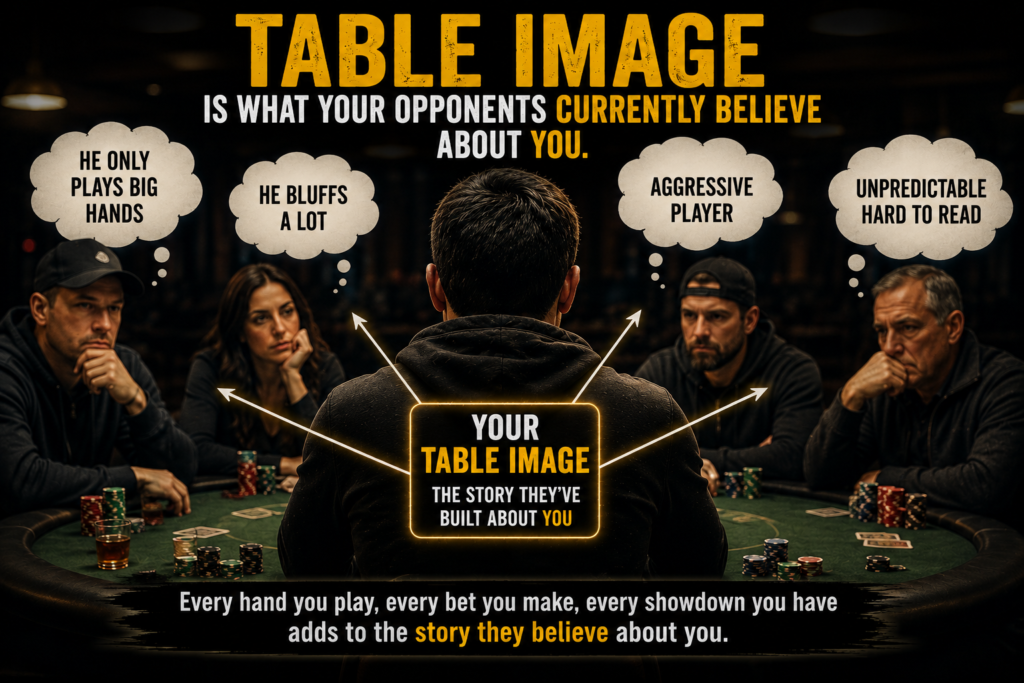
This distinction is important because table image in poker exists entirely in the minds of other players. Unlike playing style, which is based on a player’s actual decisions, or reputation, which is built from past observations, table image reflects the beliefs opponents hold at a particular moment in time.
IMAGE IS A CURRENT SNAPSHOT
One way to think about a table image in poker is as a snapshot rather than a permanent label.
A player’s style may remain relatively consistent over months or years. A reputation may follow a player for an entire poker career. Table image, however, can change much more quickly.
A single showdown, a successful bluff, an unexpected hero call, or a large pot can alter how opponents view a player. As new information becomes available, players continually update their opinions about one another.
Because of this, table image is often fluid rather than fixed. It evolves as the session unfolds and as opponents gather additional information.
The important point is that table image is not a player’s identity. It is simply the current belief opponents hold about that player. Sometimes those beliefs are accurate. Sometimes they are not. Regardless, those beliefs influence the decisions opponents make at the table.
Understanding what table image is represents an important first step. Understanding how those images are formed is where things become far more interesting.
THE MISSING PIECE: PERCEPTION
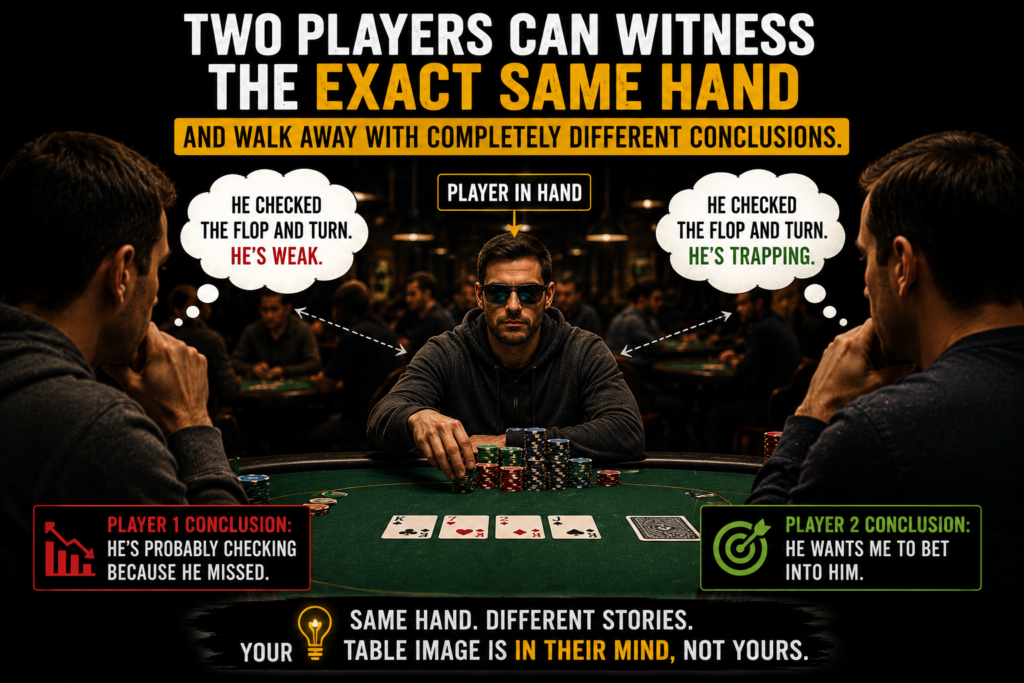
Poker players often assume that everyone at the table is seeing the same game. In reality, that is rarely the case.
While players may observe many of the same hands, betting patterns, and showdowns, they do not always interpret those events in the same way. The process through which players assign meaning to what they observe is known as perception.
This distinction is important because poker is not simply a game of observation. It is a game of interpretation.
Two players can witness the exact same hand and walk away with completely different conclusions.
WHY TWO PLAYERS CAN REACH DIFFERENT CONCLUSIONS
Imagine a player who has been relatively quiet for several hours. Then, within the span of thirty minutes, they raise three pots and win each one.
One opponent may conclude:
“This player is getting out of line and becoming overly aggressive.”
Another may conclude:
“He’s still playing tight. He’s simply picking good spots.”
A third player may not notice the pattern at all.
The facts are identical. The conclusions are not.
This happens because every player brings a unique set of experiences, assumptions, expectations, and attention levels to the table. Some players focus heavily on betting patterns. Others pay more attention to physical tells. Some remember every showdown. Others struggle to recall the previous orbit.
As a result, different players often build very different impressions from the same body of evidence.
THE POWER OF SELECTIVE PERCEPTION
Psychologists have long understood that people tend to notice information that supports their existing beliefs while overlooking information that contradicts them. This tendency is often referred to as selective perception or confirmation bias.
Poker players are no different.
If a player is already viewed as reckless, opponents may pay close attention to every bluff they show down while largely ignoring the strong hands they reveal. Conversely, a player known for being tight may receive far more credit for holding premium hands, even when they are actively bluffing.
In many cases, players do not simply evaluate new information objectively. Instead, they unconsciously filter that information through beliefs they already hold.
This can cause old assumptions to persist long after the underlying reality has changed.
WHY PERCEPTION MATTERS
Many players believe they can control how others view them by taking specific actions at the table. While those actions certainly provide information, they do not determine how that information will be interpreted.
A shown bluff may convince one opponent that you are reckless. Another may view it as evidence of creativity and balance. A third may dismiss it as an isolated hand that means very little.
The action itself remains unchanged. What changes is the meaning assigned to it.
Understanding perception helps explain why players often struggle to manage how they are viewed at the table. It also helps explain why two opponents can hold completely different opinions about the same player despite having witnessed many of the same events.
Before we can determine whether playing style creates table image, or table image creates playing style—we must first understand that every piece of information passes through the perception filter of the people observing it.
WHICH COMES FIRST?
At this point, we have defined four distinct concepts:
- Playing Style
- Reputation
- Perception
- Table Image
The question now becomes: which comes first?
Many poker players assume the answer is table image. They believe they must first establish an image and then make decisions that reinforce it. This way of thinking is common in poker strategy discussions, but it reverses the natural order of the process.
In reality, table image is not the starting point. It is the end result.
THE CHAIN THAT CREATES TABLE IMAGE IN POKER
The process begins with a player’s decisions.
Every fold, call, raise, bluff, value bet, and check contributes to an observable pattern of behavior. Over time, those patterns form a playing style.
As opponents observe those patterns, they begin developing opinions and expectations. Some of those observations become part of a player’s reputation, particularly when they are reinforced over many sessions or through repeated interactions.
That information is then filtered through the perceptions of individual opponents. Some players focus on aggression. Others focus on showdowns. Some pay close attention to details. Others rely heavily on assumptions and memory.
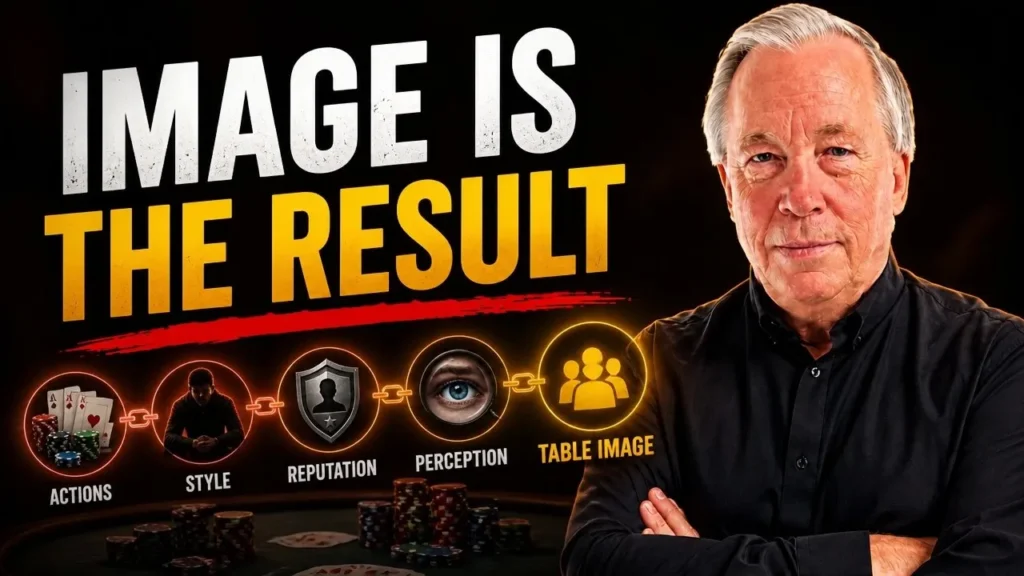
The result is the image that exists in the minds of those opponents.
In its simplest form, the process looks like this:
Decisions → Style → Reputation → Perception → Image
This sequence is important because it reveals that table image is not something that exists independently. It emerges from everything that came before it.
WHY MOST PLAYERS HAVE IT BACKWARDS
Many players approach the concept from the opposite direction.
Rather than focusing on making the best decision in a given situation, they become preoccupied with maintaining or creating a particular image.
They begin asking questions such as:
- “Will this make me look weak?”
- “Will this make me look aggressive?”
- “Should I bluff here so opponents won’t think I’m too tight?”
- “Should I call because everyone expects me to fold?”
Notice what has happened.
The player is no longer making decisions based primarily on mathematics, opponent tendencies, stack sizes, position, or board texture. They are making decisions based on how they hope others will perceive them.
In effect, they are trying to force the process to run backward.
Instead of allowing sound decisions to create a style, and a style to influence image, they are attempting to use image as the starting point for decision-making.
That approach often leads to unnecessary bluffs, questionable calls, and strategically unsound plays that sacrifice expected value in exchange for appearances.
THE NATURAL ORDER
Strong players generally approach the process differently.
They focus first on making the most profitable decision available based on the information at hand. They understand that if those decisions are consistently sound, a style will naturally emerge. Over time, opponents will form opinions, develop expectations, and construct an image whether the player consciously tries to create one or not.
The image is therefore a consequence of the process, not the cause of it.
Understanding this distinction changes how we think about table image entirely. Rather than asking how to create an image, a better question may be whether players should be trying to create one at all.
WHY CRAFTING YOUR TABLE IMAGE IS OFTEN BAD ADVICE
Once players begin viewing table image as the end result of a process rather than the starting point, much of the conventional advice surrounding the subject begins to look questionable.
For decades, poker players have been told to “create an image.” Build a loose image. Establish a tight image. Convince opponents that you are capable of bluffing. Show a hand to send a message. Make a play simply so others will think differently about you.
At first glance, this advice sounds reasonable. After all, if opponents’ perceptions influence their decisions, shouldn’t we actively try to shape those perceptions?
The problem is that many players take this idea too far.
WHEN IMAGE BECOMES MORE IMPORTANT THAN THE DECISION
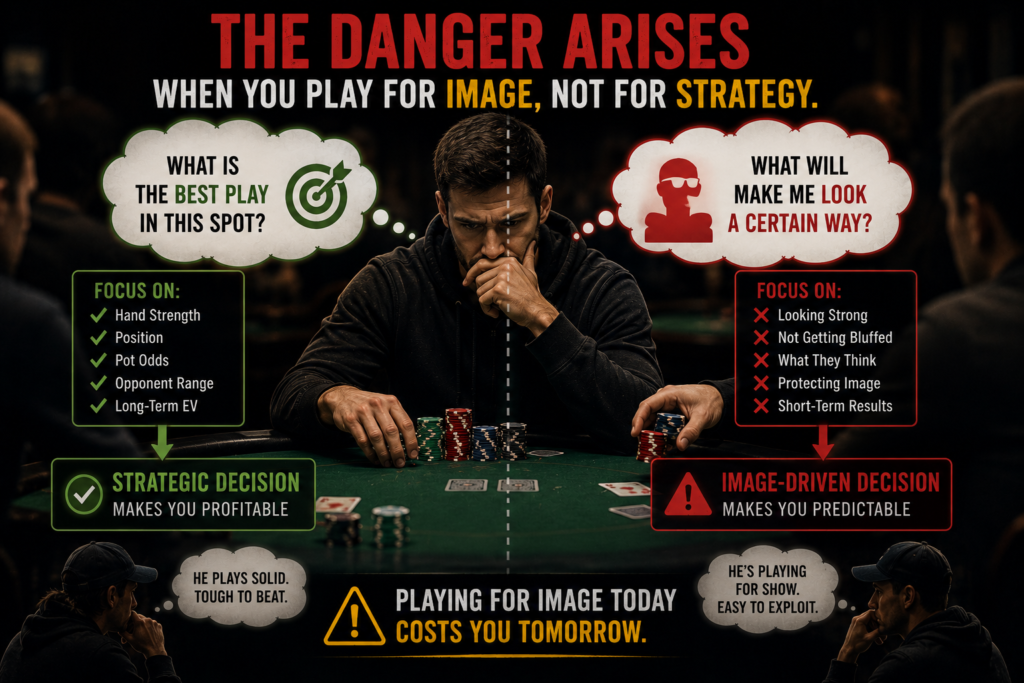
The danger arises when a player starts making decisions primarily for image purposes rather than strategic reasons.
Consider a player who believes they have developed a tight reputation. They become concerned that opponents will stop paying them off when they hold strong hands. In response, they decide to run an unnecessary bluff simply to demonstrate that they are capable of bluffing.
The question is not whether the bluff succeeds.
The question is whether the bluff was strategically correct in the first place.
If the bluff is profitable based on the situation, stack sizes, board texture, and opponent tendencies, then it may be a sound decision. If it is being made primarily to “change an image,” the player has shifted their focus away from expected value and toward appearances.
The same problem occurs when players call simply because they do not want to appear weak, raise simply because they want to appear aggressive, or show cards simply because they hope to influence future action.
In each case, image has become the reason for the decision rather than a factor to be considered alongside other information.
THE TRAP OF MANUFACTURED PERCEPTIONS
Another flaw in image-driven thinking is the assumption that opponents will interpret actions exactly as intended.
As we discussed in the previous section, perception does not work that way.
A bluff shown to establish a loose image may convince one opponent that you are reckless. Another may view it as evidence of confidence and sophistication. A third may barely notice it.
The player believes they are sending a clear message. The table receives several different messages instead.
This is one reason attempts to manufacture a specific image often produce inconsistent results. The information can be controlled. The interpretation cannot.
WHAT STRONG PLAYERS FOCUS ON INSTEAD
Strong players generally focus on making the most profitable decision available in the moment.
They evaluate position, stack sizes, player tendencies, pot odds, board texture, and expected value. They make the decision that best fits the situation rather than the decision that best supports a desired image.
Ironically, this approach often produces the strongest and most credible image of all.
Over time, disciplined decisions create a recognizable style. That style contributes to a reputation. Opponents observe the results and form opinions. Eventually, an image emerges naturally.
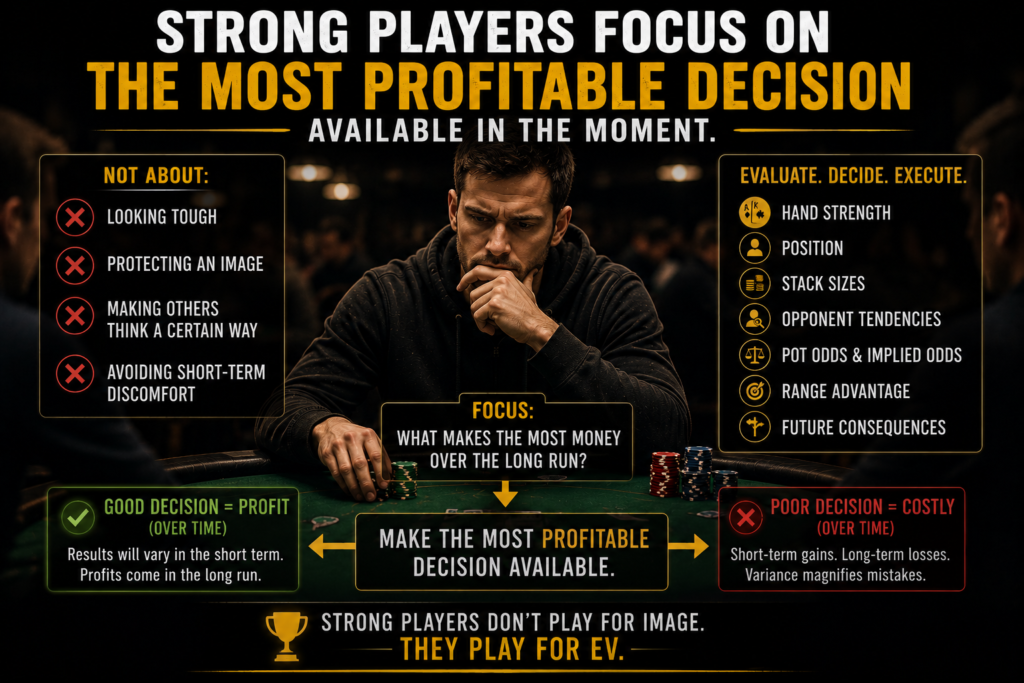
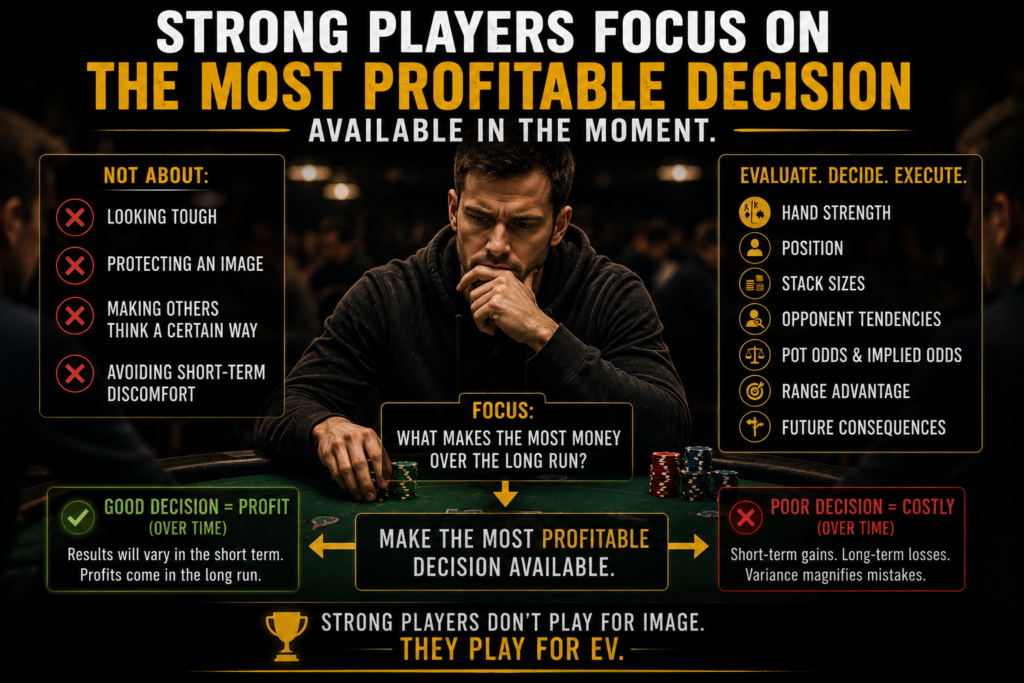
The player never needed to manufacture one.
They simply needed to play well.
This does not mean table image is irrelevant. Far from it. Opponent perceptions can have a meaningful impact on future decisions and outcomes. The key is understanding the proper relationship between image and strategy.
Image should inform decisions.
It should never become the reason for them.
CAN YOU INFLUENCE YOUR IMAGE?
After reading the previous sections, some players may conclude that table image is completely beyond their control.
That would be an overcorrection.
While players cannot directly control how opponents perceive them, they can certainly influence the information opponents use to form those perceptions.
The distinction between influence and control is important.
Control implies the ability to determine an outcome. Influence simply means increasing the likelihood of a particular outcome.
When it comes to table image, players possess influence. They do not possess control.
THE INFORMATION YOU PROVIDE MATTERS
Every action at the poker table communicates information.
That information extends far beyond the hands you choose to play. Opponents also observe how you behave between hands, how you react to wins and losses, how you treat dealers and other players, and whether you remain focused on the game. A player who stays composed after a difficult loss often projects a different image than one who slams chips, complains about bad beats, or openly berates opponents. Likewise, a player who pays attention when not involved in a hand may be viewed differently than someone who spends most of the session watching television or scrolling through a phone.
The hands you choose to play, the bets you make, the bluffs you reveal, the showdowns you reach, and even your table demeanor all contribute to the information available to opponents.
A player who consistently enters pots with strong holdings will likely be viewed differently than a player who enters nearly every pot. A player who frequently applies pressure will often create different impressions than one who rarely raises.
These observations become the raw material from which opponents form opinions.
Because of this, it would be inaccurate to claim that players have no impact on their image. They clearly do. The information they provide influences how they are viewed.
THE LIMITS OF INFLUENCE
What players cannot control is how that information is interpreted.
A shown bluff may convince one opponent that you are reckless. Another may conclude that you are capable of making sophisticated plays. A third may view the hand as an isolated event with little significance.
The information is identical.
The conclusions vary.
This is why table image remains partly outside a player’s control. Once information leaves your possession and enters the minds of your opponents, it becomes subject to their experiences, assumptions, biases, and perceptions.
No player can fully dictate how another player thinks.
WHY SOME PLAYERS OVERESTIMATE THEIR INFLUENCE
Many players assume that every action they take is being closely observed by the entire table.
In reality, most players are paying far less attention than we imagine.
Some are focused on their own cards. Some are distracted by conversations, televisions, phones, or previous hands. Others simply lack the experience necessary to recognize meaningful patterns.
As a result, attempts to carefully engineer a specific image often have less impact than expected.
A player may spend hours trying to project a particular persona while several opponents barely notice the effort.
This does not mean image is unimportant. It simply means that many players overestimate both their ability to create it and the amount of attention others devote to it.
INFLUENCE WITHOUT OBSESSION
The most effective approach is usually the simplest one.
Recognize that your actions influence how others perceive you, but avoid becoming obsessed with managing those perceptions.
Make fundamentally sound decisions. Understand that opponents will form opinions based on the information available to them. Accept that some of those opinions will be accurate, while others will not.
Over time, an image will emerge whether you consciously try to create one or not.
The goal is not to control that process.
The goal is to understand it.
And once we understand it, we can begin examining the situations where table image genuinely affects the decisions being made at the table.
WHEN TABLE IMAGE ACTUALLY MATTERS
After everything we’ve discussed so far, some readers may be tempted to conclude that table image doesn’t matter very much. That would be the wrong lesson to take away from this article.
Table image matters. In some situations, it matters a great deal.
The mistake many players make is not recognizing the importance of image. The mistake is misunderstanding where image fits within the decision-making process.
Imagine two players making the exact same river bet with the exact same hand. The board is identical. The bet size is identical. The situation is identical. Yet one player gets called while the other gets a fold.
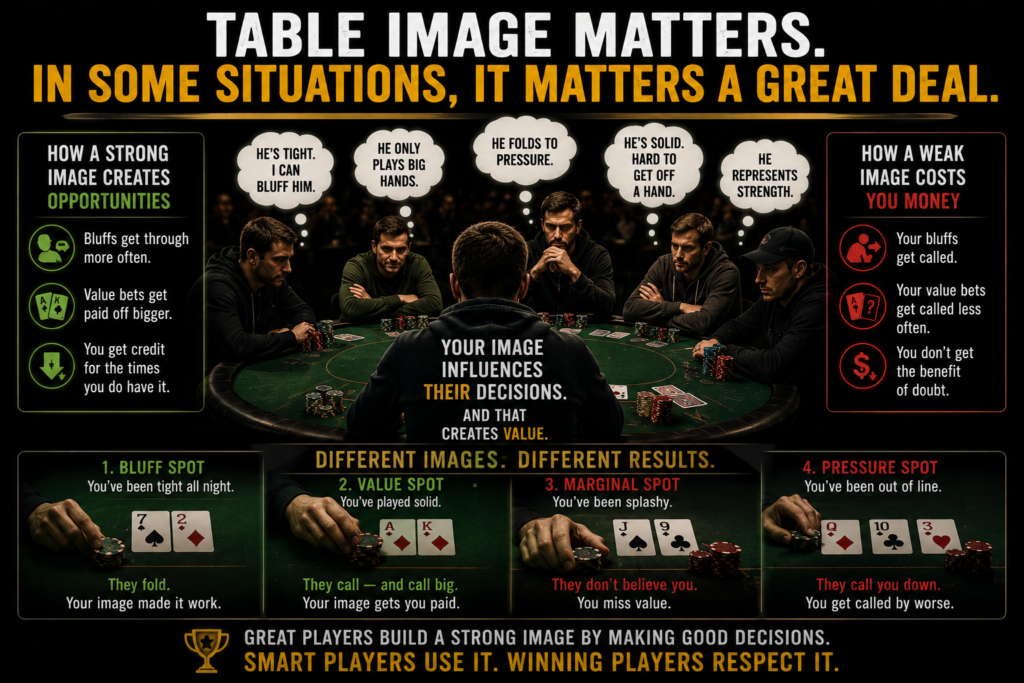
Why?
Often, the answer has nothing to do with the cards.
It has to do with what the opponents believe.
HOW OPPONENTS RESPOND TO YOUR IMAGE
Suppose you’ve been sitting at a table for several hours. You’ve played relatively few hands, avoided unnecessary confrontations, and shown down strong holdings when your cards were exposed. Whether you intended to or not, many opponents will begin forming opinions based on those observations.
When you finally make a large river bet, some players may immediately assume you have a strong hand. Others may convince themselves that you would never risk that amount of money without a legitimate holding. As a result, they fold hands they might have called against another player.
Now consider the opposite situation.
Imagine a player who has been active all night. They’ve entered numerous pots, shown a few bluffs, and generally kept the pressure on. When that player makes the same river bet, opponents may be far more willing to call. The bet has not changed. The hand has not changed. What has changed is the perception surrounding the action.
This is where table image becomes strategically relevant. Opponents do not react only to the cards. They react to the story they believe those cards are telling.
WHY IMAGE CAN INFLUENCE EXPECTED VALUE
One of the reasons table image deserves attention is that it can influence how opponents respond to future decisions.
A player who receives too much credit may find that bluffs succeed more often than expected. A player who receives too little credit may discover that opponents pay off value bets far more frequently. In both cases, the image itself is not changing the strength of a hand. What it is changing is the behavior of the people involved.
This distinction is important.
Table image does not alter the mathematics of the game. Pot odds remain the same. Hand probabilities remain the same. Expected value calculations remain the same.
What image influences is the environment in which those mathematical decisions are made.
Because poker is a game played against people rather than a computer simulation, that environment matters.
KEEPING IMAGE IN ITS PROPER PLACE
The challenge is maintaining perspective.
Over the course of this article, we’ve seen that image is shaped by style, reputation, and perception. We’ve also seen that players can influence image without fully controlling it. What follows naturally from those observations is that image should be treated as one variable among many rather than the foundation upon which every decision rests.
Strong players understand when image is affecting the way opponents respond. They recognize when a tight reputation is generating excessive folds or when an aggressive image is attracting calls. They pay attention to those dynamics because they provide useful information.
What they do not do is allow image to override the fundamentals of sound poker strategy.
Position, stack depth, and player tendencies still matter.
Pot odds, board texture, and expected value still matter.
Table image belongs alongside those factors, not above them.
The goal is not to ignore image, nor is it to become obsessed with it. The goal is to understand its role within the larger strategic picture. Once players lose sight of that distinction, they often fall into one of the most common traps associated with table image.
THE GREATEST TABLE IMAGE MISTAKES
After spending years around poker rooms, I’ve noticed something interesting. The players who talk the most about table image are not always the players who understand it best.
In fact, some of the biggest mistakes I have seen at the table stem from players becoming overly concerned with how they are perceived.
At first, this concern often appears harmless.
A player starts paying attention to how opponents react to their bets. They notice who gives them credit and who does not. They begin recognizing that perceptions influence decisions.
All of that is valuable.
The problem begins when image stops being information and starts becoming the objective.
WHEN PLAYERS BEGIN PROTECTING AN IMAGE
Consider a player who has developed a reputation for being aggressive. Over time, that reputation becomes part of how they view themselves. They begin identifying with it.
Now imagine that player finds themselves in a situation where folding is clearly the best decision.
Instead of focusing solely on the hand, another thought enters their mind:
“If I fold here, everyone will think I’ve gone soft.”
At that moment, the decision is no longer based entirely on strategy.
It is being influenced by image.
The same thing happens to players who believe they have established a tight image. They may feel compelled to bluff simply to prove they are capable of bluffing. Others make questionable hero calls because they don’t want to appear weak. Some refuse to back down from marginal situations because they fear damaging the image they have worked so hard to establish.
In each case, the player is no longer responding primarily to the situation at hand. They are responding to a perception.
THE EGO TRAP
This is where image and ego often become intertwined.
Many players become emotionally invested in how they are viewed by the table. They want to be seen as fearless or aggressive. They want others to believe they are difficult to play against.
There is nothing inherently wrong with those outcomes.
The danger arises when a player begins chasing those outcomes instead of making the best available decision.
Poker does not reward appearances.
Poker rewards good decisions.
A mathematically sound fold remains a good decision even if it makes you appear cautious. A profitable value bet remains a good decision even if it looks obvious. Likewise, a disciplined check is not a mistake simply because it fails to support a particular image.
The cards do not care what reputation you are trying to protect.
Neither does expected value.
THE BEST PLAYERS LET TABLE IMAGE TAKE CARE OF ITSELF
One of the characteristics I’ve observed in strong long-term winning players is that they rarely seem preoccupied with managing their image.
That does not mean they are unaware of it.
Far from it.
They understand how opponents perceive them and recognize when those perceptions create opportunities. They pay attention to how the table is responding.
What they do not do is force decisions in order to maintain a persona.
Their focus remains on making the best decision available given the information in front of them. If that decision happens to reinforce an existing image, so be it. If it happens to contradict that image, so be it.
The decision comes first.
The image follows.
That distinction may sound subtle, but it lies at the heart of the entire discussion.
Players who become overly concerned with maintaining an image often find themselves making increasingly poor decisions in service of that image. Players who remain focused on sound strategy allow their image to develop naturally as a consequence of their actions.
And that brings us to the PokerRailbird perspective on table image—one that differs significantly from much of the conventional advice found in poker books, forums, and strategy discussions.
THE POKERRAILBIRD PERSPECTIVE
Throughout this article, we have examined four concepts that are frequently discussed together but are often misunderstood.
A player’s style reflects the decisions they consistently make at the table. Reputation develops from what other players remember over time. Perception determines how those observations are interpreted, while table image represents the beliefs that ultimately form in the minds of opponents.
Although these concepts influence one another, they are not the same thing.
Recognizing the distinction changes the entire discussion.
Many traditional poker conversations begin with image. Players are encouraged to create one, manage one, protect one, or manipulate one. The underlying assumption is that image should guide decision-making.
The PokerRailbird perspective starts somewhere else entirely.
Rather than focusing on image first, the emphasis is placed on the quality of the decision itself.
Every poker hand presents a unique combination of variables. Position, stack depth, player tendencies, board texture, pot odds, and expected value all play a role. The objective is not to make the decision that best supports a desired image. The objective is to make the decision that is most profitable.
Repeated often enough, those decisions begin to form recognizable patterns. Over time, those patterns become a style. Opponents observe that style, develop opinions, and carry those observations forward. Each player then filters the information through their own experiences, assumptions, and biases. Eventually, a table image emerges.
In other words, image is not the strategy.
It is the consequence of the strategy.
TOOLS-NOT RULES
This idea fits naturally within the broader philosophy of PokerRailbird.
Many poker concepts are best viewed as tools rather than rules. Position is a tool. Aggression is a tool. GTO concepts are tools. Poker tells are tools. Table image belongs in the same category.
Properly understood, a tool provides information and helps players make better decisions. It improves awareness of the environment without replacing sound judgment.
Table image can serve exactly that purpose. It may help explain why a bluff succeeds, why a value bet gets paid, or why a particular opponent reacts the way they do. Used correctly, it becomes another source of information available to the observant player.
Problems arise when image is elevated beyond that role. Once players become preoccupied with maintaining a persona or projecting a specific impression, attention shifts away from the factors that actually determine profitability.
THE REAL LESSON
Perhaps the most important takeaway from this discussion is that table image does not exist independently of a player’s actions.
Unlike a costume, it cannot simply be put on. Nor is it a character that can be performed with complete precision. Instead, table image develops from thousands of observations, memories, interpretations, and assumptions taking place in the minds of other people.
Some of those perceptions will be accurate. Others will not. Certain impressions may disappear after a single session, while others can persist for years.
The strongest players understand this reality. They remain aware of how opponents perceive them without becoming consumed by those perceptions. Opportunities created by image are recognized when they appear, but sound strategic thinking always remains the priority.
Ultimately, the strongest table image is rarely the one that was carefully engineered.
More often, it is the image that emerges naturally from a long series of disciplined, profitable decisions.
CONCLUSION: THE REAL ORDER OF THINGS
When most players think about table image, they tend to start at the end of the process.
They focus on how opponents perceive them, what image they are projecting, and how they might influence those perceptions. As a result, many players come to view image as something that should guide their decisions.
The reality is that the process works in the opposite direction.
Every decision a player makes contributes to a playing style. Over time, that style helps shape a reputation. Opponents observe those patterns and interpret them through their own experiences, assumptions, and biases. From that process, a table image eventually emerges.
The sequence is simple:
Decisions → Style → Reputation → Perception → Image
Understanding this order changes the way we think about table image in poker.
Rather than viewing image as something to manufacture, protect, or obsess over, it becomes something to understand. It is not the starting point of strategy. It is one of the many consequences of strategy.
This does not mean image is unimportant. Opponents respond to what they believe, and those beliefs can create both opportunities and challenges at the table. Awareness of those dynamics is part of becoming a complete poker player.
At the same time, image should never replace the fundamentals of sound decision-making. Position, player tendencies, stack depth, pot odds, board texture, and expected value remain the foundation upon which winning poker is built.
In the end, the answer to our original question is clear.
Playing style comes first.
Table image follows.
The strongest image is rarely the one a player carefully attempts to create. More often, it is the image that develops naturally when a player consistently makes disciplined, profitable decisions over time.