
STANDARDIZATION IN POKER
ELIMINATING INFORMATION LEAKS
Standardization In Poker is one of the least discussed yet most important concepts in the game.
Most poker players spend a great deal of time thinking about tells. They study body language, watch opponents for unusual behavior, and look for subtle changes in posture, chip handling, eye movement, and speech. Entire books have been written on the subject, and countless hours have been devoted to identifying what various behaviors supposedly mean. Yet despite all of that attention, many players overlook a much simpler question:

WHAT INFORMATION AM I GIVING AWAY?

Every action at the poker table has the potential to communicate something. The way you look at your cards, handle your chips, place your bets, observe opponents, or react to a large pot can all provide clues to attentive players. Some of those clues may be meaningful. Others may be completely accidental. Either way, information is being created.
Most discussions about poker tells focus on detection. Players want to know what a particular behavior means, how to recognize it, and how to prevent opponents from using it against them. The underlying assumption is that tells are something to be hidden.
Standardization in poker approaches the problem from a different direction.
Rather than asking how to conceal information after it has already been created, standardization asks a much simpler question:
WHY CREATE THE INFORAMTION IN THE FIRST PLACE?
The concept itself is hardly unique to poker. During my career in the grocery industry, I spent years working with operational standards. Equipment, training programs, safety procedures, sanitation practices, and countless other processes were standardized across hundreds of locations. The purpose was never standardization for its own sake. Before any standard was adopted, alternatives were researched, tested, measured, and evaluated. Once a process proved reliable and effective, it became the standard because it improved consistency, reduced errors, simplified execution, and improved overall performance.
Poker presents a remarkably similar challenge.
Whether they realize it or not, every player eventually develops standards. Repeated actions become habits, and habits become routines. Over time, players begin looking at their cards the same way, handling chips the same way, reacting to bets the same way, and observing opponents through familiar patterns. The difference between inexperienced players and experienced players is not whether standards exist. The difference is whether those standards develop by default or by design.
Years ago, I was involved in a hand where an opponent spent several minutes staring directly at me while trying to make a decision. The table was silent until another player finally broke the tension and said, “You can stare at him all night. You’ll get nothing.”

CONSISTENCY IN BEHAVIOR PATTERNS
Whether that statement was entirely true is beside the point.
What mattered was the idea behind it.
The goal was never to become unreadable through acting, deception, or some carefully constructed poker persona. The goal was to develop consistent behaviors that revealed as little information as possible in the first place.
That is the purpose of standardization in poker.
It is not about becoming robotic or eliminating personality. And it is certainly not about pretending to be something you’re not.
It is about reducing unnecessary information leakage by developing consistent behaviors that remain largely unchanged regardless of the cards you hold.
Understanding how that process works begins with a simple question:
WHAT IS STANDARDIZATION IN POKER?
When most players think about poker tells, they usually focus on specific actions.
Maybe an opponent suddenly becomes talkative during a hand. Perhaps someone avoids eye contact, studies the board longer than usual, or begins handling chips differently. The natural tendency is to focus on the behavior itself and ask what it means.
In reality, experienced players are often paying attention to something else entirely.
They are paying attention to what changed.
Imagine playing with the same group of players several times a week. Over time, everyone begins developing expectations about how everyone else behaves. They notice how long you normally take to make decisions. They become familiar with how you handle chips, how often you look back at your cards, how much you talk during a hand, and even how you sit in your chair.
Whether anyone consciously realizes it or not, a baseline begins to form.
BASELINE BEHAVIOR

In poker, a baseline is simply your normal behavior. It is the collection of habits, routines, and tendencies that appear consistently enough for other players to view them as normal. Once that baseline exists, changes become much easier to recognize.
Suppose you spend most of a session handling chips casually, making routine decisions without much visible emotion. Then, in a large pot, you suddenly begin studying an opponent longer than normal, repeatedly checking your cards, and carefully counting chips before placing a bet.
None of those actions automatically reveal anything about your hand.
What attracts attention is the fact that they are different; the deviation itself becomes information.
This is the foundation of standardization in poker.
THE BENEFITS OF STANDARDIZATION
At its core, standardization is the deliberate process of establishing standards for repetitive actions and applying them consistently over time. The objective is to reduce unnecessary variability so that opponents have fewer opportunities to connect your behavior to the strength of your hand.
That distinction matters because many players misunderstand what standardization is trying to accomplish.
The goal is not to hide tells, but to avoid creating them to begin with.
Hiding tells assumes information has already been created and now needs to be concealed. Standardization approaches the problem much earlier in the process. Rather than asking how to disguise behavior, it asks why the behavior is changing in the first place.
The answer is often a lack of standards.
Without standards, behavior tends to fluctuate naturally with confidence, uncertainty, excitement, frustration, and hand strength. Those fluctuations create differences. Those differences create information. And once information exists, observant opponents can begin looking for patterns.
Strong players understand this relationship. Rather than focusing exclusively on concealing information, they focus on reducing the amount of information their behavior creates in the first place. They develop standards for repetitive actions, apply those standards consistently, and gradually remove much of the variability that opponents use to build reads.
Consistency, therefore, is not the objective, it’s the result.
Standardization is the process that creates it.
And once that relationship is understood, the next question becomes obvious:
WHY DOES VARIABILITY CREATE INFORMATION?
Poker Players are remarkably sensitive to change.
You experience this every day, often without realizing it. Something feels different, and before you can identify exactly what changed, your attention is already focused on it. The same thing happens at every poker table.
The problem is not that you have habits. The problem is that those habits often change depending on the situation.
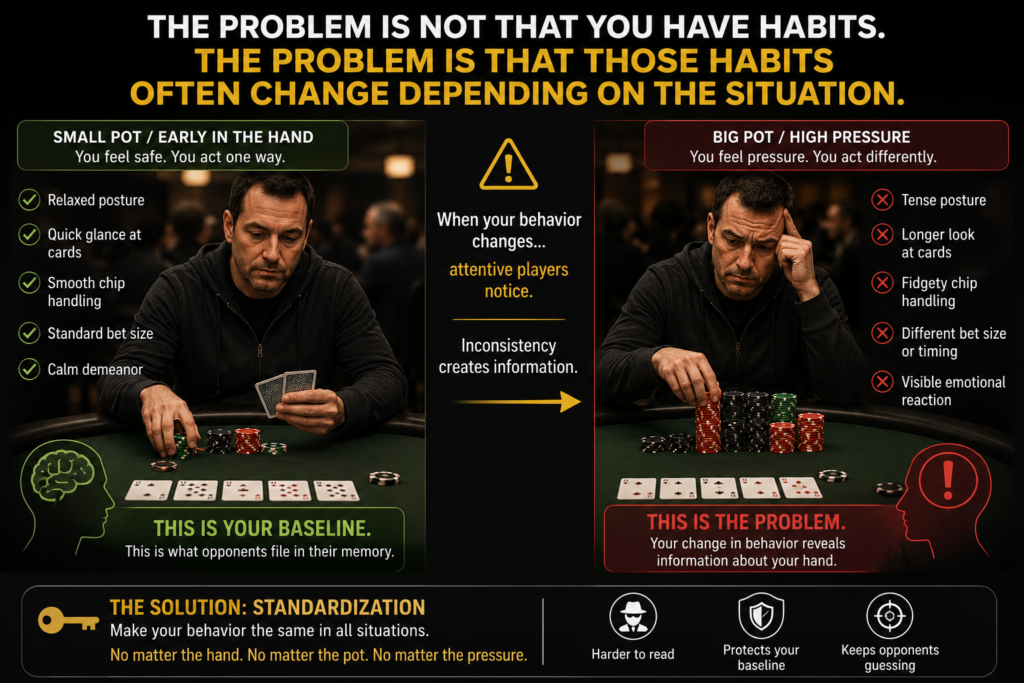
Perhaps you normally look at your cards once and never look back. Then a flush card arrives on the river and you suddenly check them again. Maybe your chip handling becomes more deliberate in large pots, or your decision-making slows down when uncertainty enters the picture. None of these actions automatically reveal anything about your hand.
What matters is that they are different.
Every time your behavior changes, you create contrast. Contrast attracts attention. Attention creates opportunities for information to be revealed.
This is why strong players place such importance on consistency. The less variation that exists between strong hands, weak hands, draws, bluffs, and routine decisions, the fewer opportunities there are for meaningful differences to emerge.
Viewed through this lens, the relationship between standardization and information leakage becomes easier to understand. Standardization creates consistency. Consistency reduces variability. Reduced variability limits the amount of information your behavior produces.
The fewer meaningful differences that exist, the less information there is to observe in the first place.
THERE IS NO SINGLE APPROACH TO STANDARDIZATION IN POKER

One of the biggest misconceptions about standardization in poker is the belief that there is a universally correct way to do it.
Players naturally want rules. They want to know the correct way to look at their cards, handle chips, place bets, and sit at the table. The assumption is that if standardization matters, then there must be a perfect standard somewhere.
In reality, there usually isn’t.
This is one of the biggest differences between standardization in poker and standardization in business.
In the corporate world, a Standard Operating Procedure (SOP) is typically designed to produce a specific result.
Poker standards operate differently.
The purpose of a poker standard is not to produce a result, but to avoid producing one, namely information.
Consider something as simple as looking at your hole cards.
Should you look at them for one second or three?
Do you pick them up off the felt or simply peel the corners?
Should you check them only once or occasionally verify them during the hand?
The answer is largely irrelevant.
What matters is not which method you choose.
What matters is that the method remains your standard, which builds consistency.
If you look at your cards for three seconds every hand, you have created a standard.
If you glance at them for one second every hand, you have also created a standard.
Neither approach is inherently superior. Both accomplish the objective so long as they are performed consistently.
The same principle applies throughout the game.
Your procedure for checking, betting, calling, raising, folding, handling chips, protecting your cards, and responding to action does not need to match anyone else’s procedure, nor do you want it to.
It only needs to match your procedure.
CREATING THE STANDARD
This is where many players become confused. They spend their time searching for the perfect standard when they should be developing a reliable one. The perfect way to look at your cards, or the perfect betting motion or posture, does not exist. What exists is the standard, which again, builds consistency.
Once a standard has been chosen, the goal is not to improve it every session or modify it whenever a new idea appears. The goal is to execute it consistently enough that it becomes part of your normal behavior.
The moment that standard changes because your hand changes, information begins to leak.
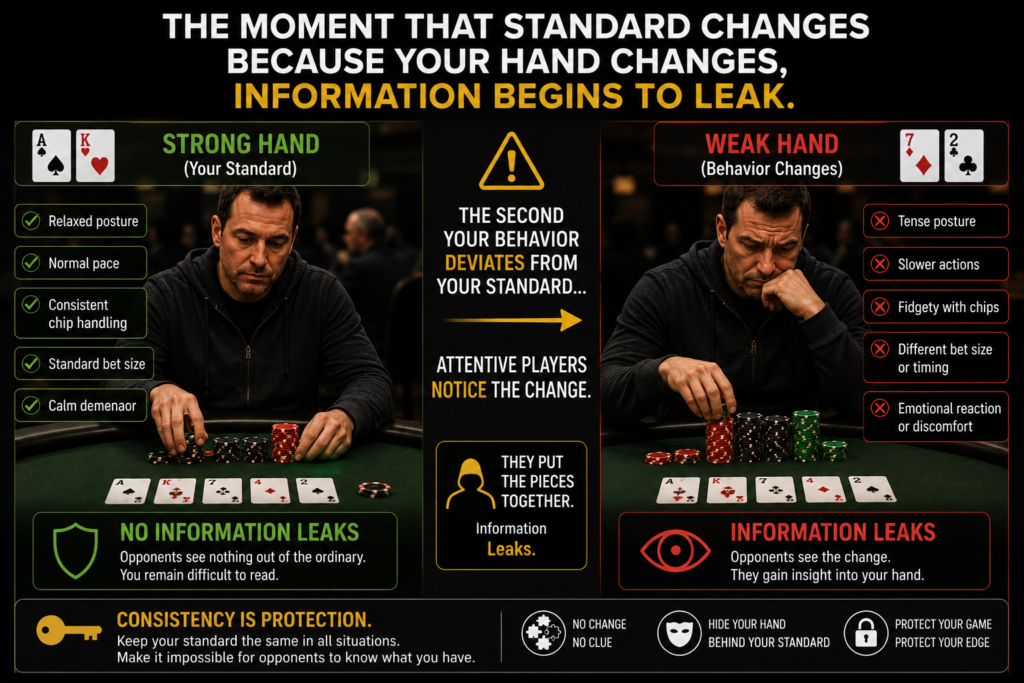
Maybe your chip handling becomes more deliberate when you’re strong or you look back at your cards when a draw completes. Maybe you take longer to act when you’re uncertain. The specific behavior is less important than the fact that the behavior changed.
That change is what creates information.
STANDARDIZATION IN POKER IS ABOUT PROCESS: NOT PLAY
At this point, it is important to draw a clear distinction.
Standardization in poker is about process, not play.
Throughout this article, we have been discussing things like how you look at your cards, handle your chips, place your bets, protect your hand, and observe your opponents. These actions happen over and over again during every session. Because they are repeated so often, they create repeated opportunities to give away information when they change.
The actual decision is different.
Poker is a situational game. Sometimes the correct play is to fold. Sometimes it is to call or raise. The right decision depends on the situation.
That part of poker should change.
What should not change is the process surrounding those decisions. You may decide to fold one hand and raise the next. That’s poker.
But there is no reason to handle your chips one way when you’re bluffing and another way when you’re holding the nuts. There is no reason to look at your cards differently simply because you picked up A-K instead of 7-2.
The decision may change, but the process does not have to.
That is what Standardization in Poker is really about.
Once that distinction is understood, the next question becomes much more practical:
WHAT AREAS OF POKER SHOULD YOU STANDARDIZE?

Once players understand the concept of standardization in poker, the next question is usually practical:
What exactly should I standardize?
The answer is surprisingly simple.
Look for repetitive actions.
The more often an action occurs during a poker session, the more opportunities it creates for information leakage when your behavior changes. Looking at your cards, handling chips, placing bets, protecting your hand, observing opponents, and reacting to action all occur repeatedly throughout every session.
The objective is to create a standard that is comfortable, repeatable, and sustainable over long periods of time. Once that standard has been established, the next step is simply adhering to it. Over time, adherence to the standard creates the consistency that reduces unnecessary information leakage.
SITTING POSITION
Every hand begins before you ever look at your cards.
Many players sit one way when nothing is happening and another way when they become interested in a hand. They lean forward, sit upright, shift in their chair, or otherwise change their posture as their level of interest changes.
A better approach is to develop a standard sitting position that is comfortable enough to maintain throughout the hand. The exact position does not matter. What matters is that it becomes your normal position whenever you are involved in a hand.
The standard creates the consistency.
LOOKING AT YOUR POCKET CARDS
One of the first opportunities for standardization occurs the moment your cards are dealt.
When will you look at them? How will you look at them? How long will you look at them?
There is no universally correct answer to any of these questions. Some players wait until it is their turn to act. Others look immediately. Some pick their cards up. Others simply peel the corners.
The specific method matters far less than having a method.
Develop a standard that feels natural and repeatable, then adhere to it. Consistency becomes the byproduct of following the standard rather than something you are consciously trying to create.
CARD PLACEMENT AND PROTECTION
After viewing your cards, what happens next?
Do you place them near the rail? Several inches from the rail? Do you use a card protector? A chip? Your hand?
Again, there is no correct answer.
What matters is that your procedure remains largely unchanged from one hand to the next. Many players unknowingly alter these behaviors depending on whether they intend to continue in the hand and sometimes to the strength of their hand. I’ve seen players put good cards closer to the edge, nearer them, and weak hands further out on the table, almost as if they’re abandoning them.
Standardization eliminates the need for those adjustments by establishing a routine before the situation has a chance to influence your behavior.
LOOKING BACK AT YOUR POCKET CARDS
Most players look back at their cards during a hand. In fact, after the flop is dealt, you’ll often see half the table do it almost automatically.
There is nothing inherently wrong with checking your cards again. The issue is that looking back at your cards involves much more than simply verifying your hand.
You break your posture. You move your hands. Your eyes leave the board and your opponents. You handle your cards. Then you return your attention to the table.
In other words, a great deal of activity occurs during what appears to be a very simple action. This draws attention to you, and that’s not something you want.
For that reason, many players benefit from developing a standard for when they revisit their cards.
One possible approach is to verify your hand after the flop if necessary and then avoid looking back again for the remainder of the hand. Another approach may work just as well.
The specific standard is less important than having one.
What matters is that your decision to revisit your cards does not become tied to specific situations such as a completed flush draw, a possible straight, or a difficult decision.
As with every other area of Standardization in Poker, the goal is not necessarily to eliminate the behavior.
The goal is to prevent the behavior from changing simply because the situation changed.
LOOKING AT COMMUNITY CARDS
The flop, turn, and river create another series of repetitive actions.
Most players immediately shift their attention to newly arrived board cards. The cards themselves are important, but so are the reactions occurring around the table.
Developing a standard for how and when you observe community cards can help reduce unnecessary variability in your behavior while simultaneously allowing you to remain focused on the information being created by others.
EYE MOVEMENT AND FOCAL POINTS
Where your attention is directed often communicates more than players realize.
Some players become intensely focused on opponents during certain situations. Others repeatedly look at chips, cards, or specific players when considering particular actions.
A simple standard can help reduce this variability.
The exact method is less important than consistency. Whether you choose to focus on the board, maintain a neutral gaze, or follow some other routine, the objective is to avoid meaningful changes in behavior simply because the circumstances changed.
HAND PLACEMENT
Many players have no standard whatsoever regarding their hands.
One hand they are folded across their chest. The next they are resting on the rail. Later they are handling chips, touching cards, or moving around the table.
None of these behaviors are inherently wrong. The issue is the variability.
A comfortable and repeatable standard for hand placement removes one more area where unnecessary differences can emerge.
CHIP HANDLING
Chip handling is one of the most common sources of information leakage because it occurs so frequently.
Players often handle chips differently when they are excited, uncertain, bluffing, or holding a strong hand. In many cases, they are completely unaware that the behavior is changing.
Developing a standard for how you handle chips can significantly reduce this variability. The specific technique is far less important than your ability to repeat it consistently over time.
BETTING-CALLING-RAISING AND FOLDING
Every hand eventually leads to action.
You may check, bet, call, raise, or fold, but regardless of the decision, there is still a physical process involved in executing that action.
Some players carefully stack chips in one situation and casually toss them in during another. Others become noticeably more deliberate when holding strong hands.
The actual procedure is largely irrelevant. What matters is that the procedure remains consistent.
Develop a standard that is comfortable, repeatable, and sustainable. Then adhere to it regardless of whether you are bluffing, value betting, calling, or folding.
The objective is reducing unnecessary variability.
Across all of these areas, the same principle applies. Create the standard first. Adhere to the standard second. Consistency is what follows.
And as consistency increases, opportunities for information leakage begin to decrease.
VERBAL BEHAVIOR
Speech is one of the most difficult areas to standardize because it is heavily influenced by emotion.
Many players become noticeably quieter when holding strong hands. Others become more talkative when bluffing. Some answer questions in certain situations but not others. In many cases, these changes occur without conscious awareness.
For that reason, verbal behavior deserves special consideration.
The simplest standard is not to engage in conversation while involved in a hand. By removing verbal interaction entirely, you eliminate one of the largest potential sources of information leakage.
Not every player will choose that approach. Some players are naturally conversational and prefer to maintain the same level of interaction regardless of the situation.
For many players, the easiest verbal standard is simple: once the cards are in the air, stop talking until the hand is over.


CONCLUSION
Most poker players spend their time looking for tells in other players. Far fewer spend time considering the information they may be revealing themselves.
Yet every action at the poker table has the potential to communicate something. The way you look at your cards, handle your chips, place your bets, observe opponents, position your body, or engage in conversation can all create information when those behaviors change from one situation to another.
That is why standardization in poker matters.
The objective is not to become robotic. The objective is not to eliminate personality. And it is certainly not to play every hand the same way.
The objective is to develop standards for repetitive behaviors and adhere to those standards consistently over time.
Consistency is the natural result of standardization.
Create the standard. Follow the standard and consistency will follow.
As consistency increases, variability begins to decline. As variability declines, information leakage begins to decline with it. Opponents have fewer opportunities to connect your behavior to your hand strength because there are fewer meaningful differences to observe in the first place.