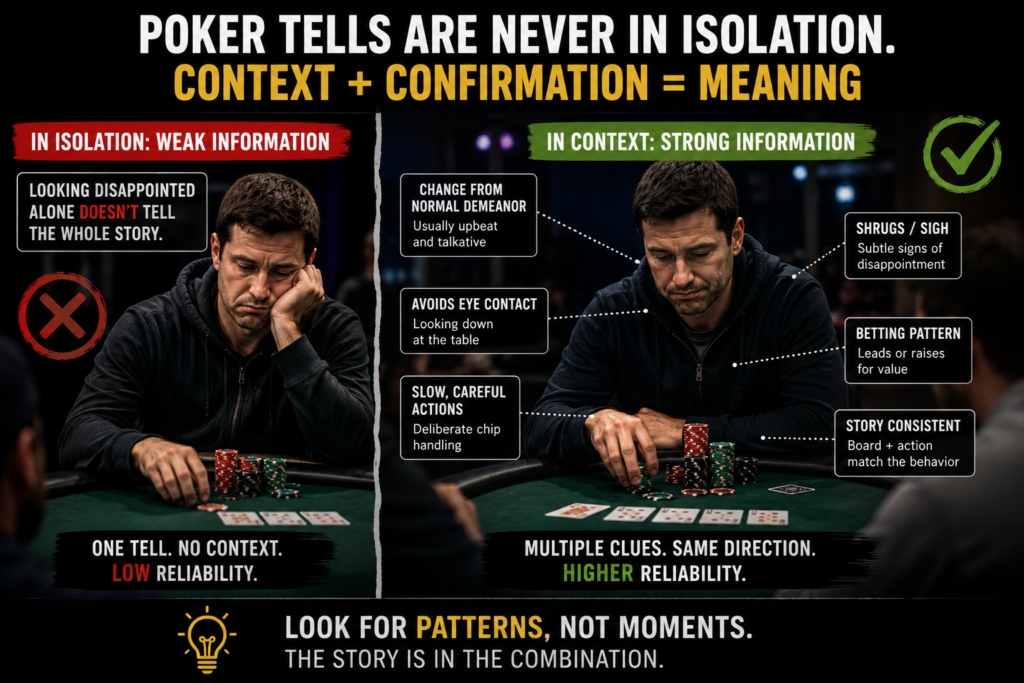
THE DISAPPOINTED PLAYER TELL
WHY STRONG HANDS SOMETIMES LOOK WEAK
Looking disappointed is not normally a sign of strength.
Outside of poker, a disappointed expression often suggests frustration, unfavorable circumstances, or an outcome someone wishes had been different. When we see a person frown, lower their head, or appear dejected, the natural conclusion is that something has gone wrong.
Poker does not always follow those rules.
At the table, a player who appears disappointed may not be unhappy at all. In some situations, what looks like weakness on the surface can be associated with considerable strength underneath.
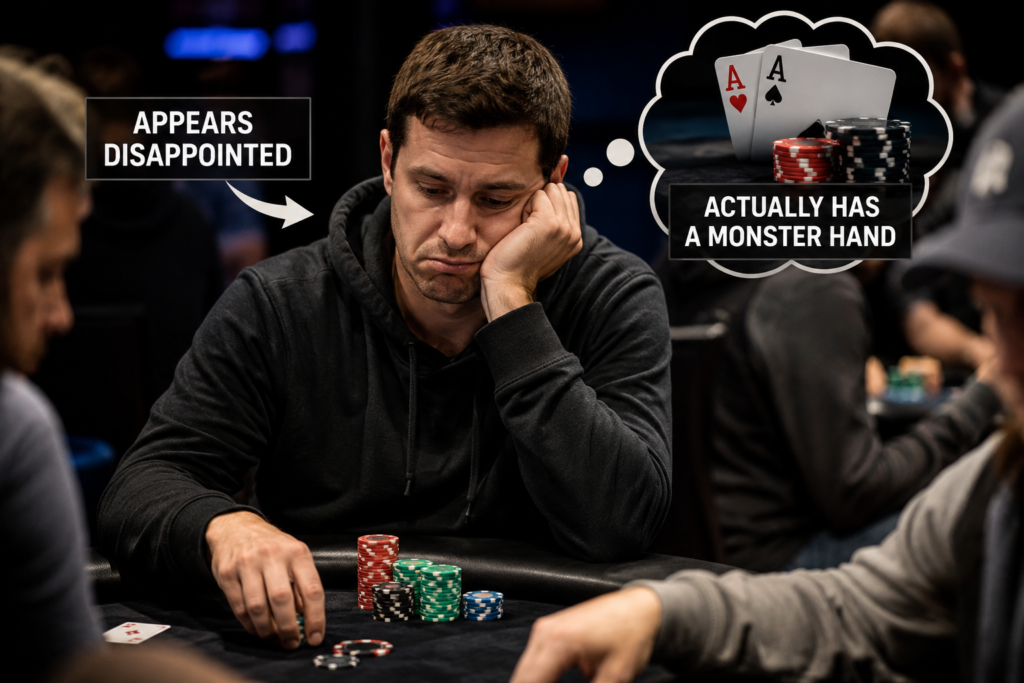
This creates an interesting question. Why would a player holding a strong hand want to appear disappointed while waiting for action?
WHAT THE TELL LOOKS LIKE
The first challenge with looking disappointed is that the behavior is often subtle.
Most players do not dramatically shake their heads, sigh loudly, or put on an obvious performance. Although those exaggerated versions occasionally occur, the more reliable examples tend to be much quieter. A player may wear a slight frown, lower their head, slump their shoulders, or appear less engaged with the action than they were moments earlier. Rather than drawing attention to themselves, they seem to fade into the background.
In many cases, the change is not limited to a facial expression. The player’s entire posture may become smaller. Their shoulders move inward slightly. Their chest appears less prominent. They may sink lower into their chair or reduce their physical presence at the table. The overall impression is not one of confidence or aggression. Instead, they appear mildly disappointed, discouraged, or uninterested in what is happening.
LOOKING BEYOND INDIVIDUAL ACTIONS
This is one reason the tell can be easy to miss. Observers often focus on individual actions while overlooking the broader picture. A slight frown by itself may mean nothing. Lowering the head may mean nothing. A subtle shift in posture may mean nothing. When several of these behaviors occur together, however, they can create an overall appearance that suggests weakness even when the player is holding a strong hand.

For that reason, it is often helpful to think less about specific movements and more about the player’s general demeanor. If you encountered the person away from the poker table, would they appear disappointed, discouraged, or unhappy about something? That overall impression is often easier to recognize than attempting to identify individual facial expressions or physical movements in real time.
The important point is that the tell is not defined by any single action. It is defined by a collection of behaviors that combine to create the appearance of disappointment while the player is waiting for someone else to act. The question, of course, is why a player holding a strong hand would want to project that image in the first place.
WHY STRONG HANDS SOMETIMES LOOK WEAK
At first glance, the behavior seems counterintuitive.
Conventional wisdom suggests that a player holding a strong hand should appear confident, alert, and engaged. After all, they are in a favorable position. The hand is going well. There is little reason to be disappointed by the situation.
Yet poker is not simply a game of holding strong cards. It is also a game of influencing the decisions of other people.
A player holding a powerful hand often wants the action to continue. They want opponents to call. They want betting to remain active. Most importantly, they do not want to appear threatening enough to encourage folds. For that reason, some players naturally project an image that is less intimidating than they actually feel. Rather than sitting taller, appearing excited, or displaying confidence, they become quieter, smaller, and less noticeable.
APPEARING LESS THREATENING
One of the more interesting observations in poker tells research is that strong hands are sometimes accompanied by behaviors that make a player appear physically smaller. Shoulders move inward. Posture becomes less prominent. The head lowers slightly. The overall effect is a reduction in perceived threat. Instead of projecting strength, the player projects weakness.
From a practical standpoint, the behavior makes sense. A player hoping to receive action gains little by looking eager or confident. Excitement can attract attention. Confidence can create suspicion. Looking disappointed, on the other hand, may encourage opponents to believe the player is uncertain, uncomfortable, or unhappy with the situation.
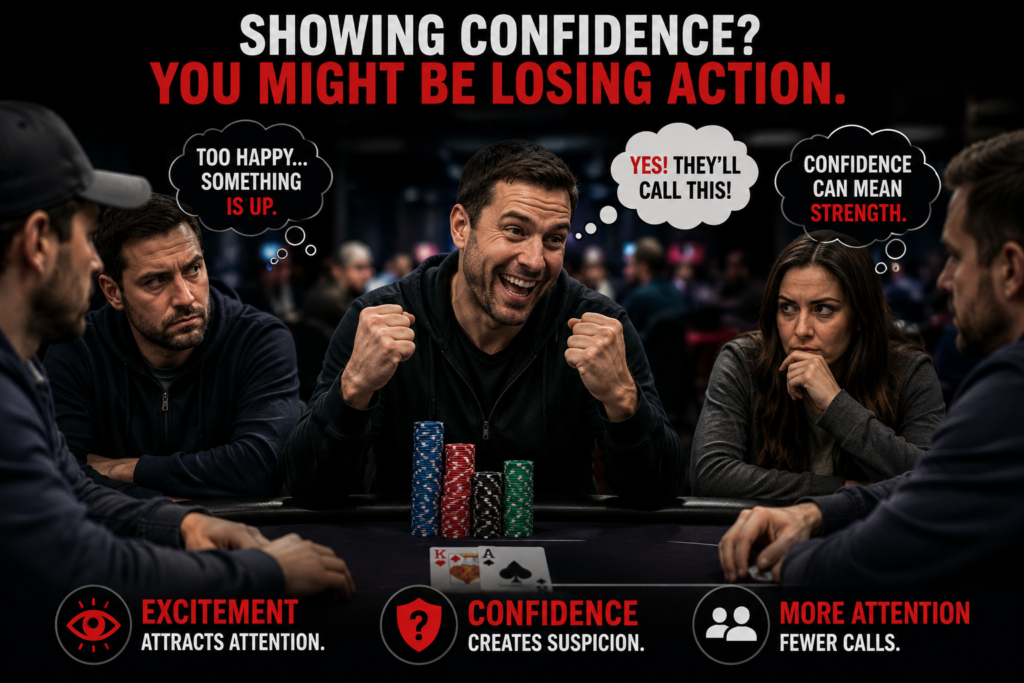
Understanding why this occurs is important because the behavior is not always the result of conscious deception.
ACTING OR INSTINCT

One of the more interesting aspects of looking disappointed is that the behavior does not always originate from the same place.
Many players assume the tell is simply an act. A player makes a strong hand, wants action, and deliberately attempts to appear weak in order to encourage calls. Sometimes that explanation is correct. Poker players have been known to fake disappointment, shake their heads, sigh, or otherwise project weakness in an effort to influence the decisions of their opponents.
The problem is that not every example of this tell is the result of conscious deception.
Some players display the behavior even when they are actively trying not to give away information. Rather than acting, they appear to be responding instinctively to the situation. A strong hand creates a desire for action, and that desire may influence behavior without the player ever consciously deciding to project weakness.
This distinction matters because many poker tells are often treated as though they must be either truthful or deceptive. Reality is not always that simple. Human behavior frequently exists somewhere between those two extremes. A player may not be intentionally acting, yet their behavior can still reveal information about how they feel regarding the hand.
Of course, not every disappointed-looking player is strong. Sometimes the expression is genuine. Inexperienced players, discouraged players, or players involved in difficult multiway situations may honestly be communicating weakness rather than disguising strength. That distinction is one reason poker tells should always be viewed as probabilities rather than certainties.
CONCLUSION
As with all poker tells, looking disappointed should not be viewed in isolation. The behavior becomes more meaningful when it represents a change from a player’s normal demeanor and when it is supported by other behaviors pointing in the same direction. No single tell provides certainty. Instead, tells help us identify situations where one interpretation becomes more likely than another.
The value of this tell is not that it predicts a strong hand every time. Its value lies in recognizing that behavior which appears weak on the surface may sometimes communicate the opposite message underneath. Understanding that possibility allows us to look beyond first impressions and make more informed decisions at the table.