
WHY POKER PLAYERS DON'T FOLD
THEY'RE PLAYING A DIFFERENT GAME
Poker players don’t fold, at least not the ones filling most $1/$3 tables. You raise to a reasonable size and still see four, five, or six callers. They peel with gutshots, three-gappers, any two suited cards, and sometimes just any two cards. Then they shrug when the river saves them or ends the hand.
That pattern is not random. It is psychology.
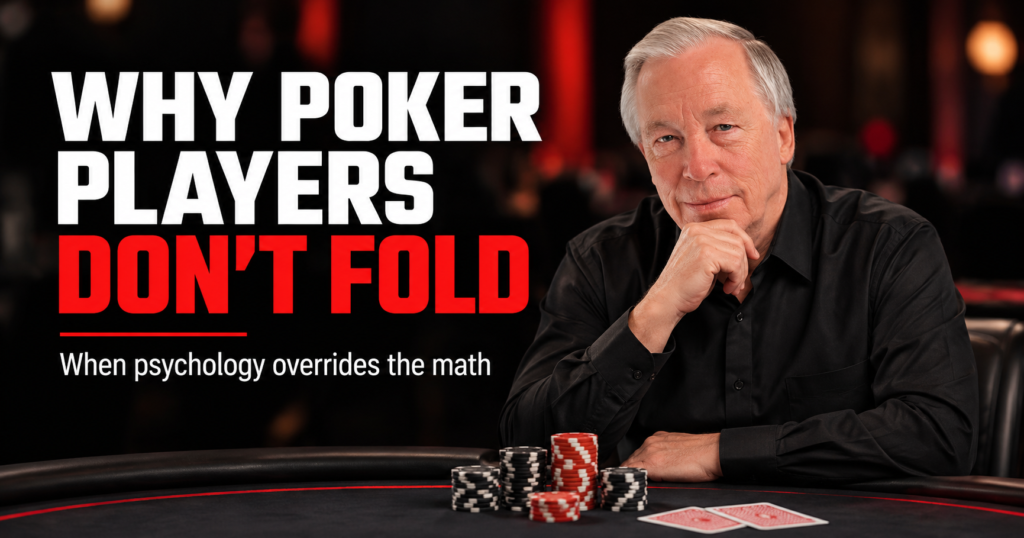
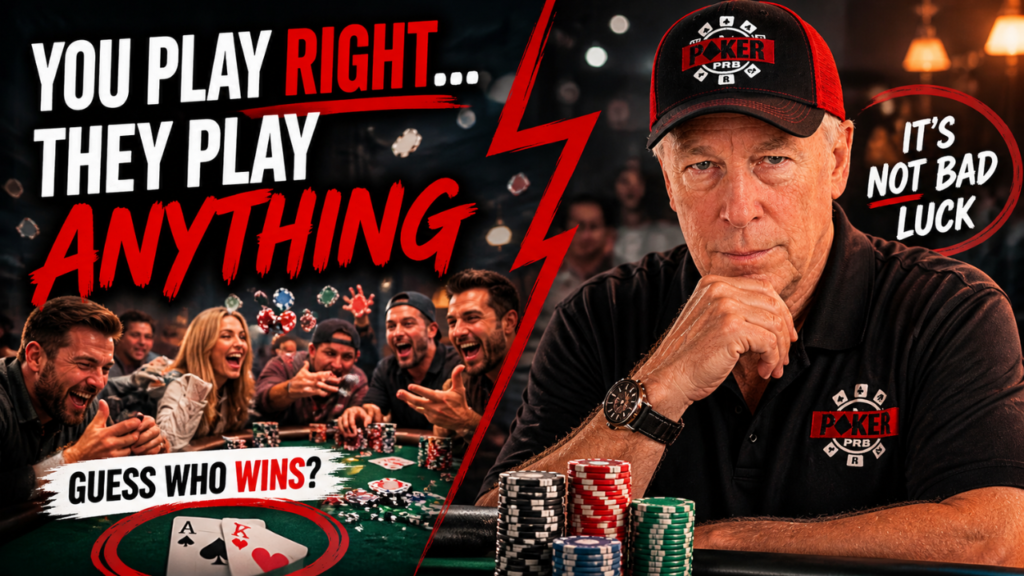
Most of these players are not trying to maximize chip EV. They are chasing action, suspense, status, and a story worth telling. Folding several hands in a row feels like sitting out. Calling feels like playing. One miracle win reinforces a long string of bad calls. Promotions, table culture, alcohol, and fatigue all push in the same direction. The result is calls in spots where the math clearly says fold.
Their scoreboard is different from yours. They care less about pot odds, hand probabilities, or long-term expected value and more about how the game feels, whether the action is flowing, and where they stand in the lineup. You have probably heard the line “there are no bad hole cards, just bad flops.” For many of these players, that is not a joke. It is closer to a working belief.
This article treats that reality directly. It explains the main reasons poker players don’t fold and how those reasons produce calls that look wrong on a chip-EV scoreboard. The goal is not to shame the callers or to supply a list of counter-strategies. It is to make the different scoreboard visible so the calling becomes understandable instead of surprising. Once the drivers are clear, the pattern is easier to anticipate.
TWO SCOREBOARDS: EV VS UTILITY
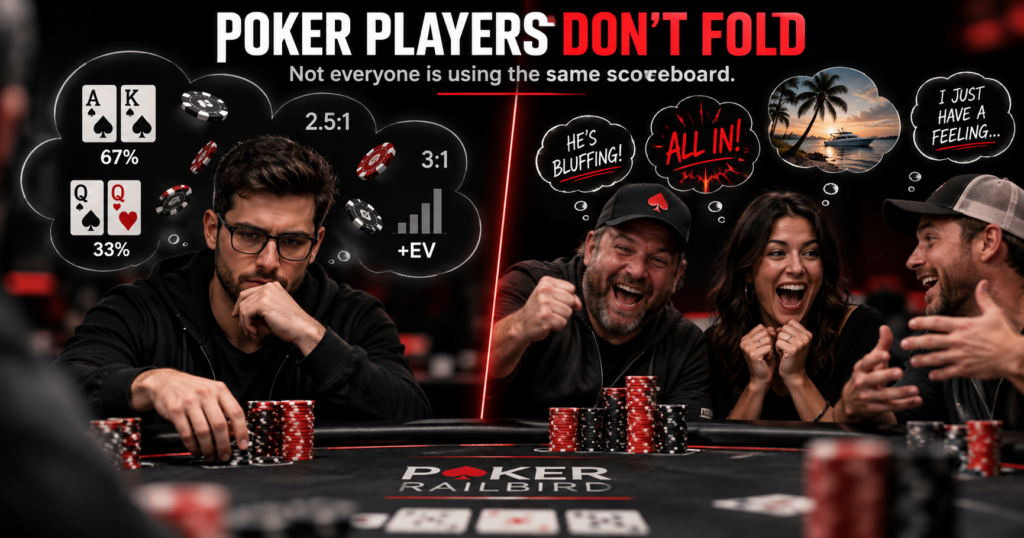
Everyone at the table keeps score, but not everyone is using the same scoreboard. Players focused on chip EV compare the price they are being offered to their chance of winning, plan for future streets, and choose lines that win across thousands of hands. Many recreational players are tracking something else: how the hand feels, whether they are involved in the action, and whether they can tell a story about it later. When those two scoreboards diverge, calls that look irrational on one measure are consistent on the other.
CHIP EV VERSUS IMMEDIATE EXPERIENCE
Chip EV is straightforward. You weigh the pot odds against your hand odds, factor in what you might win or lose on later streets, and decide whether the line is profitable over the long run. The process can feel slow or even boring. It also produces consistent results.
The other scoreboard prioritizes immediate experience. Action is better than waiting. Suspense is exciting. Refusing to fold protects status (“you won’t push me around”). A hit brings relief and a story. Alcohol, promotions, and late-night fatigue make this scoreboard even more dominant. Under those conditions, peeling “just to see one” can feel like the right decision even when the numbers are poor.
SAME SPOT: TWO OUTLOOKS
Consider a common spot. You open to $15 in a $1/$3 game and get five callers. The flop comes K-6-2. A player who called with 7-4 offsuit faces a bet.
Same cards, two different goals, two different decisions. You cannot talk most players out of their preferred scoreboard, and you do not need to. The difference in what each player is measuring is enough to explain why one folds and the other calls.
Once you accept the split, the fact that poker players don’t fold stops being a complaint. It becomes a predictable result of the scoreboard they are using.
WHY THEY STAY IN: THE MAIN DRIVERS

You are measuring chip EV. Many of the players who don’t fold are measuring something else: action, suspense, status, relief, or a story they can tell. The drivers below are the ones that show up most often at live low-stakes tables. They usually operate together rather than one at a time, which is why the calling can look stubborn even when the pot odds are clearly wrong.
ACTION BIAS AND THE NEED TO PLAY
Some players dislike sitting out. After a few folds, almost any two cards feel like a chance to be involved. Calling relieves the discomfort of doing nothing and signals that they are still in the game. Price becomes secondary to participation. The result is wider ranges and more multiway pots than the cards alone would justify.
NEAR-MISSES AND INTERMITTENT REINFORCEMENT
A single miracle river can outweigh a long series of losing calls in memory. Near-misses feel like progress even though they change nothing about the odds. Because the rewards arrive unpredictably, the habit of chasing is strengthened rather than extinguished. Players continue with gut-shots, backdoor draws, and weak pairs because the occasional hit teaches the wrong lesson: keep calling and something good will eventually happen.
SUNK COST AND "I'VE COME THIS FAR"
Chips already invested distort the next decision. A player who has called the flop often feels obligated to call the turn; a player who has called the turn often feels obligated to see the river. Each prior contribution pushes toward one more call even when the current pot odds do not match the hand odds. The past money is gone, but it still influences the present choice.
LOSS AVERSION AND THE URGE TO GET EVEN
Losses typically feel larger than equivalent gains. After a player is stuck, the desire to recover can override normal caution. Calling lighter becomes a way to avoid locking in the loss. The same tendency appears when freshly won chips feel like “house money” and therefore easier to risk. In both cases, the emotional scoreboard encourages continuation that the chip-EV scoreboard would reject.
ILLUSION OF CONTROL AND OVERVALUED STARTING HANDS
Many players overestimate their ability to “get there” or treat any suited hand as meaningfully live. Two suited cards will make a flush by the river only about 6.5 percent of the time if all five community cards are seen—roughly 14-to-1 against. When the suit is dominated, the risk of making the second-best hand is real. The belief that “any two cards can win” or that a personal read will overcome the odds keeps calls alive that the numbers do not support.
OUTCOME BIAS, SELECTIVE MEMORY, AND RESISTANCE TO LEARNING
A bad call that happens to win is often remembered as good judgment. Quiet losses fade. Dramatic suck-outs are easy to recall and therefore feel more common than they are. Without a habit of reviewing the price offered versus the hand odds at the time of the decision, the same patterns repeat. Confidence in personal reads can further reduce the likelihood that the results will be examined. The feedback the game provides is noisy, and memory edits it in favor of the calls that worked.
ROOM CULTURE, PROMOTIONS AND FATIGUE
Bad-beat jackpots, straddles, and a table atmosphere that rewards action all nudge players toward seeing more flops. Long sessions add decision fatigue. Tired players simplify: calling requires less thought than folding and re-evaluating. Late at night the same player who was selective earlier may call far more often. The environment and the player’s state both make sticky calling more likely.
These drivers explain why poker players don’t fold in spots where the pot odds and hand odds say they should. The behavior is not random, and it is not primarily about the cards. It is the predictable result of a different scoreboard reinforced by memory, emotion, and the conditions at the table. Recognizing the drivers does not require changing how those players think. It only makes the calling easier to anticipate.
CONCLUSION
Poker players don’t fold because many of them are not measuring the same things you are. Chip EV asks whether the pot odds match the hand odds and whether the line wins over time. Their scoreboard asks whether they are involved, whether the hand still feels alive, and whether they can avoid the discomfort of folding or the regret of missing. Action bias, near-misses, sunk costs, loss aversion, selective memory, and the conditions at the table all push in the same direction. A call that looks wrong on one scoreboard can feel consistent on the other.
The pattern is not random. Once the drivers are visible, the sticky calling becomes easier to anticipate. Recognizing why it happens does not require changing how those players think, and it does not require a new set of rules for every table. It simply removes the surprise. The calls are the predictable result of a different goal reinforced by memory, emotion, and environment. Understanding that difference is what lets you treat the behavior as information instead of frustration.