
THE LITTLE POKER MISTAKES
THAT COST YOU THE MOST
Costly poker mistakes are easy to recognize when they cost you hundreds of dollars in a single hand. A terrible river call, an unnecessary all-in, or a poorly timed bluff can leave an immediate and painful reminder that something went wrong. Those are the mistakes players remember, discuss, and often review after the session is over.
But not every expensive poker mistake comes with a dramatic pot or an obvious moment of regret. Some cost $20. Others cost $40 or $50. They may be questionable pre-flop calls, unnecessary bets, speculative post-flop calls, automatic straddles, or other seemingly minor decisions that barely register before the next hand begins.
Individually, these mistakes may not appear particularly significant. They don’t destroy a stack, end a session, or necessarily create a hand worth discussing afterward. In many cases, the player may not even recognize them as mistakes.
That creates a different kind of problem. When small mistakes become part of the normal rhythm of your game, they can occur repeatedly without attracting the attention given to one spectacularly bad decision.
What if the poker mistakes that cost you the most aren’t the ones you remember—but the ones you barely notice?
BIG MISTAKES GET YOUR ATTENTION
Big poker mistakes are difficult to ignore. When you lose a substantial portion of your stack because of a decision you immediately recognize as wrong, the financial and emotional impact tends to stay with you. You replay the hand, question the decision, and often know exactly where things went wrong.
That attention can actually work in your favor.
A $600 river call you should never have made is likely to receive considerably more scrutiny than a questionable pre-flop call. You may review the hand after the session, discuss it with another player, examine the mathematics, or ask yourself what information you overlooked. The size of the loss creates a reason to investigate the decision.
The same thing happens with an unnecessary all-in, a poorly constructed bluff, or a large call made despite substantial evidence that you may be behind. These decisions create immediate feedback. The mistake hurts enough that it becomes difficult to dismiss.
Unfortunately, some of these decisions receive the attention they deserve only after they have been made.
THE PROBLEM WITH THE "SNAP CALL"
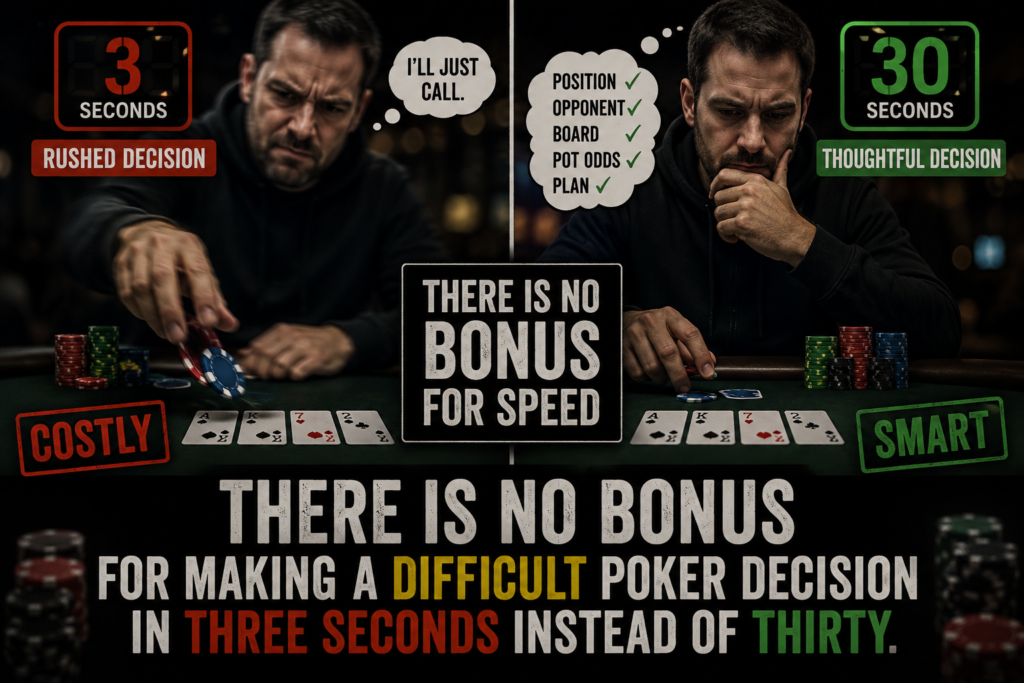
Consider the familiar poker expression “snap call.” Players sometimes use the term almost as a badge of honor: I snap called him. But when you’re facing substantial action and the correct decision isn’t immediately obvious, what exactly is gained by acting instantly?
There is no bonus for making a difficult poker decision in three seconds instead of thirty.
Take the time available to reconstruct the hand from the beginning. Consider the pre-flop action. Examine the board texture. Think about your opponent’s tendencies and previous actions. Consider the effective stack sizes, position, pot size, bet sizing, and the range of hands that reasonably fit the action. Then make the decision.
When the answer truly is obvious, very little analysis may be necessary. But when hundreds of dollars—or an entire stack—are at risk, an immediate reaction can bypass information that was available before the chips went into the pot.
Fast is not the same as decisive. And a reflexive decision is not necessarily a well-reasoned decision.
In simple terms, the process following a large mistake often looks something like this:
Large financial loss → Emotional reaction → Recognition → Review → Correction
Correction isn’t guaranteed. Players can rationalize even terrible decisions. But recognizing that something went wrong is at least the first step toward fixing it.
You don’t have to search very hard for the $700 mistake that ruined your session. It’s probably the hand you’ve been thinking about since you left the table.
The more difficult question is what happened to all the money that disappeared $6, $10, $20, $40, or $50 at a time.
The unnecessary straddle. The speculative call. The pre-flop call you barely considered. The extra money spent to see one more card.
Those mistakes don’t announce themselves nearly as loudly.
LITTLE MISTAKES ADD UP
The smaller mistakes are much easier to overlook because no single decision appears particularly damaging.
A $6 straddle doesn’t feel like much money. Neither does a $10 straddle. Calling another $20 or $30 pre-flop may seem relatively harmless, especially when you have hundreds or thousands of dollars in front of you. Even a questionable $40 call can disappear from memory almost immediately if you miss the flop, fold, and move on to the next hand.
There is no dramatic showdown. No stack disappears. There may not even be enough emotional reaction for you to remember the hand an hour later.
But the size of an individual mistake tells us only part of what that mistake costs.

FREQUENCY MATTERS
Suppose a player routinely makes a $40 decision that, after reviewing the situation, they determine is a mistake. Maybe it’s a loose pre-flop call, an unsupported post-flop call, or some other recurring decision. If it happened once every few months, it probably wouldn’t represent a significant leak.
But suppose it happens three times during an average session.
$40 × 3 = $120 per session.
If that player plays three sessions each week:
$120 × 3 = $360 per week.
Over 50 weeks:
$360 × 50 = $18,000.
The example isn’t intended to suggest that every questionable $40 decision automatically costs $40 in expected value, nor that every player repeats the same mistake at that frequency. The numbers simply demonstrate something that is easy to overlook:
Small amounts become large amounts when the same mistake is repeated often enough.
The same principle begins even lower.
An unnecessary $6 straddle made repeatedly throughout the year can become meaningful money. So can routinely calling $15 or $20 simply because several other players entered the pot. Add unnecessary pre-flop calls, mathematically incorrect draw calls, poorly considered small bluffs, and other recurring leaks, and the cumulative cost can become substantial without producing a single memorable hand.
This is why evaluating a mistake solely by the amount lost on one occurrence can be misleading.
A $500 mistake made once costs $500.
A much smaller mistake repeated hundreds of times can cost considerably more.
The better way to think about a recurring leak is:
Cost Per Error × Frequency = Long-Term Cost
That raises a very different question when reviewing your game.
Instead of asking only, “What was my biggest mistake?”
Ask:
“Which mistakes do I make most often?”
Because once repetition enters the equation, a so-called little mistake may not be little at all.
POSSIBILITY POKER VS. PROBABILITY POKER
One of the most common sources of costly poker mistakes is confusing what is possible with what is probable. Poker makes that particularly easy because the game continually presents outcomes that can happen. The next card can complete your straight. An opponent can be bluffing. A small pocket pair can flop a set. Suited connectors can make a straight or flush. A bluff can get through. None of those statements is wrong, but none of them provides enough information to make a sound decision.
The problem begins when the possibility of a favorable outcome becomes the reason for putting additional money into the pot. A player calls a pre-flop raise with a small pocket pair because they could flop a set, calls with suited connectors because they could make a straight or flush, or pays to see another card because the turn or river could improve the hand. In each case, the player has identified what they hope will happen without answering the more important question: How likely is it to happen?
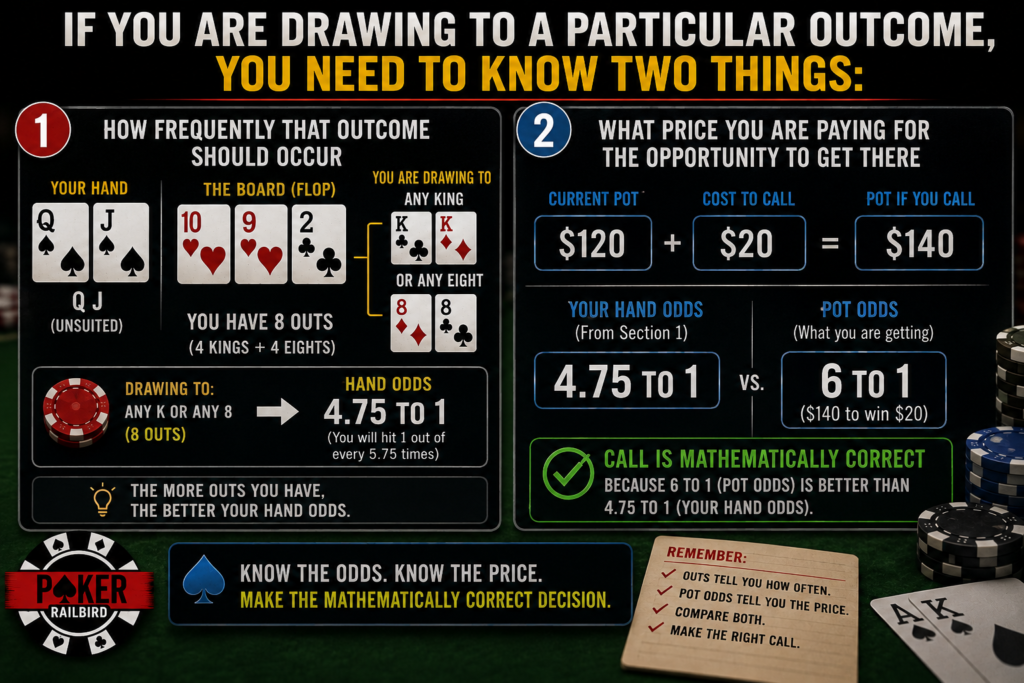
Probability gives meaning to possibility. If you are drawing to a particular outcome, you need to know how frequently that outcome should occur and what price you are paying for the opportunity to get there. You also need to consider whether the desired outcome actually produces the result you expect. An out may not be clean. Completing a draw may still leave you with the second-best hand. An opponent who could theoretically be bluffing may have taken a line that, based on everything you know about that player, makes a bluff relatively unlikely.
EXPENSIVE POKER MISTAKES BEGIN HERE
This is where many expensive poker mistakes begin with decisions that seem insignificant. Consider the familiar thought, “It’s only $30 more, and I could hit.” There are two pieces of information in that statement. Thirty dollars tells us the cost, while I could hit identifies the possibility. What is missing is the probability that allows us to compare the two. Without knowing how often the favorable outcome should occur, the fact that another card costs “only” $30 tells us very little about whether paying for it makes mathematical sense.
The same distinction applies when the favorable outcome depends on an opponent rather than the deck. Saying “he could be bluffing” establishes only that a bluff is possible. It tells us nothing about how frequently this particular opponent is likely to bluff in this particular situation. Likewise, saying “everyone could fold” does not establish whether a bluff is likely to succeed often enough relative to the amount being risked. Possibility identifies an available outcome; probability helps us evaluate how much weight that outcome deserves in the decision.
Possibility identifies an available outcome; probability helps us evaluate how much weight that outcome deserves in the decision.
WHEN A BAD DECISION PRODUCES A GOOD RESULT
Poker complicates the problem because mathematically poor decisions sometimes produce excellent results. A player can make an incorrect draw call and hit the needed card. A speculative pre-flop call can produce an unusually favorable flop. A poorly constructed bluff can work because an opponent happened to hold the bottom of their range. Those results can make the original decisions feel validated, even though nothing about the eventual outcome changes the information or probabilities that existed when the chips went into the pot.
That distinction is critical when evaluating poker mistakes that cost money over time. A favorable result does not automatically indicate a good decision, just as an unfavorable result does not automatically indicate a bad one. The decision has to be evaluated using the information, mathematics, and circumstances that existed at the moment it was made.
Possibility poker focuses on what could happen. Probability poker considers how likely it is to happen, what it costs to pursue that outcome, and whether the surrounding circumstances support the investment. Poker will always contain uncertainty, but uncertainty does not require guesswork. The objective is not to eliminate possibility from the decision; it is to put the possibility in its proper mathematical and situational context.
THE PRE-FLOP CALLS NOBODY REMEMBERS
Some of the most costly poker mistakes begin before the flop and end without anything memorable happening. A player calls a raise, misses the flop, faces a bet, and folds. The hand may last less than a minute, never reach showdown, and disappear from memory almost immediately. The chips lost pre-flop, however, are still gone.
These calls are particularly easy to overlook because players can find plenty of reasons to make them. The hand is suited. The cards are connected. Several players have already called. The raise is only another $20 or $30. The pot is getting bigger. The player has position. Perhaps they have already folded for an hour and simply want to play a hand. None of those considerations is meaningless, but none, by itself, establishes that calling is the correct decision.
A GOOD PRICE COMPARED TO WHAT?
SUITED HANDS & BROADWAY DRAWS
Players frequently justify a pre-flop call by saying they are getting good pot odds. If four other players have already entered the pot, the price may indeed appear attractive. But pot odds represent only one side of a mathematical comparison. A good price has meaning only when we consider what we are receiving for that price.
Suppose you hold a small pocket pair and are principally calling in hopes of flopping a set. The probability of flopping a set is approximately 11.8%, or about 7.5 to 1 against. If the immediate pot is offering roughly 4 to 1 on your call, then the direct pot odds alone are not paying you sufficiently for the probability of flopping the set. That does not automatically mean the call is wrong. Stack depth, position, opponents, implied odds, and other circumstances may provide sufficient additional value. But those factors are what must make up the difference; simply saying “I’m getting a good price” doesn’t complete the analysis.
The same principle applies to hands such as suited connectors, suited aces, and Broadway combinations. A player may know that 7-8 suited has attractive possibilities, but suited connector is a description of the hand, not a mathematical reason to call. What kinds of flops are you hoping to see? How frequently do they occur? What happens when you make only one pair? How often will overcards appear? What are the effective stacks, and how likely are you to realize additional value when you connect strongly?
This is where pre-flop decision-making often differs from the way players think after the flop. Once a player has a flush draw, many knowledgeable players immediately begin thinking about outs, hand odds, pot odds, and the price of seeing the next card. Yet before the flop, those same players may call without ever comparing the price of seeing the flop with the probabilities associated with the hand they are holding.
THE MATHEMATICS DID NOT SUDDEN BEGIN WHEN THE FLOP APPEARED

Pre-flop decisions also involve price, probability, position, opponents, stack sizes, and expected future value. The calculations may not always be as simple as counting nine flush outs against 47 unseen cards, but the underlying discipline is the same: understand what you are paying for and why you believe the investment makes sense.
That is why these calls can become expensive poker mistakes without ever producing a spectacular loss. A player calls $25, misses, and folds. Later, another $30 disappears the same way. Then $40. Each individual hand seems insignificant, and none becomes the hand discussed on the drive home.
But repeated often enough, the pattern becomes a leak. The problem isn’t that speculative hands should never be played. The problem is entering those pots without understanding the price, the probabilities, and the conditions required for the call to make sense.
A hand doesn’t become profitable simply because it is playable.
THE "ONE MORE CARD" LEAK
The same type of small leak that begins with a questionable pre-flop call often continues after the flop. The amounts change, the probabilities become easier to calculate, but the underlying thought process can remain remarkably similar: I’ll see one more card.
A player misses most of the flop but picks up some possibility of improvement. Perhaps there is an overcard, a gutshot, a weak flush draw, or a few cards that appear capable of improving the hand. The opponent bets $40 or $50, and the call doesn’t seem particularly expensive relative to the size of the player’s stack. Instead of evaluating the mathematics of the decision, the player pays for another card simply because improvement is possible.
This is another form of possibility poker. Once the flop has been dealt, however, much of the information required to evaluate the call is readily available. You can identify your potential outs, determine whether those outs are clean, calculate the probability of improving on the next card, and compare those hand odds with the pot odds being offered.
YOUR STACK SIZE DOESN'T DETERMINE THE PRICE
One of the easiest ways to rationalize these calls is to compare the amount of the bet with the size of the stack rather than with the size of the pot and the probability of improving. A player sitting behind $1,500 may look at a $50 call and think, It’s only $50.
But the fact that $50 represents a small percentage of your stack tells you nothing about whether the call is mathematically correct.
If the pot and the opponent’s bet are offering 3 to 1 while the probability of hitting the hand you need is 5 to 1 against, having another $1,450 behind doesn’t improve the immediate pot odds. The call still costs $50, the pot is still offering the same price, and the cards do not become more likely to cooperate simply because you can comfortably afford the call.

There may be other legitimate reasons to continue. Implied odds and position can matter. Opponent tendencies, future betting opportunities, and the possibility of winning without completing the draw can all affect the complete decision. But those considerations should be evaluated rather than used to avoid confronting the immediate mathematics.
NOT ALL OUTS ARE CLEAN OUTS
The quality of the outs matters as well. Counting eight possible cards that appear to improve your hand doesn’t necessarily mean you have eight clean outs. Some may complete a stronger draw for an opponent. Others may improve your hand while simultaneously producing a board on which substantial action should concern you. An apparent out that frequently leaves you with the second-best hand is not worth the same as an out that is likely to produce the winner.
This is why “I had outs” is not enough. How many? How clean were they? What were the odds of hitting one on the next card? What price were you being offered to try?
Those questions take only a short time to consider, yet ignoring them can create a recurring stream of costly poker mistakes. A mathematically unsupported $40 call may not hurt very much. Neither may the next $50 call. The individual amounts are small enough that they can disappear into the normal movement of chips during a session.
The danger is turning “one more card” into a habit. Once a player routinely pays to continue without comparing price to probability, the leak no longer belongs to one particular hand. It becomes part of the player’s decision-making process.
Sometimes the next card will arrive. Sometimes the draw will complete, the pot will be won, and the call will feel completely reasonable in retrospect. But as we have already seen, the result doesn’t determine whether the original decision was mathematically sound.
You are not paying for the card you hope will come. You are paying for the probability that it will.
SMALL BETS MADE WITH A PURPOSE
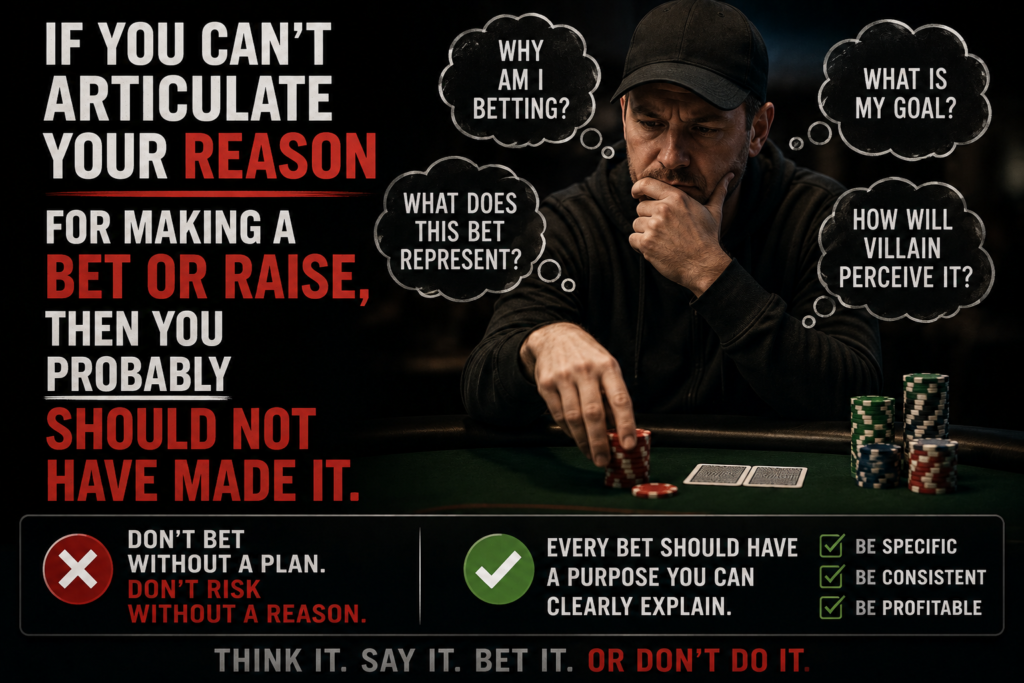
Not every costly poker mistake comes from calling too often. Players also lose money by putting chips into the pot without being able to clearly explain what the bet or raise is intended to accomplish.
Every bet should have a purpose. You may be betting for value because worse hands are likely to call. You may be bluffing because better hands can reasonably fold or maybe you are protecting equity, denying an opponent a profitable opportunity to continue, or using a particular sizing because it accomplishes something specific against the player and range you are facing. The exact reason will change with the situation, but there should be a reason.
Problems begin when betting becomes automatic.
A player raised pre-flop, so they automatically continuation bet the flop. An opponent checks, so they bet because checking back feels weak. They make a small bet to “see where they’re at,” even though they haven’t considered what useful information the opponent’s response will actually provide. They raise because they want to take control of the hand without first determining what the raise is supposed to accomplish.
None of these bets has to be particularly large to become expensive. In fact, their relatively small size can make them difficult to recognize as a leak. Losing $40 on an unnecessary continuation bet doesn’t create the same reaction as losing $500 on a failed river bluff. The $40 simply becomes part of the normal movement of chips around the table.
BETTING FOR INFORMATION CAN BECOME EXPENSIVE INFORMATION
The familiar “information bet” deserves particular attention because the explanation sounds reasonable. A player isn’t sure where they stand, so they put money into the pot hoping the opponent’s reaction will provide an answer.
The problem is that betting doesn’t necessarily produce a clear answer.
Suppose you make a small bet and your opponent calls. What did you learn? They may have a made hand, a draw, a marginal hand, a slow-played strong hand, or a hand they simply aren’t ready to fold. If they raise, the information may be more meaningful, but you’ve now paid money to create a larger and potentially more difficult decision.
Information has value in poker, but that doesn’t mean every piece of information is worth purchasing. Before making an information-driven bet, consider what each likely response will actually tell you and how that information will affect your next decision.
If you don’t know what a call, fold, or raise will mean before you make the bet, you may not be buying information at all. You may simply be putting additional money into the pot because you are uncomfortable with uncertainty.
A BET SHOULD ACCOMPLISH SOMETHING
The same scrutiny should be applied to small bluffs and automatic aggression. Betting because “I can’t win if I check” is not enough. Neither is betting simply because an opponent showed weakness. The relevant question is whether enough better hands can reasonably fold to make the bluff worthwhile given the amount being risked and the circumstances of the hand.
Value bets require the opposite analysis. If you are betting for value, which worse hands do you expect to call? If you cannot identify them, the bet may not be accomplishing what you think it is.

This does not mean every bet requires a lengthy internal debate. Many decisions become relatively straightforward once the situation is understood. But straightforward is different from automatic. A player should still understand why chips are going into the pot.
These small, purposeless bets are particularly dangerous because they can occur throughout an entire session. An unnecessary $25 bet here, a $40 continuation bet there, and a $60 bluff attempted without enough information may never become the hand you remember afterward. Taken individually, they may look insignificant. Repeated often enough, they become another source of expensive poker mistakes.
Before putting chips into the pot, a simple question can expose many of these leaks:
What exactly am I trying to accomplish with this bet?
If you cannot answer that question, the problem may not be your bet sizing. The problem may be the bet
WHEN BAD DECISIONS BECOME HABITS
Some costly poker mistakes are easy to identify because they occur in unusual situations. Others become far more difficult to recognize because they happen so frequently that the player eventually stops treating them as decisions at all.
Consider the straddle. A player sits down in a $1/$3 game where the button regularly straddles to $6, and before long the decision becomes automatic. The button moves around the table, the player posts the $6, and very little thought is given to whether straddling makes sense in that particular game. Six dollars may seem insignificant, especially with several hundred dollars in front of you, but the fact that an action is inexpensive does not mean it should be automatic.
The same thing happens with defending blinds, continuation betting, limping behind several callers, calling small pre-flop raises, and responding to aggressive opponents. Eventually, the player develops shortcuts: I always defend here. I always continuation bet this type of flop. Five players are already in, so I might as well call. I can’t keep folding to this guy or he’ll run over me.
These shortcuts can be useful when they are supported by a sound decision-making process. Poker would be unnecessarily exhausting if every routine situation required several minutes of analysis. The problem arises when experience stops making the decision more efficient and instead makes the decision automatic. At that point, the player may no longer be considering whether the current situation actually resembles the situations that originally produced the habit.
A $6 straddle made without thought is still a decision. So is a $25 blind defense, a $40 continuation bet, or a $50 call made because folding feels too passive. When those actions become habitual, their individual cost may remain small while their frequency increases. That is precisely the combination that allows a seemingly minor leak to become expensive over time.
WHEN POKER TERMINOLOGY BECOMES AN EXCUSE
Habits do not always appear as automatic physical actions. Sometimes the habit is the explanation players give themselves for continuing with a decision they already want to make.
Poker provides an enormous vocabulary for doing this. Implied odds. Equity. Position. Pot committed. Priced in. Good multiway hand. Each term describes a legitimate poker concept, and each can be relevant to a decision. The problem begins when naming the concept replaces actually evaluating it.
Saying “I had implied odds” does not establish that sufficient implied odds existed. How much additional money could realistically be won if the hand improved? Were the effective stacks deep enough? Was the opponent likely to pay off the completed hand? Could the same card that improved your hand also improve an opponent to something better?
Likewise, saying “I had equity” tells us very little by itself. Every live hand has some amount of equity against some range of hands. The relevant question is whether the available equity, price, opponent range, and circumstances support putting additional money into the pot.
The same applies to being “priced in.” Priced in relative to what? What price is the pot offering, and what probability does the hand have of producing the required outcome? Without that comparison, the phrase can become little more than permission to call.
Position can provide an advantage, but position does not transform every marginal hand into a profitable one. A hand may perform well multiway, but calling simply because several other players entered the pot does not establish that the price, probability, stack depth, and opponents make the call worthwhile.
The terminology isn’t the problem. Using terminology as a substitute for analysis is.
DID THE REASON COME BEFORE OR AFTER THE DECISION?
One useful way to identify this behavior is to pay attention to when the explanation for a decision actually occurs.
Before acting, did you evaluate the pot odds, implied odds, opponent tendencies, position, effective stacks, and other relevant factors and then reach a decision?
Or did you decide that you wanted to call first and explain it afterward by saying “implied odds”?
That difference matters.
In the first case, the poker concept contributed to the decision. In the second, the concept may simply be rationalizing it.
This is one reason recurring poker mistakes that cost relatively small amounts can survive for so long. Once the behavior has become automatic and the player has developed a familiar explanation for it, there may be very little internal resistance left. The action feels normal, and the justification is readily available.
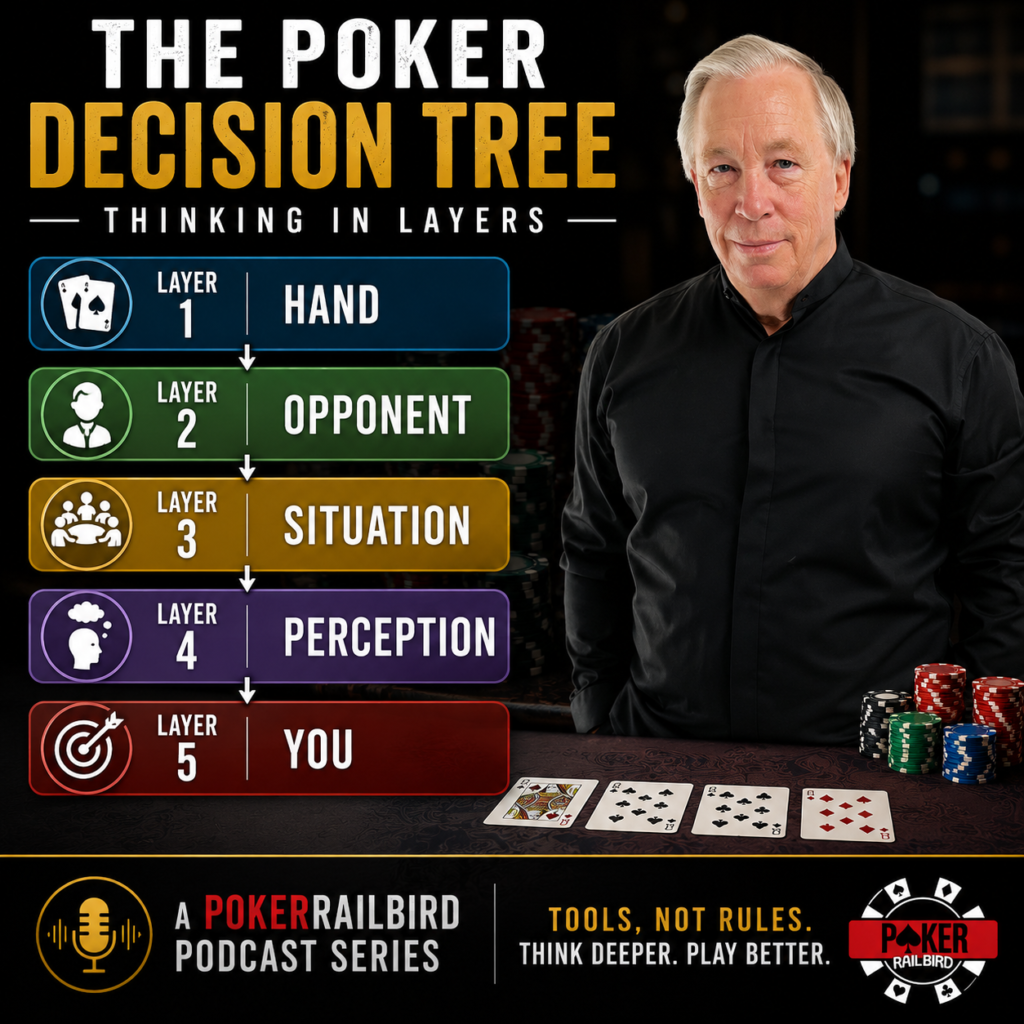
Breaking that pattern requires bringing the decision back into conscious evaluation. You don’t have to abandon straddling, defending blinds, continuation betting, speculative calls, or any other legitimate poker action. You do need to know why you are doing it in this situation.
The most dangerous habits at the poker table may not be the ones you know are bad. They may be the ones you’ve repeated so often that you stopped asking whether they are good.
FIND AND MEASURE THE MISTAKES YOU DON'T NOTICE
Most players know which hands they want to review after a difficult session. The largest pot they lost usually makes the list. So does the unsuccessful bluff, the questionable river call, the bad beat, or the hand that ended with most of a stack moving across the table. Those hands deserve examination, but focusing exclusively on them can leave some of the most costly poker mistakes untouched.
The problem is one of visibility. A $600 mistake produces a $600 event to investigate. A recurring $30 mistake may be scattered across five different hands, none of which seems important enough to remember. Unless you deliberately look for the pattern, you may never realize those decisions are related.
That means an effective session review should include more than asking, Where did I lose the most money? It should also ask where money repeatedly left your stack in smaller amounts. How many marginal hands did you call with pre-flop? How often did you pay to see another card without comparing the price to the probability of improving? And how many bets were made without a clearly defined purpose? How much did automatic straddles cost? How often did “it’s only another $20” influence a decision?
The objective isn’t to second-guess every chip you put into the pot. Poker includes plenty of correct decisions that lose money, and a losing hand is not evidence that the decision was wrong. What you’re searching for are recurring decisions that deserve closer examination.
IDENTIFY THE PATTERN BEFORE TRYINT TO FIX IT
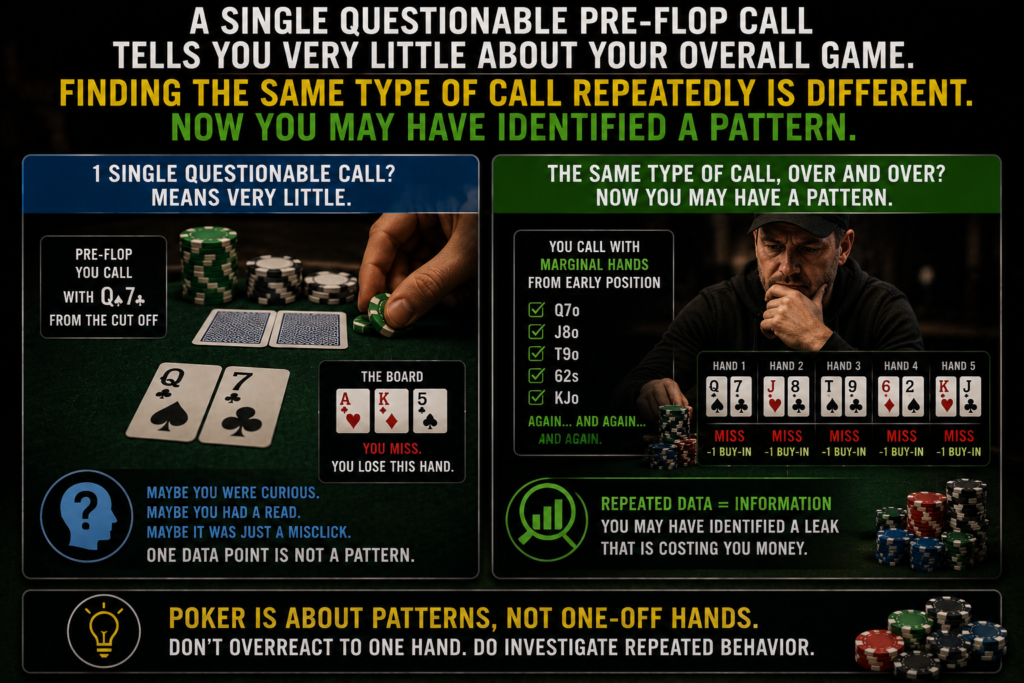
A single questionable pre-flop call tells you very little about your overall game. Finding the same type of call repeatedly is different. Now you may have identified a pattern.
Suppose you notice that you frequently call raises with marginal suited hands when several players have already entered the pot. Don’t immediately reduce the observation to “I play too many suited hands.” Look at the circumstances surrounding those calls. What position were you in and what price were you receiving? What were the effective stack sizes? Who raised? What did you know about the players already in the hand? What probability were you paying for, and what future value did you reasonably expect when you connected with the flop?
The purpose is to identify the actual decision that may be creating the leak. Otherwise, you risk replacing one automatic behavior with another. Always call suited connectors is a rule. Never call suited connectors is simply another rule. Neither evaluates the situation in front of you.
Once the pattern has been identified, the next step is to determine how often it occurs. This is where session notes and basic tracking become particularly valuable. Memory is poorly suited to measuring small repetitive decisions because those are precisely the hands most likely to be forgotten.
TURN THE LEAK INTO SOMETHING YOU CAN MEASURE
A vague observation such as “I probably call too much pre-flop” is difficult to correct because it tells you neither the size nor the frequency of the problem. A measurable observation is much more useful: During my last five sessions, I made 14 marginal pre-flop calls that I could not support after reviewing the price, position, opponents, and circumstances.
Now there is something to work with.
The process can remain simple:
Identify → Track → Quantify → Correct → Monitor
Identify the recurring decision. Track when and under what circumstances it occurs. Quantify its frequency and, where practical, its financial impact. Correct the decision-making process that produces it. Then monitor future sessions to determine whether the behavior actually changes.
The financial calculation should also be handled carefully. If you call $40 pre-flop and later determine that the call was questionable, that does not automatically mean the mistake cost exactly $40 in expected value. Poker doesn’t work that way. But tracking the money committed to recurring questionable decisions can reveal the scale of a behavior that otherwise feels insignificant one hand at a time.
This is also why the frequency of a mistake matters so much. You may discover that a particular $100 error occurs once every few months while a seemingly harmless $20 decision occurs several times every session. The larger individual mistake may still deserve attention, but the smaller recurring decision may represent the more important leak to correct.
REVIEW DECISIONS: NOT JUST RESULTS
The final step is separating the quality of the decision from the outcome of the hand. If you identify a recurring mistake only when the hand loses, you’ll miss the same mistake whenever the cards happen to bail you out.
A questionable call that produces a winning river is still worth reviewing. An unsupported bluff that happens to work is still worth examining. A speculative pre-flop call that flops an unusually strong hand doesn’t disappear from the review simply because you won the pot.
The reverse is equally important. A mathematically sound call that misses does not become a mistake because the next card failed to cooperate.
The purpose of reviewing these hands isn’t to create a record of everything that went wrong. It’s to determine whether your decision-making process is repeatedly putting money at risk for reasons that don’t withstand examination.
Big mistakes are usually easy to find because they leave evidence in the size of the pot. Little mistakes require more deliberate investigation.
But once you identify them, track them, and measure how frequently they occur, they become much harder to ignore.
FINAL THOUGHTS: THERE MAY BE NO SUCH THING AS A LITTLE MISTAKE
Poker bankrolls rarely disappear in one dramatic decision. More often, the damage occurs gradually, a few chips at a time, through decisions that seem too small to deserve much attention.
That is what makes these mistakes dangerous. The $6 straddle doesn’t hurt. The $25 pre-flop call doesn’t ruin the session. Paying another $40 to see the turn doesn’t feel catastrophic. A small bluff that had no real purpose is quickly forgotten. There is always another hand coming, and each individual amount seems insignificant compared with the stack sitting in front of you.
But your bankroll doesn’t distinguish between money lost dramatically and money lost quietly. A dollar unnecessarily put at risk is still a dollar unnecessarily put at risk.
The objective isn’t to become afraid of putting chips into the pot or to eliminate every aggressive, speculative, or unconventional decision from your game. Poker requires judgment, adaptation, and calculated risk. The objective is to make those decisions deliberately—to know why you’re making them and whether the mathematics, information, and circumstances support them.
Your biggest loss may not represent your biggest leak. The hand that cost you $700 will get your attention because it happened all at once. The habit that costs you $20 or $40 repeatedly may never produce a single memorable moment, yet over hundreds of sessions it can become far more expensive.
That is why improving your game requires looking beyond the hands that hurt the most. Pay attention to the decisions that have become routine, the chips that leave your stack almost unnoticed, and the actions you no longer stop to question.
Don’t measure a poker mistake only by what it costs you once. Measure it by what it costs you every time you repeat it.
Over the long term, there may be no such thing as a little mistake.