

BETTING MOTION TELLS IN POKER
Every bet or raise in poker involves a physical action. Some players carefully arrange their chips before pushing them forward, while others slide, flick, or toss them into the pot. The speed, force, and manner in which these movements are executed can sometimes provide information about the strength of a player’s hand. These physical behaviors are known as Betting Motion Tells.
Poker tells researcher Zachary Elwood identifies two distinct categories of betting behavior: subtle movements that often occur unconsciously and exaggerated actions that stand out from a player’s ordinary behavior. Both can provide useful information, but their meanings are not necessarily the same.
A forceful betting motion, for example, may accompany either a bluff or a strong hand. The same is true of a gentle, deliberate movement. Understanding these differences requires recognizing the behavioral tendencies involved and the circumstances under which they occur.
SUBTLE BETTING MOTIONS
Subtle betting motions are small differences in how a player physically places chips into the pot. These movements are often unconscious and may be difficult to recognize without careful observation. A player might push chips forward with slightly more force, release them with a quicker wrist movement, or arrange them differently depending on the strength of their hand.
In his research on Betting Motion Tells, Zachary Elwood identifies two opposing tendencies. Some players bet more forcefully when bluffing, while others exhibit greater force when value-betting. Both behaviors can occur naturally, even among players who consciously attempt to keep their betting motions consistent.
TENDENCY 1: MORE FORCEFUL WHEN BLUFFING
Some players exhibit slightly more aggressive betting movements when bluffing or semi-bluffing than when betting a strong hand.
The differences may be almost imperceptible. A player might release their chips with a faster flick of the wrist, push them a little farther across the felt, or use a more pronounced movement when cutting out a bet. Their hand may even rise slightly after releasing the chips. These actions are rarely dramatic enough to attract attention from someone who isn’t deliberately observing them.
One possible explanation involves the unconscious desire to project confidence. When bluffing, a player may instinctively use a firmer, more decisive betting motion to communicate strength. When holding a strong hand, that same player may become more deliberate and gentle, avoiding movements that could discourage an opponent from calling.
These differences do not necessarily reflect a deliberate attempt at deception. The player may be completely unaware that their betting motions change.
TENDENCY 2: MORE FORCEFUL WHEN VALUE-BETTING
Other players display the opposite tendency. Their betting movements become slightly more energetic or forceful when holding a strong hand, while their bluffs are accompanied by gentler, more controlled actions.
According to Elwood, this second tendency appears to be more common among players who exhibit subtle betting-motion tells.
A strong hand can produce a sense of relief or confidence. The uncertainty associated with holding a weaker hand diminishes, allowing the player to become more physically relaxed and animated. That change may appear as a quicker betting motion, a firmer chip release, or a more energetic movement of the hand.
When bluffing, the same player may become noticeably more restrained. Their movements can appear careful and controlled, possibly reflecting an unconscious desire to avoid attracting attention or to project a calm, confident appearance.
The differences can be extremely small. A player might follow the same betting procedure every time, yet vary the speed or force of the movement just enough to create an observable tendency.
OTHER SUBTLE BETTING MOVEMENTS WORTH OBSERVING
Although the force of a betting motion is particularly important, Elwood identifies several additional physical behaviors that may be worth watching.
For example, how far does a player extend their arm when betting? Do they keep their elbow bent, or reach forward with their arm fully extended? How far do their chips travel across the felt, and do they carefully arrange their stacks before pushing them into the pot?
These details may reveal differences in how a player executes their bets. Mike Caro, for example, suggested that bluffers are more likely to extend their arms fully when betting. Elwood acknowledges this possibility but cautions that he has not observed a sufficiently consistent tendency to apply it broadly.
The significance of these movements depends on the individual player. An extended arm, carefully arranged stack, or unusually short betting motion should not automatically be associated with a particular hand strength.
KNOW WHERE TO FOCUS YOUR ATTENTION
Not every opponent provides useful information through their betting movements.
Experienced players often develop consistent procedures for placing chips into the pot, minimizing variations that might reveal information. When a player’s movements remain essentially unchanged from one hand to another, continued scrutiny may offer little benefit.
Elwood advises concentrating on opponents whose betting motions vary noticeably. Players who frequently change how they handle, arrange, or release their chips may provide more opportunities to identify meaningful behavioral tendencies.
Recognizing when these differences are absent is equally useful. At a live cash-game table, attention is a limited resource, and some opponents simply provide more observable information than others.
EXAGGERATED BETTING ACTIONS: WHEN STRONG MEANS STRONG
While subtle betting motions involve small, often unconscious changes in how players handle their chips, exaggerated betting actions are considerably more noticeable. These behaviors involve unusually forceful movements, theatrical gestures, or aggressive physical displays that stand out from a player’s ordinary betting routine.
Zachary Elwood identifies an important tendency associated with these exaggerated actions: players who make unusually aggressive or conspicuous betting movements are often holding strong hands.
This observation challenges the traditional poker assumption that players who act strong are attempting to conceal weakness. Mike Caro’s well-known principle that strength often represents weakness can apply to certain poker behaviors, but Elwood argues that it is frequently misapplied to exaggerated betting actions.
In Elwood’s experience, these conspicuous displays are much more commonly associated with genuine hand strength than with bluffing.
THE PSYCHOLOGY BEHIND EXAGGERATED BETTING ACTION
Holding a strong hand can produce a significant psychological change. A player who was previously concerned about being outdrawn, making a difficult decision, or losing a substantial pot may suddenly experience confidence or relief.
For some players, that change releases physical energy. Their betting movements become more animated, their gestures more pronounced, and their willingness to engage opponents more noticeable.
A player might shove chips aggressively into the pot, throw them farther across the table than usual, or make an unusually forceful betting motion while staring directly at an opponent. Others may accompany their bets with provocative comments or theatrical displays of confidence.
One possible explanation is that players holding strong hands feel less concerned about attracting attention. They may become comfortable expressing themselves physically, particularly when they believe they have an opponent in a difficult position.
Bluffers, however, often have a reason to remain restrained. Their objective is to persuade an opponent to fold, and unusual behavior may attract unwanted attention or encourage curiosity about their hand.
Elwood distinguishes between inexperienced players, whose anxiety about being called may produce naturally cautious movements, and more experienced players, who understand the value of maintaining ordinary behavior when bluffing.
Although their motivations may differ, both types of players can exhibit relatively calm, controlled betting actions when attempting to win a pot without a showdown.
WHEN BETTING ACTIONS BECOME UNUSUALLY AGGRESSIVE
Exaggerated Betting Motion Tells can involve more than the force used to push chips into the pot. They may also appear as sudden, conspicuous changes in how a player executes a bet.
For example, Elwood describes a player who initially reaches for a few chips, apparently preparing to make a small bet, but then seems to change their mind and forcefully throws a much larger amount into the pot.
The unusual sequence of movements is significant. Rather than simply placing a large bet, the player makes a conspicuous physical display that Elwood associates with genuine hand strength.
Other examples include aggressively throwing chips toward a particular opponent, accompanying a bet with an intimidating stare, or engaging in unusually confrontational behavior while placing chips into the pot.
Elwood considers these exaggerated actions especially noteworthy because they frequently reflect a player’s confidence or emotional response to holding a strong hand.
There are exceptions. Some players deliberately perform aggressive actions when bluffing, and an unusual betting motion cannot establish hand strength with certainty. Nevertheless, Elwood’s observations suggest that conspicuous aggression is considerably more likely to accompany strength than weakness.
The critical distinction is between an ordinary variation in betting force and an exceptionally aggressive or theatrical action. Although both involve physical movement, they may arise from entirely different psychological responses.
DISTINGUISHING SUBTLE BETTING MOTIONS FROM EXAGGERATED ACTIONS
One of the more interesting aspects of Betting Motion Tells is that a player can exhibit subtle behavioral tendencies and exaggerated betting actions that appear to contradict one another. Zachary Elwood explains that these behaviors can coexist because they represent different types of physical responses.
Consider a player who normally handles their chips in a relatively consistent manner. When holding a strong hand, they carefully arrange their chips and push them forward with a gentle, deliberate motion. When bluffing, however, their movements become slightly quicker and more forceful.
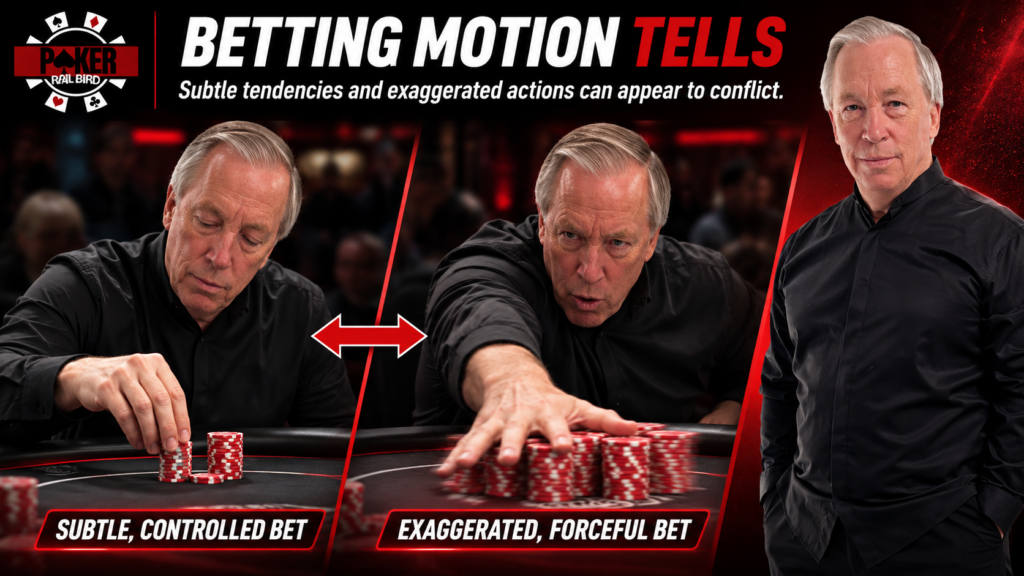
Over time, these subtle differences may become recognizable to an attentive opponent.
Now imagine that same player has been losing several substantial pots and is becoming increasingly frustrated. Later in the session, they make a very strong hand against an opponent who has repeatedly beaten them.
Instead of their usual gentle betting motion, they suddenly shove a large stack of chips aggressively across the felt, perhaps accompanied by an unusually confrontational gesture.
At first glance, this behavior might appear to contradict their established tendency to bet more forcefully when bluffing. However, the exaggerated movement represents a different category of behavior.
WHY BOTH BEHAVIORS CAN OCCUR
The subtle increase in betting force may be part of a player’s habitual behavior when bluffing. An exaggerated shove, however, may reflect an entirely different emotional response to holding a strong hand.
These observations are not necessarily contradictory. They involve different categories of behavior, each potentially influenced by different psychological factors.
The important distinction is the degree and character of the movement. A slightly quicker wrist motion is fundamentally different from an unusual, theatrical shove across the table.
WHEN EXAGGERATED ACTIONS OUTWEIGH SUBTLE TENDENCIES
Elwood makes an especially important observation about these seemingly conflicting behaviors. In his experience, unusually aggressive or theatrical betting actions are so frequently associated with strong hands that they may outweigh a player’s established subtle betting tendencies.
Consider the player in our example. Their ordinary pattern suggests that slightly more forceful betting movements accompany bluffs. However, the sudden, exceptionally aggressive shove represents a departure from those ordinary movements.
Elwood argues that this type of exaggerated behavior is a particularly strong indication of genuine hand strength, even when the player’s smaller betting movements have previously suggested the opposite.
That distinction is important because interpreting every forceful movement according to the same behavioral tendency can lead to misleading conclusions.
Although Elwood emphasizes the reliability of exaggerated betting actions in his observations, his conclusion remains an experience-based assessment rather than a universal rule.
Subtle betting motions and exaggerated betting actions must be recognized as separate behavioral categories. Understanding that distinction helps explain how the same player can display seemingly contradictory movements without those observations necessarily being inconsistent.
WHAT BETTING MOTIONS CAN TELL US
Betting Motion Tells can provide valuable information about a player’s hand, but the distinction between subtle movements and exaggerated actions is important. Small differences in speed, force, or chip handling may accompany either strength or weakness, depending on the individual player.
Zachary Elwood’s observations also challenge the traditional assumption that aggressive physical behavior indicates a bluff. While subtle betting movements can have opposing meanings, unusually forceful or theatrical betting actions are more frequently associated with strong hands.
The most useful observations come from recognizing how a player normally handles their chips and identifying meaningful changes in that behavior. Some players reveal subtle differences, others occasionally display exaggerated actions, and experienced players may maintain sufficiently consistent movements to provide little useful information.
As with all poker tells, the reliability of these observations depends on their correlation with the player’s actual holdings. For a more detailed examination of how to evaluate and interpret behavioral information, see our companion article and video, Interpreting Poker Tells.