
PERSONALIZED POKER COACHING
HOW POKERMIND ADAPTS TO YOUR GAME
Personalized poker coaching should begin with a simple fact: poker players don’t all need the same help.
Two players can sit in the same $2/$5 game, play similar hours, and have completely different strengths and weaknesses. One may understand pot odds and hand probabilities but repeatedly allow impatience to affect otherwise sound decisions. Another may remain disciplined but struggle with the mathematics behind draws, equity, or expected value. A third may understand both, yet fail to recognize meaningful changes in an opponent’s behavior or adjust to the way a particular table is playing.
Giving those three players the same material in the same order isn’t personalized coaching. It’s standardized poker training.
PokerMind was designed differently.
The process begins by learning about the player: experience level, the games and stakes being played, development goals, and the areas where the player wants help. That information establishes a starting point, but it does not define the player permanently. What someone believes needs improvement and what eventually appears through actual hands, sessions, decisions, and practice may not always be the same thing.
That distinction matters because poker decisions rarely depend on one piece of information. The mathematics of the hand, position and effective stack size are all important. Betting action and player behavior are equally as important. Psychology can affect how information is interpreted and acted upon. Previous decisions may reveal patterns that would be difficult to recognize by examining one hand in isolation.
PokerMind brings those areas together rather than treating them as unrelated subjects.
POKER DECISIONS REQUIRE MORE THAN ONE KIND OF INFORMATION
A poker decision doesn’t exist in isolation. Before deciding whether to check, bet, call, raise, or fold, a player may have several different kinds of information available. The challenge is determining which information is relevant to the decision and how much weight it deserves.
That is one of the foundations of personalized poker coaching. The objective isn’t simply to provide a player with an answer, but to evaluate the decision using the information that applies to the situation that player is actually facing.
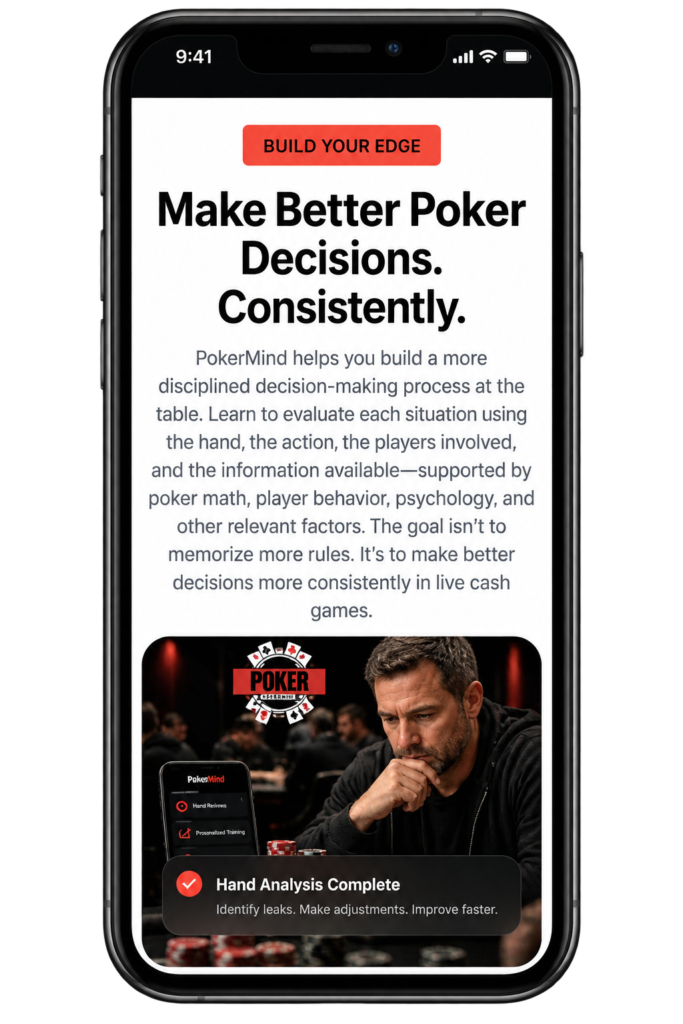
PokerMind approaches that process from three connected areas: the decision itself, the mathematics supporting it, and the available information about the players involved.M
MAKE BETTER POKER DECISIONS
Every decision begins with the situation in front of you.
What is your hand, what action has already occurred, and what is your position? What are the effective stack sizes? How large is the pot and what is the bet size? Who are the players involved, and what relevant information do you have about them?
Those facts establish the decision you actually need to make.
This is important because poker advice can become misleading when the situation is reduced to something overly simple such as, “Should I call with top pair?” No universal answer exists. Top pair in a heads-up pot against a particular opponent is not automatically the same decision as top pair in a five-way pot facing substantial action.
PokerMind evaluates the situation using the information available rather than starting with a predetermined rule for how a hand should be played.
USE THE POKER MATH THAT APPLIES TO THE DECISION
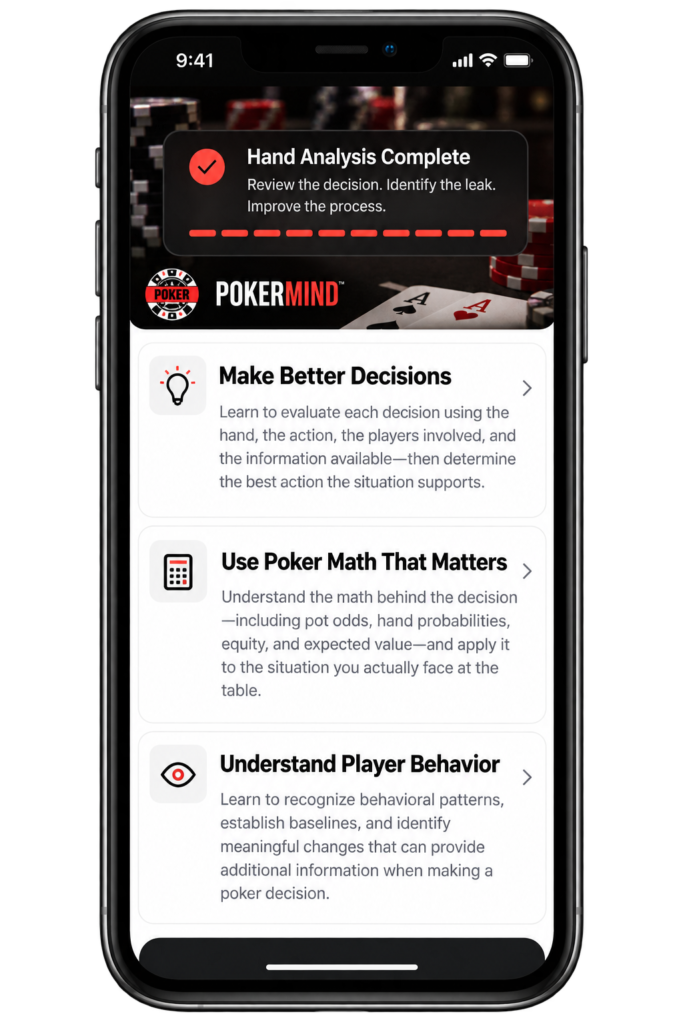
Once the situation is established, the mathematics provides the foundation for evaluating the available choices.
Depending on the decision, that may involve pot odds, hand probabilities, equity, expected value, the number of cards remaining unseen, or other relevant calculations.
But the objective isn’t to perform every poker calculation simply because one exists. The objective is to determine which mathematics applies to the decision being made.
A flush draw may require one calculation. A river call with a completed hand may require another. A preflop decision involving effective stack depth may depend on an entirely different mathematical relationship.
This is why PokerRailbird has always treated poker math as a tool rather than a collection of rules to memorize. The numbers establish what the situation mathematically supports. They still have to be applied to the actual hand being played.
UNDERSTAND THE PLAYERS INVOLVED
Poker is not played against a deck of cards alone. It is played against other people.
Player behavior can provide additional information when there is sufficient evidence to support it. Betting patterns, previous actions, tendencies, behavioral baselines, and meaningful deviations from those baselines may all contribute information to a decision.
The important distinction is that this information supplements the mathematical and situational evidence rather than replacing it.
A player behaving unusually does not make an unprofitable call mathematically profitable simply because the behavior looks suspicious. Likewise, mathematics doesn’t require us to ignore reliable information about an opponent when that information legitimately changes the assumptions behind the decision.
This is where the PokerRailbird philosophy of Tools, Not Rules becomes especially important.
Poker math is a tool. Player behavior is a tool. Position, stack depth, betting action, psychology, and previous information about an opponent can all be tools.
The objective is not to find one of those tools and use it for every decision.
The objective is to determine which information applies, establish what the evidence supports, and make the decision from there.
That is the decision-making foundation PokerMind is designed to build on.
YOUR GAME DETERMINES WHAT YOU NEED TO WORK ON
WHAT YOU WANT TO IMPROVE IS THE STARTING POINT
Knowing which factors can matter in a poker decision is only part of the process. The next question is more personal:
Which parts of your game actually need work?
That answer will be different for every player.
One player may routinely make mathematically incorrect calls because they don’t understand the underlying probabilities. Another may calculate the same situation correctly away from the table but abandon that calculation during live play. Someone else may understand the math and remain disciplined, yet consistently make poor assumptions about opponent ranges or place too much weight on unreliable behavioral information.
Those players may make similar mistakes at the table, but the source of those mistakes is different. Effective personalized poker coaching has to distinguish between them.
When you begin using PokerMind, you provide information about your experience, goals, and the areas where you believe you need help. That information matters because you know things about your poker background and objectives that PokerMind cannot know until you provide them.
But those initial answers are a starting point, not a permanent definition of your game.
Self-assessment has limitations. A player may identify poker math as a weakness when they actually understand the underlying calculations reasonably well. The larger problem may be applying that math consistently during live decisions.
Another player may believe discipline is the primary issue, while the decisions made during actual play eventually reveal a misunderstanding of pot odds or hand probabilities.
Neither player’s initial assessment is necessarily wrong. It is simply incomplete until the game itself provides evidence.
WHAT YOU DO AT THE TABLE ADDS THE EVIDENCE
This is where personalization begins moving beyond what a player believes about the game toward what the player’s decisions actually show.
A player who says, “I need to improve my poker math,” has identified an area of concern. A player who repeatedly makes decisions inconsistent with the mathematics has provided evidence of where the problem may exist.
The same principle applies elsewhere. A player may identify psychology as a concern, believe player reads are a strength, or think a particular mistake occurs only occasionally. As more information becomes available from actual play, those initial assumptions can be compared with what is happening at the table.
That distinction is important because two players can make the same mistake for entirely different reasons.
Consider two players who make the same loose river call. One may misunderstand the required equity. The other may understand the calculation but allow curiosity, frustration, or an unsupported read to override it.
The visible mistake is the same.
The underlying problem is not.
Personalized poker coaching becomes more useful when it can distinguish between the action a player took and the reason that action occurred.
BUILT AROUND HOW YOUR ACTUALLY PLAY
PokerMind therefore does not permanently define your development needs from the answers you provide when you first arrive.
Your experience and goals establish direction. The areas you identify for improvement establish initial priorities. What happens as you actually play provides additional evidence about where attention may be needed.
That is what “Built Around How You Actually Play” is intended to mean.
The objective isn’t to classify someone permanently as a “math player,” a “psychology player,” or a “tells player.” It is to develop a clearer picture of the individual player’s game and determine which areas deserve attention as more information becomes available.
Once those areas are identified, the next question is how PokerMind works on them.
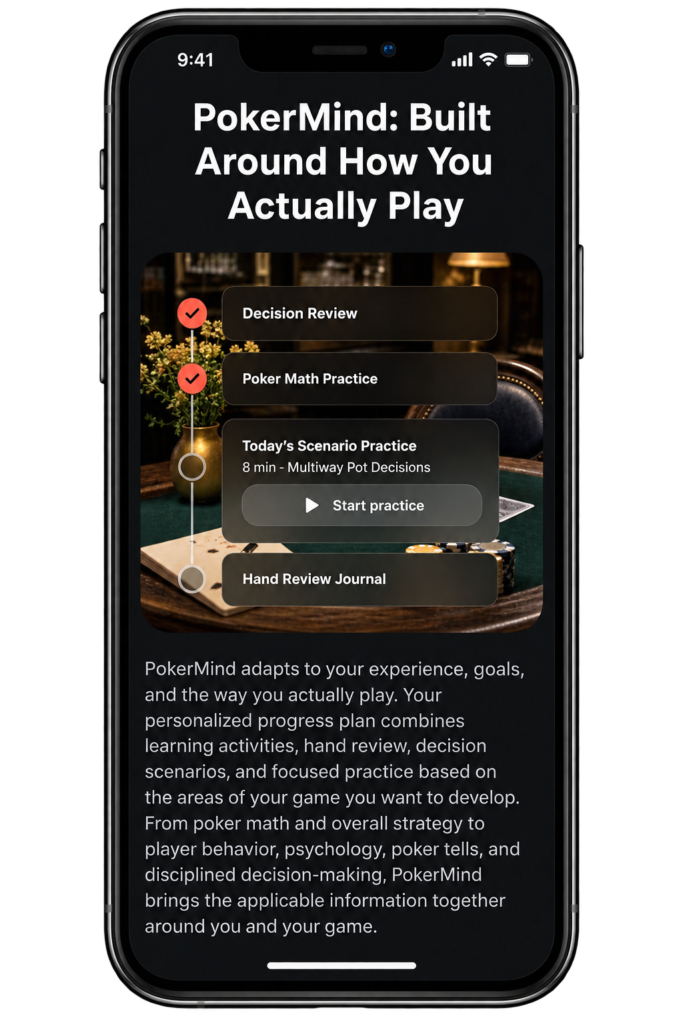
HOW THE PIECES OF PERSONALIZED POKER COACHING WORK TOEGTHER
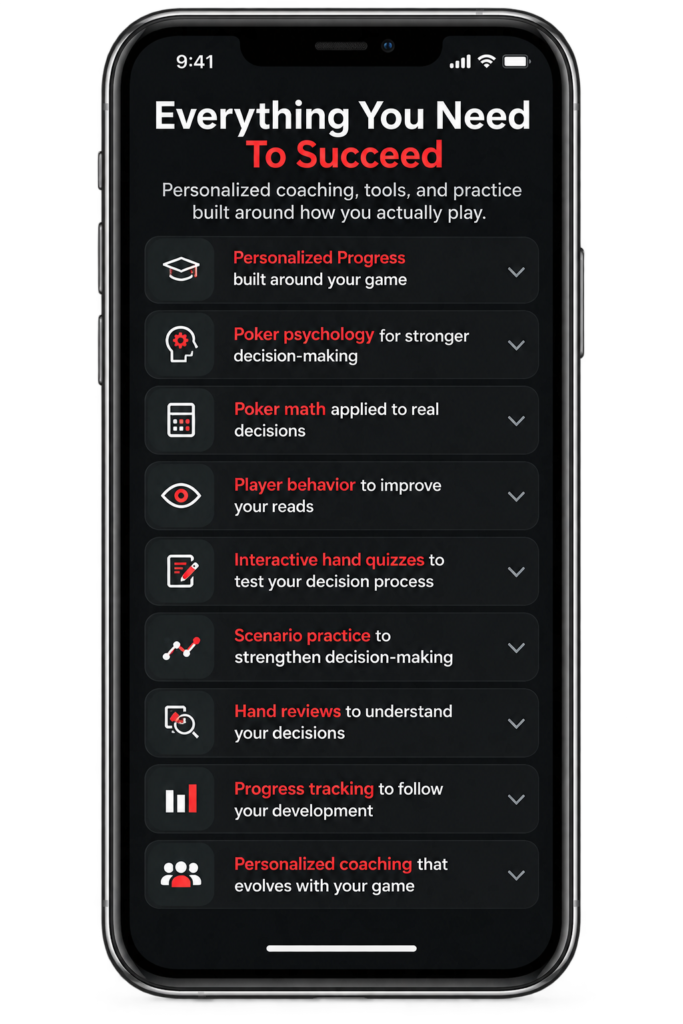
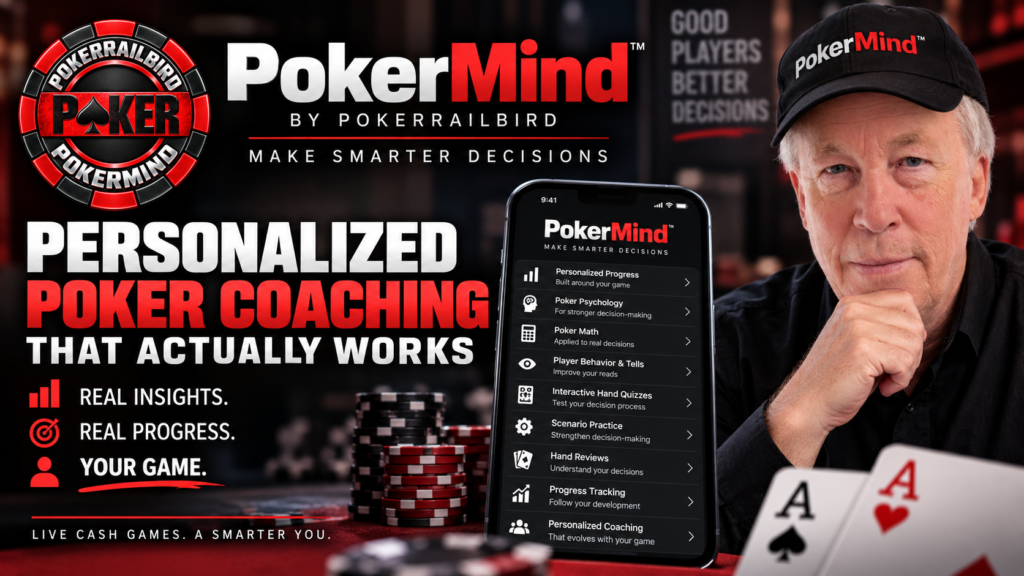
PokerMind uses different forms of learning, practice, review, and player information because no single activity provides a complete picture of a player’s game. Each component serves a different purpose, while the information developed through them contributes to personalized poker coaching.
PERSONALIZED PROGRESS BUILT AROUND YOUR GAME
Your starting point reflects your experience, goals, and the areas where you want to improve. As you use PokerMind, your progress and demonstrated needs provide additional information that can help determine which activities and areas of your game deserve greater attention.
POKER PSYCHOLOGY FOR STRONG DECISION-MAKING
Knowing the mathematically supported decision doesn’t guarantee that a player will make it. Tilt, impatience, emotional decision-making, and other psychological factors can influence what happens at the table. PokerMind helps you recognize when those factors are affecting your decisions and where the decision process may need work.
POKER MATH APPLIED TO REAL DECISIONS
PokerMind applies mathematics to the decisions where it matters. That can include pot odds, hand probabilities, equity, expected value, and bet sizing. The objective isn’t simply to learn calculations, but to understand which calculation applies, what the numbers mean, and when to use them in an actual poker decision.
PLAYER BEHAVIOR TO IMPROVE YOUR READS
Player behavior and poker tells can provide additional information when there is sufficient evidence behind the observation. PokerMind draws on the PokerRailbird approach to tells: identify behavioral patterns, establish baselines, and evaluate meaningful deviations from those baselines.
A tell is not treated as an automatic rule. It is another source of information to evaluate alongside the hand, betting action, mathematics, previous observations, and other relevant evidence.
INTERACTIVE HAND QUIZZES TO TEST YOUR DECISION PROCESS
Interactive hand quizzes test more than whether you can select the correct answer. You work through realistic poker situations, explain your reasoning, and apply concepts you’ve already studied. This gives Coach information about how you arrived at the decision, not simply whether the final choice was correct.
SCENARIO PRACTICE TO STRENGTHEN DECISION-MAKING
Scenario practice gives you constructed poker situations where you may have to evaluate several pieces of information together. You may need to consider the hand, opponent, action, position, stack depth, mathematics, or other relevant factors before deciding how to proceed.
Unlike a quiz designed primarily to test what you understand, scenario practice lets you work through the decision-making process itself.
HAND REVIEWS TO UNDERSTAND YOUR DECISIONS
Hand reviews bring the analysis back to poker you’ve actually played. PokerMind can examine the hand in context, including the information available at the time and your reasoning behind the decision.
Reviewing actual decisions can help identify recurring patterns, strengths, and potential leaks that may be difficult to recognize when each hand is considered separately.
PROGRESS TRACKING TO FOLLOW YOUR DEVELOPMENT
Progress tracking is not simply a record of completed activities. PokerMind follows learning activity, concept development, and recurring strengths and weaknesses to help identify where your game is developing and where additional work may still be needed.
That distinction matters because completing an activity does not, by itself, demonstrate that the underlying concept has been understood or applied effectively.
PERSONALIZED COACHING THAT EVOLVES WITH YOUR GAME
This is where the individual components come together.
PokerMind Coach can use your experience, goals, demonstrated needs, recurring decision patterns, progress, and the information you provide about your game to determine where attention may be needed. Coaching, practice, and applicable PokerRailbird resources can then be recommended around those needs rather than simply following the same fixed curriculum for every player.
As additional information becomes available, the areas requiring attention can change as well.
Personalized coaching is therefore not a separate feature added to the end of PokerMind. It is the result of bringing the relevant parts of the system together around the individual player’s game.
POKERMIND ADAPTS AS YOUR GAME DEVELOPS
Personalized poker coaching should not become fixed when the initial development plan is created. Your PokerMind plan begins with your experience, goals, and identified areas for improvement, but those needs can change as your game develops.
An area that requires considerable attention today may become less important as your understanding and application improve. At the same time, hands, decisions, practice, and progress may reveal another area that deserves greater attention.
PokerMind uses the information developed through your activity to help refine what you work on over time. The objective is not to react to every individual result or unusual decision, but to keep the coaching relevant as a clearer picture of your game develops.
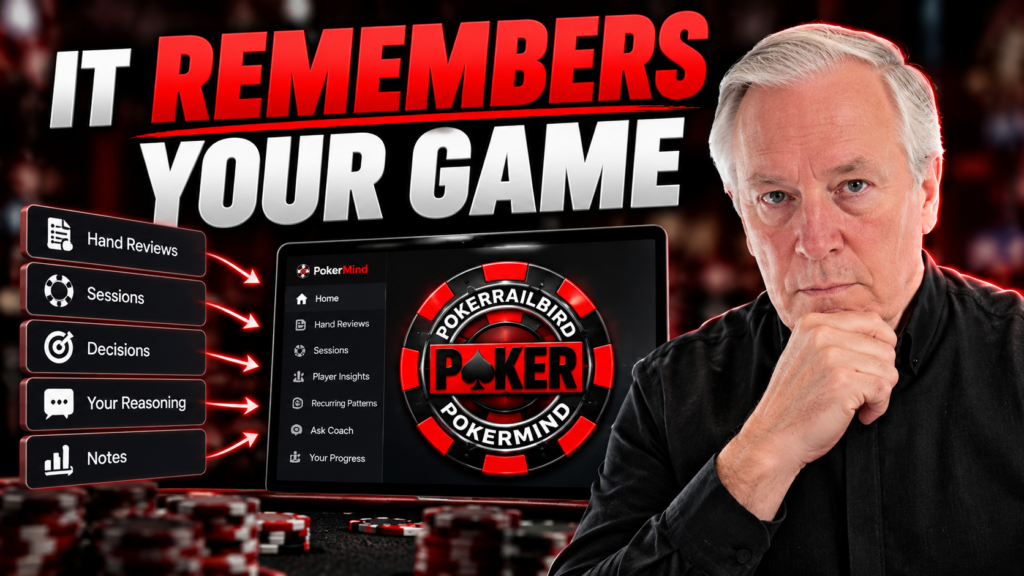
Personalization, therefore, isn’t something that happens once during onboarding. It continues as your game changes.
That ongoing process is also why the information you provide PokerMind matters. The hands you review, decisions you discuss, sessions you record, and reasoning you explain can give Coach additional context when working with your game.
We examine that part of PokerMind in greater detail here: PokerMind: Player-Driven Poker Strategy And Development
PERSONALIZED POKER COACHING MEANS "YOUR" GAME
Poker players don’t arrive with the same experience, play the same games, make the same mistakes, or need help in the same areas. That is why personalized poker coaching has to involve more than giving every player access to the same collection of poker information.
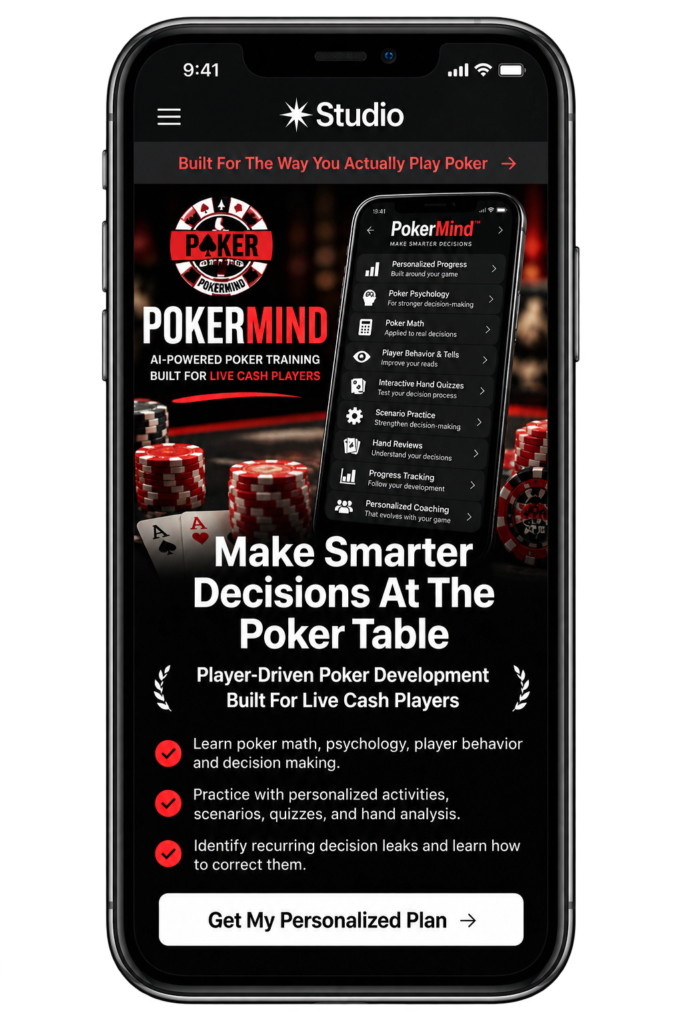
PokerMind begins with the player—your experience, goals, and the areas you want to develop. From there, the mathematics, psychology, player behavior and poker tells, practice, hand reviews, and information from your actual game provide additional evidence about what deserves attention.
Those pieces are not intended to operate independently. PokerMind Coach brings the applicable information together around the decisions you are actually making.
And that process can continue as your game develops. What requires attention today may not be what requires attention three months from now.
The objective isn’t to create a player who follows more rules.
It’s to help you understand the information available, determine what applies to the situation, and develop a more disciplined decision-making process around the game you actually play.
Tools, Not Rules.
PokerMind launches October 6.