
DISCIPLINE IN POKER
HOW WINNING PLAYERS STAY CONSISTENT
Discipline is one of the most misunderstood concepts in poker. Many players think it simply means folding weak hands, avoiding tilt, or resisting the temptation to chase losses. While those are certainly examples of discipline, they barely scratch the surface.
In reality, discipline in poker is the ability to consistently execute sound decisions, regardless of your emotions, recent results, or the pressure of the moment. It influences every aspect of the game, from emotional control and concentration to patience, bankroll management, and long-term thinking.
More importantly, discipline is one of the foundational skills in poker because, without it, every other skill you develop becomes significantly less valuable. You can understand poker math, recognize betting patterns, accurately read opponents, and know exactly what the correct decision is. But if you lack the discipline to consistently execute that decision, your knowledge rarely translates into long-term success.
This Hub explores the habits, mental skills, and psychological principles that allow winning players to remain consistent over thousands of decisions rather than a handful of memorable hands. You’ll discover why discipline isn’t a single skill, but a collection of behaviors that work together to improve every part of your game.
If Decision Making in Poker explains how winning players evaluate situations, Discipline in Poker explains how they consistently execute those decisions.
Welcome to the Discipline In Poker Hub.
SERIES OVERVIEW
Discipline isn’t a single skill. It’s a collection of habits, behaviors, and mental disciplines that work together to help you consistently execute good decisions.
For that reason, this Hub isn’t organized as a random collection of articles. Each topic builds upon the previous one, creating a structured learning path that explores the many different dimensions of discipline in poker.
You’ll begin by understanding what discipline really is and why it’s one of the foundational skills in poker. From there, we’ll examine the mental and emotional challenges that cause players to abandon good decisions, including impatience, ego, entitlement, poor concentration, and emotional control. We’ll then explore the strategic side of discipline, where concepts such as folding, session management, and long-term thinking become essential to consistent winning.
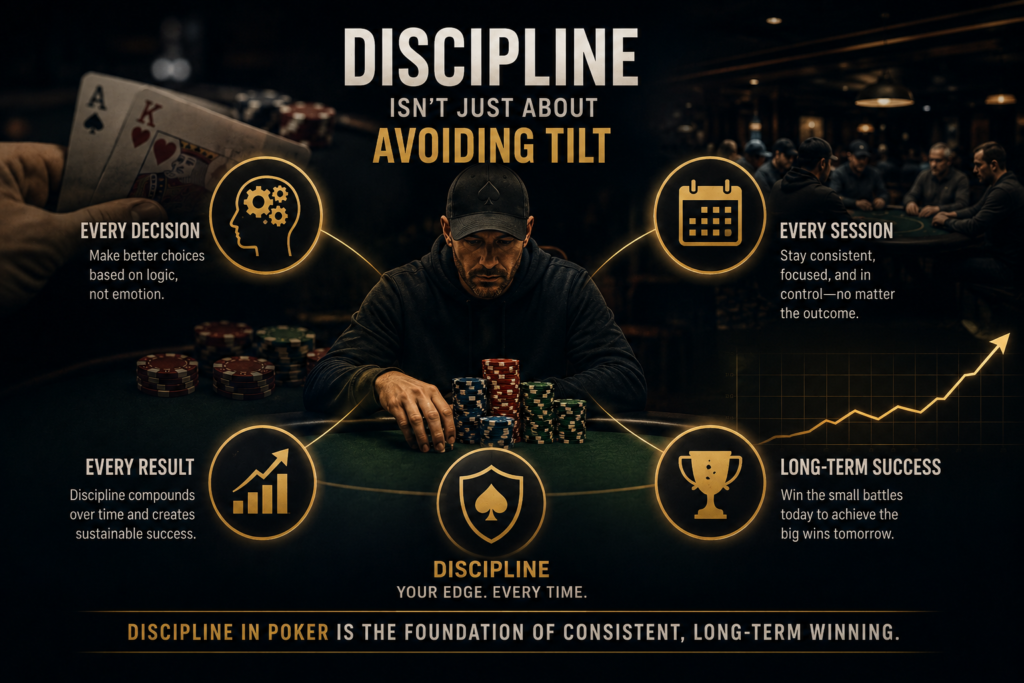
Throughout this series, you’ll discover that discipline extends far beyond simply avoiding tilt. It influences every decision you make, every session you play, and ultimately, every long-term result you achieve.
Whether you’re struggling to remain patient during long stretches of bad cards, finding yourself making emotionally driven decisions, or simply trying to become a more consistent player, this Hub provides a structured framework for developing one of poker’s most valuable skills.
We recommend working through the articles and videos in order, as each one builds upon the principles introduced in the previous lessons.
WHO IS THIS SERIES FOR?
This series is designed for poker players who want to become more consistent by improving the one skill that influences every other aspect of their game: discipline.
Whether you’re new to poker or have been playing for years, this Hub will help you understand why discipline extends far beyond avoiding tilt. It affects your patience, emotional control, concentration, session management, bankroll decisions, and your ability to consistently execute the right play under pressure.
This series is especially valuable if you:
- Struggle to remain patient during long stretches of bad cards.
- Find yourself making emotional or impulsive decisions.
- Call when you know you should fold.
- Chase losses or try to “get even.”
- Have difficulty maintaining focus during long sessions.
- Know the correct play, but don’t consistently execute it.
- Want to build a more disciplined, consistent, and profitable approach to poker.
Regardless of your current skill level, developing discipline is one of the highest-return investments you can make in your poker game. The stronger your discipline becomes, the more consistently you’ll be able to apply every other skill you’ve worked so hard to develop.
WHAT WE'LL DISCUSS
Discipline is the foundation that allows every other poker skill to function effectively. Throughout this series, we’ll discuss how to remain consistent under pressure, avoid the mental traps that lead to costly mistakes, and execute better decisions over the long run.
By working through this Hub, we’ll discuss how to:
- Develop the discipline to consistently execute good decisions.
- Recognize the emotional triggers that lead to poor play.
- Remain patient during long stretches of bad cards and card-dead sessions.
- Improve your concentration and eliminate costly distractions.
- Prevent ego, entitlement, and frustration from influencing your decisions.
- Know when discipline means folding, and when it means continuing.
- Develop habits that improve long-term consistency and profitability.
- Build the mental framework required to perform at your best, regardless of short-term results.
Discipline isn’t measured by the occasional good decision. It’s measured by your ability to consistently make the right decision, hand after hand, session after session.
CORE CONCEPTS
Discipline in poker isn’t a single skill. It’s the combination of several interconnected skills that work together to help you consistently make and execute sound decisions. When one area begins to weaken, the effects often spread throughout the rest of your game.
This Hub examines discipline from four different perspectives.
EMOTIONAL DISCIPLINE
MENTAL DISCIPLINE
STRATEGIC DISCIPLINE
LONG-TERM DISCIPLINE
Emotional discipline is your ability to remain objective regardless of short-term results. It allows you to manage frustration, avoid entitlement, control your ego, and prevent emotions from influencing your decisions.
Without emotional discipline, even technically skilled players can quickly abandon sound strategy.
Mental discipline is your ability to maintain concentration, remain patient, and continue making thoughtful decisions over long sessions. It includes focus, mindfulness, self-awareness, and resisting distractions that slowly erode your decision-making process.
Mental discipline allows you to consistently perform at your highest level.
Strategic discipline is the ability to execute the correct decision, even when it’s uncomfortable. It means folding when everyone else would call, remaining patient when the cards refuse to cooperate, and resisting the temptation to deviate from a sound strategy simply because of recent results.
Knowing the correct play has little value if you lack the discipline to consistently make it.
Long-term discipline is what allows successful players to think beyond the current hand or session. It includes managing expectations, accepting variance, maintaining perspective, and committing to continuous improvement over months and years rather than measuring success by today’s results.
Long-term thinking transforms discipline from an occasional act into a permanent habit.
These four areas don’t operate independently. They constantly influence one another.
A lapse in concentration can lead to emotional decisions. Emotional decisions often become strategic mistakes. Strategic mistakes make it more difficult to maintain a long-term perspective.
The goal of this Hub is to help you strengthen each of these areas so they work together, allowing you to play with greater consistency, confidence, and discipline.
ARTICLES AND ACCOMPANYING VIDEOS
ENTITLEMENT TILT IN POKER
Some players walk into a poker room already convinced they should win. They believe pots belong to them, not because of position, range, math, or discipline, but because of some imagined status they carry in their head. When that belief meets the reality of a live cash game, the result is what I call Entitlement Tilt In Poker – mental collapse built on ego, identity, and a complete disconnect from how the game actually works.
You don’t have to play long to encounter this player. They take every call as an insult. They see every re-raise as a personal attack. And they treat the table like a stage built for their validation. And when the cards fail to cooperate, they explode. They don’t lose a hand, they’re “wronged.” They don’t get outplayed, they’re “disrespected.” Nor do they face variance; they face a conspiracy.

EMOTIONAL INTELLIGENCE AND TILT
Tilt management is a skill that many poker players struggle with. Even the best poker players experience emotional swings, but those with high emotional intelligence are able to maintain composure and make sound decisions, even under pressure.
The goal of this article is to provide practical strategies for improving emotional intelligence and managing tilt. We will explore the core components of EI, such as self-awareness, self-regulation, and empathy, and show how mastering these can improve your poker game. Understanding variance and the role of math in poker will also help players handle emotional triggers like bad beats with greater clarity and control.
HOW EGO CAN SABOTAGE YOUR POKER GAME
Poker ego is one of the most dangerous liabilities a player can carry to the table. It’s more corrosive than variance, more disruptive than a bad beat, and more persistent than a losing streak. While ego may mask itself as confidence or bravado, beneath the surface it often signals insecurity, emotional fragility, and an unhealthy attachment to identity.
Ego doesn’t just influence decisions; it hijacks them. Instead of asking the strategic question, “What’s the most profitable play here?” the ego-driven player asks, “How do I prove I’m better than these people?” That single shift in mindset can unravel years of discipline and study in a matter of minutes.

CARD DEAD IN POKER
This is the moment your sharp focus slowly dissolves. What begins as disciplined patience gradually turns into boredom, distraction, and eventually leaking chips with marginal hands you would normally fold without hesitation. The worst part? It happens so gradually that most players don’t even realize it’s occurring until they’re already playing poorly.
This article explores the psychological and practical reality of card dead poker drift, why it happens, how it silently destroys even strong players, and most importantly, how to protect yourself from it. Because in live poker, the difference between a winning session and a losing one often comes down to who can maintain their mental game when the
MINDFULNESS IN POKER
Mindfulness in poker is often misunderstood. It gets tossed around like a buzzword, usually lumped in with staying calm, breathing deeply, or trying to “focus more.” But true mindfulness isn’t about calmness for its own sake. It’s about clarity under pressure.
At the poker table, you’re bombarded with distractions, inside and out. There’s the pressure to act, the temptation to chase, and the ego whispering that you have something to prove. Mindfulness is what allows you to step back, slow down, and see things as they are, not as you wish they were.

MULTITASKING IN POKER
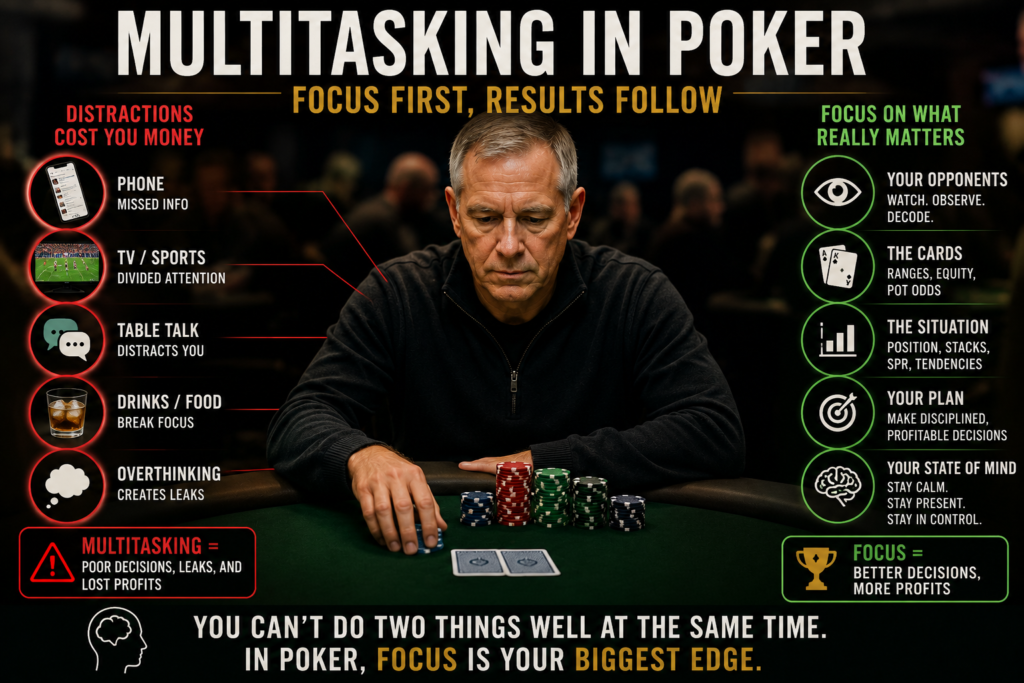
Multitasking in poker is often seen as a badge of honor, with many players believing they can juggle multiple tasks while maintaining peak performance at the table. But is it truly possible to balance distractions like social media, emails, and conversations with the intense focus poker demands? This article explores the science behind multitasking, highlighting how it affects cognitive resources, decision-making, and overall poker performance. Understanding the impact of multitasking is essential for any player aiming to refine their strategy and gain an edge over their opponents. Let’s delve into whether multitasking in poker is a myth or a manageable reality.
WHY POKER PLAYERS DON'T FOLD
Poker players don’t fold, at least not the ones filling every $1/$3 table you will sit at. You raise to a sane size. Four, five, sometimes six callers peel anyway. They chase gut-shots, three gap straight draws, any two suited cards, and often, just any two cards. Then they shrug when the river bails them out or buries them.
That isn’t randomness. It’s psychology.
Most of these players aren’t optimizing chip EV. They’re optimizing feelings, action, suspense, status, and a story to tell. Folding ten hands in a row feels like failure. Calling feels like playing. One miracle win, psychology reinforces a month of bad calls. Promotions and table culture push more flops. Alcohol and fatigue compress horizons. Result: they call where the math screams fold.
HOW TO WIN IN POKER WHEN LOGIC BREAKS DOWN
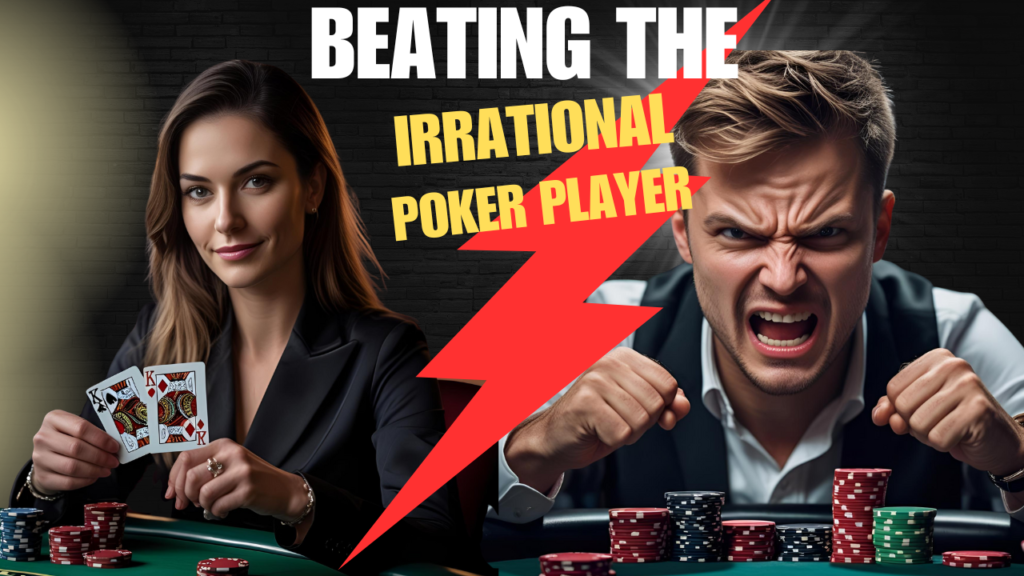
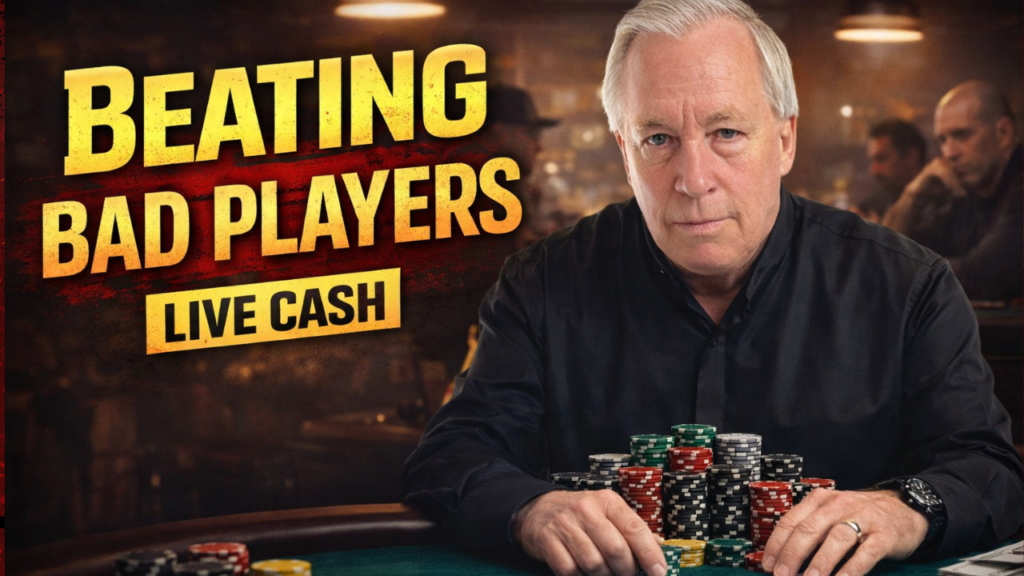
If you want to beat bad poker players, you have to rethink the game. Forget applying textbook poker the way you were taught, bad poker players don’t play by the math, the theory, the careful hand selection and pot odds calculations. In some of today’s wildest games, that stuff barely slows down the madness.
If you’ve ever tried to beat truly bad poker players, you already know what I’m talking about. The ones who play J/4 offsuit like it’s pocket Aces and who cold-call $25 preflop with 9/2 suited from under the gun. The ones who never fold, ever, and somehow still win.
VALUE RIGIDITY
In South America, hunters trap monkeys with a coconut chained to a stake. Rice sits inside, reachable through a small hole. The monkey slides his hand in, grabs a fistful of rice, and oops, he’s stuck. He is stuck because the hole is big enough to put his hand in, but not pull his fist full of rice out. Letting go means freedom, but the monkey can’t revalue the rice; he can’t reason that freedom without rice is better than what awaits him if he clings to the rice. That’s value rigidity.
In poker, Value Rigidity works the same way!

WHEN SHOULD YOU LEAVE A POKER TABLE?
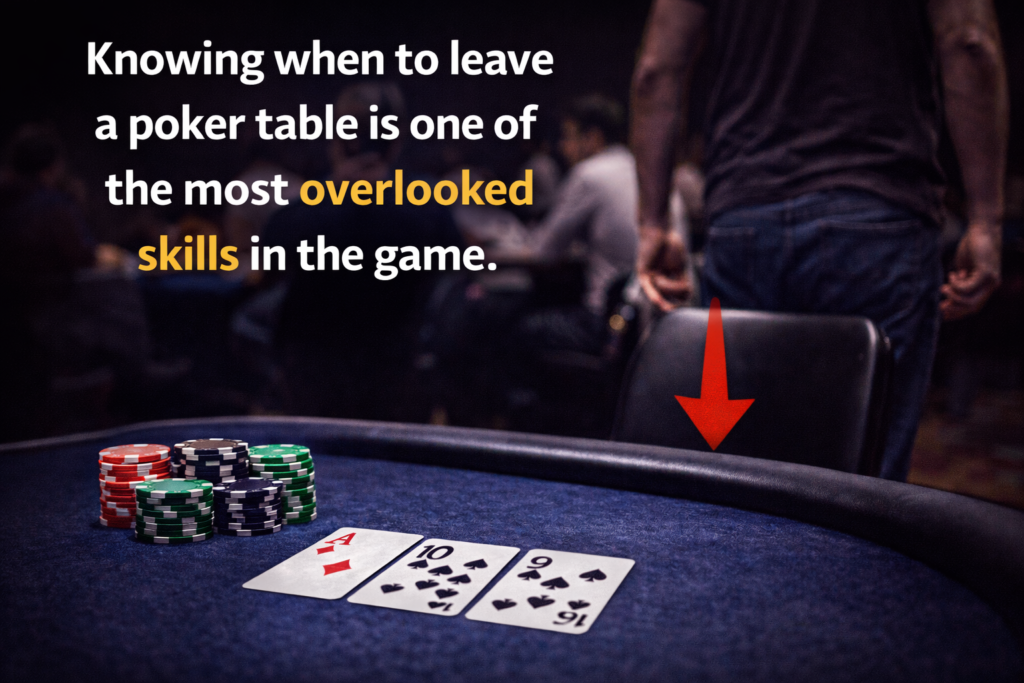
Most poker strategy discussions focus on what happens during a hand. Players study starting hands, betting patterns, and the mathematics of pot odds. These skills are essential, but they overlook another decision that can have an equally powerful impact on long-term results.
Knowing when to leave a poker table is one of the most overlooked skills in the game.
Poker is played in constantly changing environments. Players arrive and leave, table dynamics shift, and the overall quality of the game can change dramatically over the course of a session. A table that was highly profitable an hour ago may gradually become far less favorable as the lineup evolves.
THE PARADOX OF PATIENCE
Patience has long been called a virtue, but in poker it’s a paradox. The very quality that keeps you disciplined and profitable can also make you appear passive, predictable, or even timid. That’s the essence of The Paradox of Patience: you win by waiting, yet waiting too long can cost you everything.
In everyday life, patience is about endurance; in poker, it’s about intention. Every fold, every silence, every measured breath is an act of calculation. True poker patience isn’t sitting idly until the deck rewards you, it’s staying mentally engaged while the cards refuse to cooperate. You’re observing betting patterns, stack sizes, and emotional cues while the impatient players lose focus.

WHY YOU KEEP MAKING THE SAME POKER MISTAKES
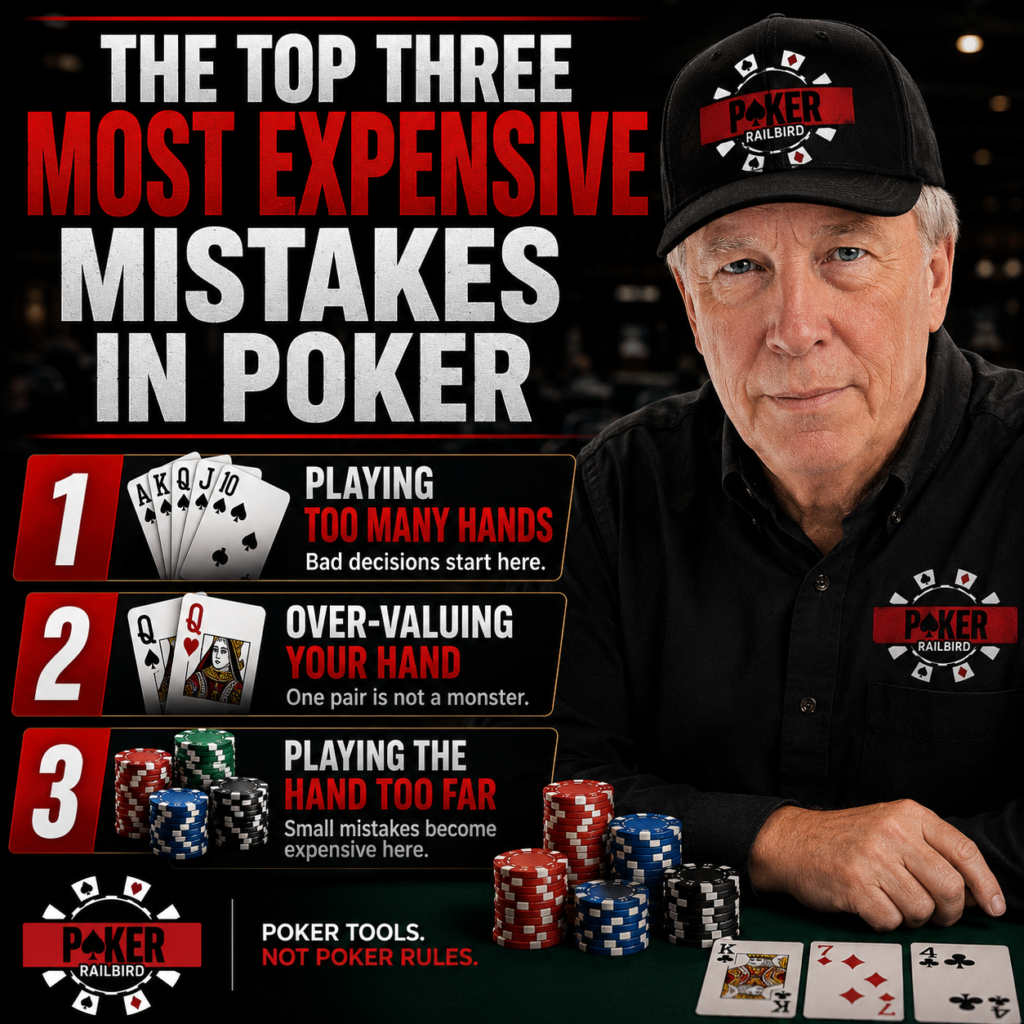
Avoiding common poker mistakes is one of the great dividing lines between the player who breaks even and the one who consistently builds a bankroll. But the most costly errors aren’t buried in obscure spots,they’re right on the surface. In fact, the three biggest mistakes in poker are painfully familiar to most players:
- Playing too many hands
- Overvaluing your hand strength
- Taking hands too far
These aren’t just common; they’re interconnected. One leads to another. You play a weak hand because you are bored. You hit a middle pair and convince yourself it’s good. Then you call again on the turn, hoping something will change. Most players don’t just make one of these mistakes; they make all three, over and over again.
So why does this happen?
FREQUENTLY ASKED QUESTIONS
WHAT IS DISCIPLINE IN POKER?
Discipline in poker is the ability to consistently execute sound decisions regardless of your emotions, recent results, or the pressure of the moment. It extends far beyond simply avoiding tilt and includes patience, concentration, emotional control, bankroll management, and long-term thinking.
WHY IS DISCIPLINE IMPORTANT IN POKER?
Discipline is one of the foundational skills in poker because it determines how consistently you apply every other skill you’ve developed. Without discipline, your understanding of poker strategy, mathematics, psychology, and hand reading becomes much more difficult to execute consistently.
IS DISCIPLINE JUST ABOUT AVOIDING TILT?
No. Avoiding tilt is only one aspect of discipline. True discipline also includes remaining patient during long card-dead stretches, maintaining concentration throughout long sessions, managing your bankroll responsibly, controlling your ego, and consistently making sound decisions under pressure.
HOW CAN I BECOME MORE DISCIPLINED IN POKER?
Discipline is developed through consistent habits rather than willpower alone. Learning to control your emotions, improve concentration, remain patient, and follow a structured decision-making process all contribute to becoming a more disciplined player.
DOES DISCIPLINE MATTER MORE THAN POKER KNOWLEDGE?
Poker knowledge and discipline work together.
Knowledge helps you identify the correct decision. Discipline allows you to consistently execute it. Without one, the other becomes significantly less valuable.
IS DISCIPLINE SOMETHING YOU ARE BORN WITH?
Like every other poker skill, discipline can be developed through practice, self-awareness, and deliberate effort. The more consistently you reinforce disciplined habits, the more naturally they become part of your game.
RELATED HUBS
The skills discussed in this Hub work together with many other areas of poker strategy and psychology. Continue building your game by exploring these related PokerRailbird Hub Pages.
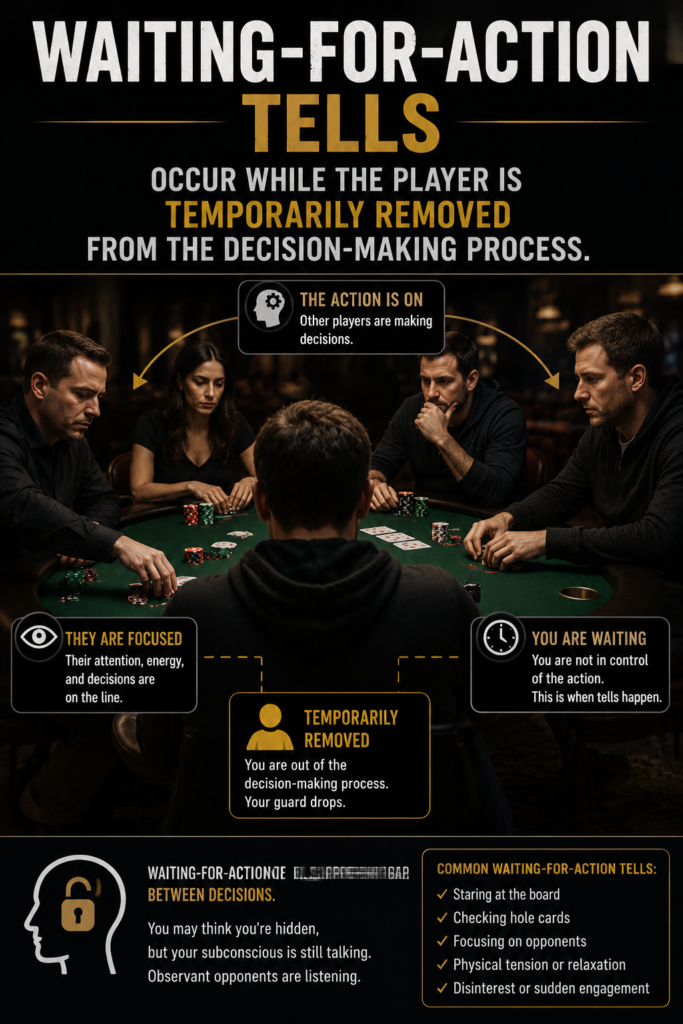
Waiting-for-action tells occur after you’ve acted but before your opponent responds, making them some of the most reliable behavioral observations in live poker. This Hub explores the most common tells of strength and weakness, explains how to interpret them within the proper context.
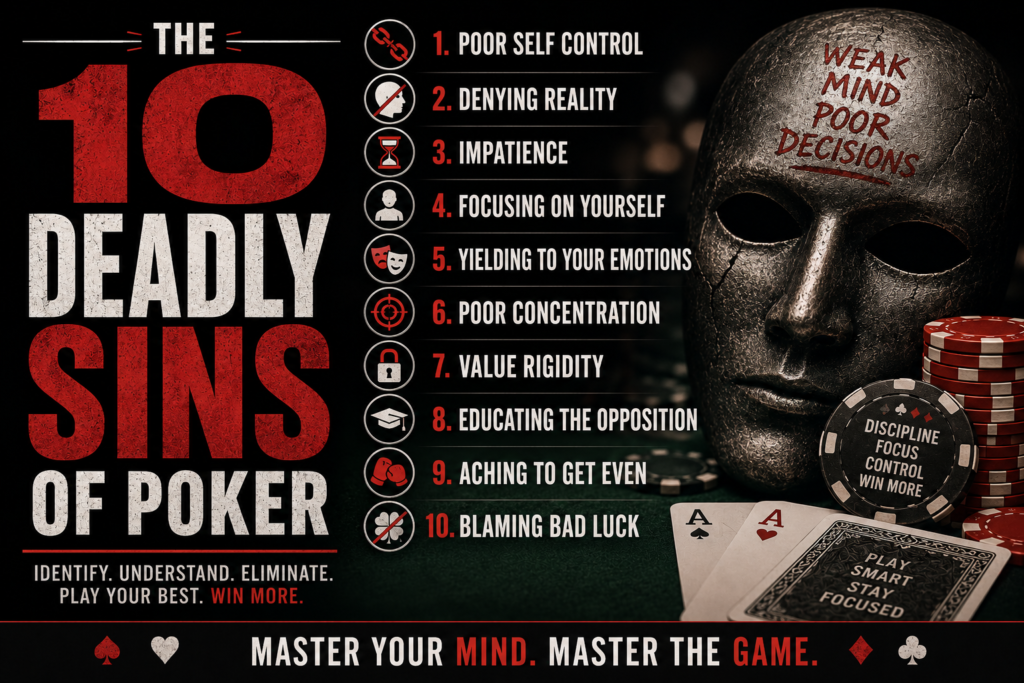
Even technically skilled players lose money when psychological mistakes begin to influence their decisions. This Hub examines the ten most common mental and emotional leaks that quietly undermine discipline, distort decision-making, and prevent players from consistently performing at their best.
Decision-making in poker is the foundation of long-term success. Every hand presents a series of choices made with incomplete information, uncertain outcomes, and constantly changing circumstances.