
UNUSUAL BEHAVIOR EARLY IN A HAND
A POKER TELL OF STRENGTH
Unusual Behavior In Poker often attracts attention because it seems different or out of character. While any unexpected change in behavior can be worth noticing, the timing of that change is equally important. When a player’s behavior changes during the early stages of a hand, before much action has taken place, it may provide useful information about how they’ve connected with the hand.
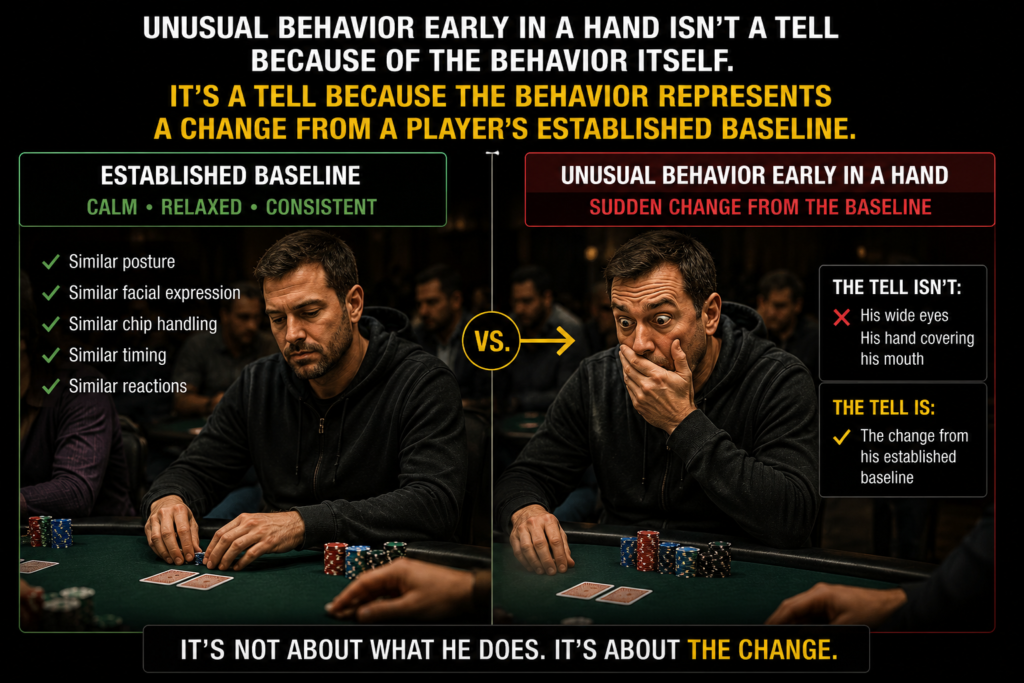
This tell isn’t defined by any one specific action. Instead, it refers to a noticeable change from a player’s established baseline. That change might be becoming unusually quiet, unusually talkative, unusually serious, or displaying some other unexpected behavior. The specific action is less important than the fact that the player’s behavior has changed.
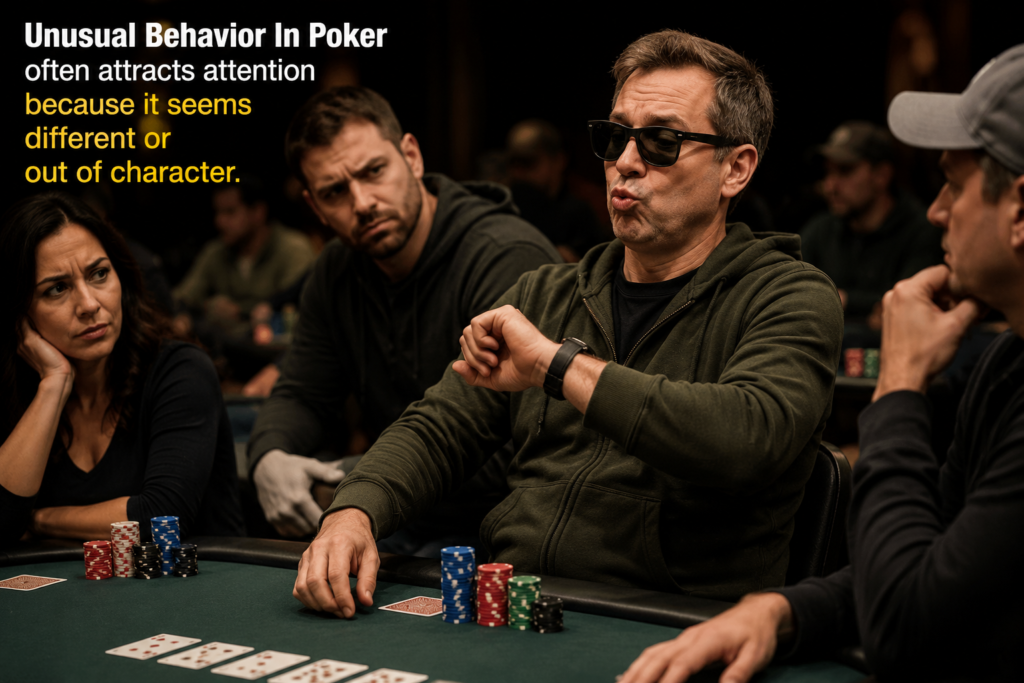
Like all tells, Unusual Behavior In Poker should never be interpreted in isolation. However, when evaluated alongside betting patterns, timing, player tendencies, and the overall context of the hand, an unexpected change in behavior can become another valuable piece of evidence when evaluating an opponent’s holding.
WHAT DOES "UNUSUAL BEHAVIOR" MEAN?
The phrase unusual behavior doesn’t refer to any one specific action. Instead, it describes a player doing something that differs from their normal behavior during the early stages of a hand.

You’re not looking for a particular behavior. You’re looking for a change in their baseline behavior. For one player, that change might be becoming unusually quiet. Another player may suddenly look away from the table, avoid eye contact, or appear distracted. Someone who is normally relaxed may become noticeably serious, while another who is typically reserved may begin talking more than usual. The specific behavior isn’t what’s important. What matters is that it represents a noticeable departure from that player’s established baseline.
Recognizing those changes begins with observation. The better you understand how a player normally behaves, the easier it becomes to recognize when something changes.
WHY EARLY IN THE HAND MATTERS
The timing of this tell is what makes it interesting.
When unusual behavior occurs during the early stages of a hand, players often haven’t yet shifted their attention toward managing the information their behavior may reveal. Instead, they’re focused on evaluating their hole cards, the community cards, and the developing situation.
As a result, subtle changes from their normal behavior may occur before they consciously begin monitoring their physical reactions. Those changes are often brief and completely unintentional, making them easy to overlook unless you’re already observing your opponents from the beginning of the hand.
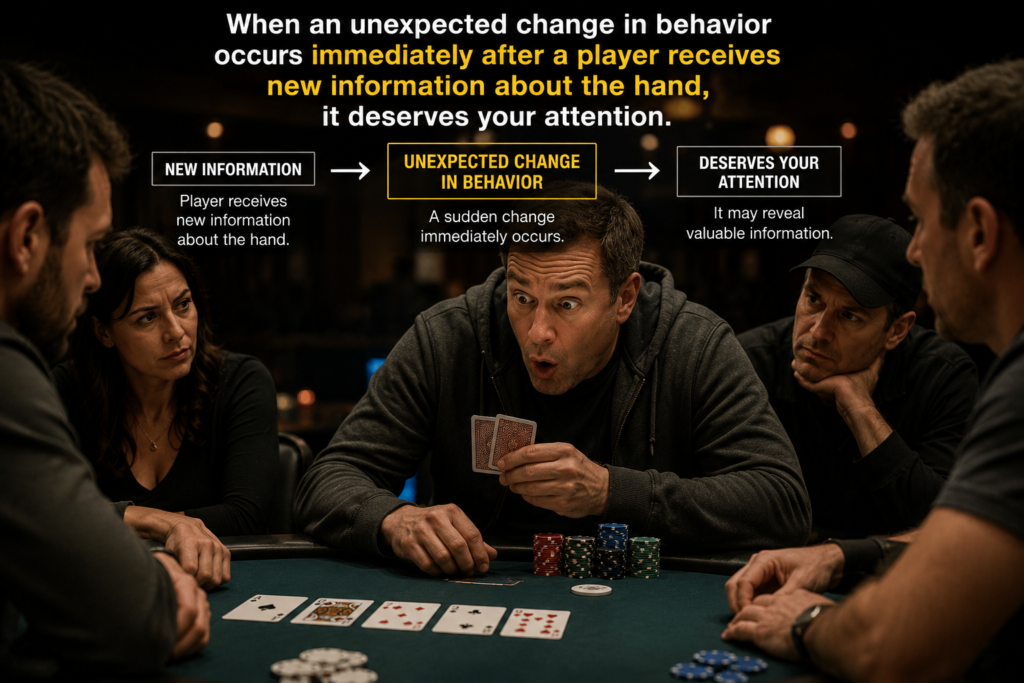
This doesn’t mean every change in behavior is meaningful. Players can become distracted, tired, frustrated, or react to something completely unrelated to the hand. However, when an unexpected change in behavior occurs immediately after a player receives new information about the hand, it deserves your attention. Whether that information comes from their hole cards before the flop or from the community cards after the flop, turn, or river, the timing may provide an important clue.
WHEN THE TELL CARRIES WEIGHT
Like every tell, unusual behavior in poker is not universal. Some players naturally display more emotion than others, while some maintain the same demeanor regardless of the cards they’re holding. That’s why understanding a player’s baseline remains essential.
This tell becomes more meaningful when the change in behavior is both noticeable and unexpected. If a player who normally jokes with the table suddenly becomes quiet after looking at their hole cards, or a player who is usually relaxed suddenly appears distracted after the flop, those changes deserve your attention because they represent a departure from that player’s normal behavior.
Experience also plays a role. Recreational players are generally more likely to display instinctive changes in behavior, while experienced players often make a conscious effort to keep their actions consistent throughout a hand. Some experienced players may even use false tells in an attempt to mislead observant opponents.
For these reasons, Unusual Behavior Early In A Hand should never become the basis for a decision by itself. Its value comes from recognizing it as one observation among many rather than treating it as proof of what an opponent is holding.
PUTTING THE TELL INTO CONTEX
Like every poker tell, Unusual Behavior Early In A Hand is only one piece of information. By itself, it should never determine your decision.
Instead, ask whether the change in behavior fits everything else that’s happened during the hand.
Does it make sense given the betting action?
Does it fit the board texture?
Is it consistent with what you know about this particular player?
Have you observed similar changes in their behavior before?
.
When several independent observations all point toward the same conclusion, your confidence in the read naturally becomes much stronger. On the other hand, if the change in behavior conflicts with the betting, the board, or the player’s established tendencies, it’s usually better to trust the overall context than the physical reaction.
That’s why experienced live players rarely rely on a single tell. They build their decisions by combining physical behavior with betting patterns, timing, player tendencies, and the situation itself.
Poker tells don’t make decisions.
They contribute evidence.
The better you become at recognizing changes in behavior and placing those changes into the proper context, the more complete your understanding of an opponent’s holding becomes.
CONCLUSION
Unusual behavior early in a hand isn’t a tell because of the behavior itself. It’s a tell because the behavior represents a change from a player’s established baseline.
Whether that change is becoming unusually quiet, unusually talkative, unusually distracted, or displaying some other unexpected reaction, the important observation is that something has changed. That change may or may not prove meaningful, but it deserves to be evaluated alongside the betting, board texture, timing, and everything else you’ve observed during the hand.
Like all poker tells, unusual behavior early in a hand should never be viewed in isolation. Instead, think of it as another piece of evidence that helps you build a more complete understanding of your opponent’s holding. The more disciplined your observations become, the more accurately you’ll be able to distinguish between behavior that is simply different and behavior that genuinely conveys information.