

POKER PHILOSOPHY
THE CHURCH OF REASON
Poker philosophy starts with a fundamental reality: the game doesn’t change to fit how we perceive it. Two players can sit at the same table, observe the same action, and reach entirely different conclusions about what is happening. Their interpretations may be influenced by experience, education, intuition, or personal beliefs. Yet the mathematics, rules, and circumstances of the game remain unchanged.
Every poker player develops ideas about how the game should be played. Some come from study and observation, while others emerge from personal experience. Over time, these ideas can become firmly established beliefs, influencing how we interpret information, evaluate opponents, and make decisions. But how often do we stop to examine whether the evidence actually supports those beliefs?
The Church of Reason represents a philosophy of rational inquiry, intellectual honesty, and disciplined thinking. Inspired by the philosophical perspectives explored in Robert Pirsig’s Zen and the Art of Motorcycle Maintenance, it examines the relationship between how we perceive the game and the underlying reality we are attempting to understand.
CLASSICAL AND ROMANTIC THINKING
TWO PERSPECTIVES ON THE SAME GAME
In Zen and the Art of Motorcycle Maintenance, Robert Pirsig explores two fundamentally different ways of understanding the world: classical thinking and romantic thinking. The distinction concerns how individuals perceive reality, what captures their attention, and how they arrive at their understanding of something.
Pirsig describes classical understanding as an examination of underlying structure, while romantic understanding emphasizes immediate appearance and experience. He characterizes the romantic mode as inspirational, imaginative, creative, and intuitive, stating:
“Feelings rather than facts predominate.”
The classical approach, by contrast, proceeds through reason, established principles, and an examination of how things work.
THE CLASSICAL PERSPECTIVE: UNDERSTANDING HOW THE GAME WORKS

A classical poker player seeks to understand the game’s underlying structure and the relationships among its many components. Mathematics, strategy, psychology, player behavior, betting patterns, tells, position, and table dynamics are all worth examining. Each contributes information that may improve the player’s understanding of what is happening.
Consider the process of reading an opponent. A classical player studies previous actions, betting patterns, behavioral tendencies, and the circumstances surrounding those observations. He recognizes that a hesitation, an unusual bet, or a change in behavior may provide information, but he also understands that interpreting that information requires evidence and context.
This doesn’t mean that feelings or intuition are absent. A classical thinker may form a strong impression of an opponent, but that impression remains open to examination. When reliable evidence contradicts his expectations, he allows the evidence to influence his thinking.
THE ROMANTIC PERSPECTIVE: EXPERIENCING THE GAME
The excitement of competition, the drama of a difficult decision, the satisfaction of reading an opponent, and the artistry of a successful bluff may hold considerably more appeal than studying mathematical relationships or strategic principles.
Studying probability tables, examining betting structures, or analyzing the mathematics behind decisions may seem tedious or unnecessarily complicated. Such activities can appear to diminish the very qualities that make the game enjoyable.
Consider a familiar statement heard at poker tables: “I don’t need the math. I play the player.”
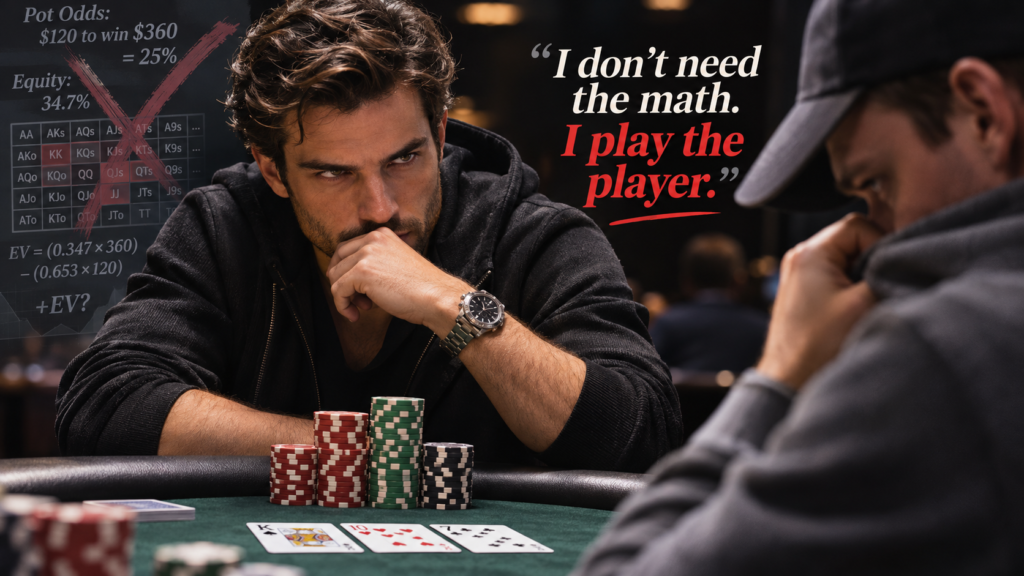
It suggests that understanding an opponent through personal intuition can substitute for examining the game’s underlying structure. The player may believe he knows what his opponent is thinking, senses weakness, or recognizes an opportunity without needing to analyze the mathematical or strategic circumstances.
This emphasis on immediate experience does not imply that intuition is necessarily wrong. Pirsig is distinguishing modes of understanding, not assigning every person a fixed level of reasoning ability or an inevitable outcome.
THE SAME GAME: VIEWED DIFFERENTLY
Both observe the same betting action, the same community cards, and the same opponent exhibiting an unusual behavior. The romantic player may develop an immediate impression that the opponent is bluffing. His thinking centers on how the situation appears and what his intuition suggests.
The classical player examines that same behavior within the broader context of the hand. He considers previous observations, betting patterns, mathematical relationships, and any other information relevant to understanding the situation.
We aren’t examining whether either player makes the correct decision or ultimately wins the hand. Both could take identical actions, even though they arrive at them through entirely different thought processes.
Pirsig observes that people tend to think and perceive the world predominantly through one mode of understanding or the other. This division extends beyond perspective differences. Each tends to misunderstand or underestimate the other, often becoming firmly attached to its own interpretation of reality.
In poker philosophy, recognizing these contrasting processes matters because reaching a decision and understanding the reasoning behind it are two different things. Classical and romantic thinkers may occasionally reach the same conclusion, but that agreement does not mean both understand the circumstances or the principles involved.
HOW POKER PLAYERS FORM THEIR BELIEFS
Every poker player develops beliefs about how the game works, how opponents behave, and which strategies are most effective. These beliefs influence the way we interpret information, evaluate situations, and approach decisions at the table.
THE KNIFE, THE SAND AND THE LIMITS OF AWARENESS
In Zen and the Art of Motorcycle Maintenance, Robert Pirsig introduces an analogy involving a handful of sand and what he calls the knife of analytical thought.
Pirsig explains that the world presents us with far more information than we can consciously process. At any moment, countless events, objects, relationships, and experiences surround us. Yet our conscious attention captures only a small portion of that reality.
He compares this limited awareness to taking a handful of sand from an enormous landscape. That handful represents the world of which we are consciously aware. But even within that small selection, we begin making distinctions.
We separate the grains according to color, shape, size, and other characteristics. We organize them into categories, examine their similarities and differences, and establish relationships between them. Pirsig calls this process of dividing and classifying information the knife.
Classical understanding examines the individual grains, the categories we create, and the relationships between them. Romantic understanding focuses on the handful of sand before the analytical sorting begins.
But there’s another consideration: Neither perspective encompasses the entire landscape from which the sand was taken.
WHAT DO WE ACTUALLY NOTICE AT THE POKER TABLE
Consider nine players sitting at the same table, participating in the same game. Throughout a session, they’re exposed to an enormous amount of information: betting actions, player behavior, stack sizes, conversations, changes in table dynamics, emotional reactions, and countless other details.
But no individual can consciously observe, process, and remember everything that occurs. One player concentrates primarily on his cards and the community board. Another pays close attention to betting patterns and position. Someone else notices facial expressions, body language, or changes in an opponent’s behavior.
Consider a player who makes an unusually large river bet. One observer may focus on the size of the wager. Another recalls that the same opponent previously made a similar bet with a strong hand. A third notices a change in the player’s behavior, while someone else remembers an earlier bluff.
All four observations may be accurate. Yet each represents only part of the information surrounding the decision.
The significance lies not only in how we interpret what we observe, but also in what we fail to notice.
The classical player may systematically examine the information he recognizes, but his analysis still begins with what entered his awareness. The romantic player may develop an immediate impression of the situation without examining its underlying relationships.
HOW OBSERVATIONS BECOME BELIEFS
Personal experience plays an important role in this process. Every poker session provides opportunities to recognize patterns, reconsider assumptions, and develop ideas about how the game works.
Consider a player who repeatedly loses large pots with pocket aces after raising preflop. Eventually, he begins limping with aces because he believes raising creates situations in which he’s more likely to lose.
His conclusion developed from genuine experiences. He remembers the losses, recognizes a recurring outcome, and changes his behavior.
He knows that several large pots ended unfavorably after he raised with aces. That observation alone does not establish that raising caused those losses or that limping provides a better alternative.
The experience is factual. The explanation he assigns to it is an interpretation.
The process is further influenced by selective memory. Emotionally significant hands, painful losses, and spectacular successes often receive more attention than ordinary outcomes. As a result, the experiences we remember may not accurately represent the full range of situations we’ve encountered.
The significance for poker philosophy is that a belief can grow from experiences that are genuine but incomplete. Remembering an outcome does not establish what caused it.
EDUCATION, EXPERIENCE AND CONVENTIONAL WISDON
Poker beliefs also develop through books, videos, coaching, professional players, and advice received from others. These sources can provide valuable knowledge, but they also introduce ideas that players may accept without fully examining the reasoning behind them.
Consider familiar statements such as “always raise with premium hands,” “never limp,” or “aggression wins in poker.”
Each may originate from a legitimate strategic principle. However, repeated exposure can transform a situational recommendation into a general belief about how the game should always be played.
A player may eventually adopt that belief because it came from a respected authority, because others repeat it, or because personal experience appears to confirm it.
But understanding what someone recommends is different from understanding why the recommendation exists. The source of a belief does not, by itself, establish its validity.
WHEN BELIEFS BECOME CONVICTIONS
As beliefs become established, they begin influencing how we interpret new experiences.
A player convinced that aggressive opponents are constantly bluffing may remember every successful bluff catch as confirmation. When the same opponent shows a strong hand, the player dismisses it as an exception.
Another player who believes a particular strategy is superior may attribute successful outcomes to that strategy while explaining unfavorable results as bad luck.
Psychology refers to this tendency as confirmation bias: the tendency to favor information that supports what we already believe.
Our understanding of poker begins with a limited selection of the information available to us. We organize that information, assign meaning to our observations, and develop conclusions that gradually become beliefs. Those beliefs can then influence which information we notice, how we interpret it, and what we choose to disregard.
THE DIFFERENCE BETWEEN KNOWLEDGE, OBSERVATION AND ASSUMPTION
One important question in poker philosophy is how to determine the strength of a conclusion. In Zen and the Art of Motorcycle Maintenance, Pirsig examines inductive and deductive reasoning and the scientific method. He also discusses, through Immanuel Kant, the distinction between empirical and a priori knowledge.
INDUCTIVE AND DEDUCTIVE REASONING
Inductive reasoning begins with specific observations and uses them to develop broader conclusions.
Suppose we observe an opponent repeatedly calling substantial bets with relatively weak hands. From those observations, we develop the belief that this player is reluctant to fold.
However, the conclusion remains dependent on the observations supporting it. We may have witnessed only a limited number of situations, and the player’s behavior may change under different circumstances.
Inductive reasoning allows us to recognize patterns and develop informed expectations, but those expectations are not mathematical certainties.
Deductive reasoning works in the opposite direction. It begins with an established principle or premise and applies that principle to reach a specific conclusion.
Consider a poker decision in which the pot contains $200 and an opponent bets $100. A $200 pot faces a $100 bet. A call costs $100, and the final pot would contain $400. The call therefore requires 25% equity to break even, assuming no further betting, no rake or other costs, and no complicating outcomes such as ties.
But whether our hand actually has a 25% chance of winning is a separate question. We may need to examine an opponent’s likely holdings, betting history, or behavioral tendencies to estimate that probability.
Deduction establishes what follows from the information and premises we use. It does not establish that every premise accurately represents the situation.
In poker, inductive and deductive reasoning frequently work together. We develop expectations through observation, then apply established mathematical and strategic principles to evaluate the decisions those expectations suggest.
EMPIRICAL AND A PRIORI KNOWLEDGE
Pirsig also discusses the philosophical distinction between knowledge derived from experience and knowledge that can be established independently of experience. In examining Immanuel Kant’s philosophy, he introduces the concepts of empirical and a priori knowledge.
Empirical knowledge develops through observation and experience. We learn something about the world by examining what actually occurs.
For example, understanding an opponent’s betting tendencies requires observing that player’s behavior. We cannot determine those individual tendencies through mathematical reasoning alone.

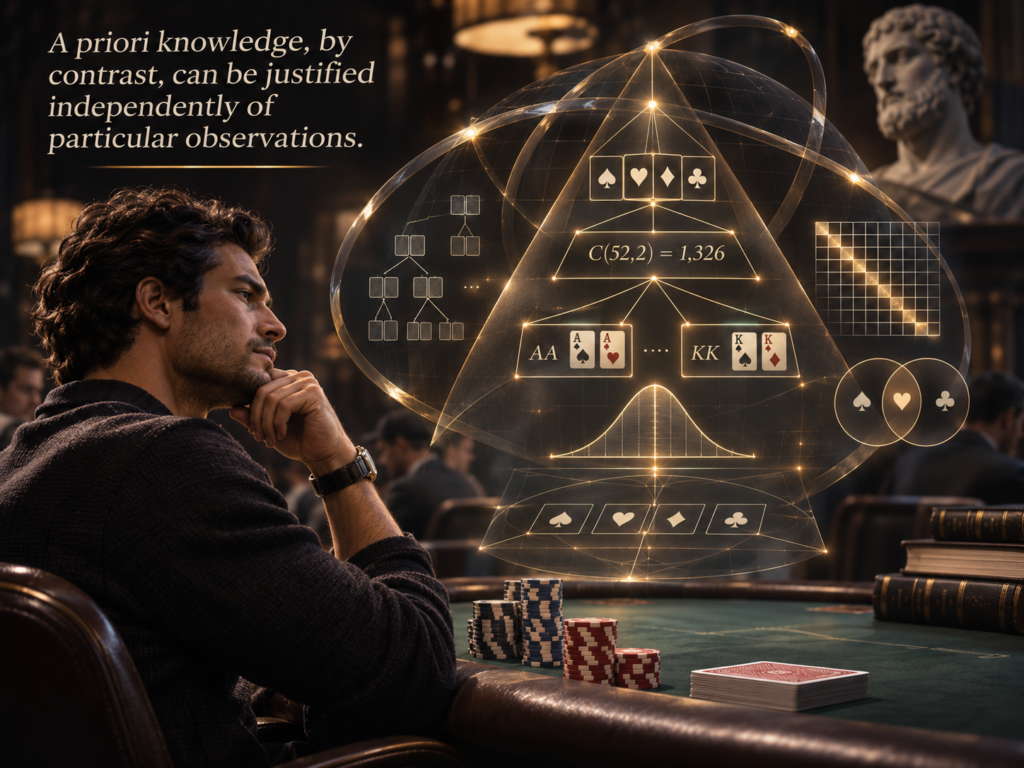
A priori knowledge, by contrast, can be justified independently of particular observations. Mathematical relationships provide a familiar example.
Given a standard deck and specified conditions, we can calculate the probability of completing a flush draw with nine outs and one card remaining. We do not need to deal thousands of hands to establish the mathematical relationship.
But applying that probability to a particular poker decision requires us to examine whether the assumptions behind the calculation are appropriate. Are all nine outs capable of producing the winning hand? Are there other ways to win? What information about the opponent remains unknown?
The mathematical relationship may be exact while our understanding of the actual situation remains incomplete.
POKLER PHILOSOPHY AND THE SCEINTIFIC METHOD
Pirsig’s discussion of inductive and deductive reasoning leads naturally to the scientific method. Rather than accepting an explanation simply because it seems reasonable, the scientific method encourages us to develop hypotheses, examine evidence, test predictions, and reconsider conclusions when new information emerges.
We can apply this way of thinking to poker without turning every session into a scientific experiment.
Suppose we suspect that an opponent frequently bluffs the river. We may have developed it through observation, previous encounters, or an interpretation of the player’s behavior. But the strength of our conviction does not establish the accuracy of the hypothesis.
Additional observations may support our interpretation, contradict it, or reveal circumstances we had not previously considered.
There is also an important limitation. Poker situations rarely repeat under identical conditions, and our observations may be too limited to establish reliable behavioral frequencies.
Nevertheless, we can still examine the evidence supporting our beliefs and avoid giving uncertain conclusions more authority than they deserve.
DISTINGUISHING FACTS, OBSERVATIONS, INTERPRETATIONS AND ASSUMPTIONS
Poker philosophy applies these distinctions at the table. Consider an opponent making a substantial river bet. We may have several kinds of information available:
- Established facts: The pot size, bet amount, community cards, and mathematical relationships associated with the decision.
- Observations: The opponent’s previous betting actions, revealed hands, and behavior during the current hand.
- Interpretations: Our assessment of what those observations suggest about the opponent’s likely holdings or intentions.
- Assumptions: Conclusions we rely upon despite lacking sufficient evidence to establish their accuracy.
These categories are not necessarily independent. An observation may establish a fact, while several observations may contribute to an interpretation.
For example, observing that an opponent previously showed down a bluff is factual. Concluding that the opponent is bluffing now requires additional reasoning. Assuming that the opponent must be bluffing because he has done so before gives a previous observation more authority than it warrants.
The same issue arises when players use mathematical formulas that depend on estimated opponent behavior. Knowing the exact folding frequency required to make a bluff profitable does not establish how frequently a particular opponent will actually fold. The calculation and the behavioral estimate represent different kinds of information, with different levels of certainty.
REASON REQUIRES INTELLECTUAL HONESTY
A player can study extensively, develop considerable experience, and become highly skilled at recognizing patterns without possessing complete knowledge of a situation.
There is nothing unreasonable about drawing conclusions from incomplete information. Poker requires us to do so constantly.
The problem arises when we treat uncertain interpretations as established facts or become unwilling to reconsider beliefs that the evidence no longer supports.
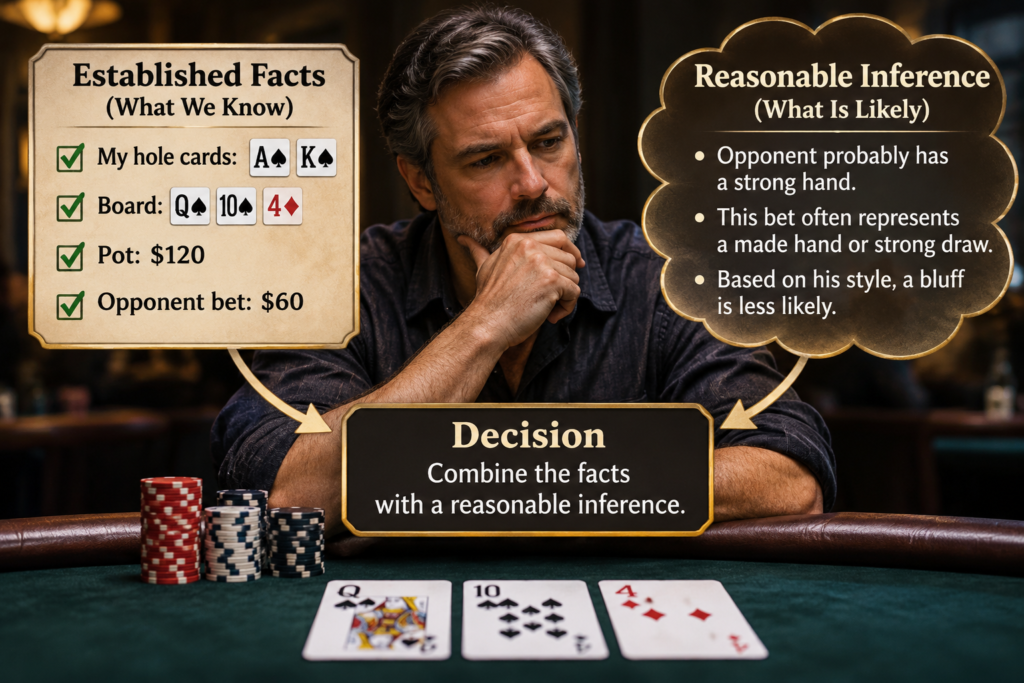
Extensive experience and careful observation can produce well-supported judgments without producing certainty. Poker philosophy asks us to distinguish a reasonable inference from an established fact, especially when a decision depends on both.
REALITY DOES NOT CHANGE TO ACCOMMODATE OUR BELIEFS
Every poker player enters a game with expectations. We develop ideas about how opponents should behave, which strategies should succeed, and what ought to happen when we make a particular decision. Those expectations may be based on mathematical principles, previous experiences, education, or personal convictions.
WHEN EXPECTATIONS COLLIDE WITH REALITY
Consider a player holding pocket aces who raises preflop and receives five callers.
He may believe that such a strong starting hand should discourage opponents from entering the pot with weaker holdings. Perhaps he has studied conventional preflop strategy and expects his raise to reduce the field.
But five players have called. Complaining that his opponents should have folded accomplishes nothing. Neither does insisting that their decisions were strategically incorrect.
The relevant circumstances have changed. He is now holding pocket aces against five opponents, and his decisions must account for the conditions that actually exist.
A player may believe that a substantial river bet should force an opponent to fold a marginal hand. His reasoning may be supported by established strategic concepts, yet the opponent calls. If repeated observations demonstrate that this particular opponent rarely folds, continuing to rely on the expectation that a large bet should produce a fold becomes increasingly difficult to justify.
A strategic principle does not cease to exist because an opponent behaves differently than expected. Its application must account for the circumstances in which the decision is being made.
THE DIFFERENCE BETWEEN AN UNFAVORABLE OUTCOME AND A CONTRADICTED BELIEF
There is an important distinction between reality contradicting our expectations and an individual outcome contradicting a mathematically sound decision.
Suppose a player holds a flush draw on the turn, with nine cards capable of completing his flush on the river. Under the assumption that all nine outs produce a winning hand and that 46 cards remain unseen, the probability of completing the flush is approximately 19.6%.
If the river fails to complete the draw, the mathematical relationship has not been disproven. That outcome was already included in the probability.
Similarly, winning a pot does not establish that the decision leading to that outcome was mathematically profitable.
Individual results are part of reality, but they must be interpreted within the circumstances and probabilities that produced them.
This is why examining the reasoning behind a decision matters more than using its immediate outcome as the sole measure of its quality.
WHEN OUR BELIEFS BECOME AN OBSTACLE
A player may insist that his preferred strategy is effective because it has worked for him in the past. Another may reject a mathematical explanation because it conflicts with years of personal experience.
Some become convinced that opponents are playing incorrectly and spend more energy criticizing their decisions than understanding their behavior.
An approach that worked well against one group of opponents may require adjustment against another. Betting patterns, table composition, stack depths, and individual tendencies can all influence the circumstances surrounding a decision.
A player who remains committed to an interpretation formed under different conditions may fail to recognize that the information supporting it has changed.
Poker philosophy requires us to evaluate whether a belief still fits the information and table conditions that support it, rather than defend it merely because it has worked in the past.
REASON AS A POKER DECIDION-MAKING PROCESS
The practical value of poker philosophy lies in making decisions from the information actually available. Some details are established, others must be interpreted, and much remains unknown. Reasoning helps us identify which is which before we act.
REASON BEGINS WITH UNDERSTANDING THE SITUATION
Before deciding what action to take, we need to understand the circumstances confronting us. Position, stack sizes, betting action, opponent tendencies, table dynamics, and behavioral observations may all contribute to our understanding of a particular situation. The relevance of each depends on the decision we’re facing.
For example, pot odds may tell us the minimum equity required to call, while assessing that equity requires a defensible estimate of an opponent’s range. An observation about that player may support the estimate, but it does not turn the estimate into mathematical certainty.
QUESTIONING OUR OWN CONCLUSIONS
One of the more difficult aspects of rational decision-making is recognizing when our reasoning is influenced by what we already believe. Suppose we’ve developed the opinion that a particular opponent is excessively aggressive. When he makes a substantial bet, we may immediately interpret it as another example of that aggression.
Perhaps his previous aggression occurred primarily before the flop. Maybe his large river bets have consistently represented strong hands. Or the current betting sequence may differ significantly from those we’ve observed before.
These considerations do not automatically invalidate our original assessment. They require us to examine whether it applies under the present circumstances.
We must be willing to distinguish between what the evidence supports and what we would prefer to believe. That includes acknowledging when an opponent’s behavior surprises us, when a previous interpretation proves unreliable, or when we simply lack enough information to reach a confident conclusion.
MAKING DECISIONS WITHOUT COMPLETE KNOWLEDGE
Reasoning does not eliminate uncertainty. Poker is a game in which essential information frequently remains concealed. Even after examining every relevant mathematical relationship, observation, and strategic consideration available to us, we may still be uncertain about an opponent’s holdings or intentions.
It is to understand the information we possess, recognize its limitations, and make a decision supported by the strongest reasoning available.
Sometimes that means relying heavily on established mathematical relationships. In other situations, observations about a particular opponent may play a significant role. Frequently, both contribute to the decision. But their relative importance depends on the circumstances, not on a predetermined preference for one kind of information.
A disciplined thinker also recognizes that decisions must be made with the information available at the time. New information may emerge later, but that does not necessarily mean the original reasoning was unsound.
What matters is whether the decision reflected a reasonable evaluation of what was known when it was made.
REASON AS AN ONGOING PROCESS
Every session provides opportunities to examine our understanding of poker. We encounter unfamiliar situations, observe unexpected behavior, and sometimes discover that our previous explanations were incomplete.
A player committed to reason does not need to defend every previous conclusion or preserve every established belief. Instead, he examines new information, considers its significance, and adjusts his understanding when the evidence warrants it.
This process does not require abandoning intuition, experience, or personal judgment. It requires recognizing that each must remain open to examination.
Across sessions, the same discipline applies: observations can strengthen a previous interpretation, narrow its scope, or reveal that the supporting conditions have changed. Revising a conclusion when warranted is part of the decision-making process.
CONCLUSION
The Church of Reason begins with a recognition that our understanding of poker will always be incomplete. Like Pirsig’s handful of sand, the information we consciously recognize represents only a portion of the reality surrounding us. We organize that information, interpret its meaning, and develop beliefs that influence our decisions.
But understanding how we arrived at a conclusion is just as important as the conclusion itself.
This philosophy also reflects one of PokerRailbird’s fundamental principles: Tools, Not Rules. Mathematics, strategic concepts, psychological principles, behavioral observations, and personal experience provide tools for understanding the game. Their value depends on knowing what they establish, recognizing their limitations, and applying them within the circumstances we actually face.
Poker philosophy, considered through the Church of Reason, asks that we examine what our information actually establishes. The closer our conclusions reflect the evidence available, the more accurately we can understand the game and the decisions it requires.