PLEASE NOTE: PokerMind links on this page will become active at noon on October 6, 2026.
POKERMIND
PLAYER-DRIVEN POKER STRATEGY AND DEVELOPMENT
PokerMind combines the information you provide about your game with the PokerRailbird knowledge base to help you analyze decisions, identify areas for development, and work through the situations you actually encounter at the table.

WHY WE BUILT POKERMIND

Poker players don’t suffer from a lack of information.
There are thousands of videos, articles, books, courses, charts, and strategy discussions explaining how poker should be played. PokerRailbird alone has spent years developing material covering poker mathematics, strategy, decision-making, psychology, player behavior, tells, discipline, and the other elements of live cash-game poker.
The problem is that non-specific poker advice is everywhere.
Ask a specific question, and you’ll often get a generic answer: be more aggressive, apply pressure, widen your range, defend more often, bluff more, or follow whatever strategy is supposed to apply to that type of spot.
But against whom? At what stakes? With what stack sizes? What action led to the decision? Do we have any knowledge regarding the opponent? What has that player actually been doing?
Those aren’t minor details. They’re part of the decision.
That’s the problem we wanted PokerMind to address.
We didn’t need another place giving poker players generic or canned responses to specific questions. We wanted something different.
PokerMind Coach is designed to have a conversation with you about your game. You provide the information surrounding the situation, Coach brings the relevant Poker knowledge into that conversation, and the two of you can work through the decision together. You can add information, ask follow-up questions, challenge the analysis, explain what you were thinking, or ask Coach why it reached a particular conclusion. And when Coach needs more information before it can properly evaluate the situation, it will ask you for it.
It’s not a one-way exchange where you ask a question and PokerMind tells you what to do. It’s a conversation about the decision you’re trying to understand.
That’s why we built PokerMind.
WHAT MAKES POKERMIND DIFFERENT
PokerMind starts with something most poker resources don’t have: information about you and your game.
During onboarding, you tell PokerMind about your experience, the games and stakes you play, the areas you want to work on, your current results, and your goals. That gives PokerMind a starting point that is specific to you.
But onboarding is only the beginning.
As you use PokerMind, you continue providing information through the hands you review, the sessions you record, the scenario drills and other activities you complete, the questions you ask, and the observations you make about your own game and the players you encounter.
PokerMind remembers the information you provide and carries it forward as you continue using it.
But it doesn’t simply store that information as a record of what you’ve done. PokerMind correlates it based on its relevance to different areas of your game—whether that’s poker math, strategy, player behavior, psychology, tells, hand analysis, or something else you’re working on.
When that information becomes relevant to a future question, hand, or situation, PokerMind can retrieve it and incorporate it into the analysis. An observation you make about an opponent today, a hand you review tomorrow, or something that develops repeatedly across several sessions can become useful information later when PokerMind encounters a situation where it applies.
That’s why the conversation doesn’t have to begin from zero every time you ask a question. PokerMind can work with what you’ve already told it, while allowing you to add whatever new information is relevant to the situation you’re discussing.
POKERMIND COACH
PokerMind Coach isn’t designed around generic questions and predetermined answers. It’s designed to have an ongoing conversation with you about your game, the situations you encounter, and the decisions you’re trying to understand.
You can bring Coach a poker-math question, reconstruct a hand, discuss an opponent you’ve been observing, examine a possible tell, work through a strategic decision, or analyze a complex situation involving numerous pieces of information that may affect the decision.
And there are multiple ways to communicate with Coach.
You can type your information directly into the conversation, record audio and talk to Coach, record or upload video, take or upload photos, upload existing audio files, or provide documents such as written hand histories, session notes, or your own analysis.
The method you use is up to you. What matters is giving Coach the information it needs to understand what you’re asking about.
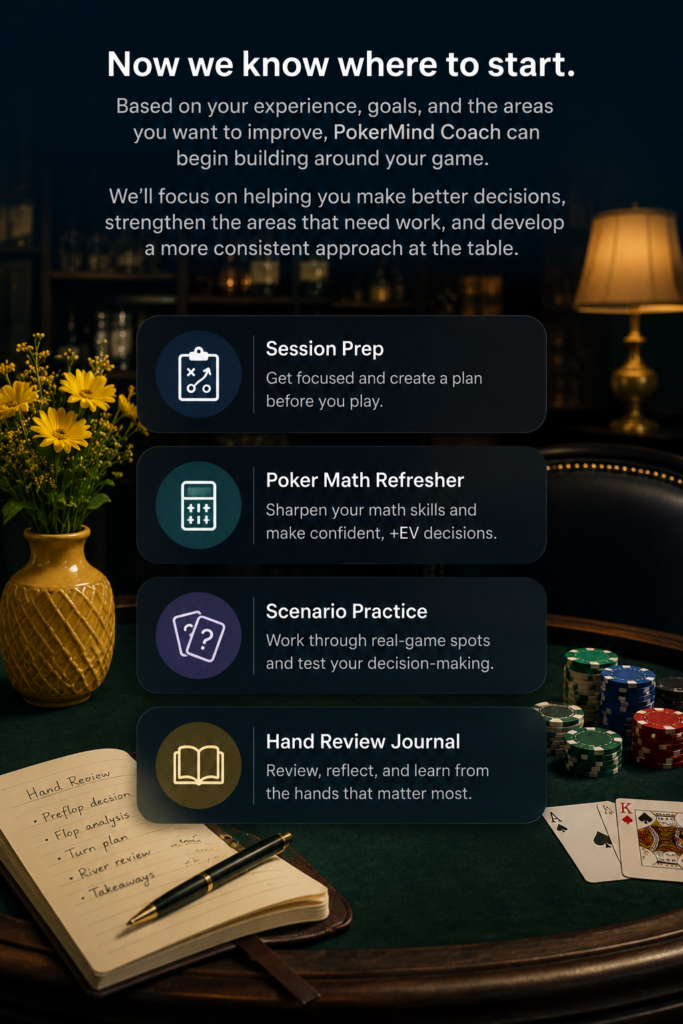
THE MORE COACH KNOWS ABOUT THE SITUATION, THE MORE SPECIFIC THE CONVERSATION BECOMES
Suppose you ask Coach:
“Should I call this turn bet with a flush draw?”
Coach will establish the mathematics, but that’s only part of the decision.
What are the pot and bet sizes? How many clean outs do you have? What are the effective stacks? How many players are still in the hand? What position are you in? What action took place before the flop, on the flop, and on the turn? Do you have any information about your opponents? What has that player’s bet sizing represented previously? If you make your hand, how likely is that player to put additional money into the pot?
Those aren’t minor details. They’re part of the decision.
When Coach needs additional information to properly evaluate the situation, it will ask for it.
And that’s where the conversation becomes important. You can answer Coach’s questions, clarify what happened, provide another observation, add information you didn’t originally include, challenge the analysis, or ask Coach why it reached a particular conclusion.
The conversation develops as the information develops.
COACH REMEMBERS WHAT YOU'VE TOLD IT

The conversation doesn’t necessarily begin with only the information you just entered.
PokerMind retains relevant information you’ve previously provided about your game, correlates that information based on where it may apply, and retrieves it when it becomes relevant to something you’re working on later.
If you’ve discussed a particular opponent, identified a betting tendency, reviewed similar hands, recorded recurring decision problems, or provided other relevant information, Coach can bring that history into a future conversation when it applies.
An observation you make today may become useful information weeks later when you’re discussing another situation involving the same player or a similar decision.
That gives Coach something generic or canned poker advice doesn’t have:
Context about the player asking the question and the game that player is actually playing.
COACH EVALUATES THE COMPLETE DECISION
PokerMind is built on a math-first approach, so Coach begins by establishing the mathematics relevant to the decision. But the calculation is only one part of the analysis.
Coach will also consider the number of players in the hand, position, the current street, pot and bet sizes, effective stack depth, previous action, likely ranges, player type, opponent tendencies, behavioral observations, psychology, tells, implied odds, possible future action, and the other information relevant to the situation you’ve described.
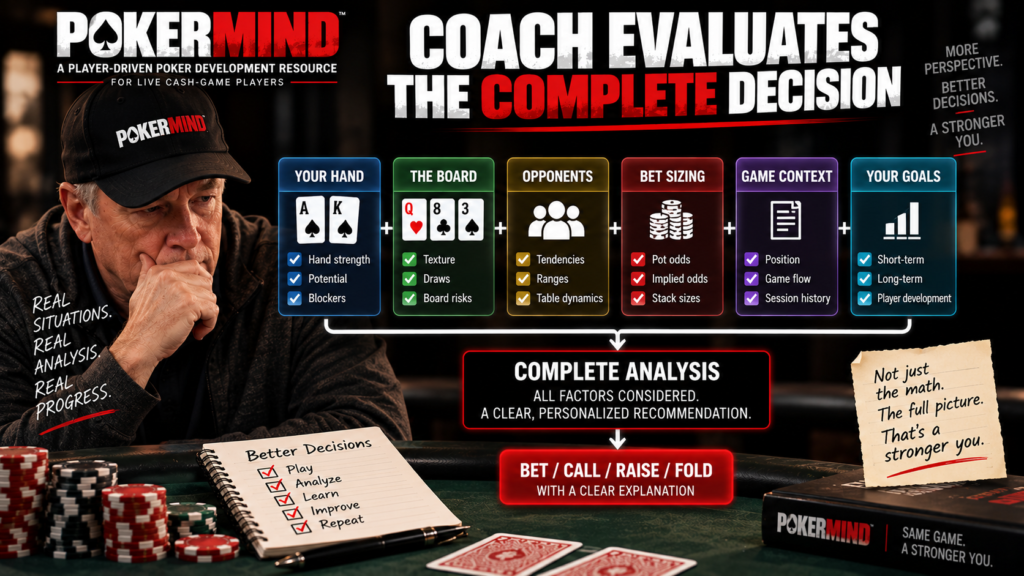
Not every factor will matter equally in every hand. Coach determines which information is relevant to the specific decision and brings those pieces together in the analysis.
The objective isn’t to apply one piece of information to the decision. It’s to evaluate the decision using the information that actually matters.
BACKED BY THE POKERRAILBIRD KNOWLEDGE BASE
Coach also has access to the PokerRailbird knowledge behind PokerMind.
When evaluating a question or situation, Coach will retrieve relevant PokerRailbird knowledge before making an action recommendation and incorporate the material that applies to the decision.
That knowledge extends across poker mathematics, strategy, decision-making, psychology, player behavior, tells, discipline, aggression, player types, and the other areas we’ve developed over the years.
Coach can also surface relevant PokerRailbird videos, articles, and other resources when additional material may help you develop a particular area of your game.
So the conversation isn’t based solely on the question you just asked.
Coach brings together the current situation, the information you’ve provided about your game, relevant information PokerMind remembers from your previous activity, and the applicable PokerRailbird knowledge to evaluate the decision you’re discussing.
Analyze It. Discuss It. Challenge It. Ask Why.
There will be times when you want Coach to analyze a situation and help you understand all of the factors involved.
There will be other times when you want a recommendation.
You can ask for either.
And the response doesn’t have to end the conversation.
If you don’t understand something Coach tells you, ask it to explain. When you disagree, tell Coach why. If you remember another piece of information that may matter, add it. If changing one assumption might change the decision, ask Coach to work through that alternative.
You’re not simply submitting a poker question and receiving an answer. You’re having a conversation about the decision.
That’s PokerMind Coach.
TAKE A TOUR OF POKERMIND

We’ve talked about what makes PokerMind different. Now you can see it for yourself.
In this complete PokerMind orientation, I take you inside PokerMind and walk through the experience from the player’s perspective. You’ll see how PokerMind is initially set up around the individual player, how the different areas work together, how Coach handles both straightforward questions and complex poker decisions, how your activity and results are tracked over time, and how the PokerRailbird knowledge base becomes part of the experience.
This isn’t a promotional preview built from selected screenshots or carefully edited examples. You’re looking at PokerMind itself and seeing how it actually works.
THE POKERRAILBIRD KNOWLEDGE AND PHILOSOPHY BEHIND POKERMIND
PokerMind wasn’t built from scratch as a generic poker resource.
It was built on years of PokerRailbird research, writing, video production, poker experience, and the decision-making philosophy we’ve developed specifically around live No-Limit Hold’em cash games.
Today, PokerMind has access to well over 1.25 million words of poker knowledge.
That material covers poker mathematics, strategy, decision-making, psychology, player behavior, reading poker tells, player types, discipline, aggression, hand analysis, and the many other subjects that become relevant when evaluating a live poker decision.

The PokerMind Library itself contains a curated collection of nearly 200 long-form PokerRailbird videos and more than 115 written articles. When newer material substantially replaced or updated an older video on the same subject, we generally included the newer version rather than loading unnecessary duplication into the Library.
But PokerMind’s access to PokerRailbird material extends beyond what you see displayed in the Library.
PokerMind can also retrieve relevant material from the broader PokerRailbird YouTube channel, including Shorts, when that material applies to something you’re working on. That gives PokerMind access to hundreds of additional pieces of PokerRailbird content beyond the resources organized for direct browsing inside the Library.
KNOWLEDGE MATTERS: BUT SO DOES HOW YOU USE IT!
The size of the knowledge base is important, but simply having access to a large amount of poker information isn’t the objective.
What matters is identifying which information applies to the decision you’re actually trying to make.
PokerRailbird has always approached poker from a math-first perspective. The mathematics provides structure and establishes what is mathematically profitable over the long term. But a live poker decision doesn’t occur in a vacuum.
The players involved, position, stack sizes, betting action, ranges, player tendencies, behavior, psychology, tells, previous observations, and future action can all provide information that affects the complete decision.
PokerMind brings that same methodology into the way it works with you.
Rather than treating every piece of PokerRailbird knowledge as equally relevant to every situation, PokerMind retrieves and applies the material that relates to the question, hand, opponent, or decision you’re discussing.
TOOLS-NOT RULES

That leads directly to the philosophy behind both PokerRailbird and PokerMind:
PokerMind isn’t designed to give you another collection of poker rules to memorize or predetermined answers to follow.
Mathematics and range analysis are tools. Player tendencies, betting patterns, and behavioral observations provide information. Position, stack depth, game type, table dynamics, the number of players involved, previous action, and the current street provide the context in which that information has to be evaluated.
No single factor automatically determines the decision. The value of each depends on its relevance to the specific situation and the weight the available evidence supports.
PokerMind helps bring those pieces together so you can understand what the available information tells you, how much weight that information deserves, and how it applies to the specific situation you’re evaluating.
The final decision still belongs to you.
That’s what Tools, Not Rules means, and it’s built into PokerMind.
PROGRESS AND HISTORY WITHIN POKERMIND
Your Game Doesn’t Start Over Every Day
The information you provide to PokerMind doesn’t disappear when you finish an activity, complete a hand review, or end a poker session.
PokerMind’s Progress section tracks both your playing results and your activity over time. You can follow your net win or loss, hourly win rate, total hours played, percentage of hands played, hands reviewed, scenario drills, quizzes, and other recorded activity.
This gives you more than a snapshot of where you are today. As additional sessions and activities are recorded, you can see how those measurements develop over time and examine the individual results behind them.
History provides the other side of that record.
The Daily Briefings you receive, the hands you review, the Poker Concepts and Scenario Drills you complete, the sessions you record, and the other information you provide remain part of your PokerMind history.
That means you can return to previous work instead of relying on memory or trying to reconstruct what you did weeks or months earlier.
And that history isn’t simply being stored for you to look at later. Relevant information from your previous activity can also become part of what PokerMind uses when working with you in the future.
Progress shows you how your game and your activity are developing. History preserves the information behind that development.
WHAT YOU BRING TO POKERRAILBIRD
PokerMind is player-driven, and that means the information you provide plays an important role in the conversation.
You can begin a conversation with Coach using the information you have. But that doesn’t mean Coach will simply accept incomplete information and produce an answer anyway.
If Coach determines that additional information is necessary to properly evaluate your question, it will tell you what information it needs and ask you to provide it before completing the analysis.

For example, asking:
“Should I call this turn bet with a flush draw?” may not provide enough information to properly evaluate the decision.
Coach may need to know the cards, pot size, amount of the bet, effective stack sizes, position, number of players in the hand, previous action, information about the opponent, or other details relevant to the situation.
WHICH DETAILS MATTER?
You don’t have to know in advance which of those details will matter. That’s part of the conversation. Coach determines what additional information is needed, asks you for it, and then incorporates what you provide into the analysis.
The same principle applies beyond an individual hand.
The sessions you record, opponents you describe, hands you review, observations you make, questions you ask, and information you provide about your own decision-making give PokerMind additional context about your game.
As that information accumulates, PokerMind develops an increasingly detailed history of your play, your decisions, and the areas you’re working on. When something you’ve previously provided becomes relevant to a future question or situation, PokerMind can retrieve that information and incorporate it into the conversation.
The objective isn’t to enter more information simply for the sake of entering more information.
It’s to give PokerMind the information that matters to the decision you’re trying to understand.
The more complete and relevant that information is, the more specifically PokerMind can evaluate the situation and discuss it with you.
POKERMIND LAUNCHES
Beginning October 6th, you’ll be able to access PokerMind through PokerRailbird, complete your onboarding, and begin building your personalized plan.
ANNUAL PLAN — $399/year
Billed annually — approximately $7.67 per week
Save 16%
QUARTERLY PLAN — $119/quarter
Billed every three months — approximately $9.15 per week
Both plans provide access to the complete PokerMind experience, including PokerMind Coach, your personalized plan, Poker Concepts, Daily Briefings, Scenario Drills, Hand Reviews, session tracking, Progress and History, the PokerMind Library, and the other resources available within PokerMind.
Both plans renew automatically and can be canceled at any time.
7-Day Money-Back Guarantee
You can try PokerMind for seven days. If you decide it’s not the right fit for you, you can receive a full refund within the first seven days.
MY COMMITMENT TO POKERMIND PLAYERS
PokerMind carries the PokerRailbird name, and I take personal responsibility for the product we’re asking you to pay for.
If you have a question or concern, or if PokerMind doesn’t perform the way you believe it should, I want to know about it.
You can call or text me directly at 985-773-4095.
I may not always be able to answer the phone when you call, but leave me a message and I will personally return your call or text within 24 hours.
I’m not promising that every problem can be solved immediately. What I am promising is that you’ll have someone who takes responsibility for getting the problem to the right people, following up on it, and getting back to you.
If you’re paying for PokerMind, you deserve a response from someone who is responsible for it.
That’s my commitment to PokerMind and to the players who choose to use it.
Terry Wood
Founder, PokerRailbird.com
FREQUENTLY ASKED QUESTIONS
We’ve answered some of the most common questions about PokerMind below.
If you still have questions, email us at PokerMind@pokerrailbird.com. We’ll be happy to help.
WHAT TYPE OF POKER IS POKERMIND DESIGNED FOR?
PokerMind is designed specifically for live No-Limit Hold’em cash-game players.Your experience level, the stakes and games you play, the areas you want to develop, your current results, and your goals are established during onboarding and become part of the information PokerMind uses when working with you.
DO I NEED TO BE AN EXPERIENCED POKER PLAYERS TO USE POKERMIND?
No.
PokerMind is designed to work with players at different experience levels. The information you provide during onboarding establishes your starting point, and your plan is built around your experience, goals, and the areas of your game you want to develop.
As you continue using PokerMind, the information you provide through your activities, sessions, hand reviews, questions, and conversations with Coach gives PokerMind an increasingly detailed picture of your game.
IS POKERMIND A GTO TRAINER OR SOLVER?
No.
PokerMind is built around a math-first, situational approach to live poker decision-making. GTO concepts can be useful tools for studying poker, but PokerMind does not automatically treat a theoretically optimal strategy as the answer to every live poker decision.
Coach evaluates the information relevant to the situation you’ve described, including the mathematics, position, stack depth, previous action, ranges, opponent tendencies, player behavior, psychology, tells, table dynamics, and other available evidence.
That’s consistent with the PokerRailbird philosophy behind PokerMind:
DOES POKERMIND TELL ME HOW TO PLAY EVERY HAND?
No.
You can ask Coach for a recommendation when you want one, but PokerMind is designed to help you understand the decision rather than simply issue instructions.
You can ask for analysis, question Coach’s reasoning, provide additional information, challenge an assumption, explore an alternative, or ask why a particular factor changes the decision.
The final decision belongs to you.
WHAT INFORMATION DOES POKERMIND REMEMBER ABOUT MY GAME?
PokerMind retains all the information you provide as you use it.
That includes information developed through your activities, hand reviews, recorded sessions, questions, observations, and conversations with Coach.
PokerMind correlates that information based on where it may be relevant and can retrieve it when it applies to something you’re working on later. That allows future conversations to build on information you’ve previously provided rather than requiring every discussion to begin from zero.
DOES POKERMIND PROVIDE THE SAME EXPERIENCE FOR EVERY PLAYER?
No.
PokerMind begins with information about your experience, the games and stakes you play, your goals, and the areas of your game you want to develop.
From there, your experience continues to develop based on the information you provide, the activities you complete, the sessions and hands you record, the questions you ask, and your conversations with Coach.
Two players may begin PokerMind on the same day and have very different plans, activities, conversations, and areas of emphasis because PokerMind is developing around the information each player provides.
That’s what we mean when we describe PokerMind as player-driven.
HOW DO I COMMUNICATE WITH POKERMIND COACH?
There are multiple ways to communicate with Coach.
You can type directly into the conversation, record audio and talk to Coach, record or upload video, take or upload photos, upload existing audio files, and provide documents such as written hand histories, session notes, or your own analysis.
If Coach needs additional information to properly evaluate your question, it will tell you what it needs and ask you to provide it before completing the analysis.
HOW DOES THE 7-DAY MONEY-BACK GUARANTEE WORK?
We want you to have an opportunity to determine whether PokerMind is right for you.
If you decide it isn’t the right fit, you can request a full refund within the first seven days of your initial purchase.