
GTO VS EXPLOITATIVE POKER STRATEGY
WHICH APPROACH WINS MORE?
GTO vs Exploitative Poker is one of the most widely debated topics in modern poker strategy. Some players believe Game Theory Optimal (GTO) provides the ideal framework for every decision, while others argue that exploiting opponents’ mistakes produces greater long-term profits. In reality, both approaches have strengths, limitations, and situations where they perform best.
Understanding the differences between GTO and exploitative poker is not about choosing one philosophy over the other. It’s about recognizing what each approach is designed to accomplish and learning when each creates the highest expected value. Successful players understand both concepts and adapt their decision-making to the game they’re actually playing.
This Hub brings together PokerRailbird’s complete collection of articles and videos comparing GTO vs Exploitative Poker, explaining how each philosophy influences betting, bluffing, hand selection, aggression, table dynamics, and long-term profitability. Whether you’re new to these concepts or looking to refine your strategic thinking, this Hub provides a structured path for understanding how both approaches fit into winning live cash game poker.
SERIES OVERVIEW
This Hub explores two fundamentally different approaches to poker strategy and explains how each can improve your decision-making when applied in the appropriate situations.
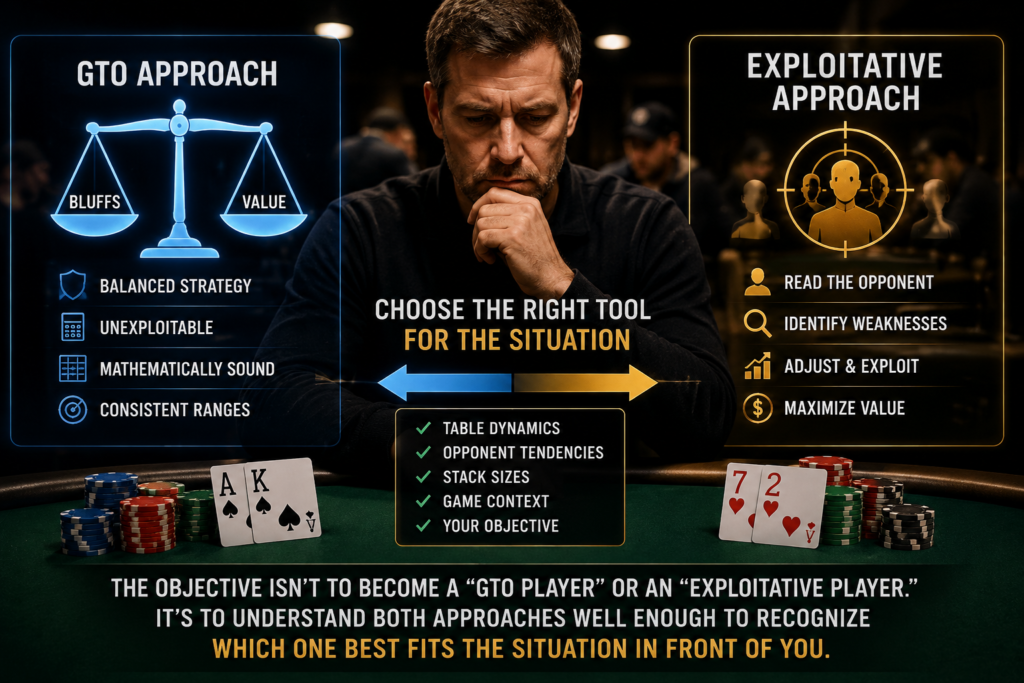
You’ll begin by learning the principles behind Game Theory Optimal poker and exploitative play before examining where each strategy performs well—and where each begins to lose effectiveness. Along the way, you’ll see how table conditions, player tendencies, fold equity, multiway pots, and behavioral observations influence which approach creates the greatest expected value.
Rather than promoting one philosophy over the other, this series demonstrates that successful poker players develop a complete strategic toolbox. The objective isn’t to become a “GTO player” or an “exploitative player.” It’s to understand both approaches well enough to recognize which one best fits the situation in front of you.
WHO IS THIS SERIES FOR?
This Hub is designed for poker players who want to move beyond rigid strategic labels and develop a deeper understanding of why different approaches succeed under different conditions. Whether you’re new to Game Theory Optimal poker, already studying GTO concepts, or prefer an exploitative style of play, this series will help you understand the strengths, limitations, and practical applications of both approaches.
It is especially valuable for live cash game players who routinely face loose, tight, passive, aggressive, and unpredictable opponents where adapting to changing conditions often produces better long-term results than relying exclusively on a single strategic philosophy.
WHAT WE'LL DISCUSS
Understanding GTO vs Exploitative Poker requires more than comparing two different strategies. It requires understanding the assumptions behind each approach and recognizing when those assumptions match, or fail to match, the game you’re actually playing.
Throughout this Hub, you’ll learn how to:
- Understand the principles behind Game Theory Optimal (GTO) poker.
- Recognize the objectives of exploitative poker strategy.
- Identify the strengths and weaknesses of both approaches.
- Understand how player tendencies influence profitable decision-making.
- Recognize when balanced play is appropriate.
- Recognize when exploiting opponents creates greater expected value.
- Understand how table conditions affect strategic choices.
- Develop a flexible decision-making framework rather than relying on a single philosophy.
CORE CONCEPTS
Before comparing GTO and exploitative poker directly, it’s important to understand that both strategies are attempting to solve the same problem:
How do you maximize long-term expected value?
They simply approach that objective from different directions.
Game Theory Optimal poker begins by asking:
“What strategy cannot be exploited, regardless of what my opponent does?”
Exploitative poker begins by asking:
“What mistakes is my opponent making, and how can I profit from them?”
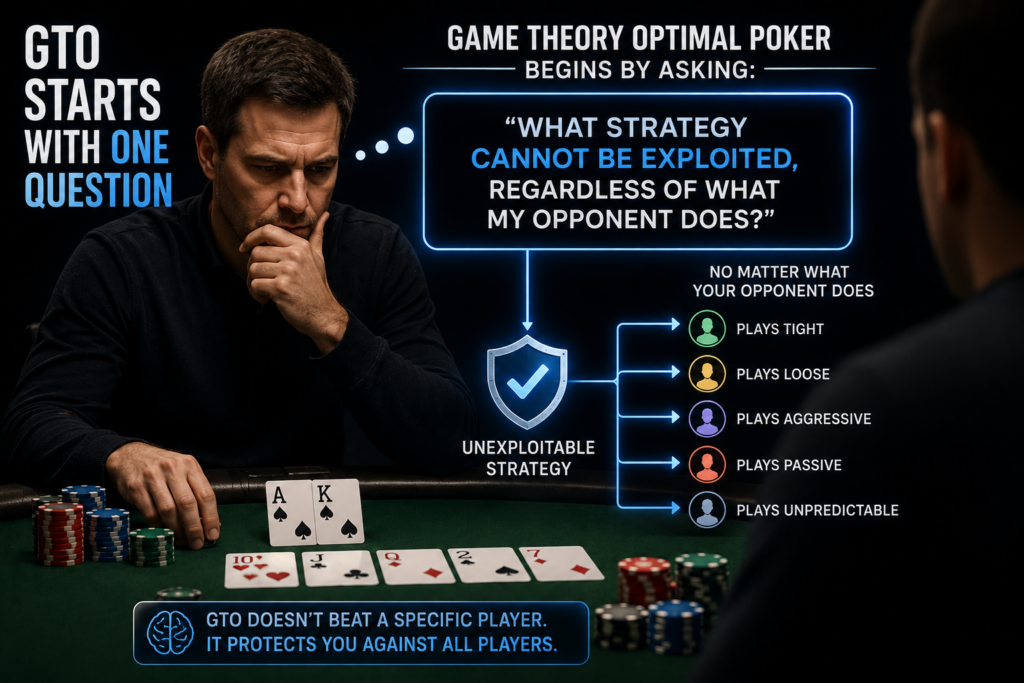
Neither question is inherently better than the other. Each reflects a different philosophy of decision-making, and each produces advantages under the right circumstances.
Throughout this Hub, you’ll see that profitable poker is rarely about choosing one philosophy and rejecting the other. Instead, strong players learn to understand both approaches, evaluate the situation in front of them, and select the strategy that creates the highest expected value.
INDIVIDUAL ARTICLES AND VIDEOS
HOW GTO MAKDE PLAYERS WORSE: A TACTICAL AUTOPSY
Game Theory Optimal poker has transformed modern poker strategy, but many players misunderstand how it should be applied. Instead of improving their decision-making, they become overly focused on memorizing solver outputs, balanced ranges, and theoretical play while ignoring the realities of the games they actually play.
This article explores how an overreliance on GTO concepts can reduce adaptability, discourage independent thinking, and ultimately make players less effective in the loose, exploitative environments found in many live cash games.
THE GTO MYTH: WHY SOLVERS FAIL IN LIVE CASH GAMES
Poker solvers are powerful analytical tools, but they solve problems under a specific set of assumptions. Live cash games often violate those assumptions through loose calling ranges, multiway pots, emotional decision-making, and player tendencies that solvers were never designed to address.
This article explains why solver solutions frequently lose effectiveness in real-world live poker and demonstrates why understanding your opponents often creates more value than attempting to replicate theoretically perfect play.
TEXAS HOLD'EM AND GTO
Game Theory Optimal poker has become one of the most influential concepts in modern Texas Hold’em, yet many players misunderstand both its purpose and its limitations. Understanding what GTO is designed to accomplish—and what it is not—provides the foundation for making better strategic decisions.
This article introduces the principles of GTO within the context of Texas Hold’em while explaining where balanced strategy provides value and where practical adjustments become the more profitable choice.
FREQUENTLY ASKED QUESTIONS
IS GTO BETTER THAN EXPLOITATIVE POKER?
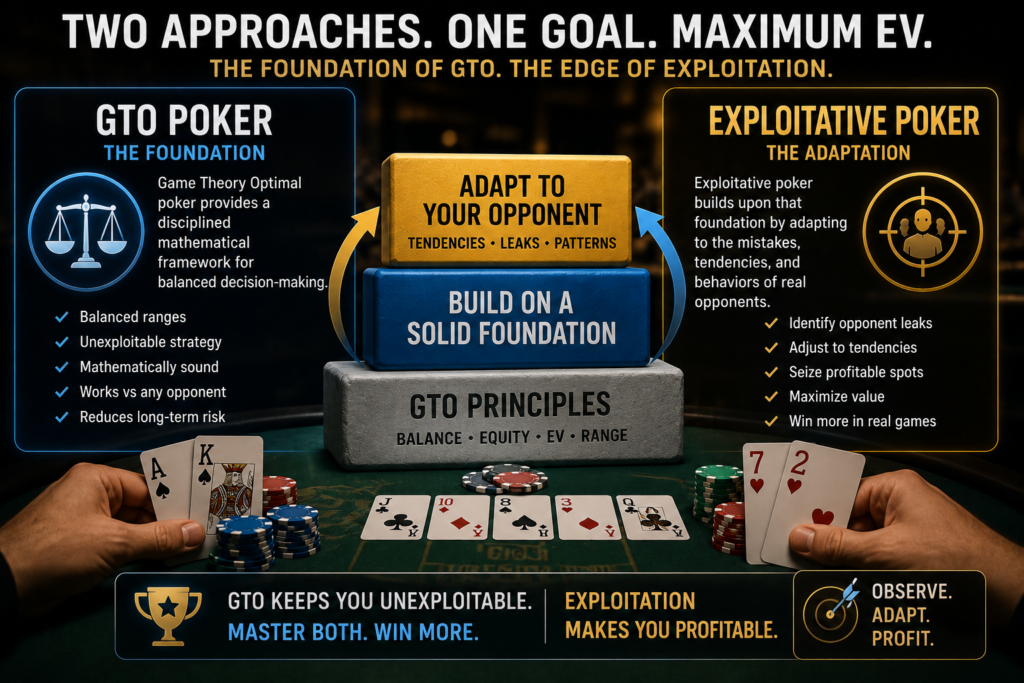
Neither approach is inherently better. Game Theory Optimal poker provides a mathematically balanced foundation that is difficult to exploit, while exploitative poker seeks to maximize profit by adjusting to opponents’ mistakes. The more accurately you can identify those mistakes, the more valuable exploitative adjustments become.
SHOULD LIVE CASH GAMES PLAYERS STUDY GTO?
Yes, but for the right reasons. GTO provides valuable insight into balanced ranges, bet sizing, bluffing frequencies, and overall strategic thinking. Understanding these concepts strengthens your poker foundation, even if you don’t attempt to play perfectly balanced poker in every situation.
WHY DOESN'T GTO ALWAYS WORK IN LIVE CASH GAMES?
Most live cash games differ significantly from the assumptions used by poker solvers. Loose calling ranges, passive players, emotional decisions, multiway pots, and inconsistent betting patterns create opportunities that balanced GTO strategies may not fully exploit.
DOES EXPLOITATIVE POKER IGNOR MATHEMATICS?
No. Exploitative poker is still built upon mathematics, expected value, equity, probability, and pot odds. The difference is that those mathematical principles are adjusted to reflect how opponents actually play rather than how theoretically perfect opponents would play.
CAN I COMBINE GTO AND EXPLOITATIVE POKER?
Absolutely. The strongest players understand both approaches and apply them according to the situation. GTO provides a valuable strategic foundation, while exploitative adjustments allow players to capitalize on specific opponent tendencies whenever profitable opportunities arise.
WHICH APPROACH DOES POKERRAILBIRD RECOMMENT?
PokerRailbird views both GTO and exploitative poker as valuable strategic tools rather than competing philosophies. The objective is not to become committed to one system, but to understand the strengths and limitations of each so you can choose the approach that creates the highest expected value in the situation you’re facing.
FINAL THOUGHTS
The debate surrounding GTO vs Exploitative Poker often asks the wrong question. The goal isn’t to prove one strategy superior to the other. The goal is to understand what each approach is designed to accomplish and recognize when each creates the greatest long-term expected value.
Game Theory Optimal poker provides a disciplined mathematical framework for balanced decision-making. Exploitative poker builds upon that foundation by adapting to the mistakes, tendencies, and behaviors of real opponents. Understanding both approaches gives players a broader strategic toolbox than relying exclusively on either philosophy alone.
As you work through the articles and videos in this Hub, focus less on choosing sides and more on understanding the principles behind each approach. The strongest poker players aren’t defined by a single strategy—they’re defined by their ability to apply the right tool to the right situation at the right time.
That’s ultimately what winning live cash game poker is all about.
RELATED HUB PAGES
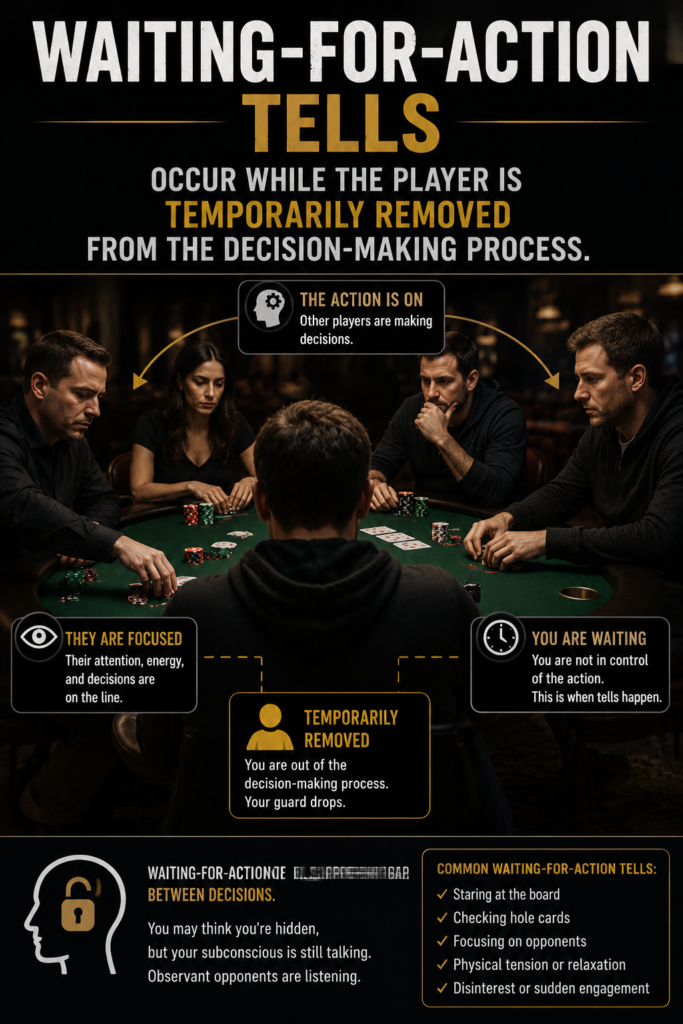
Waiting-for-action tells occur after you’ve acted but before your opponent responds, making them some of the most reliable behavioral observations in live poker. This Hub explores the most common tells of strength and weakness, explains how to interpret them within the proper context.
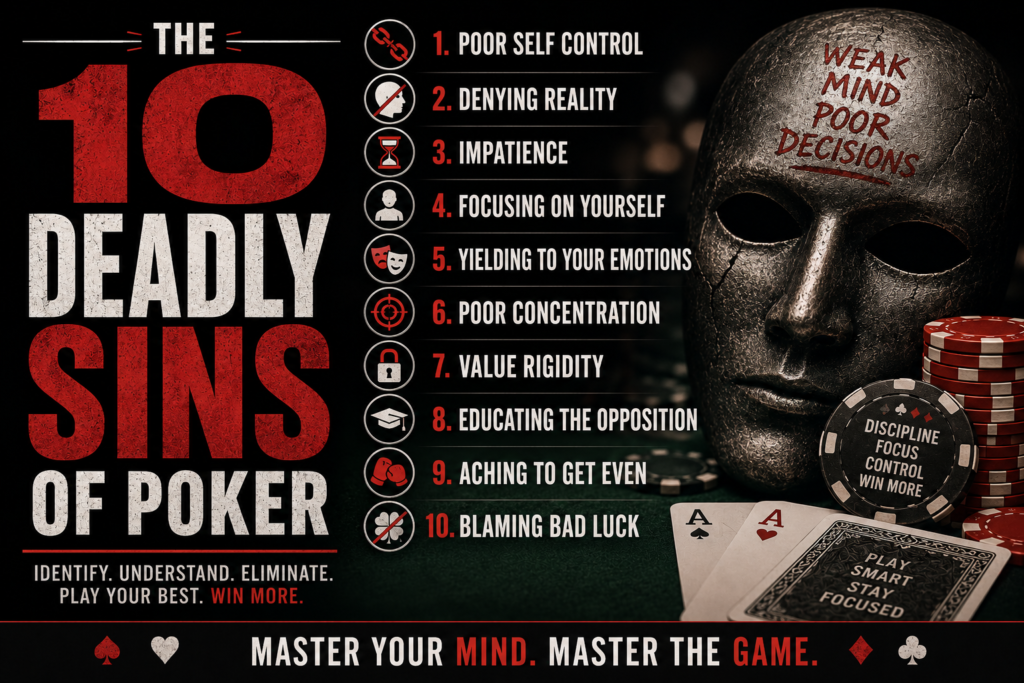
Even technically skilled players lose money when psychological mistakes begin to influence their decisions. This Hub examines the ten most common mental and emotional leaks that quietly undermine discipline, distort decision-making, and prevent players from consistently performing at their best.
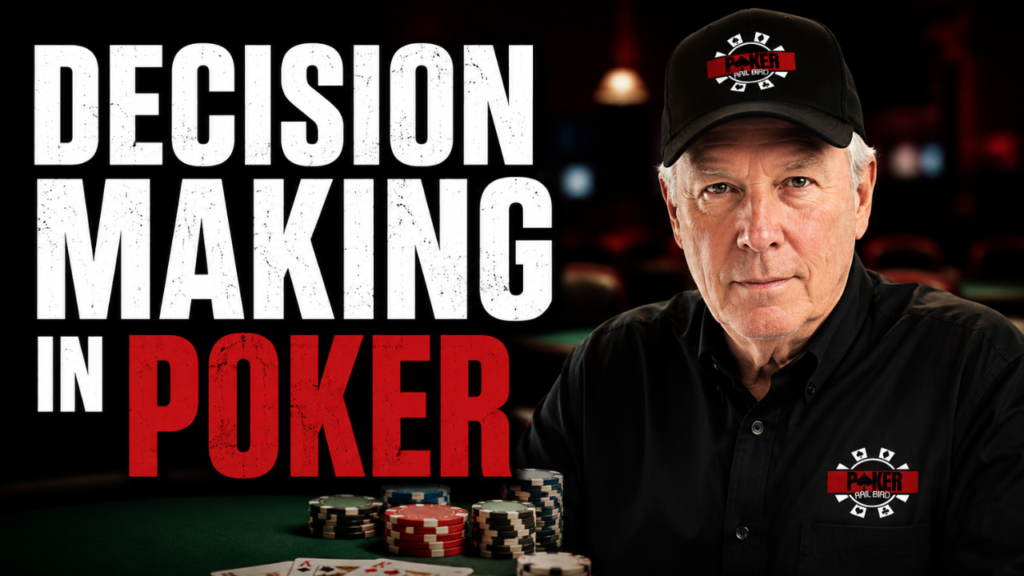
Decision-making in poker is the foundation of long-term success. Every hand presents a series of choices made with incomplete information, uncertain outcomes, and constantly changing circumstances.