
LOOKING AWAY FROM GOOD CARDS
A POKER TELL OF STRENGTH
Looking Away From Good Cards is a subtle poker tell that often surprises players because it seems to contradict common sense. Most people assume that when someone makes a strong hand, they’ll continue looking at the cards that created it. Yet, in some cases, the opposite occurs. A player who has just improved to a powerful holding may instinctively look away from the board almost immediately.
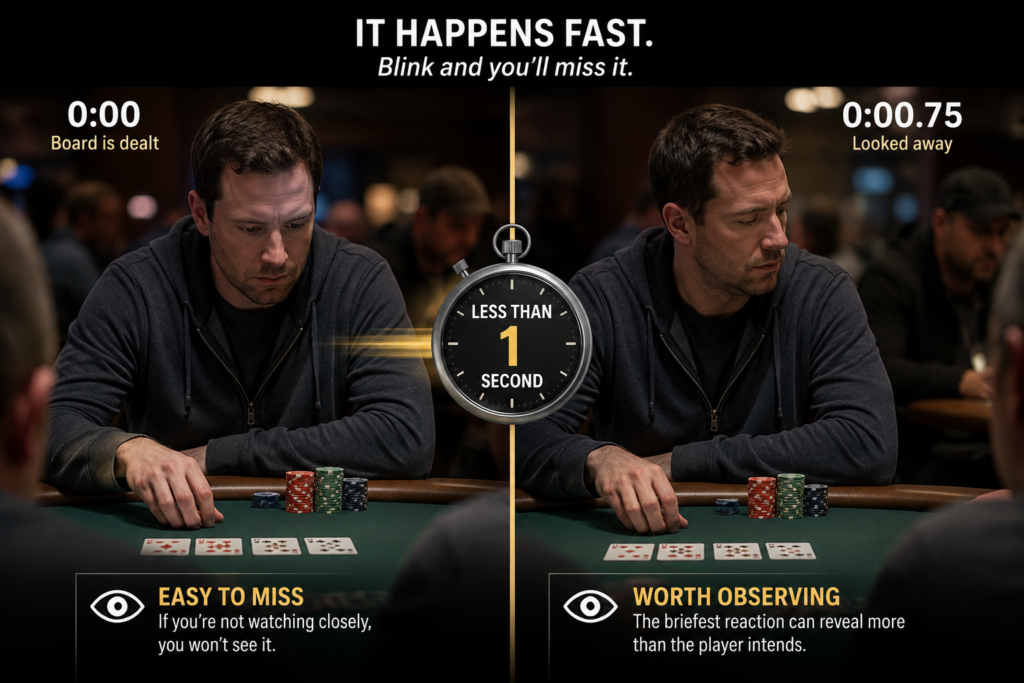
The behavior usually lasts only a second, making it easy to miss unless you’re already observing your opponents as the community cards are dealt. Like all poker tells, it should never be interpreted in isolation. However, when it appears alongside other evidence, it can provide another useful clue about the strength of an opponent’s hand.
WHEN THE TELL OCCURS
Looking away from good cards most often occurs at the second a player first realizes the community cards have significantly improved their hand. The opportunity to observe the tell exists during that initial reaction to the flop, turn, or river. If your attention is focused on your own cards, chips, or pending decision instead of your opponents, the reaction will likely be over before you ever notice it.
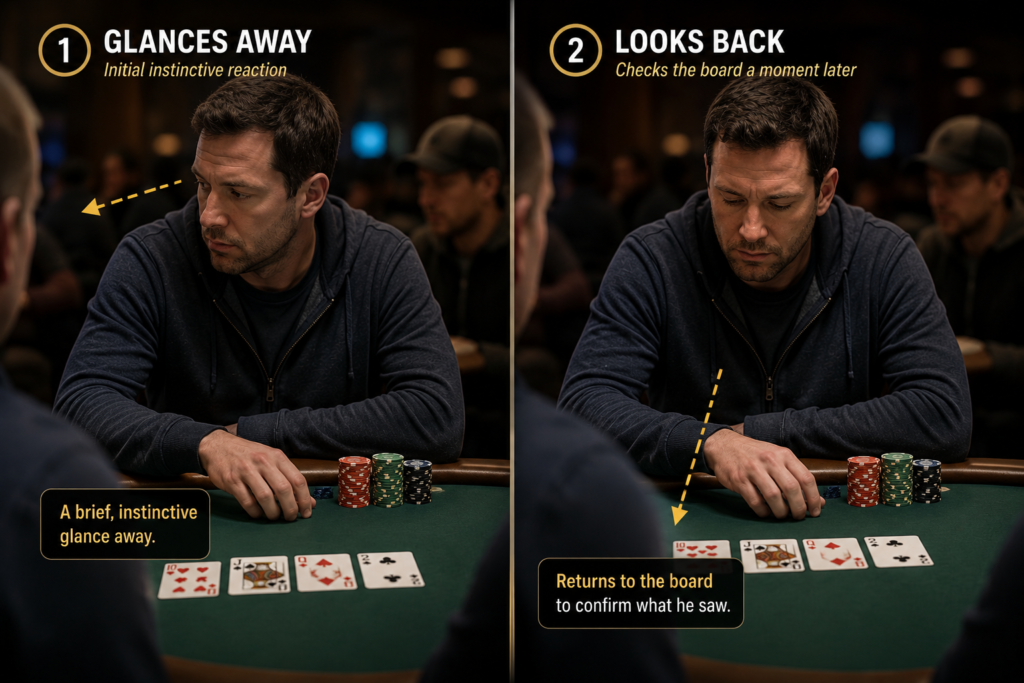
In many cases, the player will instinctively glance away from the board, only to look back a moment later. That second look often serves a different purpose. Players naturally want to verify they saw the board correctly, particularly after making an unexpected or disguised hand. They may also assume everyone else has already examined the community cards, making a second look feel less noticeable. Ironically, the brief glance away that preceded it is often the more meaningful reaction because it occurred before conscious thought had an opportunity to intervene.
A similar reaction can sometimes occur before the flop when players first look at their hole cards. Some inexperienced players who discover a premium starting hand will immediately place their cards back on the felt, almost as though they want to distance themselves from what they just saw. While this version of the tell tends to be less reliable than reactions to the community cards, it reflects the same instinctive response.
WHY PLAYERS LOOK AWAY
Initially, looking away from good cards seems illogical. If the board has just given you top set, a made straight, or the nut flush, you might expect your attention to remain fixed on the cards that created your hand. Yet for many players, the opposite reaction occurs because the response is driven by instinct rather than conscious thought.
When something valuable suddenly appears, people often have a natural desire to protect it. In poker, a strong hand represents opportunity, and the subconscious mind may respond by trying to avoid drawing attention to the source of that opportunity. Looking away becomes an automatic attempt to conceal interest, even though no one at the table is likely to notice where the player’s eyes have moved.
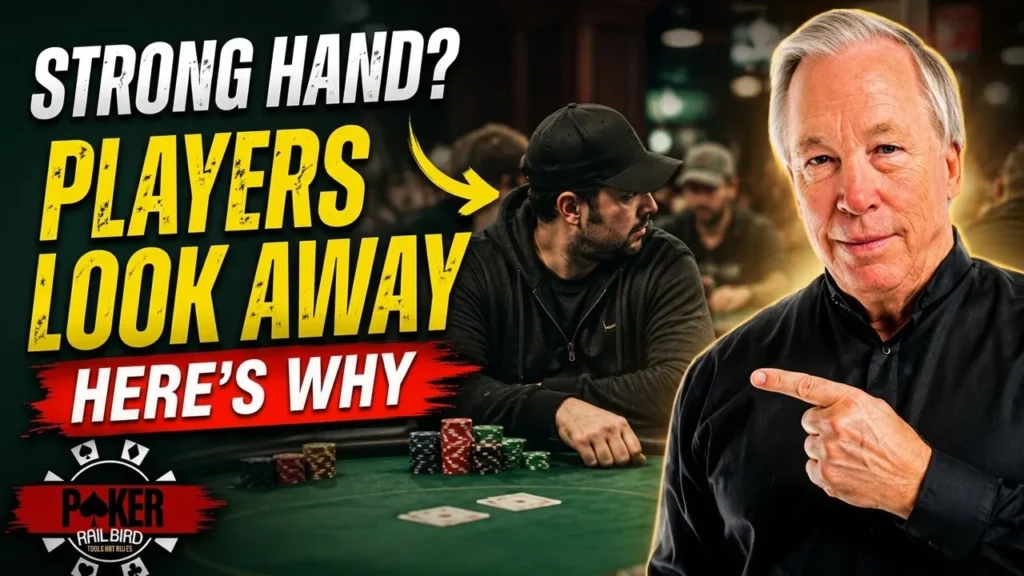
This reaction should not be confused with acting. In most cases, the player isn’t trying to deceive anyone. The movement happens before they have time to think about how they should appear. Only afterward might they consciously return their attention to the board or attempt to behave as though nothing unusual has happened. That distinction is important because instinctive reactions are often more reliable than deliberate performances.
Like many physical tells, this behavior is rooted in basic human psychology rather than poker strategy. The player’s objective isn’t to communicate strength; in fact, the subconscious is often trying to accomplish exactly the opposite. Ironically, that instinctive attempt to hide interest can become a small but meaningful clue for observant opponents.
WHEN THE TELL IS MOST RELIABLE

Like most physical tells, looking away from good cards is not universal. Some players exhibit the behavior consistently, while others never do. Its reliability depends largely on the individual player, their experience level, and whether the reaction occurs naturally or is consciously controlled.
This tell is most often seen in recreational and less experienced players who have not learned to standardize their behavior. Because they are focused on the excitement of making a strong hand rather than controlling the information they reveal, their first reaction is more likely to be instinctive. Experienced players, on the other hand, are generally better at maintaining consistent behavior regardless of the strength of their hand.
Timing is equally important. The initial reaction is usually the most meaningful because it occurs before the player has time to think about how they appear. Once that moment has passed, conscious behavior often replaces instinctive behavior. A player who immediately looks away, then deliberately returns their attention to the board, may be displaying two entirely different processes—the first subconscious, the second intentional.
It is also important to recognize that some players deliberately create false tells. An experienced opponent who understands that others watch for physical reactions may intentionally look away from a weak hand or stare at a strong one in an attempt to manipulate perception. For that reason, this tell should be viewed as one piece of information rather than a conclusion. The more experienced the player, the more cautious you should be when interpreting any single physical behavior.
CONTEXT AND CORROBORATION
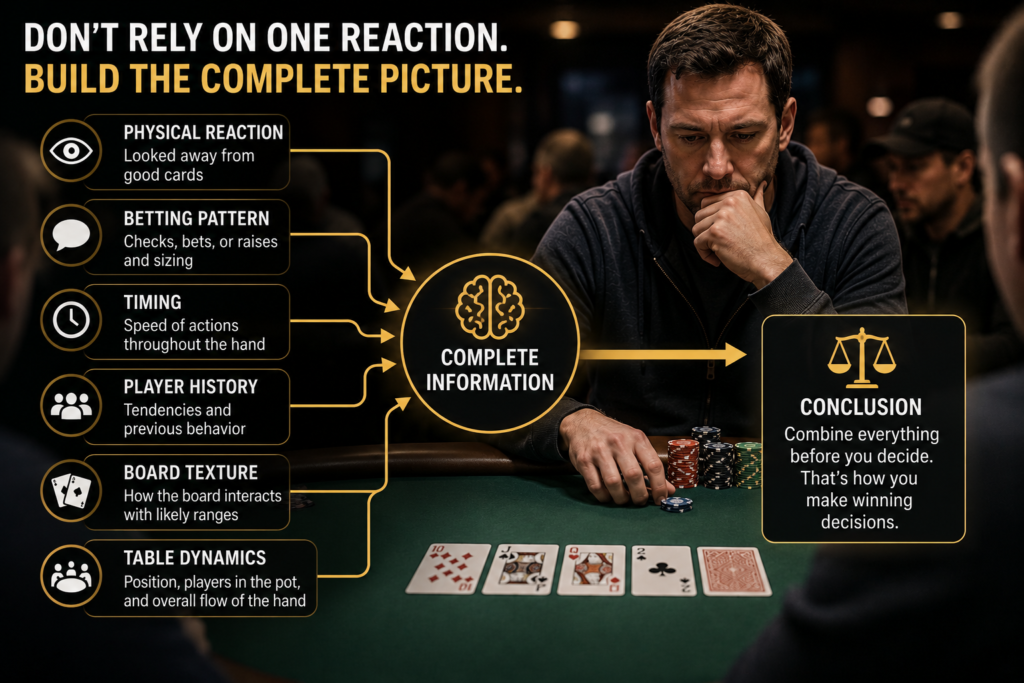
Looking away from good cards should never be interpreted in isolation. Like every physical tell, it is simply one piece of information that must be considered alongside everything else occurring in the hand. Betting patterns, bet sizing, timing, board texture, player tendencies, and previous behavior all contribute to a more complete and reliable read.
Equally important is establishing a player’s baseline. Some individuals naturally avoid looking at the board for reasons that have nothing to do with hand strength. Others routinely shift their attention around the table regardless of the cards they hold. Without first understanding what is normal for a particular opponent, it becomes difficult to determine whether a specific reaction represents meaningful information or simply part of their usual behavior.
The strongest reads rarely come from a single tell. They develop when multiple pieces of evidence point in the same direction. If a player instinctively looks away from the board, then follows with confident betting and behavior that differs from their established baseline, the combined information carries far more weight than any one observation by itself.
Viewed this way, looking away from good cards is not proof that an opponent has made a strong hand. Instead, it is another clue that helps build a larger picture. The objective is never to make decisions based on one physical reaction, but to combine that observation with every other piece of available information before reaching a conclusion.
CONCLUSION
Imagine you’re walking through a parking lot and notice a $100 bill lying on the ground. Your first instinct probably isn’t to stand there staring at it. Many people instinctively look around first or briefly look away before picking it up. The money has suddenly become valuable, and without consciously thinking about it, you become aware that you don’t want to draw unnecessary attention to it.
The same instinct can appear at the poker table.
When a player unexpectedly makes a strong hand, the subconscious may briefly shift their attention away from the very cards that created it. They’re not trying to perform or deceive. They’re simply reacting to something they suddenly perceive as valuable.