
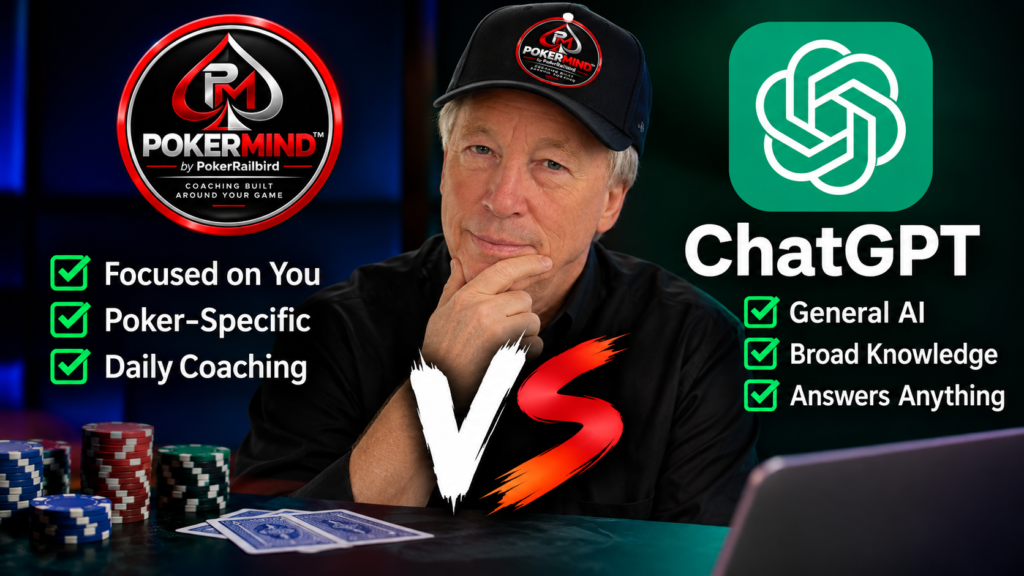
POKERMIND VS CHATGPT
LIVE CASH GAME POKER COACHING
The PokerMind vs ChatGPT comparison begins with a familiar experience: you’ve probably used ChatGPT to ask a poker question Maybe you wanted to review a tough hand, calculate your drawing odds, or understand why a decision might have been wrong. It’s convenient, accessible, and can provide useful information.
But how much does answering an individual poker question contribute to your development as a player?
Think about the hands you’ve played over the past month. How many difficult decisions have you encountered? Have you noticed recurring problems with hand selection, bet sizing, reading opponents, or evaluating the math in a particular situation? More importantly, what have you done with that information?
Improving your live cash game means building knowledge, applying what you’ve learned, reviewing your decisions, and identifying areas that need more attention. The process continues from one session to the next, often over months or years.
That is where the comparison of PokerMind vs ChatGPT becomes particularly relevant.
Both systems can provide poker-related information, but they were developed for different purposes. ChatGPT is a general-purpose AI assistant that can address an enormous range of subjects. PokerMind was developed specifically to provide structured, personalized, and continuing education and coaching for live cash-game poker players.
Understanding those different purposes and how each system approaches poker player development is the foundation for evaluating their capabilities.
WHAT HAPPENS WHEN YOU ASK CHATGPT ABOUT A HAND

Suppose you’ve just finished a $1/$3 live cash-game session. You faced a substantial river bet holding top pair, called, and lost. Now you’re wondering whether your decision was mathematically and strategically justified.
You describe the hand to ChatGPT and request an analysis.
ChatGPT can calculate pot odds, discuss possible opponent holdings, evaluate alternatives, and explain its reasoning. However, the reliability of that analysis depends heavily on the information available.
Did you provide the effective stack sizes, positions, complete betting sequence, and board cards? How many opponents were involved? What did you actually know about the player who made the river bet?
Missing information can materially change the analysis. ChatGPT may request clarification, but when essential details remain unavailable, its conclusions depend upon assumptions that may not accurately represent the situation.
THE LIMITATIONS OF CONVERSATIONAL POKER ANALYSIS
Now consider what happens when you return two weeks later with another difficult hand.
ChatGPT can retain and reference information from previous conversations through its memory capabilities, but that does not guarantee complete or consistent recall of your earlier hands, opponent observations, mathematical errors, or the reasoning behind your decisions.
This is an important consideration in PokerMind vs ChatGPT: whether the analysis draws upon a complete, organized history of the player’s previous decisions and observations.
Analytical consistency is also a question.
ChatGPT is not inherently required to examine every poker decision using a particular live cash-game methodology, verify its conclusions against a defined educational library, or maintain an organized record of weaknesses identified during previous reviews.
You can provide instructions, establish a project, maintain records, and direct ChatGPT to follow a particular analytical process. However, that requires you to develop and supervise much of the coaching structure yourself.
An individual hand analysis can provide valuable information. Developing a player’s knowledge and skills over time requires a systematic process that connects individual decisions, previous observations, identified weaknesses, and subsequent instruction.
That distinction becomes increasingly important as the number of hands, sessions, and learning activities grows.
WHAT POKERMIND IS BUILT TO DO INSTEAD
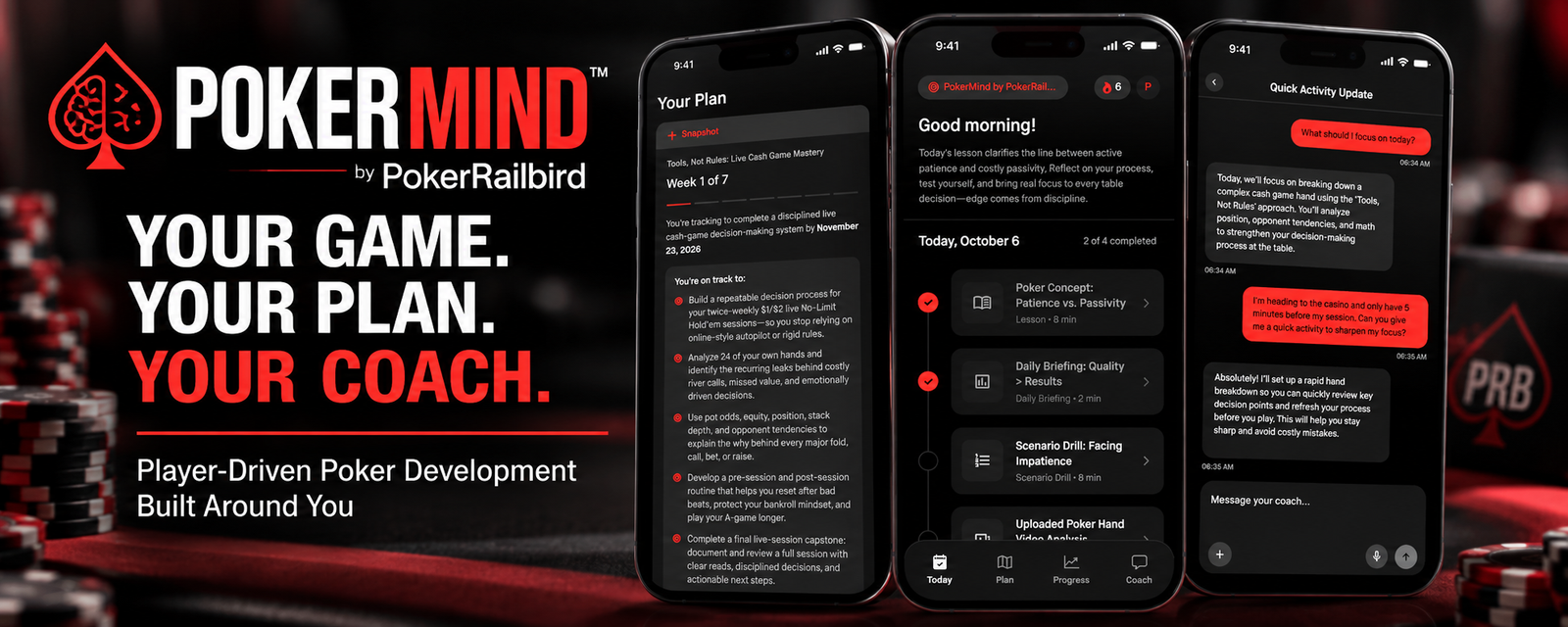
PokerMind was developed specifically for the education and continuing development of live cash-game poker players. Its coaching system brings together individual player information, structured instruction, mathematical analysis, and a defined strategic methodology within a single program.
The purpose is to provide each player with a coaching experience shaped by their own game, including the decisions they face, the difficulties they encounter, and the areas where additional knowledge or practice may be needed.
YOUR GAME BECOMES THE FOUNDATION FOR YOUR COACHING
PokerMind begins with an onboarding process designed to establish a detailed understanding of the individual player.
This includes your experience, stakes, game types, playing style, strengths, weaknesses, and development goals. You also identify the opponents you find most difficult, the decisions that give you trouble, and what typically goes through your mind when evaluating a hand.
These answers establish the initial direction of your coaching program.
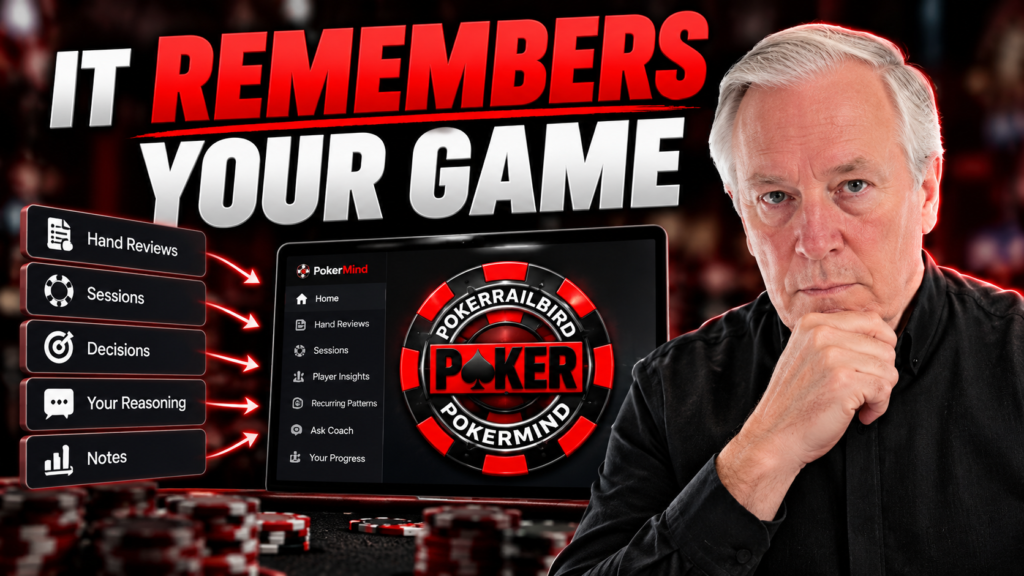
As you continue using PokerMind, that record expands through hand reviews, poker session reports, quiz results, scenario exercises, and conversations with your coach. Your previous work becomes part of the information available for subsequent coaching.
For example, if several hand reviews reveal difficulty evaluating pot odds against drawing odds, PokerMind can direct additional attention toward those mathematical concepts. If your session reports repeatedly identify impatience or frustration, your coaching can incorporate exercises addressing those behavioral concerns.
The objective is to identify weaknesses through accumulated evidence and concentrate instruction where it is most useful.
A DEFINED EDUCATIONAL AND ANALYTICAL METHODOLOGY
Another key distinction between PokerMind and ChatGPT is the specialized educational framework that supports PokerMind’s coaching.
PokerMind incorporates daily instructional videos, practical assignments, knowledge assessments, realistic poker scenarios, and a dedicated Poker Math Academy. These activities give players opportunities to study a concept, apply it to a decision, test their understanding, and revisit the subject when additional work is needed.
Its strategic foundation draws upon the PokerRailbird educational library, developed specifically around live cash-game poker. That broader body of work includes more than 382 instructional videos, over 120 articles, and approximately 1.4 million words covering poker mathematics, strategy, psychology, player behavior, and decision-making.
PokerMind’s coaching instructions require consultation of relevant material from its available PokerRailbird knowledge resources when evaluating strategic questions. This establishes a consistent instructional foundation based on the methodology developed for the program.
That methodology emphasizes mathematical accuracy, available information, observed opponent behavior, and careful evaluation of assumptions. It also recognizes that sound poker decisions can produce unfavorable outcomes and that a profitable result does not necessarily establish correct reasoning.
Together, these components create a comprehensive coaching structure that connects individual instruction, hand analysis, practical exercises, and player development.
PokerMind is designed to provide the specialized educational framework, individual coaching history, and organized development process that a live cash-game player would otherwise need to assemble and manage independently.
SIDE-BY-SIDE: WHAT MATTERS FOR IMPROVING YOUR POKER GAME
The comparison of PokerMind vs ChatGPT becomes more meaningful when we examine five functions that directly influence a player’s education, development, and performance at the poker table.
MEMORY: WHAT DOES YOUR COACH KNOW ABOUT YOUR GAME?
ChatGPT can remember information from previous conversations, but that memory is selective. It does not guarantee that every hand you’ve discussed, opponent you’ve described, or decision you’ve examined will be available in a future conversation.
PokerMind maintains a dedicated player record that includes your playing profile, submitted hand reviews, session information, and completed learning activities.
Consider a player who regularly participates in loose, aggressive $1/$3 games, struggles with multiway pots, and has identified impatience as a recurring concern.
Those details are relevant when evaluating hand selection, bet sizing, and emotional decision-making. PokerMind is designed to incorporate that information into subsequent coaching rather than relying on the player to repeatedly reconstruct their playing circumstances.
The advantage is a coaching record organized specifically around the player’s poker experience.
CONTINUITY: WHAT HAPPENS TO PREVIOUSLY IDENTIFIED WEAKNESSES?
Imagine that several hand reviews reveal a recurring misunderstanding of drawing probabilities. The player repeatedly evaluates a flop decision using the probability of completing a draw by the river, even though the immediate decision concerns the price of seeing only the turn.
ChatGPT can explain the mathematical distinction and help the player work through additional examples. However, maintaining an organized record of the problem and coordinating subsequent instruction generally requires additional direction from the player.
PokerMind’s coaching structure is designed to connect the identified weakness with its educational activities. The player can receive additional work on drawing probabilities, compare those probabilities with pot odds, and practice applying the correct calculations to new situations.
Subsequent quizzes and hand reviews provide further information about the player’s understanding.
The advantage is a process that connects an identified weakness with instruction, practice, and subsequent evaluation.
EVIDENCE AND MATHEMATICAL ACCURACY: HOW ARE THE CONCLUSIONS REACHED?
Poker decisions combine mathematical facts, incomplete information, opponent observations, and strategic judgment.
Suppose a player submits a hand for review but omits the effective stack sizes, the turn action, and relevant information about an opponent’s betting tendencies.
ChatGPT can recognize those omissions and request clarification. Its analytical approach, however, depends on the instructions, context, and information supplied during the conversation.
PokerMind operates under a defined hand-analysis methodology. Its coaching instructions require identifying missing material information, checking the cards and betting sequence, applying the appropriate street-by-street mathematics, and distinguishing established facts from assumptions.
When a player’s description is insufficient to support a strategic conclusion, the appropriate response is to request additional information or explain the limits of the available evidence.
This is particularly important when evaluating opponent behavior. A player who makes a large river bet might be bluffing, betting for value, or misjudging the strength of their hand. Without supporting observations, assigning that opponent a precise range or bluffing frequency would introduce assumptions into the analysis.
The advantage is a consistent analytical framework designed to make the reasoning behind a poker decision visible and open to examination.
STRUCTURED PRACTICE: HOW DOES INSTRUCTION BECOME APPLIED KNOWLEDGE?
Understanding an explanation is different from demonstrating that you can apply the concept correctly.
ChatGPT can generate poker exercises, build scenarios, and test a player’s knowledge on request. The player generally determines what to study, which exercises to request, and how to organize the progression.
PokerMind incorporates these activities into its educational program.
For example, a player studying set mining can start with the math of flopping a set, including the ~11.8% chance of doing so with a pocket pair.
From there, the player can examine the relationship between the cost of entering the pot, effective stacks, and the potential return when they make a set.
A quiz can test the underlying mathematics, while a scenario presents a decision involving actual positions, raise sizes, and effective stack depths.
The objective is to develop the player’s ability to recognize when the mathematical and financial conditions support entering the pot, rather than simply memorizing the probability of flopping a set.
The advantage is an established instructional process that incorporates explanation, application, assessment, and additional practice.
SPECIALIZED KNOWLEDGE: WHAT GUIDES THE STRATEGIC ANALYSIS?
One of the most significant distinctions in PokerMind vs ChatGPT is the educational knowledge base supporting each system.
PokerMind draws upon PokerRailbird’s extensive library of more than 380 instructional videos and 125 articles, representing over 1.4 million words of specialized live cash-game poker knowledge.
This collection covers poker mathematics, strategic decision-making, player psychology, behavioral observations, bet sizing, equity, and the practical challenges encountered in live cash games.
PokerMind has dedicated access to its curated PokerRailbird knowledge base and is instructed to retrieve relevant material when evaluating strategic poker questions.
ChatGPT does not have this same integrated knowledge base or a standing requirement to consult PokerRailbird’s educational material. Its responses draw upon broader information and the context available in the conversation.
This distinction creates a consistent foundation for PokerMind’s coaching, incorporating years of specialized research, instruction, and practical experience into its analytical methodology.
The advantage is direct access to an extensive, purpose-built body of live cash-game poker knowledge, integrated into a structured coaching program.
WHAT THIS LOOKS LIKE IN PRACTICE
Consider a player who regularly participates in $1/$3 live cash games. He’s reasonably experienced, understands basic poker mathematics, but occasionally struggles with difficult river decisions.
THE FIRST HAND: EXAMINING THE DECISION
During a session, he’s holding 9♠8♠ on a board of A♣9♦4♠6♥2♣. His opponent bets $150 into a $300 pot on the river.
He calls, loses to a pair of aces, and submits the hand to PokerMind for review.
The mathematics establishes that the call requires approximately 25% equity to break even, before additional costs. But whether his pair of nines has that equity depends on the opponent’s range and the information available when the decision was made.
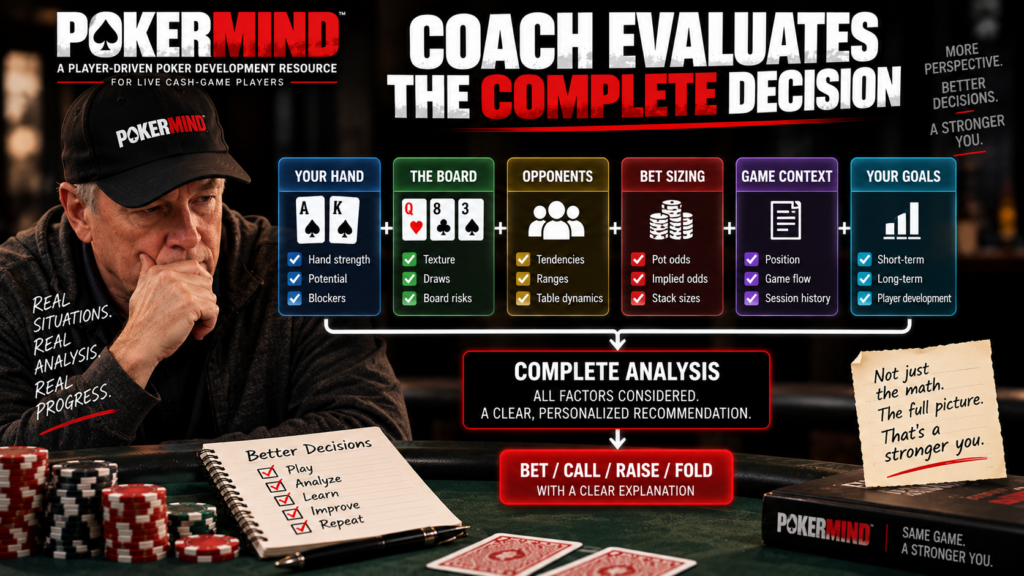
Coach begins examining the hand. What happened on the earlier streets? How did the opponent arrive at this river bet? What had the player observed about this opponent’s betting tendencies? Was there evidence that the opponent would bluff or bet a weaker hand?
During the discussion, the player explains that his opponent was generally passive and rarely made substantial bets without a strong hand. Nevertheless, he called because he felt his pair was too strong to fold.
That explanation reveals something important about his reasoning.
The player understood his hand’s strength but struggled to connect it to the opponent’s likely betting range. His decision relied heavily on his cards, despite observations suggesting his opponent’s river bet represented considerable strength.
The review preserves the hand information, the player’s observations, his explanation, and the mathematical considerations. These details become part of his coaching history.
TWO WEEKS LATER: A SIMILAR DECISION

During another $1/$3 session, the same player encounters a difficult river situation.
This time, he’s holding Q♣T♣ on a board of K♥T♠6♥3♣2♦. His opponent bets $120 into a $240 pot.
Again, he holds second pair. Again, he’s facing a substantial river bet, requiring approximately 25% equity to justify calling.
But there’s an important difference.
This opponent has demonstrated a willingness to bluff missed draws and make aggressive bets with weak holdings. The board also contains a possible missed heart draw.
The player submits the hand to PokerMind.
Because the earlier review is part of his coaching record, PokerMind is designed to use that history when examining the new situation. Coach can revisit the earlier reasoning and ask the player to compare the information available in both hands.
In the first review, the player called despite observations suggesting his opponent was unlikely to bluff. In this situation, he has observed behavior that could support a wider river betting range.
Does that evidence materially change the decision? Which hands might the opponent bet for value? What bluffs are plausible given the complete betting sequence? Is there sufficient information to estimate whether the player’s hand wins often enough?
The coach guides the player through those questions, examining the evidence rather than drawing a conclusion from the similarity of the two hands.
HOW THE REVIEW INFLUENCES FUTURE COACHING
Suppose additional reviews reveal that the player consistently evaluates river calls according to the absolute strength of his hand, without adequately considering the opponent’s range and the price of calling.
That recurring pattern provides a specific subject for further instruction.
PokerMind can direct additional coaching toward river decision-making, assign mathematical exercises involving pot odds and required equity, and present scenarios requiring the player to evaluate different opponent types and betting sequences.
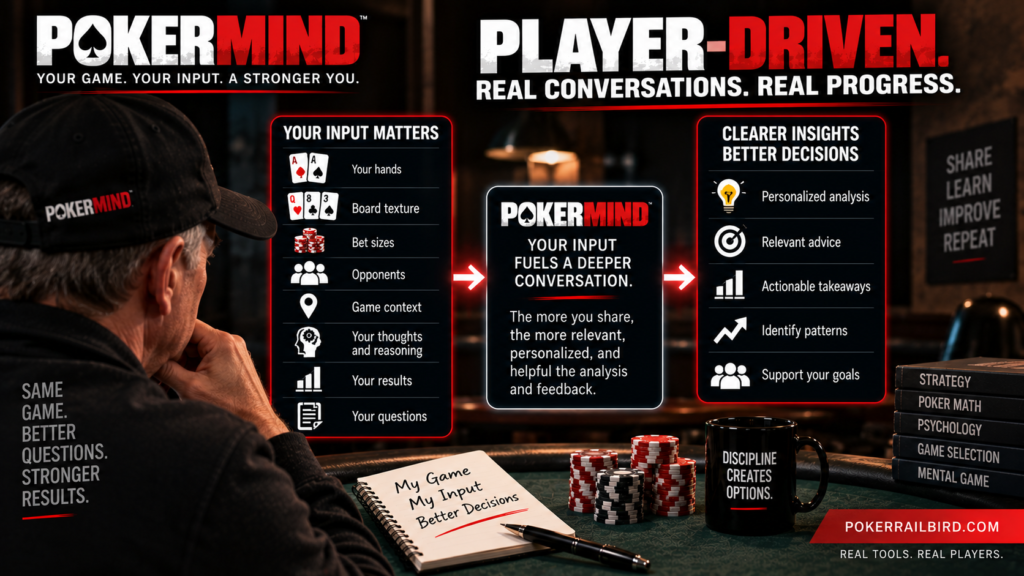
Quiz results, scenario responses, and later hand reviews can then provide additional evidence of whether the player understands and applies those concepts.
The coaching process develops from the decisions the player actually encounters, the reasoning he provides, and the weaknesses supported by his accumulated record.
THE PRACTICAL DIFFERENCE: CHOOSING THE RIGHT TOOL FOR YOUR GAME

ChatGPT is a versatile artificial intelligence assistant capable of answering questions, explaining concepts, and helping players examine individual poker decisions. Its usefulness extends across thousands of subjects, and poker is one of them.
PokerMind serves a more specialized purpose.
It was developed to provide live cash-game players with a comprehensive educational and coaching program, supported by a defined instructional methodology, mathematical analysis, personalized learning activities, and an accumulating record of their individual development.
The value of that approach becomes apparent as the coaching relationship progresses. Previous hand reviews, session observations, identified weaknesses, and demonstrated knowledge can contribute to the instruction and guidance a player receives next.
The central distinction in PokerMind vs ChatGPT is the purpose each system was designed to fulfill.
For players seeking answers to individual poker questions, ChatGPT remains a useful resource. For those who want a dedicated program that combines instruction, practice, assessment, and continuing personalized coaching, PokerMind offers a purpose-built approach to developing their live cash game.
Start With Your Own Game
Your PokerMind coaching experience begins with you: the games you play, the opponents you face, the decisions you struggle with, and the goals you want to pursue.
Complete your onboarding profile, introduce your coach to your playing experience, and begin exploring the areas of your game that deserve attention.
If you’re already using PokerMind, bring your next difficult hand into review. Examine the reasoning behind your decisions, question your assumptions, and use what you discover to guide your continuing development.
Your poker experience provides the information. PokerMind provides the coaching structure to help you learn from it.