

BET TIMING TELLS
IN LIVE CASH GAMES
Bet timing tells are the during-action behaviors that show up from the moment it becomes a player’s turn until they finish acting. In live cash games, these tells can give you useful information, but they can also lead you astray. The same pause or quick action can mean different things depending on the player, the situation, and what they’re trying to accomplish in the hand.
Many players treat bet timing tells as simple. They figure a fast bet means strength and a long pause means weakness or indecision. That view misses a lot of what actually happens at the table. In no-limit especially, players often control timing on purpose. Players use it to create a certain impression, and stronger players will deliberately balance how long they take so the timing itself reveals very little.
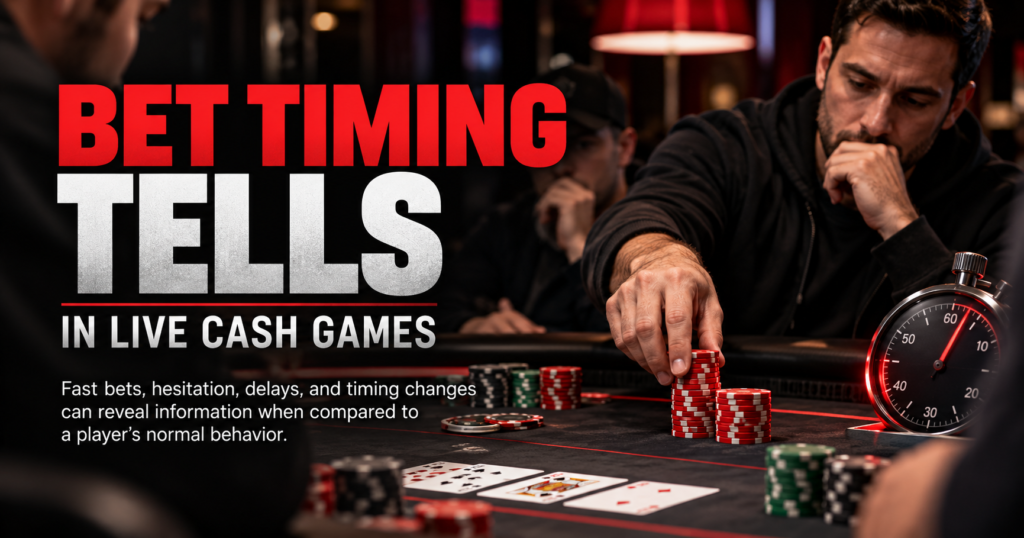
This article looks at bet timing tells as tools rather than rules. We’ll cover differences between limit and no-limit, the common patterns and counter-patterns you see with different player types, and the importance of asking what a player is trying to accomplish by acting quickly or slowly. The goal is better observation and clearer thinking, not a fixed formula you can apply every time.
Bet timing tells tend to work best when you combine them with other information you already have. Player type, prior actions in the hand, stack sizes, and the overall table dynamic all matter. An isolated timing read is usually unreliable on its own. Consistent observation over many hands is what turns these behaviors into something useful.
LIMIT VS NO-LIMIT: DIFFERENT INFORMATION ENVIRONMENTS
Bet timing tells behave differently depending on whether you’re playing limit or no-limit. The difference comes down to how much each individual decision is worth and how much incentive players have to control their timing.
HOW TIMING USUALLY PLAYS OUT IN LIMIT
In limit games, the action is usually faster, and the timing is more likely to be honest. Immediate bets or raises, meaning something that happens in about half a second or less, tend to represent easy decisions, and easy decisions are usually strong hands. Long pauses are more often genuine. Most regulars won’t sit there acting like a decision is difficult when it isn’t, partly because they don’t want to slow the game down and partly because the value of deception is lower when the bets and pots are smaller. You can still get tricked, but pure acting with timing is less common than it is in no-limit.
HOW NO-LIMIT CHANGES THE PICTURE
It changes because each decision matters more; players have a stronger reason to manage how long they take. Weaker or more straightforward players will often bet quickly when they’re bluffing and take more time when they’re value-betting. Better players know this and will deliberately balance their timing so that a fast or slow action doesn’t reliably indicate strength or weakness. In no-limit, you’ll also see more intentional deception overall, so the same timing can mean the opposite depending on the player and the spot.

One practical exception is worth keeping in mind. Even in limit, if the size of a single bet is meaningful to the player: nosebleed limit or a recreational player who is uncomfortable with the stakes, their timing behavior can start to look more like what you see in no-limit. The more the money matters relative to the player, the more likely they are to treat the decision the way a no-limit player would.
None of this turns bet timing tells into a simple rule. It just means the information environment is different. In limit, you can often take timing more at face value. In no-limit, you have to be more careful about reading intent and more willing to treat timing as only one piece of a larger picture. The useful approach is still the same: observe the specific player, notice how their timing lines up with their known style, and ask what they might be trying to accomplish in that moment.
COMMON PATTERNS AND COUNTER-PATTERNS
Bet timing tells rarely work the same way for every player. The same action, a quick check, a long pause before betting, or an immediate raise, can mean different things depending on who does it and what they are trying to communicate. This is where a lot of the complexity shows up.
PATTERNS YOU SEE WITH CHECKS
One common pattern is a player who takes a long time to check when their hand is weak. They are often trying, consciously or not, to look like they have something to think about. The pause is meant to suggest strength or at least a real decision, even though they are mostly just folding or giving up. Another type of player does the opposite: they check quickly almost every time, whether the hand is strong or weak. Their goal is simply to keep their timing consistent so they don’t give anything away. They would rather act a little faster than normal with a strong hand than let the timing itself become a tell.
Then there are the more deliberate players who sometimes take a long time to check when they actually have a strong hand. The long pause is intentional. They want the opponent to read the delay as weakness or uncertainty and put more money in the pot. This is a classic false tell. The timing is being used to create the opposite impression of what the hand actually is.
HOW BETS AND RAISES ADD MORE LAYERS
Bets and raises bring even more variation. In many no-limit games, weaker players bet quickly when bluffing and take longer when value-betting. They haven’t yet learned to balance their timing, so the speed of the action can leak information. Stronger players know this tendency exists and will often mix up how long they take. A fast bet might be a value bet or a bluff; a slower one might be either. The timing alone stops being reliable.
You will also see players who fire a large bet immediately, almost without seeming to consider the card that just came. In some cases this is genuine strength, an easy decision that doesn’t require much thought. In other cases, especially with less experienced players who have already committed themselves to a line, the quick large bet can be a bluff. They have painted themselves into a corner and are trying to end the hand as fast as possible.
WHY THESE PATTERNS OVERLAP
These patterns and counter-patterns exist side by side because bet timing tells are among the more consciously controlled behaviors at the table. Players can choose how long to take, and many of them do. That choice usually depends on what they want the other player to believe or do in that moment. Because players have different habits, awareness levels, and goals, the same visible timing can point in opposite directions.
This is why isolated reads on timing tend to be shaky. A long pause before a check might mean a weak hand from one player and a strong hand from another. A quick bet might be strength from a regular and a bluff from a recreational player. The patterns are real, but they only become useful once you have seen enough of a particular player to know which version of the pattern they tend to follow.
THE MOTIVATION QUESTION
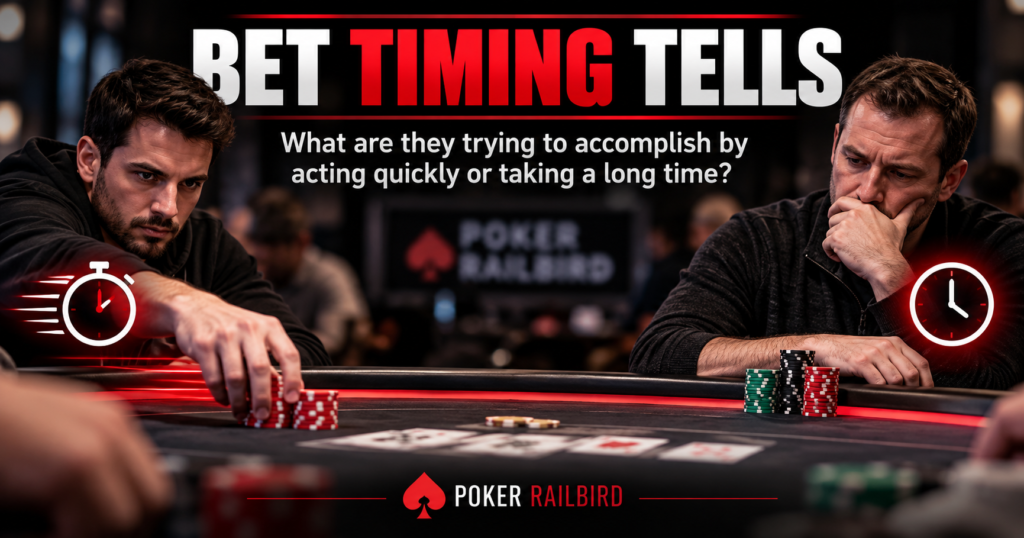
The most useful way to look at bet timing tells is to start with what the player is trying to accomplish in the hand. Timing is rarely random. Even when a player isn’t consciously thinking about it, their timing is often shaped by their goal in that moment. Asking a simple question cuts through much of the noise: what are they trying to accomplish by acting quickly or taking a long time?
WHAT THE TIMING IS MEANT TO DO
A player who bets quickly may be trying to look strong and decisive so the opponent folds. They may also be trying to look weak or uncertain so the opponent calls or raises. A long pause can be an attempt to make the decision seem difficult, which might induce a bluff or discourage a value bet. It can also be genuine thinking. The visible behavior is the same; the intended effect is what changes. Once you have a sense of the player’s normal style, you can start to reverse-engineer which effect they are going for.
This is why knowing the player matters more than memorizing a general rule about fast or slow action. A tight, straightforward regular who suddenly takes a long time before checking is sending a different signal than a loose, tricky player who does the same thing. The first player’s pause is more likely to reflect a real decision. The second player’s pause is more likely to be part of a plan. Their known tendencies and motivations give the timing its meaning.
PUTTING MOTIVATION AHEAD OF THE CLOCK
In practice, this means the clock is secondary. You first look at the player, the action so far, the board, and the likely goals in the hand. Then you notice how long they took and ask whether that timing lines up with what they probably want to happen next. If a player who rarely bluffs takes a long time and then bets small, the pause may simply be them deciding whether their hand is strong enough to bet. If a player who loves to induce action takes a long time and then checks, the pause may be designed to look weak. The same length of time can support opposite conclusions once motivation is part of the read.
Bet timing tells become more reliable when you treat them this way. Instead of treating a fast or slow action as a direct signal of hand strength, you treat it as one clue about intent. The question of what the player is trying to accomplish keeps the read tied to the specific situation and the specific person. That is usually more useful than any general rule about how long someone “should” take.
PRACTICAL APPLICATION AND LIMITATIONS
Bet timing tells become useful mainly through repeated observation of the same players. One or two hands rarely tell you much. Over time, you start to notice whether a particular player tends to act quickly with strong hands, slowly with weak ones, or mixes everything up on purpose. That player-specific baseline is what turns raw timing into a workable piece of information.
BUILDING A USEFUL BASELINE
The process is straightforward, even if the results aren’t. Watch how a player times their actions across different situations: checks, bets, raises, and folds; strong hands and weak ones; heads-up pots and multi-way pots. Note whether their timing stays consistent or changes with pot size or the strength of their perceived hand. Once you have that picture, deviations stand out more clearly. A player who normally checks quickly and suddenly takes a long time is giving you something to weigh. A player who always takes time is giving you less.
You also have to keep the rest of the hand in view. Position, stack sizes, prior action, and the board all change what a given timing pattern likely means. A quick, large river bet from a short-stacked recreational player who has been passive all hand is different from the same bet from a deep-stacked regular who has been applying pressure. The timing is one factor among several. Treating it as the deciding factor usually leads to mistakes.
WHERE THE INFORMATION BREAKS DOWN
There are clear limitations. Bet-timing tells are noisier in multi-way pots because more players are involved and motivations are harder to isolate. Short stacks can compress decision time in general, so the usual patterns may not apply. Recreational players often have less consistent timing habits than regulars, which makes their actions both more readable in some spots and more random in others. Strong players who actively balance their timing will give you very little reliable information from the clock alone.
This area is complicated, and quick progress is unlikely. Timing is one of the more consciously controlled behaviors, so it involves more acting and more false signals than many other tells. The best results come from treating bet-timing tells as one tool to check against the player’s known style, their likely goals in the hand, and the rest of the available information. When those pieces line up, the timing can support a stronger read. When they don’t, it is usually safer to discount it.
CONCLUSION

Bet timing tells are real, but they are also noisy. A fast action or a long pause can point toward strength, weakness, or deliberate deception depending on the player and the situation. The same visible behavior often supports opposite conclusions once you factor in who is acting and what they are trying to accomplish.
The useful skill is not memorizing simple rules about speed. It is learning to ask better questions in the moment. What does this player normally do? What are they trying to get the other person to do right now? How does the timing line up with the rest of the hand? Those questions keep the read grounded in observation instead of assumption.
This fits the broader approach of treating poker decisions as tools rather than rules. Bet timing tells work when they are combined with player type, prior action, stack sizes, and the specific goals in the hand. They fail when they are treated as a standalone signal that always means the same thing. Quality decisions come from clear observation and situational reasoning, not from rigid interpretations of how long someone took to act.
Over time, consistent attention to these patterns improves your ability to weigh timing properly. You will still get it wrong sometimes. The area is complicated, and many players actively manage their timing. The edge comes from reducing how often you misread the signal, not from expecting it to be reliable on its own. That is the practical value of studying bet timing tells in live cash games.