
STACK TO POT RATIO IN POKER
WHY IT MATTERS
Stack-to-Pot Ratio helps describe the financial structure of a poker hand by comparing the amount of money remaining in the effective stack with the size of the pot.
Knowing only one of those numbers can be misleading.
A $500 pot may sound large, but the decisions that remain are very different when the effective stack is $400 compared with $4,000. In both situations, the pot is exactly the same size. What changes is the amount of money still available to be wagered relative to that pot.
That relationship affects the decisions that can develop on later streets. It can influence how much flexibility remains, how much additional money can potentially be won or lost, and how the bet or call you make now can change the structure of the decisions you face on later streets.
This is where Stack-to-Pot Ratio, commonly referred to as SPR, becomes useful.
SPR does not tell you whether to bet, call, raise, or fold. It gives you another piece of information about the situation you’re facing, and about the decisions your current action may help create.
WHAT IS STACK-TO-POT RATIO?
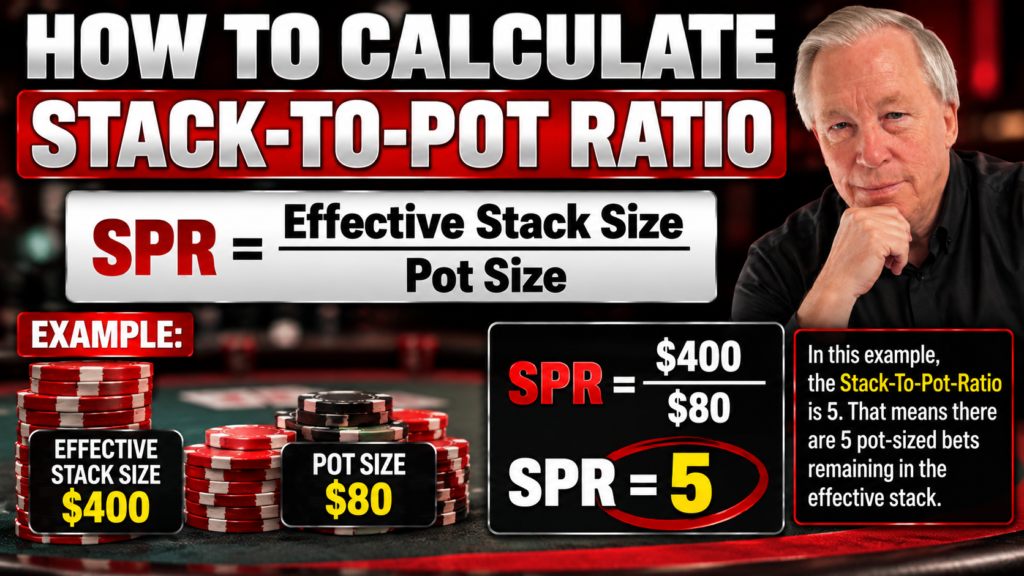
Stack-to-Pot Ratio, or SPR, compares the effective stack remaining in a hand with the current size of the pot.
The calculation is straightforward:
Effective Stack ÷ Pot Size = Stack-to-Pot Ratio
The effective stack is the maximum amount of money that can still be wagered between the players involved in the hand. If you have $1,500 remaining but your opponent has only $900, the effective stack between the two of you is $900. You cannot win more from that opponent than they have available to wager.
Suppose the pot is $300 and the effective stack is $900.
The calculation is: $900 ÷ $300 = 3
The Stack-to-Pot Ratio is therefore 3, usually written as an SPR of 3. In plain poker terms, the effective stack contains three times the amount currently in the pot.
That number does not tell you whether your hand is strong, whether you should bet, or whether you should continue. It simply describes the relationship between the money already in the pot and the amount that remains available to be wagered.
That relationship becomes useful because the same $300 pot creates very different future decisions when the effective stack is $300, $900, or $3,000.
SPR gives you a way to measure that difference.
STACK-TO-POT RATIO CHANGES DURING THE HAND
Stack-to-Pot Ratio is not fixed. It changes as money enters the pot and the effective stacks become smaller.
Suppose the pot is $300 on the flop and the effective stack is $900. As we calculated in the previous section:
$900 ÷ $300 = an SPR of 3
Now suppose one player bets $150 and the other player calls. The pot increases from $300 to $600:
$300 + $150 bet + $150 call = $600
At the same time, the effective stack decreases from $900 to $750 because each player has committed another $150 to the pot. When the turn is dealt, the new Stack-to-Pot Ratio is:
$750 effective stack ÷ $600 pot = an SPR of 1.25
The SPR has fallen from 3 on the flop to 1.25 on the turn.
What changed was the financial structure of the hand. On the flop, the players had three times the size of the pot remaining in their effective stacks. On the turn, they have only 1.25 times the pot remaining.
This is important because the decisions on the turn are now being made with $750 remaining against a $600 pot—not with $900 remaining against a $300 pot.
The same process continues as the hand moves toward the river. Bets and calls increase the pot while reducing the effective stacks. As more money enters the pot, the SPR will generally continue to decrease.
This is one reason bet sizing matters beyond the immediate price being offered to an opponent. A flop bet determines more than how much an opponent must call. If the bet is called, its size also helps determine the Stack-to-Pot Ratio of the next street.
Every betting decision can change the financial structure of the decisions that follow.
LOW SPR AND HIGH SPR CREATE DIFFERENT SITUATIONS
The value of Stack-to-Pot Ratio is not simply knowing whether the number is high or low. It is understanding what that number tells you about the amount of money remaining relative to the pot.
As SPR becomes lower, less money remains behind compared with the amount already in the pot. This reduces the number and size of future betting decisions that can occur before the effective stack is exhausted.
Consider the turn example from the previous section. The pot is $600, the effective stack is $750, and the SPR is 1.25. There is only slightly more than one pot-sized bet remaining in the effective stack.
Compare that with a $600 pot and a $3,000 effective stack. The SPR is now:
$3,000 ÷ $600 = an SPR of 5
There is substantially more money remaining relative to the pot, creating more room for betting, raising, and additional decisions on later streets.
That difference matters.
A lower SPR generally creates fewer options because a significant bet can quickly represent a large portion of the effective stack. A higher SPR provides greater flexibility, but it also creates the possibility of facing several substantial decisions before the hand is complete.
Neither situation is automatically better.
WHAT IS "POT COMMITTED" AND IS IT REAL?
A low SPR does not mean you should automatically put the remaining money into the pot, and a high SPR does not mean you should automatically play cautiously. The SPR describes the financial structure of the decision, not telling you which action to take.
This is why arbitrary rules such as “an SPR below a certain number means you’re committed” can be misleading. The number tells you how much money remains relative to the pot.
It does not tell you whether putting that money into the pot is a good decision.

SPR tells you how much room remains for the hand to develop financially. It does not determine the relative strength of your hand. The board, opponent ranges, previous action, bet sizing, player tendencies, position, and the other information available determine what you should do with that financial structure.
SPR: DRAWS AND FUTURE STREETS
Stack-to-Pot Ratio also matters when the value of a hand depends on what may happen on later streets.
Consider a drawing hand. The immediate pot odds tell you the price you are being offered to continue, but they do not necessarily describe all of the money that may be won or lost if the draw is completed.
When the SPR is higher, more money remains behind relative to the pot. That can create greater implied-odds potential because there is more money available to win from an opponent after you improve.
But the same financial structure can also work against you.
If the card that improves your hand leaves you with a vulnerable or second-best hand, a higher SPR also creates greater reverse-implied-odds exposure. More money remains available to lose on the decisions that follow.
A lower SPR limits both possibilities. With less money remaining behind relative to the pot, there is less additional money available to win after improving, but also less additional money available to lose if the improvement is not good enough.
This is why you can’t always evaluate the value of a draw by looking only at the probability of making the hand.
The amount of money remaining matters because it affects what can happen after the draw.
SPR does not tell you whether the draw is worth pursuing. You still have to consider the immediate price, whether your outs are clean, the relative strength of the hand you may make, opponent ranges, board texture, position, and likely future action.
Stack-to-Pot Ratio tells you how much financial opportunity—and financial risk—may remain after the next card arrives.
SPR IS INFORMATION, NOT A COMMITMENT RULE

One of the biggest mistakes players can make with Stack-to-Pot Ratio is turning a useful measurement into an automatic rule.
A low SPR is sometimes interpreted to mean that a player is “pot committed.” But SPR does not make that decision. It only tells you how much money remains in the effective stack relative to the size of the pot.
Suppose the pot is $1,000 and you have $700 remaining. The SPR is 0.7. There is relatively little money left compared with the size of the pot, but that does not mean the remaining $700 automatically belongs in the middle
SPR DESCRIBES THE FINANCIAL STRUCTURE: NOT THE DECISION
The cards, the board texture and the opponent’s range, previous action, bet sizing, player tendencies, position, and any other relevant information still matter.
If new information indicates that you are likely behind with insufficient reason to continue, the fact that the SPR is low does not transform a poor call into a good one.
The same principle applies to money you have already invested in the hand. Those chips are now part of the pot. They do not create an obligation to invest the chips that remain.
This is where SPR can become dangerous when you treat it as a rule instead of a tool. A player may begin with a useful observation: there isn’t much money remaining relative to the pot- and turn it into an unsupported conclusion: therefore, I have to continue.
Those are not the same statement.
A high SPR can be misused in the opposite direction. Having substantially more money behind does not automatically mean you should avoid a strong hand or become excessively cautious. It means there is greater financial exposure remaining and potentially more decisions to make before the hand is complete.
Stack-to-Pot Ratio describes the financial structure of the hand. It does not determine the quality of your hand or the action you should take.
Use SPR alongside the rest of the information available to you. Consider relative hand strength, ranges, board texture, position, bet sizing, opponent tendencies, mathematics, and the likely consequences of each available action.
SPR can help you understand what is at risk; it’s not supposed to make the decision for you.
KNOW THE DECISION YOU ARE CREATING
Every bet, call, or raise changes more than the amount of money in the pot. It also changes the amount remaining behind and, with it, the financial structure of the decisions that may follow.
That is where Stack-to-Pot Ratio becomes useful.
SPR lets you look beyond the decision in front of you and consider what the hand may look like if the action continues. A bet that appears reasonable now may create a much larger pot with relatively little money remaining. A smaller investment may leave substantially more room for decisions on later streets.
Neither situation is automatically better.
The important part is recognizing what you are creating before you get there.
Poker becomes considerably more difficult when players make one decision at a time without considering how those decisions affect what comes next. By the turn or river, they can find themselves facing a large pot, a small remaining stack, and a decision they never considered when the earlier money went in.
Stack-to-Pot Ratio gives you a way to see that possibility developing.
Don’t use SPR to tell you what to do. Use it to understand what the decision you make now may require you to deal with later.