
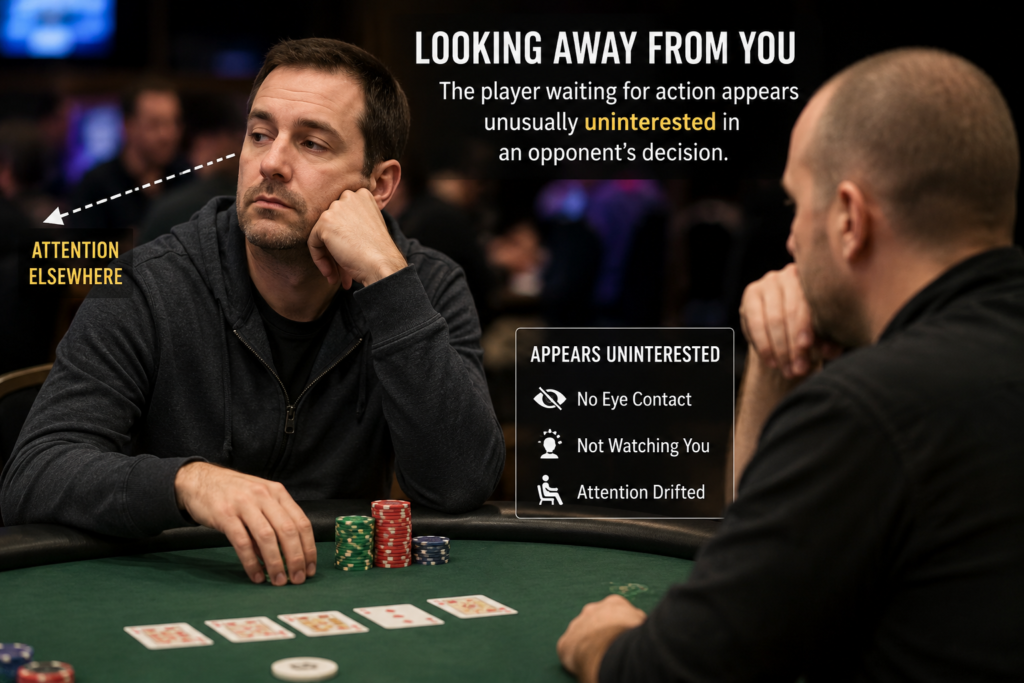
LOOKING AWAY FROM YOU
A WAITING FOR ACTION TELL OF STTRENGTH
Most poker players assume that a strong hand causes a player to become more interested in what an opponent is about to do. After all, when significant money is potentially about to enter the pot, it seems reasonable to expect a player holding a strong hand to watch the action closely.
In practice, the opposite sometimes occurs.
The tell known as Looking Away From You occurs when a player waiting for action appears unusually uninterested in an opponent’s decision. Rather than maintaining eye contact, studying reactions, or watching the action unfold, the player directs attention elsewhere. He may look down at the felt, glance toward a television, watch activity at another table, or simply avoid looking at the opponent altogether. In some situations, the behavior becomes so pronounced that it appears the player has lost interest in the hand entirely.
WHEN STRENGTH REDUCES ATTENTION

At first glance, Looking Away From You may seem counterintuitive. A player holding a strong hand would appear to have every reason to pay attention. Yet poker decisions are often driven by uncertainty, and strong hands tend to reduce uncertainty.
A player holding a marginal hand frequently wants information. He wants to know whether an opponent appears confident, hesitant, interested, or uncomfortable. Because the situation is less clear, he becomes interested in gathering as much information as possible before the action reaches him.
A strong hand often changes that dynamic.
When a player believes he has connected well with the board, much of the uncertainty disappears. The decision becomes easier, confidence increases, and the need to closely study an opponent may decline. As a result, attention naturally begins to drift elsewhere.
Another reason Looking Away From You may occur is that many players with strong hands prefer not to draw attention to themselves. Whether this behavior is conscious or unconscious, the objective is often the same. Players who connect strongly with a board generally want opponents to feel comfortable continuing with the hand. Intense eye contact, obvious interest in the action, or visible anticipation can sometimes attract attention that a player would rather avoid. Looking elsewhere can become a natural way of appearing relaxed, harmless, and unconcerned.
In many cases, the player is not acting at all. He is simply comfortable with the situation. The need to gather additional information has diminished, concern about an opponent’s decision has decreased, and attention has shifted away from the action in front of him.
That combination of comfort, confidence, and reduced interest in an opponent’s decision is what makes Looking Away From You a potentially valuable tell of strength.
THE LIMITATIONS OF LOOKING AWAY FROM YOU
As with all poker tells, Looking Away From You should not be viewed as a standalone indicator of strength.
Some players naturally avoid eye contact regardless of the cards they hold. Others routinely look around the room, watch nearby games, or divide their attention between the table and other distractions. In those situations, the behavior may have little or nothing to do with hand strength.
For that reason, the value of Looking Away From You comes from changes in behavior rather than the behavior itself.
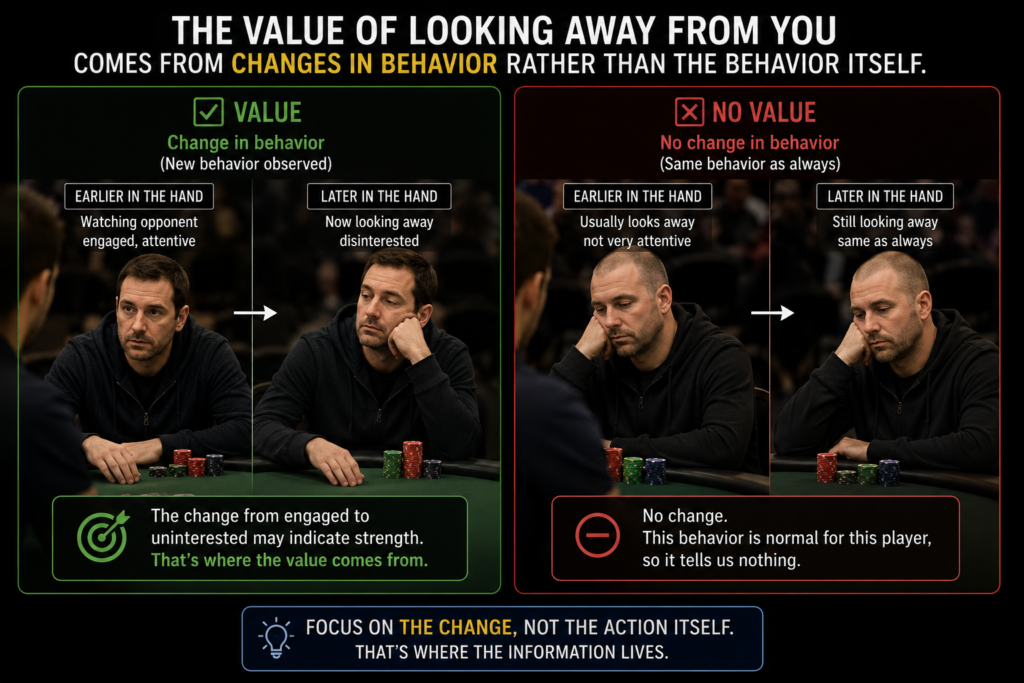
A player who normally watches every decision closely and suddenly appears uninterested after a particular board card arrives may be providing useful information. Conversely, a player who always looks away from opponents is simply behaving as he normally does. Without an established baseline, there is little reason to assume the behavior means anything at all.
This is one reason correlation remains so important when interpreting poker tells. A single observation may be interesting, but repeated observations that consistently lead to the same result are far more valuable. Over time, patterns begin to emerge, and those patterns are often more reliable than any individual tell.
Like many poker tells, Looking Away From You is most useful when viewed as one piece of a larger puzzle. Betting patterns, player tendencies, board texture, position, stack sizes, and other observations should always carry more weight than a single physical behavior.
When a player’s attention suddenly changes at the same time the board changes, however, the behavior may be worth noting.
LOOKING AWAY VERSUS LOOKING AT YOU
TWO BEHAVIORS MOVING IN OPPOSITE DIRECTIONS
One reason Looking Away From You is particularly interesting is that it often contrasts with a common waiting-for-action tell of weakness.
In the earlier article Looking At You: A Waiting For Action Tell Of Weakness, we discussed how some players become intensely interested in an opponent’s decision when they are uncertain about the strength of their own hand. They watch closely, study reactions, and look for information that may help them determine what to do next.
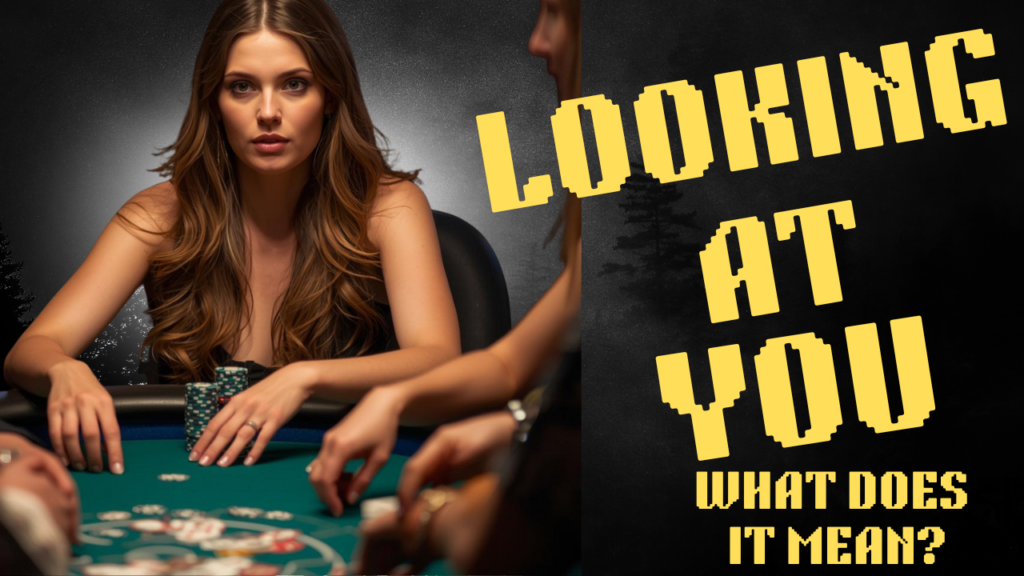
The psychology behind Looking At You is relatively straightforward. Uncertainty creates a desire for information. When players are unsure where they stand, they often become interested in anything that might reduce that uncertainty. As a result, their attention becomes focused on the opponent.
Looking Away From You may represent the opposite dynamic.
When players feel comfortable with their hand, the need for additional information often decreases. Confidence replaces uncertainty, and attention shifts away from studying an opponent’s behavior. Rather than watching closely for clues, the player becomes less interested in what the opponent is about to do.
CONFIDENCE VERSUS UNCERTAINTY
This does not mean every player who looks at an opponent is weak or that every player who looks away is strong. Human behavior is rarely that simple. The value of these tells comes from understanding the emotional forces that may be driving the behavior.
In many situations, uncertainty encourages attention while confidence reduces it.
That distinction can be particularly useful when observing changes in behavior. A player who normally studies every decision may suddenly become disinterested after connecting strongly with the board. Conversely, a player who normally appears relaxed may become unusually focused when facing a difficult situation. In both cases, the change itself may be more important than the behavior.
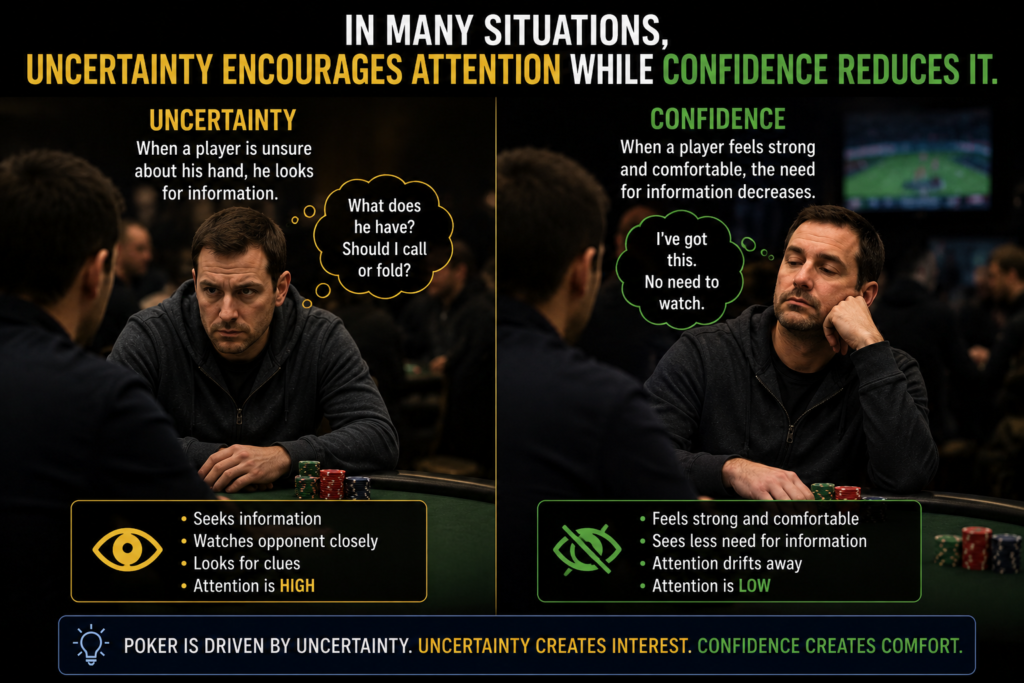
Viewed together, Looking At You and Looking Away From You illustrate an important principle of poker tells. Physical behaviors often reveal less about specific cards than they do about a player’s level of comfort. The player seeking information may be uncertain. The player who no longer appears interested in gathering information may already have the answers he needs.
Understanding that relationship can provide valuable context when interpreting behavior at the poker table.
CONCLUSION
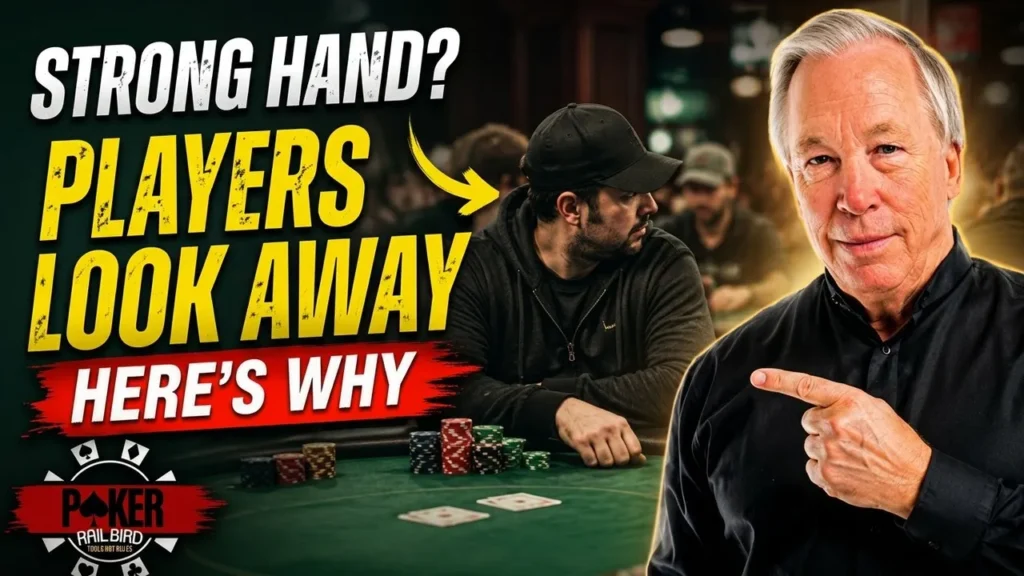
The tell known as Looking Away From You can appear deceptively simple. A player avoids eye contact, directs attention elsewhere, or seems surprisingly uninterested in your decision. In isolation, the behavior may mean very little. Viewed within the context of a player’s normal tendencies, however, it can sometimes provide insight into how comfortable that player feels about the hand.
One reason this tell can be valuable is that it reminds us that poker tells are often less about specific cards and more about emotional state. Players who are uncertain frequently seek information. Players who are comfortable frequently have less need for it. As confidence increases, attention sometimes shifts away from the opponent and toward anything but the hand itself.
That does not mean every player who looks away is strong, nor does it mean every strong player will avoid eye contact. Like all poker tells, Looking Away From You is most useful when combined with observation, correlation, and an understanding of the individual player involved.
The next time you find yourself waiting for action, pay attention to where your opponents are looking. Occasionally, the player who appears least interested in your decision may be the player holding the strongest hand.
IMPORTANT NOTE
It is also important to remember that the interpretation of a tell depends heavily on context. In this article, Looking Away From You has been discussed specifically as a waiting-for-action tell. The same behavior occurring during a decision or immediately after a player acts may carry a very different meaning. The timing of a behavior is often just as important as the behavior itself.