
THE 8 MOST EXPENSIVE POKER FALLACIES
AND HOW THEY QUIETLY DESTROY YOUR WIN RATE
The 8 Most Expensive Common Poker Myths That Quietly Destroy Your Win Rate
Poker is full of myths. Some are harmless. Others are expensive. Many players lose far more money to flawed thinking than they do to bad cards or tough opponents. They believe they are “due” for a win after a long dry spell. They stay at terrible tables because they’ve already invested hours, and often they convince themselves they’re crushing the game while making the same mistakes over and over again.
These are not minor misconceptions. They are common poker myths that act like silent leaks in your game, draining your bankroll while making you feel like you’re playing well.

In this article, we’re going to examine the eight most damaging fallacies in poker. For each one, we’ll break down what it is, how it shows up at the table, the real cost to your results, and the psychology that makes it so hard to escape.
Understanding these myths is one of the fastest ways to improve your win rate, not by learning new strategies, but by removing the mental traps that sabotage the strategies you already know.
Here are the eight most expensive common poker myths we’ll cover:
| Fallacy | Description |
Believing you are “due” for a win after a dry spell | |
Staying in bad situations because you’ve already invested time or money | |
Only remembering the times your loose play worked | |
Thinking you can force outcomes through aggression or personality | |
Overconfidence despite lacking skill | |
Judging decisions by outcomes instead of process | |
Believing you’re “running hot” and should play bigger | |
Creating stories to explain losses instead of analyzing decisions |
Let’s start with the most seductive and dangerous of them all.
FALLACY NO. 1: THE GAMBLER'S FALLACY
One of the most persistent common poker myths is the Gambler’s Fallacy, the mistaken belief that past independent events influence the probability of future ones. In simple terms, it’s the idea that “I’m due” for something good after a streak of bad luck.
CLASSIC EXAMPLE
If you flip a coin five times and get heads every time, many people believe tails is now “due” because it’s a 50/50 proposition. In reality, the coin has no memory. The next flip is still 50/50. It could land heads another twenty times in a row. Over thousands of flips, it will average out, but each individual flip remains independent.
This same flawed thinking shows up constantly in poker.
How It Applies to Poker:
This is one of the most common poker myths you’ll hear at the table:
- “I haven’t had a pocket pair in an hour, therefore I am due for one.”
- “I haven’t hit a set in my last 9 pocket pair, I am due for one now.”
- “I’ve been card dead forever, I deserve to play this marginal hand.”
Players start forcing action because they feel the universe owes them compensation for their suffering.
HOW IT NEGATIVELY IMPACTS YOUR GAME
The Gambler’s Fallacy is expensive because it pushes you to play hands you know are negative EV. After folding for a long time, you rationalize opening Q-8 offsuit or calling raises with weak suited aces “because you’re due for something good.
”This leads to:
- Increased variance
- Larger losses during dry spells
- Emotional decision-making instead of strategic play
- A slow erosion of discipline that carries over even when you finally get good cards
THE PSYCHOLOGY BEHIND IT
The psychology is rooted in our brain’s powerful desire for patterns and fairness. Humans hate randomness. We desperately want the world to feel balanced, so after a long stretch of bad cards, our mind tells us a reward is coming to restore justice.
I once had a regular tell me he had been dealt seven pocket pairs that session without flopping a single set. He said he was going to raise big with the next pair because “now the set was due.” He genuinely asked me if one out of eight times was correct. I had to laugh and remind him: the math doesn’t know you’re due. You could hit three sets in a row… or miss the next fifty.
This fallacy becomes especially dangerous during card-dead poker stretches, when boredom and ego combine to make irrational thinking feel completely reasonable.
FALLACY NO. 2: THE SUNK COST FALLACY
Another one of the most damaging common poker myths is the Sunk Cost Fallacy, the tendency to continue an action or decision because you have already invested time, money, or effort into it, even when continuing is no longer rational.
In poker, this shows up when players make decisions based on money already in the pot rather than the current price and their actual equity. You’ll often hear players say things like “I’m pot committed” or “I’ve already put so much in, I have to call.
THE NEGATIVE IMPACT TO YOUR GAME
This fallacy causes players to call off stacks with marginal or even beaten hands simply because they feel too invested to fold. It leads to:
- Paying off value bets they should avoid
- Chasing draws long after the price is no longer correct
- Staying in bad games or sessions far longer than they should
- Making emotional rather than mathematical decisions
Over time, this single fallacy can cost players thousands of dollars per year.
WHAT THE PSYCHOLOGY SAYS
Humans hate feeling like they wasted something. Once we’ve invested money, time, or ego into a situation, our brain resists letting go, even when continuing is clearly negative EV. This is why the term “pot committed” is so dangerous. It sounds strategic, but it’s usually just the sunk cost fallacy wearing poker language.
A few weeks ago, I was in a hand with a huge pot, around $570 after the turn. I had a set of queens on a board that had both straight and flush draws possible. I bet $350 on the river, which paired the board and gave me a full house, but also completed the flush.
One player folded. The other, who had just hit the flush, tanked for a long time. He finally called and said, “I have too much money in the pot to fold now.
”He knew he was likely beat, but he couldn’t let go of the money he had already invested.
The correct question on the river is never “How much have I already put in?”
The correct question is always: “Is calling this bet profitable right now?”
Mastering poker requires learning to ignore sunk costs completely.
FALLACY NO. 3: CONFIRMATION BIAS
Confirmation Bias is the tendency to search for, interpret, favor, and recall information in a way that confirms or supports one’s preexisting beliefs or preferences, while ignoring or downplaying contradictory evidence.
This is one of the most pervasive common poker myths because it feels completely natural. Our brains love to be right, so they cherry-pick data that makes us feel smart or skilled.
HOW IT IMPACTS YOUR GAME

Confirmation Bias causes players to:
- Remember the one time they won a huge pot with 8-4 offsuit, but forget the 40 times they lost with it.
- Believe they are “good at reading people” because they remember the times their reads were correct, while ignoring all the times they were wrong.
- Justify loose play by thinking, “I always win when I play any two cards,” even though the math says otherwise.
- Stick with flawed strategies because they focus only on the sessions where those strategies happened to work.
WHAT THE PSYCHOLOGY SAYS
Humans are wired to protect their ego and self-image. Confirmation Bias is one of the brain’s favorite defense mechanisms. It allows us to maintain positive beliefs about ourselves while filtering out uncomfortable truths.
A classic poker version of this is the “favorite hand” myth. A player wins a massive pot with something like 8-4 offsuit once, maybe even years ago, and from that day forward, 8-4 becomes their “lucky hand.” They play it far too often, convinced it’s special. They remember the big win vividly, but conveniently forget all the times they lost stacks with the same hand. This is Confirmation Bias in action: they only recall the evidence that supports their belief.
The same thing happens with reads. A player makes a big hero call and is right once. From then on, they think they’re a genius at reading people. They ignore the dozens of times they made the same call and were wrong.
This fallacy is especially dangerous because it feels like learning. In reality, you’re just reinforcing bad habits while ignoring the data that would help you improve.
NO. 4: THE ILLUSION OF CONTROL
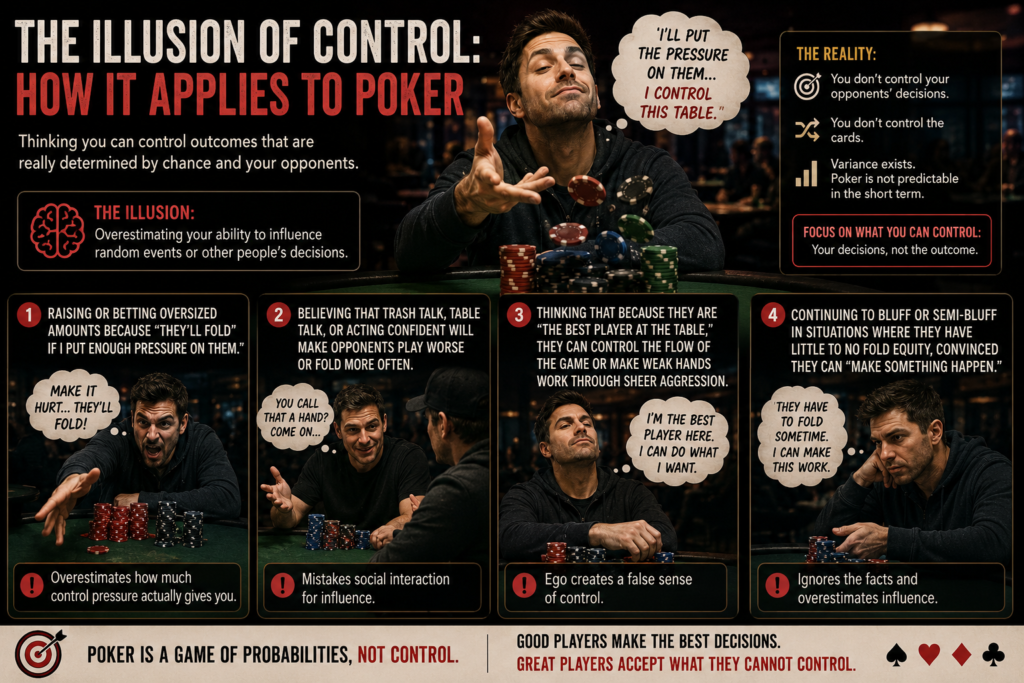
The Illusion of Control is the tendency for people to overestimate their ability to control events and outcomes, even when those outcomes are largely determined by chance or factors outside their influence. It is one of the more subtle but dangerous common poker myths.
Players who suffer from this fallacy believe their actions, personality, or “presence” at the table can force results that the math and situation simply do not support.
IT'S APPLICATION TO POKER
This fallacy appears in many forms:
- Raising or betting oversized amounts because “they’ll fold if I put enough pressure on them.”
- Believing that trash talk, table talk, or acting confident will make opponents play worse or fold more often.
- Thinking that because they are “the best player at the table,” they can control the flow of the game or make weak hands work through sheer aggression.
- Continuing to bluff or semi-bluff in situations where they have little to no fold equity, convinced they can “make something happen.”
THE IMPACT IT HAS ON YOUR GAME
The Illusion of Control leads to expensive over-aggression and poor risk assessment. Players put too many chips in the pot with marginal holdings, thinking their pressure or image will magically make opponents fold. When those opponents don’t fold (as is often the case in live games), the player loses large pots they should never have been in.
Over time, this fallacy increases variance dramatically and turns potentially profitable sessions into losing ones. It also prevents players from making the correct adjustments when the table dynamics don’t respond to their aggression.
THE PSYCHOLOGICAL ASPECTS
Humans have a deep psychological need to feel in control. The Illusion of Control helps protect our ego by making us believe we have more power over uncertain situations than we actually do. In poker, this is especially tempting because the game gives us many opportunities to take action (raising, bluffing, talking), which creates the feeling of control even when the actual influence is minimal.
A common example is the player who consistently over-bets or raises huge with weak hands, convinced that “no one will call me because they know I’m aggressive.” In reality, the table has adjusted and started calling wider, but the player continues the same strategy because they believe they are controlling the action.
This fallacy is particularly common among naturally aggressive or extroverted players who rely heavily on personality and table presence rather than disciplined, situational decision-making.
NO. 5: THE DUNNING-KRUGER EFFECT (OVERCONFIDENCE BIAS)
The Dunning-Kruger Effect is a cognitive bias in which people with limited knowledge or skill in a domain significantly overestimate their own ability, while highly competent people tend to underestimate theirs. In poker, this is one of the most widespread and damaging common poker myths.
APPLYING IT TO POKER
You see this fallacy constantly at the table:
- Weak recreational players who think they are “crushing” because they won a couple of big pots with junk hands.
- Regulars who have been playing for years but still make fundamental mistakes while claiming they are “experienced.”
- Players who dismiss solid strategy as “too tight” or “playing scared” because they don’t understand it.
- People who believe their “instincts” or “feel” are superior to math and study.
They genuinely believe they are much better than objective reality suggests.
HOW IT NEGATIVELY IMPACTS YOUR GAME
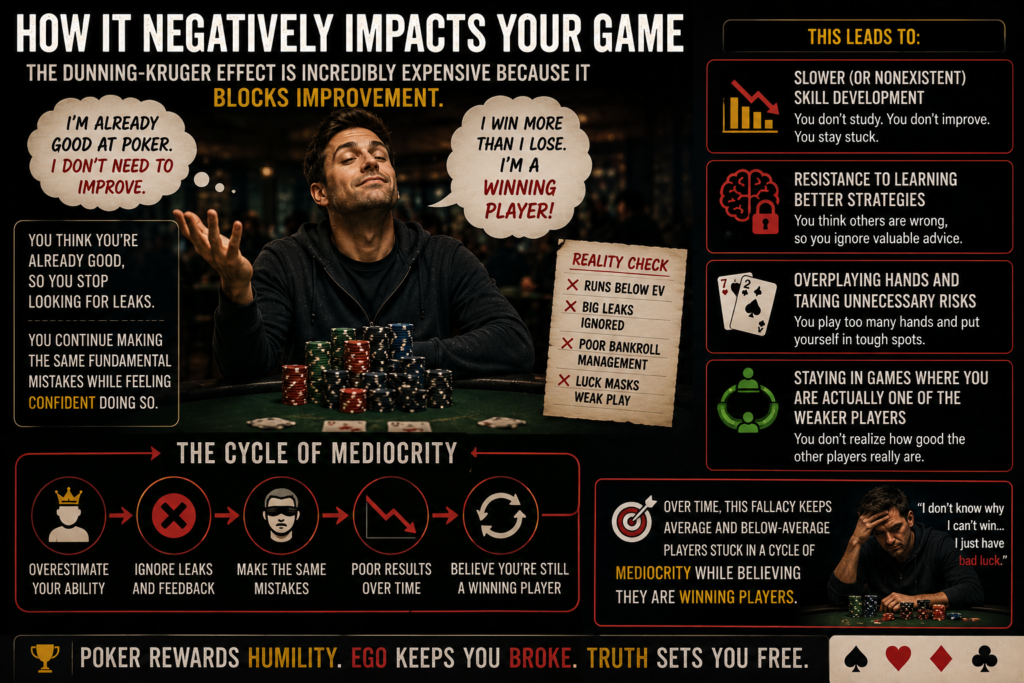
The Dunning-Kruger Effect is incredibly expensive because it blocks improvement. If you think you’re already good, you stop looking for leaks. You continue making the same fundamental mistakes while feeling confident doing so. This leads to:
- Slower (or nonexistent) skill development
- Resistance to learning better strategies
- Overplaying hands and taking unnecessary risks
- Staying in games where you are actually one of the weaker players
Over time, this fallacy keeps average and below-average players stuck in a cycle of mediocrity while believing they are winning players.
THE PSYCHOLOGY BEHIND IT
The psychology is both fascinating and brutal: the same lack of skill that causes poor performance also prevents people from recognizing their own incompetence. In other words, you need a certain level of competence just to accurately assess your own competence.
A classic example is the player who plays any two cards, calls every bet, and occasionally hits a miracle hand. Because he wins that one big pot, he walks away thinking he played brilliantly. He doesn’t see (or refuses to see) the dozens of times he lost stacks with the same reckless style.
You’ll often hear these players say things like “I don’t need to study, I just play by feel” or “These tight players don’t know how to gamble.” Their overconfidence protects their ego and prevents any real growth.
The Dunning-Kruger Effect is one of the hardest fallacies to overcome because the people who need to recognize it the most are the least likely to do so.
NO: 6 RESULTS-ORIENTED THINKING
Results-Oriented Thinking (also called Outcome Bias) is the tendency to judge the quality of a decision based on its outcome rather than on the information available and the reasoning at the time the decision was made. It is one of the most insidious common poker myths.
HOW IT APPLIES IN POKER
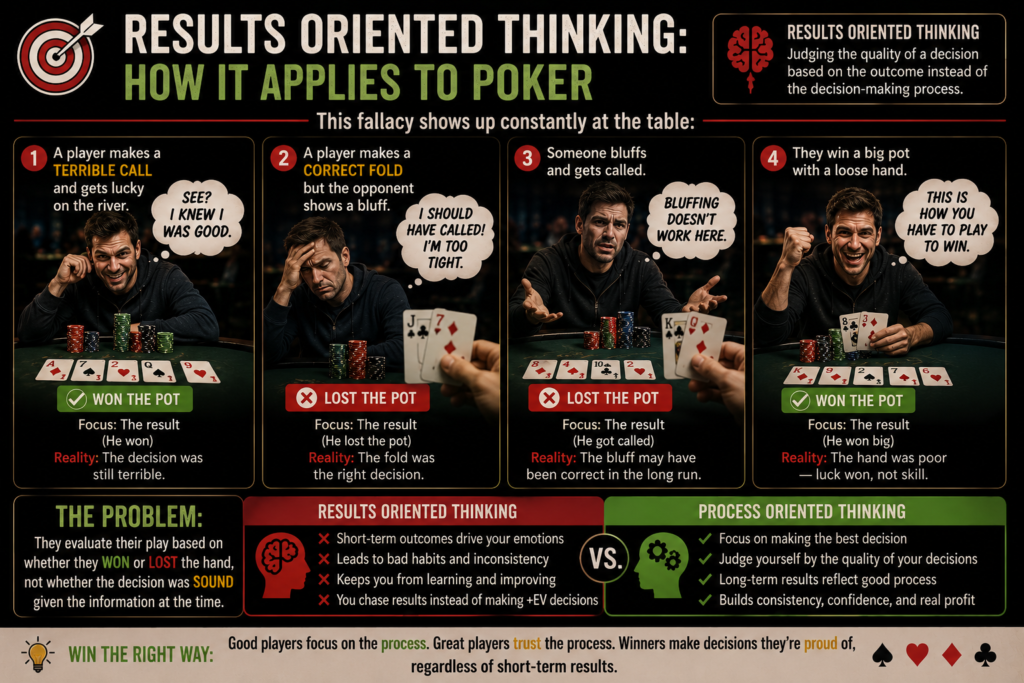
This fallacy shows up constantly at the table:
- A player makes a terrible call and gets lucky on the river → “See? I knew I was good.”
- A player makes a correct fold but the opponent shows a bluff → “I should have called! I’m too tight.”
- Someone bluffs and gets called → “Bluffing doesn’t work here.”
- They win a big pot with a loose hand → “This is how you have to play to win.”
They evaluate their play based on whether they won or lost the hand, not whether the decision was sound given the information at the time.
THE NEGATIVE IMPACT TO YOUR GAME
Results-Oriented Thinking is extremely damaging because it prevents real learning. You reinforce bad plays when they work and criticize good plays when they lose. Over time, this leads to:
- Repeating costly mistakes because they occasionally win
- Abandoning correct strategies because of short-term bad luck
- Emotional decision-making instead of process-driven play
- Slower skill development and inconsistent results
The player who judges decisions by results is doomed to stay average or worse, no matter how many hours they play.
WHAT THE PSYCHOLOGY SAYS
Humans are wired to associate outcomes with causes. Our brains crave simple stories: “I won, therefore I played well.” “I lost, therefore I played badly.” This is much more comfortable than the truth, that good decisions can lose and bad decisions can win in the short term due to variance.
A common example is the player who calls a big turn bet with a weak hand and gets there. They celebrate and say “I knew it was coming on the river”, completely ignoring that they made a negative EV call. Conversely, a player makes a correct fold with top pair, only to see the opponent had a bluff. They berate themselves for being “too tight,” even though the fold was correct based on the information available.
This fallacy is especially dangerous during downswings. Players start questioning fundamentally sound strategies because “it’s not working right now,” leading them to make even bigger mistakes trying to force results.
Mastering poker requires learning to ignore short-term outcomes and focus on decision quality. The best players judge themselves by process, not by results.
NO: 7 THE HOT HAND FALLACY (i'M ON A RUSH)
The Hot Hand Fallacy is the mistaken belief that a person who has experienced success in a random event has a greater chance of further success in additional attempts. In poker, this is commonly known as “I’m on a rush” or “I’m running hot.
”This is one of the most seductive and dangerous common poker myths because it feels so real in the moment.
APPLYING IT TO POKER
You’ll hear players say things like:
- “I’ve won the last four pots,I’m on a rush, let’s play bigger.”
- “I just hit two sets in a row, keep raising, the deck is with me.”
- “I’m running good tonight, time to gamble!”
They start loosening their ranges, raising more aggressively, and taking bigger risks because they believe their recent wins mean they are more likely to win future hands.
HOW IT IMPACTS YOUR GAME

The Hot Hand Fallacy leads to reckless over-aggression during winning streaks. Players:
- Play too many hands because “the deck is hot.”
- Take marginal spots they would normally avoid.
- Dramatically increase bet sizes, thinking momentum will protect them.
- Fail to adjust when the streak inevitably ends.
This fallacy dramatically increases variance and often turns winning sessions into break-even or losing ones as players give back their profits (and usually more) trying to ride the “rush.
THE PSYCHOLOGICAL IMPACT
Humans love patterns and momentum. Our brains are wired to see cause-and-effect relationships even where none exist. After a few wins, it feels like the universe is on your side, so you push harder. This is comforting and exciting, but completely irrational.
A common real example is the player who wins a couple of big pots in a row with strong hands. Suddenly, they start raising with marginal holdings, calling re-raises light, and playing like a maniac because “I’m running hot.” They feel invincible until the streak ends and they give back all their winnings (and usually more) in a short period.
The math doesn’t care about your recent results. Each hand is independent. Believing you’re “on a rush” is just another way the mind tries to create order in a game defined by randomness.
NO. 8: THE NARRATIVE FALLACY
The Narrative Fallacy is the tendency to create simple, coherent stories to explain complex, random, or uncertain events, even when those stories are inaccurate or misleading. In poker, this is one of the most subtle and destructive common poker myths.
HOW IT APPLIES IN POKER
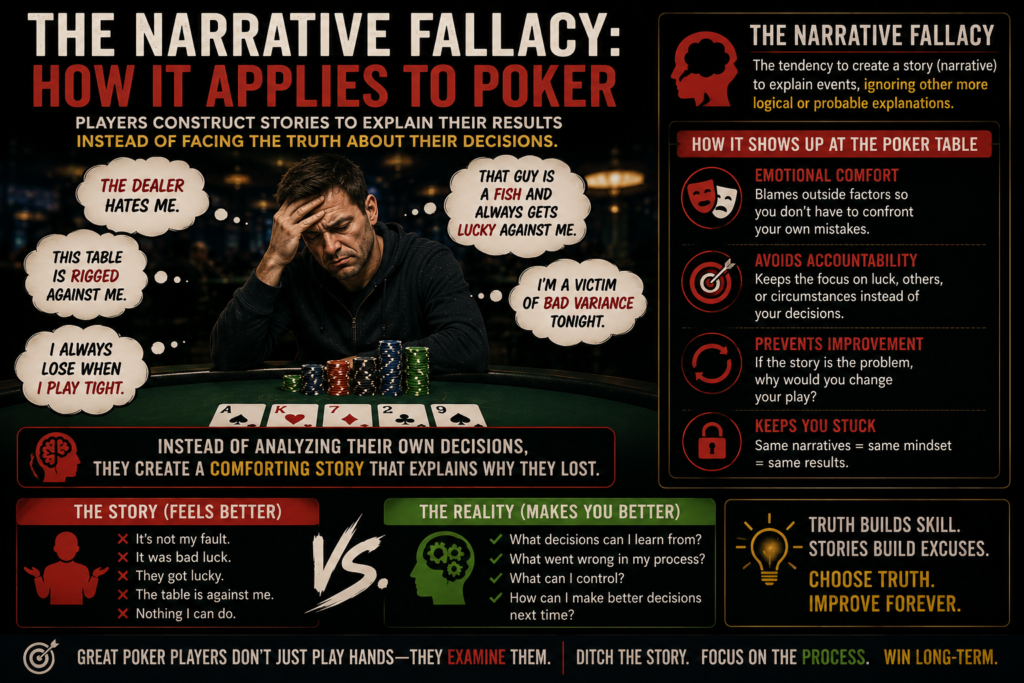
Players constantly construct narratives to make sense of their results:
- “The dealer hates me.”
- “This table is rigged against me.”
- “I always lose when I play tight.”
- “That guy is a fish and always gets lucky against me.”
- “I’m a victim of bad variance tonight.”
Instead of analyzing their own decisions, they create a comforting story that explains why they lost.
HOW IT NEGATIVELY IMPACTS YOUR GAME
The Narrative Fallacy prevents real improvement. By blaming external factors (luck, the dealer, the table, other players), you remove any incentive to examine your own play. This leads to:
- Repeating the same mistakes session after session
- Slower skill development
- Emotional decision-making driven by the story instead of reality
- Staying in bad games because “the deck is against me” rather than recognizing table dynamics
Over time, this fallacy keeps players stuck at the same level while believing the game is unfair.
THE PSYCHOLOGY BEHIDN IT
Humans have a deep need to understand the world through stories. Randomness and uncertainty feel uncomfortable, so our brains create simple explanations that give us a sense of control and meaning.
A classic example is the player who loses several big pots in a row and concludes, “The poker gods are punishing me today” or “This room always deals me bad cards.” They completely ignore the times they made loose calls or poor bluffs, focusing only on the narrative that protects their ego.
Another common version: A player gets stacked with a strong hand and says, “Every time I play well, I get sucked out on.” This story allows them to maintain their self-image as a good player while excusing their losses.
The Narrative Fallacy is particularly dangerous because it feels like insight. In reality, it’s a sophisticated form of self-deception that blocks genuine growth.
The best players fight this fallacy aggressively. They focus on process and decision quality, not on creating comforting stories about why they lost.
HOW THESE FALLACIES WORK TOGETHER
The eight common poker myths listed above rarely operate in isolation. They feed on each other, creating powerful, self-reinforcing cycles that keep players stuck and bleeding money for years.
Here’s how the most destructive combinations typically play out:
GAMBLER'S FALLACE + SUNK COST FALLACY
CONFIRMATION BIAS + NARRATIVE FALLACY
ILLUSION OF CONTROL + DUNNING-KRUGER EFFECT
RESULTS-ORIENTED THINKING + HOT HAND FALLACY
This is perhaps the most expensive duo. A player goes card dead for an hour, starts believing they are “due,” then justifies calling or raising with a marginal hand because “they’ve already put so much in the pot.” The result is throwing good money after bad in the name of being “due.
A player wins one big pot with 8-4 offsuit and suddenly declares it their “lucky hand.” They remember the win vividly but forget the 30 times they lost with it. Over time, they build an entire personal mythology (“I run good with suited connectors”) that justifies continued poor play.
The overconfident player believes their aggression and table presence can force opponents to fold. When it doesn’t work, they don’t question their strategy; they blame the opponents for “not respecting them.” Their lack of skill prevents them from seeing their lack of skill.
A player wins three pots in a row and suddenly starts playing much looser because “I’m on a rush.” When the inevitable downswing comes, they judge their loose plays as correct because “they worked earlier,” reinforcing the cycle.
These combinations create a dangerous feedback loop: bad thinking leads to bad decisions, bad decisions lead to bad results, and bad results are then explained away with more bad thinking. The player stays trapped in mediocrity while feeling like they’re “learning” from experience.
Breaking free requires ruthless self-honesty and a commitment to process over story, math over narrative, and reality over ego.
HOW TO PROTECT YOURSELF FROM THESE COMMON POKER MYTHS
Recognizing these fallacies is the first step. Defending yourself against them is the second, and far more important, step. Here are practical, battle-tested ways to reduce their influence on your game:
1. ADOPT A PROCESS-ORIENTED MINDSET
Judge every decision by the quality of your reasoning at the time, not by the outcome. After each session, ask yourself:
- Did I make the best decision possible with the information I had?
- Was I objective, or was I influenced by emotion or ego?
This single habit dramatically reduces Results-Oriented Thinking and Confirmation Bias.
2. KEEP HONEST RECORDS
Maintain a simple poker journal or use tracking software. Record not just results, but your reasoning for key decisions. Over time, this creates an objective record that counters selective memory and narrative fallacies.
3. USE THE "ONE HAND RULE"
Before playing a marginal hand during a dry spell or winning streak, ask yourself:
“Would I play this hand if I had just sat down fresh?”
If the honest answer is no, fold.
This rule cuts through both the Gambler’s Fallacy and the Hot Hand Fallacy.
4. SEEK EXTERNAL FEEDBACK
Regularly review hands with stronger players or coaches. External perspectives help expose Dunning-Kruger overconfidence and Confirmation Bias that are nearly impossible to see on your own.
5. BUILD PRE-DECISION DHECKLIST
Create simple mental checklists before major decisions:
- Am I making this decision based on current price and equity, or sunk costs?
- Am I being objective, or am I telling myself a story?
- Would I make this play if I weren’t on a rush / tilt / card dead?
These small systems act as guardrails against emotional and biased thinking.
6. ACCEPT VARIANCE AS A FEATURE, NOT A BUG
Remind yourself regularly: “Each hand is independent. The cards have no memory.” This mental reminder is one of the best defenses against the Gambler’s Fallacy and Illusion of Control.
The players who consistently win in the long run aren’t free from these fallacies, they are simply better at catching themselves when they start slipping into them.
CONCLUSION: BREAKING FREE FROM COMMON POKER MYTHS
Poker is hard enough when you play it straight. When you layer on these eight common poker myths, it becomes exponentially more difficult, and expensive.
The Gambler’s Fallacy makes you play hands you know you shouldn’t.
The Sunk Cost Fallacy keeps you trapped in bad situations.
Confirmation Bias and the Narrative Fallacy protect your ego at the cost of your growth.
The Illusion of Control, Dunning-Kruger Effect, Results-Oriented Thinking, and Hot Hand Fallacy all push you toward reckless decisions while convincing you that you’re doing something right.
These fallacies don’t just cost you money in individual hands. They quietly sabotage your entire development as a player. They keep you repeating the same mistakes while feeling like you’re learning. They turn variance into a personal enemy instead of an expected part of the game. And worst of all, they feel completely natural.
The best players aren’t the ones who never fall into these mental traps. They are the ones who catch themselves when they do, and correct course quickly.
This is the real edge in poker: not just studying strategy, but relentlessly improving the quality of your thinking. It means replacing rigid rules and comforting stories with tools, processes, and radical self-honesty. It means judging your play by the decisions you made with the information available at the time, not by the outcome of any single hand or session.
Poker rewards clarity. It punishes self-deception.
If you want to move to the next level in this game, start by examining your own thinking more rigorously than your opponents’ ranges. Question your assumptions. Challenge your narratives. Stay humble enough to admit when you’re wrong.
The cards will always be random.
Your thinking doesn’t have to be.
Master your mind, and the rest of the game becomes much easier.