
WHEN AGGRESSION LOSES
THE MYTH OF CONSTANT AGGRESSION
Most poker players believe aggression is a good thing. In fact, many players believe that if some aggression is good, then more aggression must be better. This belief has become so common that many players never stop to question it. They simply assume that raising more hands, applying more pressure, and creating more action will automatically lead to better results. This way of thinking forms the foundation of what I call The Myth of Constant Aggression.
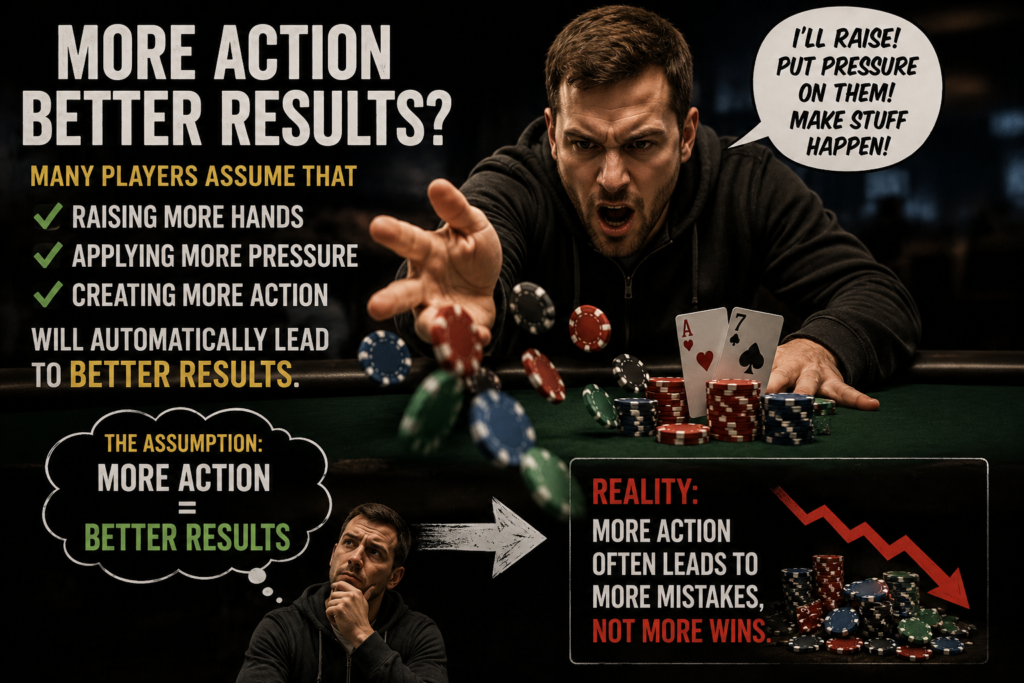
After all, aggressive players play more hands, raise more often, apply more pressure, and generally create more action at the table. From the outside looking in, they appear to be in control of the game while tighter, more disciplined players often appear passive, cautious, or even weak.
This creates an interesting assumption that exists in many poker rooms: the most aggressive player should also be the most profitable player.
Unfortunately, poker doesn’t work that way.
Aggression is one of the most powerful tools in poker, but like any tool, its value depends entirely on how and when it is used. The fact that a play is aggressive does not automatically make it profitable, just as the fact that a player is active does not automatically mean they are accomplishing anything meaningful.
This raises an important question:
If passive players struggle because they aren’t aggressive enough, and overly aggressive players often create problems for themselves, where is the balance?
To answer that question, we first need to understand that not all aggression is the same. In most live poker games, players tend to fall into one of three broad categories, each with a very different approach to creating action and applying pressure.
THE THREE LEVELS OF AGGRESSION
When discussing aggression in poker, many players treat it as though it exists on a simple scale. They assume that passive play sits at one end, aggressive play sits at the other, and the closer you move toward aggression, the better your results will become.
That assumption sounds logical, but it overlooks an important reality: not all aggression is created equal.
In live poker, particularly in loose low-stakes cash games, players generally fall into one of three broad categories. Each approaches action, pressure, and risk differently, and each produces very different long-term results.
Understanding these distinctions is essential because The Myth of Constant Aggression begins with the belief that aggression itself creates profit. In reality, profitability depends far more on when aggression is applied than on how often it is applied.
THE PASSIVE PLAYER
The passive player tends to call more often than raise. They frequently check when betting would be appropriate and often avoid confrontation unless holding a very strong hand.
While this style can reduce variance and help avoid large mistakes, it creates a different problem. Passive players often fail to capitalize on their advantages. They allow opponents to realize equity too cheaply, miss value when ahead, and frequently surrender control of the hand to more assertive opponents.
Most players recognize these weaknesses, which is why relatively few poker books or training programs advocate passive play as a long-term strategy.
THE CONSTANTLY AGGRESSIVE PLAYER
At the opposite end of the spectrum sits the player who believes aggression is the answer to nearly every situation.
This player raises frequently, applies pressure whenever possible, attacks weakness aggressively, and often measures success by the number of pots won rather than the profitability of individual decisions.
From a distance, this style can appear intimidating and highly effective. The player is constantly involved, constantly creating action, and constantly forcing decisions on others. Many players mistake this activity for strength.
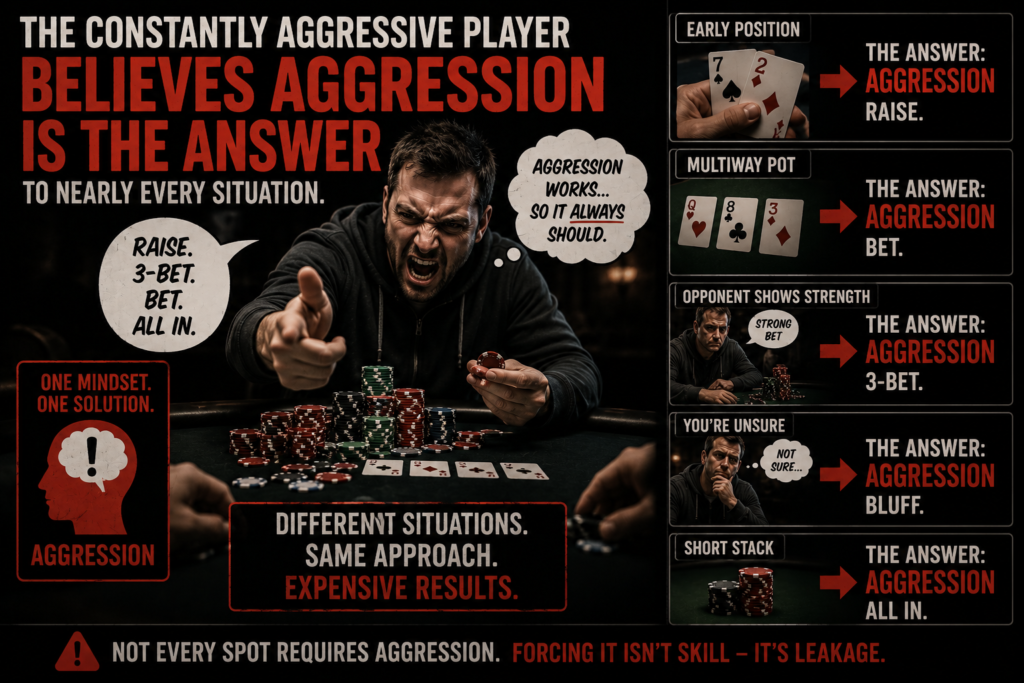
The problem is that aggression alone does not create profit. A raise made with a clear strategic purpose can be extremely profitable. A raise made simply because a player wants to remain aggressive is something entirely different.
This distinction lies at the heart of The Myth of Constant Aggression. The assumption that more aggression automatically leads to more profit ignores the quality of the situations in which that aggression is being applied.
THE AIKIDO AGGRESSIVE PLAYER
Between these two extremes sits a third type of player: the Aikido Aggressive player.
This player is not passive, nor are they interested in forcing action for the sake of appearing aggressive. Instead, they view aggression as a tool rather than an identity.
When the situation warrants aggression, they apply it decisively. When the situation does not justify aggression, they remain perfectly comfortable checking, calling, folding, or waiting for a better opportunity.
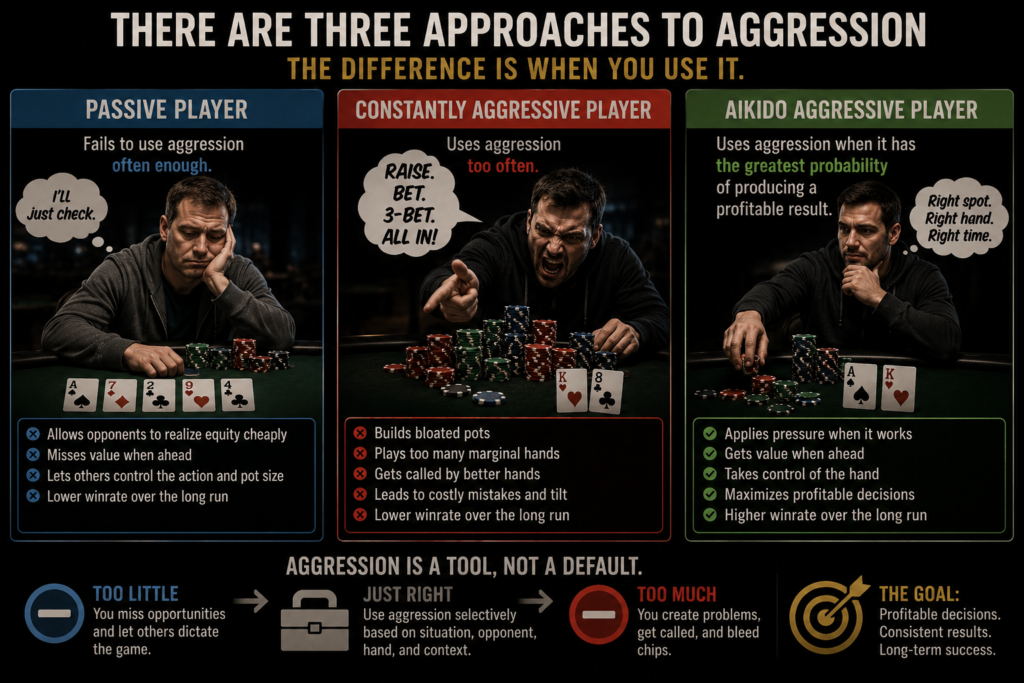
The difference may appear subtle, but it is significant. The passive player fails to use aggression often enough. The constantly aggressive player uses it too often. The Aikido Aggressive player focuses on using it when it has the greatest probability of producing a profitable result.
This distinction becomes increasingly important once we examine a simple mathematical reality: the deck does not provide nearly as many premium opportunities as many aggressive players seem to believe. That reality forms the foundation for why constant aggression often struggles in the long run and why selective aggression tends to perform far better over time.
THE MATHEMATICAL REALITY OF HAND DISTRIBUTION
One of the biggest problems with The Myth of Constant Aggression is that it ignores a simple mathematical reality: premium opportunities are relatively rare.
Many aggressive players behave as though they have a steady supply of strong hands available to them. In reality, the deck simply doesn’t cooperate often enough to support that approach.
Consider a typical ten-hour live cash game session. At roughly thirty hands per hour, you’ll see approximately 300 hands during the course of the day.
Over those 300 hands, random distribution suggests you can expect to receive pocket aces only about once. The same is true for kings, queens, or any other specific pocket pair. Ace-King suited appears less than once on average, while Ace-King offsuit may appear only two or three times.
Even pocket pairs, which many players feel they see constantly, occur only about once every sixteen hands. Over a 300-hand session, that works out to roughly eighteen pocket pairs total. Since a set is flopped only about 11.8% of the time, those eighteen pairs may produce only two or three sets all night.

The point is not that strong hands never occur. The point is that they occur far less frequently than many players seem to believe.
WHAT EXACTLY ARE YOU RAISING WITH?

This is where the mathematics begin to challenge the logic of constant aggression.
If a player is raising thirty percent of their hands in a 300-hand session, they are raising approximately ninety times.
The obvious question becomes:
What exactly are those ninety raises being made with?
They certainly aren’t all being made with premium holdings. The deck does not provide enough premium holdings to make that possible.
Instead, many of those raises must come from hands such as suited connectors, weak aces, medium broadway combinations, small pairs, suited gappers, and a variety of other marginal holdings.
Some of those hands can certainly be profitable in the right circumstances. The problem is that the circumstances are rarely as favorable as players assume.
A hand like J♦9♦ may look attractive because it can make straights and flushes. A hand like K♠10♠ may appear powerful because it contains high cards and suited potential. Small pocket pairs offer the possibility of flopping a set.
The mistake occurs when players focus entirely on what those hands can become while ignoring how often those outcomes actually occur.
POSSIBILITY VERSUS PROBABILITY
This distinction separates many losing players from winning ones.
The constantly aggressive player often evaluates hands through the lens of possibility.
“I could flop a flush draw, or I could make a straight, hit two pair, flop a set, etc.
While all of those statements are true, the problem is that they are equally true for everyone else at the table.
When five players see a flop, four other hands are competing against yours. Those players can make flushes, straights, sets, and two pair as well. The same mathematical opportunities available to you are available to them.
Yet many players evaluate their own hand in isolation, as though they are the only person receiving cards.
This is one of the hidden assumptions behind The Myth of Constant Aggression. The player becomes so focused on the potential of their own hand that they lose sight of the fact that eight other players are participating in the same distribution process.
The deck is not choosing favorites. Over time, everyone receives roughly the same opportunities.
The question is not whether your hand can improve. The question is whether the situation justifies investing additional money based on the probability that it will improve and the likelihood that improvement will ultimately be profitable.
.
Understanding that distinction is critical because it reveals why many aggressive players become trapped in marginal situations. They are not evaluating probability. They are chasing possibility.
And once that happens, aggression begins to drift away from profitability. It becomes activity for its own sake, which is exactly where the myth begins to take hold.
THE AGGRESSOR'S MISTAKE
By this point, an obvious question begins to emerge.
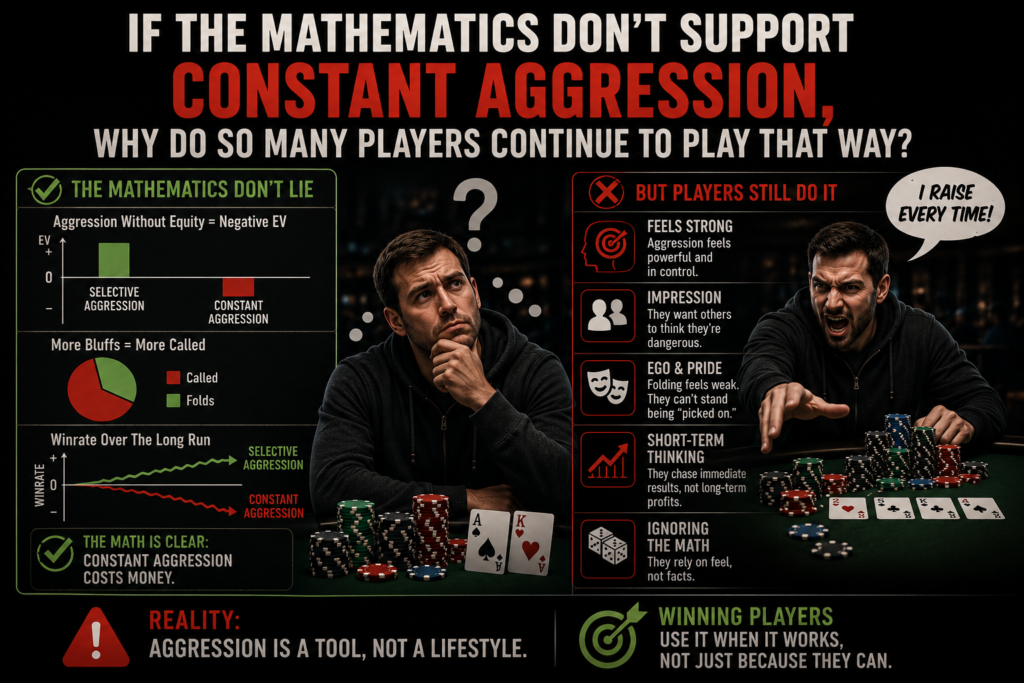
If the mathematics don’t support constant aggression, why do so many players continue to play that way?
The answer has less to do with poker strategy than many people realize. It begins with how people naturally process success and failure.
Most losing decisions in poker are remarkably forgettable. A marginal hand misses the flop, a weak draw fails to improve, or an overaggressive play runs into resistance and gets abandoned. Nothing dramatic happens, the hand ends, and the next deal begins.
The opposite is also true.
A disguised straight that wins a large pot, a speculative hand that connects perfectly with the board, or an unlikely bluff that gets through tends to leave a lasting impression. Those moments are exciting. They become stories. Long after the session ends, they remain far easier to remember than the dozens of small losses that helped pay for them.
Over time, this creates a subtle distortion. The memorable outcomes remain visible while the routine outcomes gradually disappear from view. What should be evaluated as a long series of decisions becomes remembered as a collection of highlights.
WHEN RESULTS HIDE REALITY
Poker creates another challenge that few players fully appreciate.
Results are easy to see, but decision quality is not.
A profitable decision can lose money. An unprofitable decision can win money. In the short term, outcomes often disguise the quality of the thinking that produced them.
This becomes particularly dangerous when evaluating aggressive play.
Winning a large pot with a speculative hand feels like validation. The fact that the same decision may have lost money dozens of times before is rarely given the same weight. Instead of evaluating the entire body of work, attention becomes focused on the handful of occasions where everything worked out perfectly.
The result is a dangerous conclusion:
“This strategy works because I won.”
In reality, winning and being correct are not always the same thing.
ACTIVITY VS. ACCOMPLISHMENT
One of the reasons The Myth of Constant Aggression is so difficult to recognize is that constant action often feels productive.
At first glance, this makes perfect sense. A player who is entering pots, raising preflop, applying pressure, and forcing decisions on opponents appears to be actively influencing the game. By comparison, a player who folds repeatedly can appear passive, cautious, or even disengaged.
The problem is that poker does not reward activity; it rewards profitable decisions. They are not always one in the same.
In fact, some of the most profitable decisions made during a session never involve putting additional money into the pot at all. A disciplined fold may save far more money than a marginal call earns. A decision to wait for a better opportunity may have greater long-term value than forcing action in a questionable situation.
Yet many players struggle with this concept because activity provides an immediate sense of participation.
Every hand played creates anticipation, every draw seems to create possibility, and every raise makes the player feel some form of accomplishment.
Folding creates none of those sensations. Nothing happens. There is no suspense, no opportunity to win a large pot, and no immediate reward for making the correct decision.
As a result, involvement itself can begin to feel like progress.
WHEN PARTICIPATION BECOMES THE OBJECTIVE

This shift often happens so gradually that players never notice it occurring. The original goal is simple: make profitable decisions. Over time, however, that objective begins to change.
Instead of asking whether a situation justifies additional investment, the focus turns toward finding reasons to stay involved. The question quietly shifts from:
“Is this profitable?”
to:
“Can I play this hand?”
That distinction may seem minor, but it changes the entire decision-making process.
Once participation becomes the objective, marginal hands begin to look more attractive. Speculative situations become easier to justify. Aggression becomes less about extracting value and more about maintaining involvement.
The player remains active, but activity itself is no longer serving a strategic purpose.
THE COST OF CONSTANT ACTION
This is where the hidden cost of constant aggression begins to appear. Every additional hand played creates more decisions, while every marginal decision creates more uncertainty. Along with that uncertainty comes the increased opportunity for mistakes.
As the number of difficult decisions increases, so does the likelihood of making an error somewhere along the way.
The consequences extend well beyond the chips invested in a single pot. Constant involvement creates larger swings in stack size. It introduces more emotionally charged situations. It demands more mental energy and increases the number of decisions that must be processed throughout a session.
Over time, fatigue begins to accumulate and frustration becomes easier to trigger, making Tilt more likely. What started as an attempt to create an edge often ends up creating unnecessary complexity.
THE DISCIPLINE ADVANTAGE
This is one reason disciplined players frequently appear less busy than their opponents. They are not avoiding action because they are afraid of it. Rather, they are avoiding unnecessary action because it creates difficult decisions, leading to increased problems.
Every hand that does not meet their standards is simply discarded, allowing them to conserve both chips and mental energy for situations where the probability of success is significantly higher.
The constantly aggressive player views folding as a missed opportunity, while the disciplined player often views folding as successful decision-making.

That difference in perspective is critical. One player is measuring success by their level of participation. The other measures success not only by profitability, but also by the quality of his decisions.
WHY THE AGGRESSOR FALLS BEHIND
The aggressor believes constant motion creates progress. The Aikido player understands that movement alone has no value unless it is moving in the right direction. This is why activity and accomplishment should never be confused.
A player can be involved in twice as many pots, make twice as many raises, and create twice as much action while producing inferior long-term results. The amount of effort being expended tells us very little about the quality of the decisions being made.
Poker is not a game that rewards the player who does the most. It rewards the player who consistently makes the most profitable decisions.
And once that distinction becomes clear, many of the assumptions behind The Myth of Constant Aggression begin to fall apart.
WHAT THE AIKIDO PLAYER GAINS
By this point, it should be clear that the Aikido Aggressive player is not simply a less aggressive version of the overly aggressive player. The difference runs much deeper than that.
The overaggressive player attempts to create opportunities through constant action. The Aikido player understands that opportunities already exist and focuses on identifying the ones that offer the greatest potential return. Rather than trying to force the game into a particular shape, he works with the conditions the game naturally provides.
This distinction produces many advantages that extend well beyond the chips won or lost in any single hand.
SIMPLER DECISIONS
One of the most overlooked benefits of selective aggression is decision quality.
Every marginal hand played creates additional decisions ane every speculative situation introduces uncertainty. Every questionable investment increases the number of difficult choices that must eventually be made. The Aikido player avoids many of these situations before they begin.
As a result, the average decision tends to be clearer. Hand ranges are stronger, positions are better, and situations are easier to evaluate. Instead of constantly searching for ways to justify continuing, attention can be focused on extracting value from genuinely favorable opportunities.
The objective is not to avoid difficult decisions entirely. Poker will always present those. The objective is to avoid creating unnecessary difficult decisions through excessive participation.
MORE OBSERVATION: BETTER INFORMATION
There is another advantage that many players underestimate. At a typical live table, most of the valuable information is gathered while not involved in a hand.
Every fold creates an opportunity to observe. Betting patterns become visible, showdowns reveal information, timing tendencies emerge, and conversations provide clues.
The longer a player remains outside the action, the more attention can be directed toward understanding the people who are in it.
Constantly aggressive players spend much of their time managing their own decisions. The Aikido player spends more time studying everyone else’s.
Over hundreds of hours, that information compounds into a meaningful advantage.
REDUCED EMOTIONAL VOLATILITY
Selective aggression also tends to create a more stable emotional environment.
Constant action naturally produces more large pots, more marginal situations, and more emotionally charged decisions. Even highly disciplined players are not immune to the effects of repeated stress and uncertainty.
The Aikido approach reduces much of that pressure.
Because aggression is being applied more selectively, fewer situations arise where large amounts of money are invested with limited certainty. Variance still exists, but much of the unnecessary variance created by constant involvement is removed.
The result is often greater emotional consistency throughout long sessions and over extended periods of time.
SUSTAINABILITY
Perhaps the greatest advantage is sustainability. Many aggressive styles work well in short bursts. Maintaining that same level of intensity for ten consecutive hours can be challenging.
The Aikido approach places fewer demands on both bankroll and mental energy. Decision fatigue develops more slowly. Emotional swings become easier to manage. Concentration can be maintained for longer periods because attention is not being consumed by an endless stream of marginal situations.
Over the course of a single session, these advantages may appear small.Over the course of years, they become significant.
A DIFFERENT DEFINITION OF SUCCESS
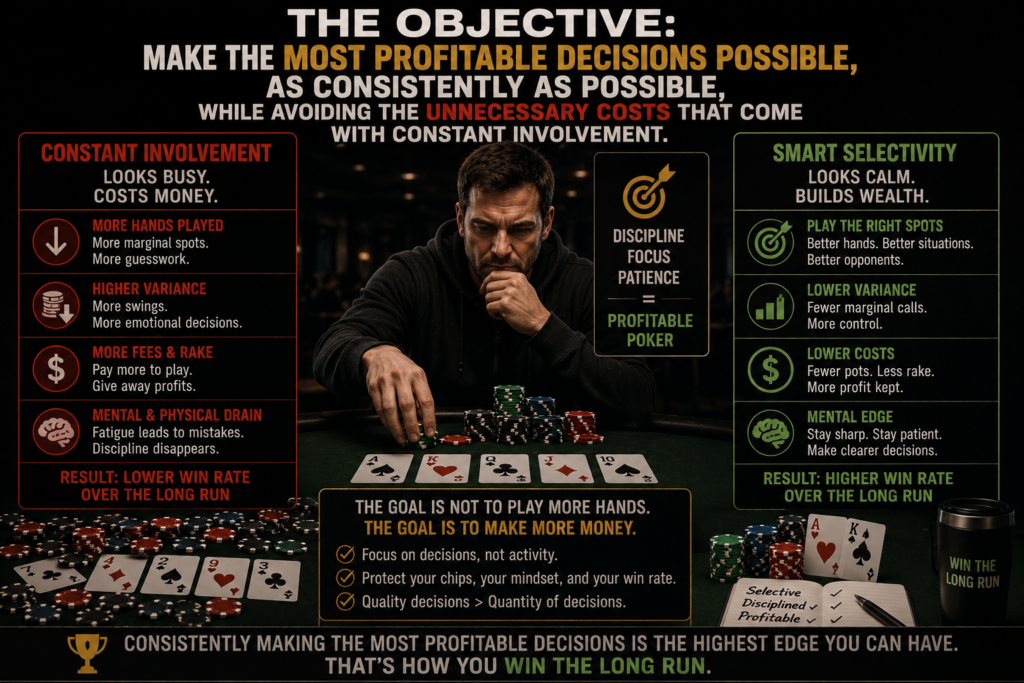
This ultimately reflects the fundamental difference between the overly aggressive and the Aikido player.
One measures success by activity. More hands played, more pots contested, and more action created become evidence that progress is being made.
The Aikido player uses a different scorecard. The objective is not to be the busiest player at the table.
The objective is to make the most profitable decisions possible, as consistently as possible, while avoiding the unnecessary costs that come with constant involvement.
That difference may not always be visible in a single session. Given enough time, however, it often becomes visible in the results. And understanding why requires looking beyond the current hand, the current pot, or even the current session and focusing instead on the much larger picture.
CONCLUSION
Every poker player eventually chooses a philosophy, whether they realize it or not.
Some players believe success comes from constant involvement. They want to see more flops, play more hands, apply more pressure, and create more action. The assumption is understandable. Aggression is powerful, and when it works, the results can be dramatic. Over time, however, many players begin measuring success by how active they are rather than by how profitable they are.
That is where The Myth of Constant Aggression begins.
The reality is that poker does not reward activity. It rewards decision quality. The number of hands you play, the number of pots you enter, or the number of raises you make are not objectives in themselves. They are simply tools that may or may not contribute to a profitable outcome depending on the situation.
The Aikido Aggressive player understands this distinction. Rather than forcing action, they focus on selecting opportunities. Rather than treating aggression as a playing style, they treat it as a tool to be used when conditions justify it. Some situations call for pressure. Others call for patience. The ability to recognize the difference is where the edge is created.
The overly aggressive sees motion and assumes progress is being made. The Aikido player understands that progress is measured by results, not activity. One evaluates success by participation. The other evaluates success by profitability.
Over the course of a single session, either approach can appear successful. Poker has a way of rewarding and punishing both good and bad decisions in the short term. Over hundreds of sessions, however, the distinction becomes much clearer. Constant aggression creates action. Selective aggression creates opportunity.
And opportunity, when combined with discipline, is what creates long-term profit.
The objective is not to be the most aggressive player at the table. The objective is to make aggression work for you when it has value and abandon it when it does not.
That is the difference between aggression as a habit and aggression as a strategy. And understanding that difference is the first step toward escaping The Myth of Constant Aggression.