
CRAFTING YOUR TABLE IMAGE
HOW TO BUILD THE IMAGE YOU WANT (INSTEAD OF ACCEPTING THE ONE YOUR GET)
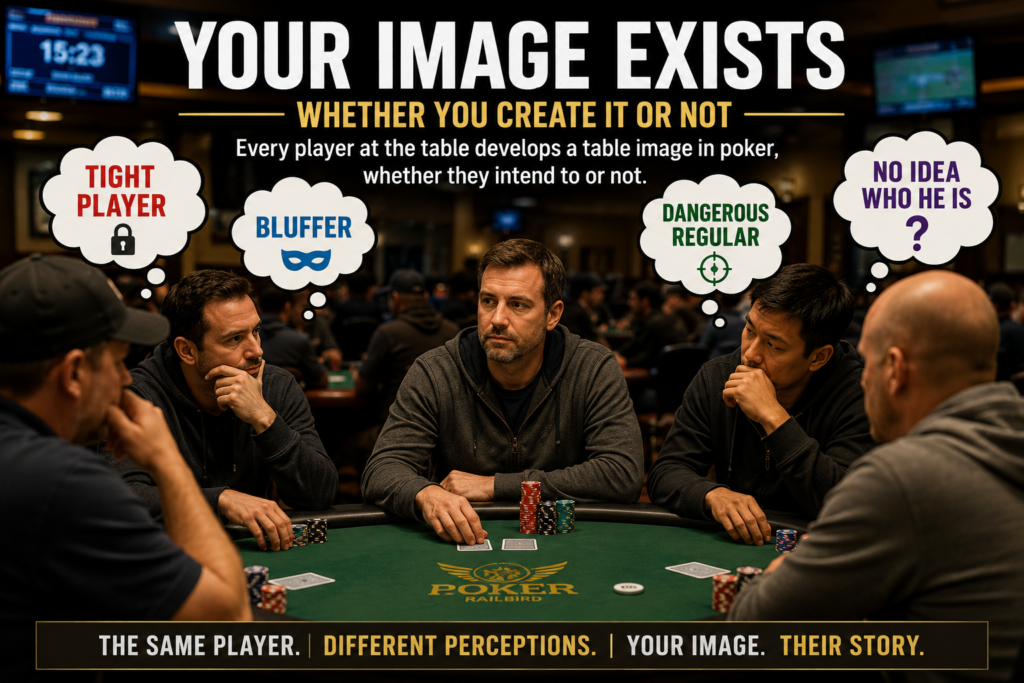
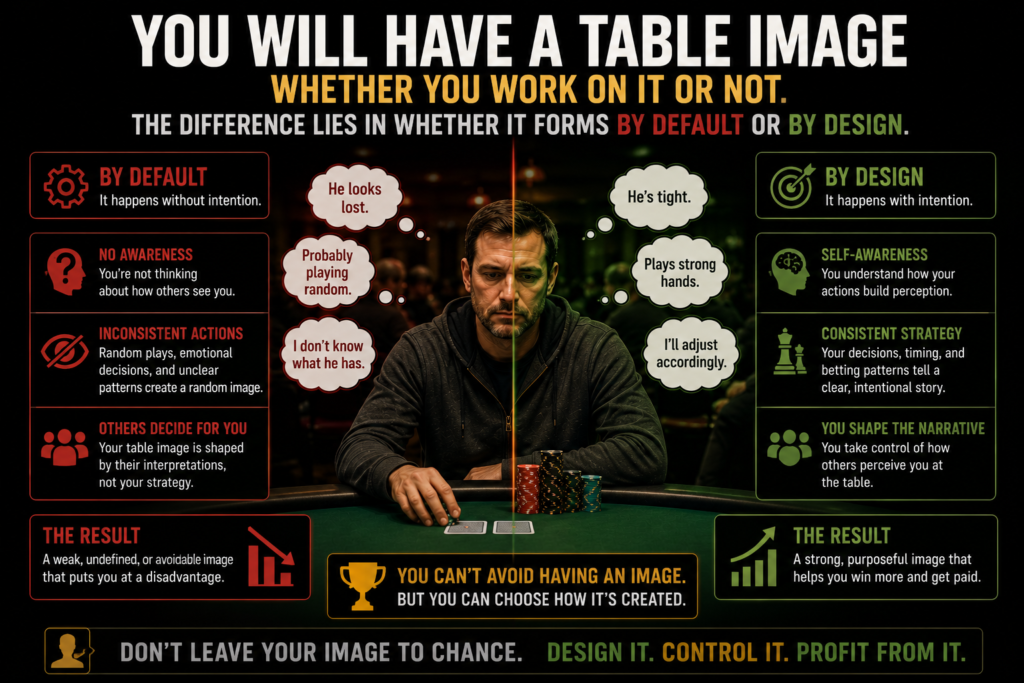
Every player at the table develops a table image in poker, whether they intend to or not.
The only real choice you have is whether that image forms by default or by design.
This is one of the most overlooked but highest-leverage skills in live poker. While most players focus on hand selection, bet sizing, and opponent reads, few give serious thought to how others perceive them. Yet your table image in poker directly influences how opponents react to your raises, bets, and bluffs.
A well-crafted table image in poker can create extra fold equity when you need it most. It can induce calls when you hold strong hands. It can make opponents second-guess themselves or become overly confident at exactly the wrong time.
WHAT "TABLE IMAGE IN POKER" REALL MEANS
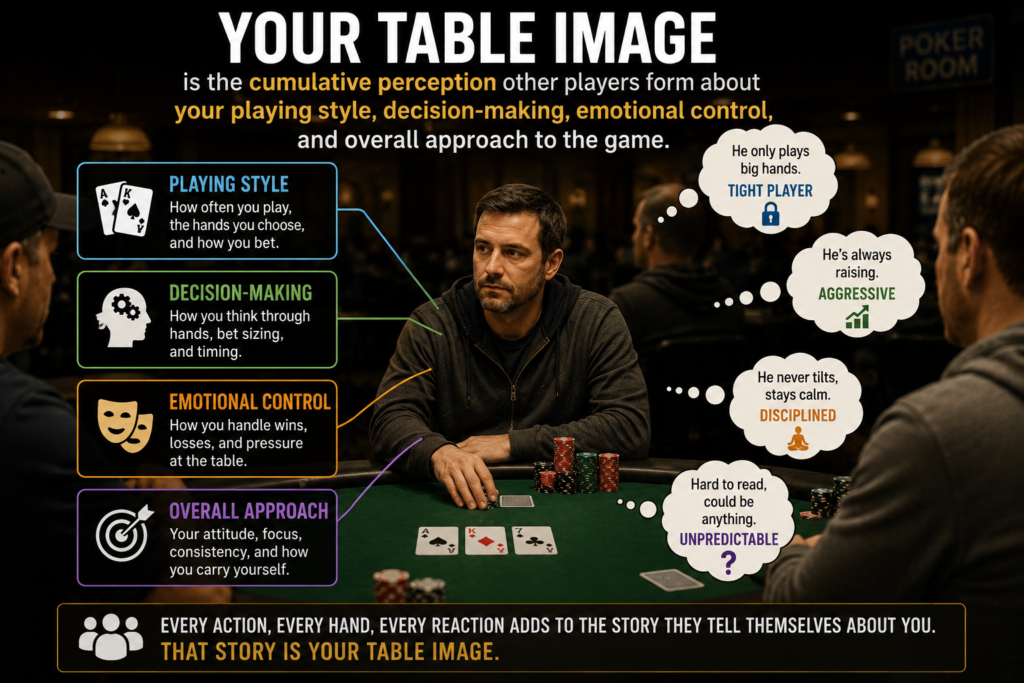
Your table image is the cumulative perception other players form about your playing style, decision-making, emotional control, and overall approach to the game. It includes what hands you show down, how often you raise or fold, your physical demeanor, verbal behavior, and consistency over time.
Importantly, your table image is not always what you believe you are projecting. It is what others believe you are doing. That gap between reality and perception is where real strategic advantage lives.
In regular games, this perception evolves into a longer-term reputation that can follow you across sessions. Changing a firmly established reputation takes significant time and consistent effort.
In this article, we will discuss the key components that shape your table image in poker and how to intentionally craft the one that serves your strategy best.
THE MOST IMPORTANT CONCEPT: PERCEPTION VS REALITY
The foundation of mastering your table image in poker is understanding one critical distinction:
Your table image is not what you are actually doing.
It is what your opponents believe you are doing.
This gap between reality and perception is where significant strategic advantage is created.
Most players assume that if they play tightly, everyone will see them as tight. If they play aggressively, everyone will see them as aggressive. In practice, this is rarely true. Opponents form their opinions based on incomplete information, the hands they happen to see, the showdowns they remember, your demeanor, and their own biases.
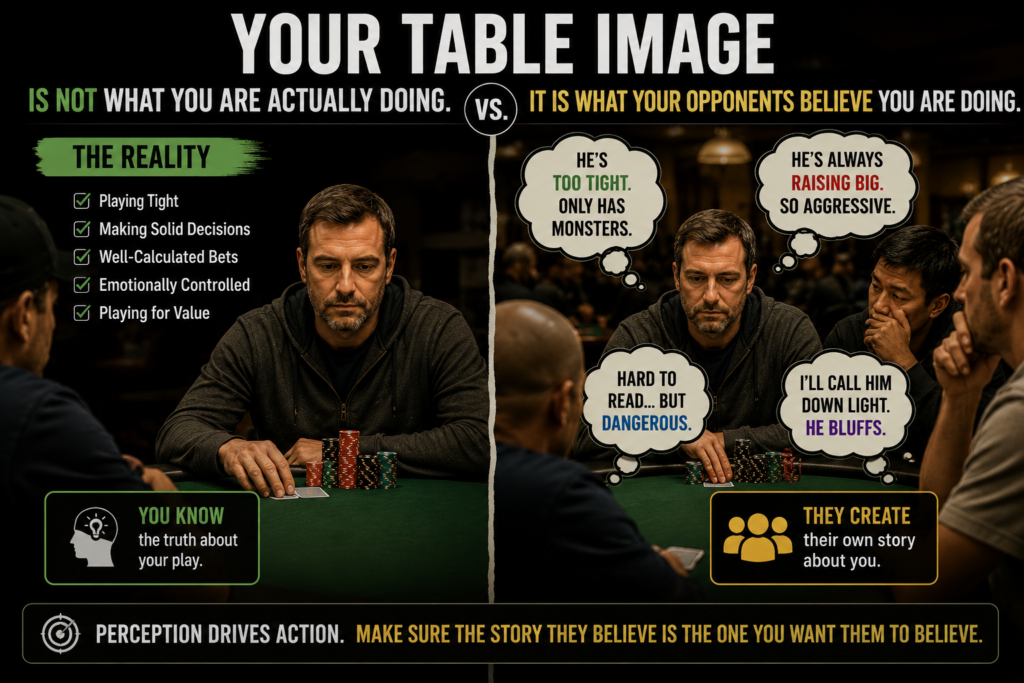
You can fold 50 hands in a row and then get caught bluffing once. Many players will now label you as “wild” or “bluffy,” even though your overall play has been extremely disciplined. Conversely, you can show down two premium hands in a short period and suddenly be viewed as a “nit” who only plays big hands.
This is why table image in poker is so powerful, and so dangerous if left unmanaged. Opponents do not react to your actual strategy. They react to the story they have built about you in their minds.
NOT EVERYONE IS PAYING ATTENTION
PERCEPTION VS REALITY IN ACTION
It is important to keep perspective. In most live games, a large percentage of players (often 60% or more) are not closely observing your play. Many are focused only on their own two cards and the board. Some don’t understand what table image is, how it forms, or why it matters. Others simply don’t care; they came to gamble and will play their hand regardless of what you have done for the past hour.
This means your carefully crafted image primarily affects the more observant and skilled players at the table. The recreational players who aren’t paying attention become the ones you can exploit more easily when your image is working in your favor.
A player who has watched you fold repeatedly may give your raises far more credit than they deserve. Another player who only saw one big bluff may call you down much lighter than the math suggests. A third player who just sat down may have no opinion at all. All three are reacting to the same person, yet each has a completely different version of “you.
”Understanding this concept is the first step toward intentionally crafting your table image in poker. Once you accept that perception often matters more than reality at the table, you can begin shaping that perception deliberately rather than leaving it to chance.
THE CORE COMPONENTS OF TABLE IMAGE IN POKER
Your table image in poker is built from many different observable elements. Some carry more weight than others. Understanding these components gives you the ability to intentionally influence how others perceive you.
HAND SELECTION AND PLAYING FREQUENCY
This is the foundation of most players’ first impression. Observant opponents quickly notice whether you play many hands or fold the majority. Do you enter pots only with premium holdings, defend blinds widely, or play somewhere in between? Consistent tight play creates a “nit” or “rock” image. Frequent participation creates a loose image. This component forms the baseline perception before anything else happens.
FREQUEENCY OF AGGRESSION
Separate from hand selection, this answers how you play the hands you do enter. How often do you raise, 3-bet, check-raise, or bluff? A player who raises frequently develops an aggressive image, while one who rarely raises is seen as passive. This layer determines whether opponents fear your bets or view them as steal attempts.
SHOWDOWN HISTORY AND RECENCY BIAS
Showdowns carry enormous weight because they provide concrete evidence. Players remember what you showed down far more than what you folded. You can fold for three hours straight, then get caught in one bluff and suddenly become “the bluffer.” One monster hand can label you “the nit.” Recency bias makes this even stronger; the last memorable hand often overwrites hours of previous play.
PHYSICAL DEMEANOR, VERBAL BEHAVIOR, AND TIMING
Live poker is visual and auditory. Are you calm and composed or nervous and fidgety? Do you talk a lot, complain, joke, or stay silent? How quickly or slowly do you make decisions? A player who talks constantly often appears looser than he actually is. Consistent, calm timing and quiet demeanor project strength and control. These elements heavily influence the story opponents tell themselves about you.
EMOTIONAL CONTROL AND COMPOSURE
How you handle wins and losses speaks loudly. Do you stay steady after a bad beat, or do you show frustration? Do you gloat after a big win? Players who maintain composure under pressure earn respect and credibility. Those who tilt or celebrate excessively create exploitable images.
WINNING, LOSING, AND STACK SIZE
Players often judge your skill and danger level based on whether you appear to be winning or losing. A big stack usually looks competent, lucky, or dangerous. A short stack can look vulnerable or frustrated. One practical way to manage this perception is to keep your stack near the maximum buy-in. If you lose a portion of your stack, quietly topping up helps maintain a consistent, strong appearance. Most players notice stack size more than they admit, even if they don’t consciously track every detail.
APPEARANCE AND AGE
Fair or unfair, appearance and age heavily influence initial perceptions. Young players are often stereotyped as loose, aggressive, impatient, and influenced by TV, YouTube, or TikTok poker. Older players are frequently assumed to be more conservative, patient, and knowledgeable, until proven otherwise. Clothing, jewelry, posture, and overall presentation send immediate signals. Dressing sloppily can create a loose or recreational image. Dressing neatly or wearing expensive items (such as a high-end watch) can project financial strength and confidence. Female players often face additional stereotypes that can be leveraged or countered depending on the image they wish to project.
REPUTATION
In rooms where you are a regular, your long-term reputation can be one of the strongest components of your table image. Once players label you as tight, loose, a fish, or a strong regular, that label is difficult to shake. You can often sense your reputation before you even sit down. Loose or fishy players are often welcomed with smiles, while known tight-aggressive players may receive wary looks or the “oh shit” reaction. Changing a well-established reputation requires consistent effort over many sessions.
WHAT YOU DO BETWEEN HANDS
Observant players notice what you do when you are not in a hand. Are you paying close attention to the action, studying opponents, and staying mentally engaged? Or are you scrolling on your phone, watching TV, or chatting about unrelated topics? Players who remain involved and attentive project focus and competence. Those who appear distracted create an image of carelessness or disinterest. This component matters more to good players than most realize.
THE CONSTANT REMINDER
No matter how carefully you try to craft your table image in poker, the final decision is never yours. It belongs to your opponents. A useful mental habit is to regularly ask yourself: “What do they think I’m thinking right now?” or “How do they see me in this moment?” This keeps you attuned to perception rather than just your own actions.
No list of components can ever be complete. Poker is highly situational. Unexpected events, big wins or losses, player tilt, table dynamics, or unique personalities can suddenly alter how others perceive you in either a positive or negative way. You must constantly monitor the game flow, player tendencies, and current table atmosphere to recognize opportunities to enhance or adjust your image as needed.
FIXED VS FLEXIBLE: SESSION IMAGE VS LONG-TERM REPUTATION
One of the most important realities about your table image in poker is that it operates on two different time scales: short-term (session image) and long-term (reputation).
SESSION IMAGE
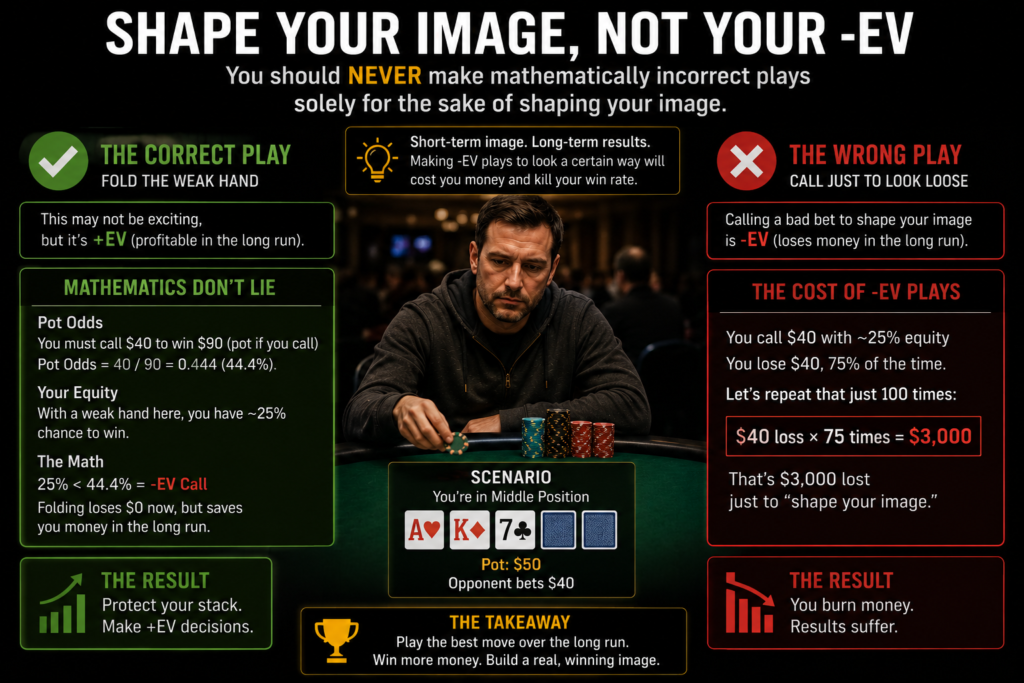
This is the perception players form during a single session. It is relatively flexible and can be influenced more quickly than long-term reputation. However, you should never make mathematically incorrect plays solely for the sake of shaping your image.
For example, you might temporarily widen your range slightly because the table is playing too tight and folding too much; this is both image-building and positive EV. Likewise, you might tighten up if the table is overly loose and splashy. These adjustments serve dual purposes: they are strategically sound while also influencing how opponents perceive you.
Making strategic changes (such as opening too wide or folding too much) purely for image purposes is usually a mistake. The best image work comes from playing correct poker that naturally projects the image you want, not from forcing unnatural plays that cost you money in the long run.
LONG-TERM REPUTATION
In rooms where you play regularly, your image evolves into a more stable reputation. This is much harder to change. Once players label you as “tight,” “loose,” “a fish,” “a nit,” or “dangerous,” that label tends to stick across multiple sessions. Changing a well-established reputation usually requires consistent behavior over many visits, sometimes weeks or months.
This fixed vs flexible dynamic creates both opportunity and limitation. You have more control over your image in new games or with new players. In your regular room, however, you must work with (or around) the reputation you have already built.

Practical Implications
- In a brand-new game or with tourists, you have a clean slate and can craft your image almost from scratch.
- In your regular cardroom, you must account for existing perceptions. If you are known as tight, your bluffs may get more respect. If you are known as loose, your value hands may get called lighter.
- You can still shift perception in the short term even with a long-term reputation, but it requires more effort and consistency.
Understanding whether you are working with a flexible session image or a more fixed long-term reputation helps you make better decisions about when to maintain your current image and when to try shifting it.
The strongest players are always aware of which level they are operating on and adjust their strategy accordingly.
HOW TO INTENTIONALLY CRAFT YOUR TABLE IMAGE
Crafting your table image in poker is not about choosing a specific persona and forcing it. It is about making deliberate, consistent decisions across the core components so that the perception you create aligns with your goals, while always remembering that the final image exists in your opponents’ minds, not yours.
THE PROCESS OF CRAFTING YOUR IMAGE
Start by reviewing the core components outlined in Section 3. Every one of them matters, even if some carry more weight than others in your particular games:
- Hand Selection and Playing Frequency
- Frequency of Aggression
- Showdown History and Recency Bias
- Physical Demeanor, Verbal Behavior, and Timing
- Emotional Control and Composure
- Winning/Losing Patterns and Stack Size
- Appearance, Age, and External Factors
- Reputation and What You Do Between Hands
STEP-BY-STEP FRAMEWORK
1. DECIDE YOUR STRATEGIC GOALS
What do you want opponents to believe about you? Do you want more fold equity, bigger payoffs on strong hands, or maximum unpredictability? Your answers guide how you adjust the components above.
2. ALIGN YOUR ACTIONS WITH YOUR DESIRED PERCEPTION
Make consistent choices across the core components. For example, if you want to be perceived as tight and patient, your hand selection, aggression frequency, and showdowns should support that story. Small, repeated actions compound over time.
3. MANAGE WHAT YOU CAN CONTROL
You control your own actions, demeanor, timing, emotional responses, and what you show down. Focus your effort here. You cannot control what opponents notice or remember, but you can increase the likelihood they see what you want them to see.
4. ACCOUNT FOR MULTIPLE PERCEPTIONS
In a typical 9-handed game, you will rarely have one single table image. You can easily have 2 to 4 different perceived images simultaneously, plus your own self-perception. The nit in Seat 2 may see you as a maniac. The tourist in Seat 7 may see you as a rock. The drunk player in Seat 9 may have no opinion at all. Skilled players understand and adjust to these differing perceptions.
5. MONITOR AND ADJUST GRADUALLY
Regularly ask yourself: “What do they think I’m thinking right now?” and “How do they see me in this moment?” Pay attention to how opponents react to your raises, folds, and showdowns. Make small, mathematically sound adjustments rather than dramatic shifts.
No matter how carefully you craft your table image in poker, the final verdict is never yours to make. Perception belongs to your opponents. You can influence it, but you cannot control it completely. The best approach is to play solid poker that naturally supports the image you want, while staying aware of how different players interpret your actions.
COMMON MISTAKES WHEN TRYING TO SHAPE YOUR TABLE IMAGE
Even players who understand the importance of table image in poker often make costly mistakes when trying to craft or adjust it. Here are the most frequent errors to avoid:
TRYING TO CHANGE YOUR IMAGE TOO QUICKLY
Many players attempt to shift from “nit” to “maniac” (or vice versa) in a single session or a few orbits. This rarely works and usually makes you look erratic or unpredictable in a bad way. Image changes should be gradual and consistent over time.
MAKING NEGATIVE EV PLAYS PURELY FOR IMAGE
This is one of the biggest mistakes. Widening your range dramatically, bluffing too much, or making other mathematically unsound plays just to “look loose” or “look tight” almost always costs money in the long run. Image adjustments should support +EV play, not replace it.
INCONSISTENT ACTIONS THAT CONFUSE YOUR IMAGE
Sending mixed signals, playing tight for an hour, then suddenly splashing around, or showing down a bluff, then immediately tightening up, creates confusion rather than a clear, useful image. Observant players will notice the inconsistency and may exploit it.
FOCUSING ONLY ON PLAYING STYLE
Many players try to craft their image solely through hand selection and aggression, while ignoring physical demeanor, verbal behavior, emotional control, timing, and what they do between hands. In live poker, these non-card elements often carry more weight than most realize.
OVER ESTIMATING HOW MUCH ATTENTION OPPONENTS ARE PLAYING
Assuming every player at the table is carefully tracking your every move leads to wasted effort. As discussed earlier, a large percentage of players (especially recreational ones) are not paying close enough attention to form a meaningful opinion of your image.
IGNORING LONG-TERM REPUTATION
In your regular room, trying to completely overhaul a well-established reputation in a short period is usually futile. Fighting against a strong long-term label without patience and consistency often backfires.
FORGETTING THAT PERCEPTION BELONGS TO OPPONENTS
The most dangerous mistake is believing you fully control your table image. You can influence it, guide it, and manage it, but you cannot dictate it. Different opponents will always have different perceptions of you, and those perceptions can shift for reasons outside your control.
Avoiding these mistakes allows you to build a table image that is both authentic to your game and strategically useful
USING YOUR TABLE IMAGE AS A STRATEGIC WEAPON
Once you have intentionally shaped your table image in poker, the next step is learning how to use it. A well-crafted image becomes one of the most powerful tools in your arsenal.
A tight, disciplined image often generates extra fold equity. Opponents are more likely to fold marginal hands to your raises and continuation bets because they believe you only play strong holdings. This image is particularly effective for bluffing and stealing pots.
A more aggressive or active image can induce calls when you finally show up with a strong hand. Opponents who perceive you as loose or “bluffy” are more willing to call down lighter, which increases your payoff on value hands.
An unpredictable or balanced image makes you harder to read. Good players may struggle to assign you accurate ranges, leading to more mistakes on their part.
The key is not that one image is better than another. The key is understanding what your current image allows you to accomplish and adjusting your strategy to exploit it.
PRACTICAL WAYS TO EXPLOIT YOUR IMAGE
- When perceived as tight: Use larger bet sizes for bluffs and thinner value bets. Opponents will often give you more credit than you deserve.
- When perceived as loose: Value bet more aggressively. Opponents are more likely to call you down with second-best hands.
- When perceived as passive: Surprise opponents with well-timed aggression. Check-raises and large turn/river bets carry extra weight.
- When perceived as emotional or tilted: Use this to your advantage by playing more straightforward value hands while opponents try to exploit your “tilt.”
TIMING YOUR IMAGE USAGE
The best players constantly monitor how opponents are reacting to them. They notice when their image is working and when it is being countered. They then make small, mathematically sound adjustments to either reinforce the current image or gradually shift it.
The Most Important Rule:
Never let your desire to project a certain image override sound poker strategy. The strongest table images are built on a foundation of correct play. Your image should enhance good decisions, not justify bad ones.
When used properly, your table image in poker becomes a silent partner at the table — one that works for you even when you are not in a hand.
CONCLUSION: MAKING YOUR TABLE IMAGE WORK FOR YOU
Mastering your table image in poker is one of the highest-leverage skills you can develop. While most players focus only on their cards and immediate reads, those who intentionally craft and manage their image gain a significant advantage that compounds over time.
You will have a table image whether you work on it or not. The difference lies in whether it forms by default or by design. By understanding the core components, recognizing the gap between reality and perception, and making consistent, mathematically sound adjustments, you can shape how opponents see you — and more importantly, how they react to you.
Remember that perception ultimately belongs to your opponents. In any given game, you may face multiple different versions of your image simultaneously. The strongest players stay aware of this reality and use it to their advantage rather than fighting against it.
Your table image in poker should never be a gimmick or a replacement for sound strategy. Instead, treat it as an additional layer that enhances everything else you’ve learned in the Poker Decision Tree. When built thoughtfully and used wisely, it becomes a quiet but powerful force that helps you win more pots and lose fewer.
Start paying closer attention to how others perceive you. The small, consistent adjustments you make today can create significant edges in the weeks and months ahead.