CARD DEAD POKER
WHY YOUR A-GAME SLOWLY DIES AT THE TABLE
Card Dead Poker: Why Your A-Game Slowly Dies at the Table:
You sit down sharp. Focused. Fully locked in.
You’re watching every hand, noting bet sizing, timing, player tendencies, and table flow. You’re making disciplined folds, staying patient, and playing your A-game. Everything feels right.
Then the cards go cold.
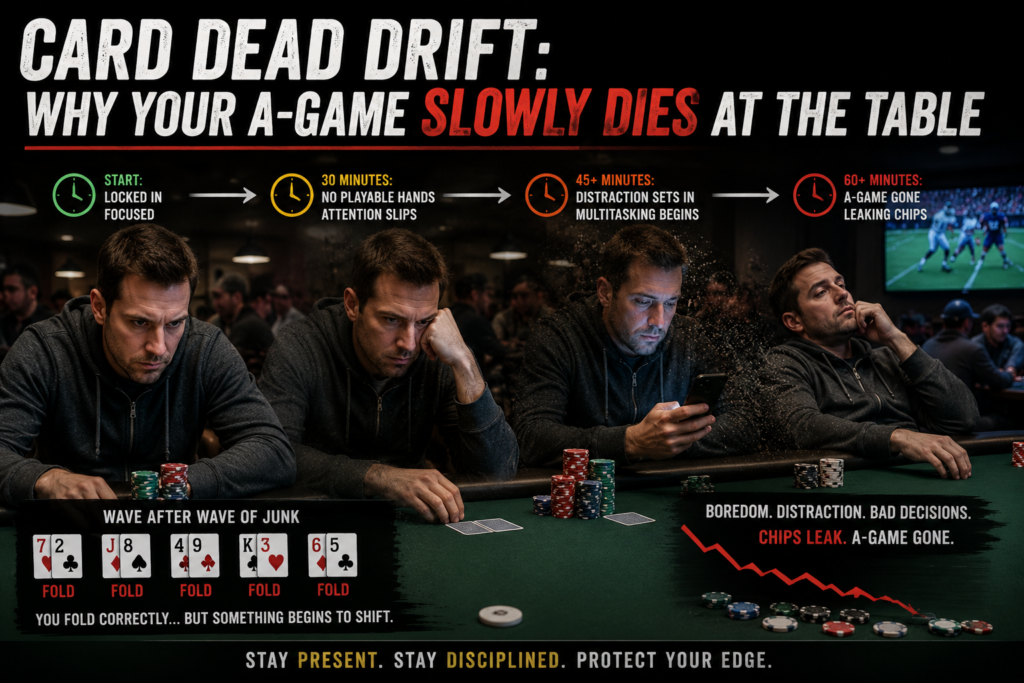
Thirty minutes pass. Then forty-five. Then an hour or more with nothing playable, no pocket pairs, no suited connectors, no strong aces. Just junk. You continue folding correctly, but something begins to shift. Your attention starts to wander. You check your phone or watch the TV across the room. You fidget. And then you tell yourself you can “multitask” and still play well.
Before long, you’re no longer truly present at the table. You’ve entered what many live players quietly experience but rarely talk about: card dead poker drift.
This is the moment your sharp focus slowly dissolves. What begins as disciplined patience gradually turns into boredom, distraction, and eventually leaking chips with marginal hands you would normally fold without hesitation. The worst part? It happens so gradually that most players don’t even realize it’s occurring until they’re already playing poorly.
This article explores the psychological and practical reality of card dead poker drift, why it happens, how it silently destroys even strong players, and most importantly, how to protect yourself from it. Because in live poker, the difference between a winning session and a losing one often comes down to who can maintain their mental game when the
THE DOWNARD SPIRAL
HOW CARD DEAD POKER ERODES YOUR GAME
It starts innocently enough.
You begin the session fully engaged. You’re observing players, tracking tendencies, and noting bet sizing and timing. You’re making disciplined folds and staying mentally sharp. This is the honeymoon phase of a good session — the version of yourself that plays excellent poker.
Then the cards turn cold.
Thirty minutes pass with nothing playable. Forty-five minutes. Then a full hour or longer. No pocket pairs, no suited connectors. No strong aces. Just wave after wave of junk. You continue folding correctly, but the lack of stimulation begins to take its toll. This is where card dead poker drift begins.
Your brain, wired to seek reward and stimulation, starts rebelling against the prolonged lack of action. What was once sharp focus gradually loosens. You catch yourself checking your phone between hands. You glance up at the TV. And you shift in your chair more often. The internal dialogue begins: “I’ve been so patient… I can play this one-handed.”
This is the dangerous transition point. You are no longer fully present at the table. You’ve begun the slow slide into distraction.
THE MULTITASKING MYTH TAKES HOLD
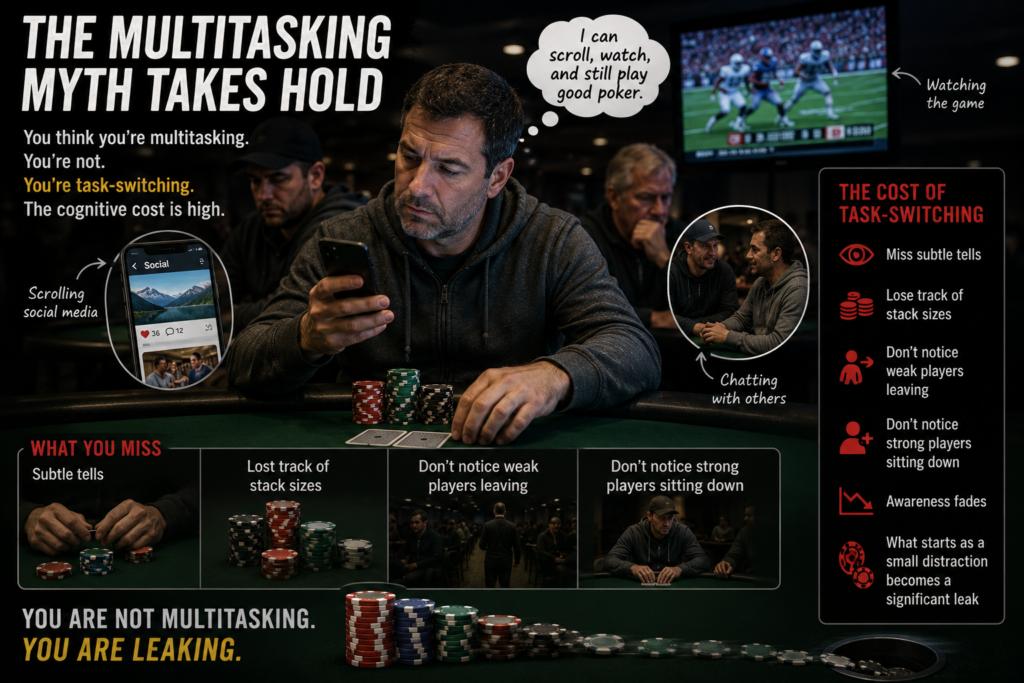
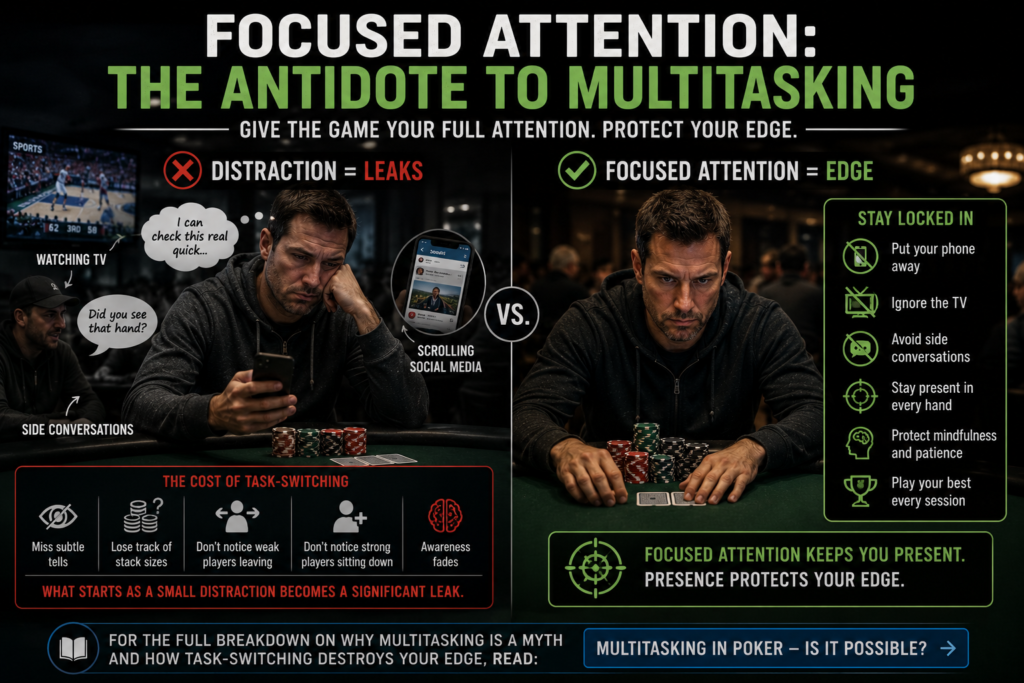
Once focus slips, the multitasking lie quickly follows. You convince yourself you can scroll social media, watch sports, or chat with others while still playing solid poker. In reality, you are not multitasking; you are task-switching, and the cognitive cost is high.
Each switch pulls attention away from the game. Often, you miss subtle tells. Or you lose track of stack sizes. You stop noticing when weak players leave, and stronger ones sit down. Your awareness of table dynamics fades. What began as a minor distraction becomes a significant leak.
THE RATIONALIZATION AND THE LEAK

The final stage is the most costly. Boredom and ego combine to create dangerous rationalizations. “I’ve folded for two hours; I deserve to play this hand.” “Everyone else is playing junk and winning.” “It’s just one hand.
Suddenly, you’re opening Q-8 offsuit or calling raises with J-7 suited, hands you would have folded without hesitation when you were sharp. The disciplined player who sat down has been replaced by someone who is no longer playing mindful poker. You are now reacting instead of observing, participating instead of controlling.
This is card dead poker drift in full effect. It rarely happens all at once. It creeps in gradually, session after session, until poor play feels normal.
The painful truth is that many players lose far more money during these drifted periods than they realize, not because of bad luck, but because they stopped playing the game with the same clarity they started with.
THE THREE SKILLS: HOW THEY SUPPORT EACH OTHER
Card dead poker drift does not result from a single failure. It occurs when the three core mental skills that form your Mental Game Triangle begin to weaken. These skills are deeply interconnected. When one falters, the others usually follow, creating a slow but dangerous decline in performance.
The three skills are:
- Patience
- Mindfulness
- Focused Attention (the rejection of multitasking)
Together, they determine how well you play when the cards stop coming. Understanding how they support or undermine each other is essential for protecting your edge during long dry spells.
PATIENCE: THE FOUNDATION
MINDFULNESS: CLARITY UNDER PRESSURE
Patience in poker is far more than the ability to fold correctly for extended periods. It is active strategic restraint, the disciplined skill that allows you to maintain a thoughtful, purposeful approach throughout every phase of the game.
A patient player does not simply sit back and wait for premium hands. They:
- Think ahead, considering how each decision on the current street will affect future streets.
- Observe opponents, identifying patterns, betting tendencies, and potential weaknesses.
- Control emotions, avoiding rash decisions driven by frustration, boredom, or tilt.
- Maximize value by knowing exactly when to apply pressure and when to wait for the right spot.
Patience is not passivity. Passive players fold too often, avoid risk, and let aggressive opponents control the game. Patient players are selective but decisive — they strike at the right moments when the odds and circumstances favor them.
Without strong patience, mindfulness and focus eventually collapse. Boredom sets in, distraction follows, and the entire mental game triangle begins to break down.
For a deeper exploration of patience as a foundational skill, read our full article: [The Power of Thoughtful Patience in Poker].
Mindfulness is the skill of seeing the table as it actually is, not as your ego, emotions, or wishes want it to be. It is not about staying calm for the sake of calmness. It is about clarity under pressure.
A mindful player remains fully present even during long stretches of folding. They observe betting patterns, body language, timing, and table dynamics. They notice when a normally tight player begins loosening up or when someone’s breathing changes after looking at the flop.
Think of Sherlock Holmes at a crime scene. He is not rushing, nor is he reacting emotionally. He is still, focused, and absorbing every detail without judgment. And, he waits for the data to reveal itself.
Contrast that with Dr. Watson, who sees the clues but does not truly observe them. He reacts. He gets distracted by his own assumptions and feelings.
Poker tables are filled with Watsons. The mindful player, Holmes, is quietly playing every hand at the table, even when not involved. This level of awareness creates a massive information advantage over time.
To dive deeper into developing true clarity under pressure, see our dedicated article: [Mindfulness in Poker].
FOCUSED ATTENTION: THE ANTIDOTE TO MULTITASKING
Focused attention is the ability to give the game your undivided cognitive resources. It is the recognition that true multitasking in poker is a myth. What most players call multitasking is actually rapid task-switching, and it carries a heavy mental cost.
When focused attention is strong, you resist the urge to check your phone, watch TV, or engage in side conversations during card dead stretches. You stay locked into the rhythm of the game. When it weakens, the door opens to distraction, which then erodes both mindfulness and patience.
For the full breakdown on why multitasking is a myth and how task-switching destroys your edge, read: [Multitasking in Poker – Is It Possible?].
HOW THE TRIANGLE WORKS TOGETHER
These three skills create either a virtuous cycle or a vicious one:
Virtuous Cycle (Strong Mental Game):
Strong patience creates space for mindfulness. Mindfulness supports sustained focused attention. Focused attention makes patience easier to maintain over long periods.
Vicious Cycle (Card Dead Drift):
Weak patience (boredom) leads to loss of mindfulness. Loss of mindfulness opens the door to task-switching and multitasking. Multitasking further destroys patience and focus, accelerating the drift.
The player who masters this triangle maintains their A-game even during long dry spells. The player who loses one leg of the triangle usually loses all three.
THE SCIENCE AND PSYCHOLOGY BEHIND THE COLLASPE
Card dead poker drift is not just a bad habit. It is a predictable psychological and neurological process. Once you understand the science behind it, you can see exactly why even disciplined players slowly lose their edge during long dry spells.
VIGILANCE DECREMENT: THE BRAIN'S NATURAL LIMIT
TASK SWITCHING AND THE MULTITASKING MYTH
Sustained attention is mentally expensive. Research on “vigilance decrement” shows that the longer you must maintain high focus with little stimulation, the more your performance degrades. After 30 to 60 minutes of low-reward activity (such as folding hand after hand), your brain’s ability to stay sharp naturally declines. This is not laziness, it is biology. Your brain is wired to seek stimulation and reward. When it doesn’t receive any for an extended period, it begins to disengage.
This is the exact moment when card dead poker drift begins.
What most players call “multitasking” is actually rapid task-switching. According to research from the University of California, Irvine, it takes an average of 23 minutes and 15 seconds to regain deep focus after a distraction. Every time you check your phone, watch TV, or engage in side conversation, you create “attention residue”, part of your brain is still thinking about the previous task.
In poker terms, this means you miss subtle tells, lose track of stack sizes, and fail to notice important shifts in table dynamics. Your decision-making quality drops significantly, often without you realizing it.
DOPAMINE, BOREDOM, AND REWARD-SEEKING
EGO DEPLETION AND IDENTITY PROTECTION
When you go card dead for long stretches, your brain experiences a dopamine deficit. To compensate, it begins seeking stimulation wherever it can find it, social media, conversations, watching sports, or playing marginal hands just to “do something.” This is not a lack of discipline. It is your brain trying to restore chemical balance.
This reward-seeking behavior is what leads players to rationalize playing Q♦-8♠ or J♣-7♥ after folding for an hour. The urge is chemical, not strategic.
As mental fatigue sets in, ego protection mechanisms kick in. You start telling yourself stories like:
- “I’ve been so patient, I deserve to play this hand.”
- “Everyone else is playing junk and winning.”
- “It’s just one hand.”
This is your ego trying to protect your self-image as “a player who gets action.” Folding for extended periods can feel like a threat to that identity, so the mind creates justifications to take action, even when the math says otherwise.
Understanding these psychological forces is the first step toward protecting yourself. The collapse is not inevitable, but it is predictable. The players who succeed long-term are the ones who recognize these patterns early and have systems in place to interrupt them before they turn into costly leaks.
REAL-WORLD CONSEQUENCES AND CASE STUDIES
The slow erosion of your mental game during card dead stretches is not just theoretical. It produces very real, very expensive consequences at the table, often without the player realizing what is happening until significant damage has been done.
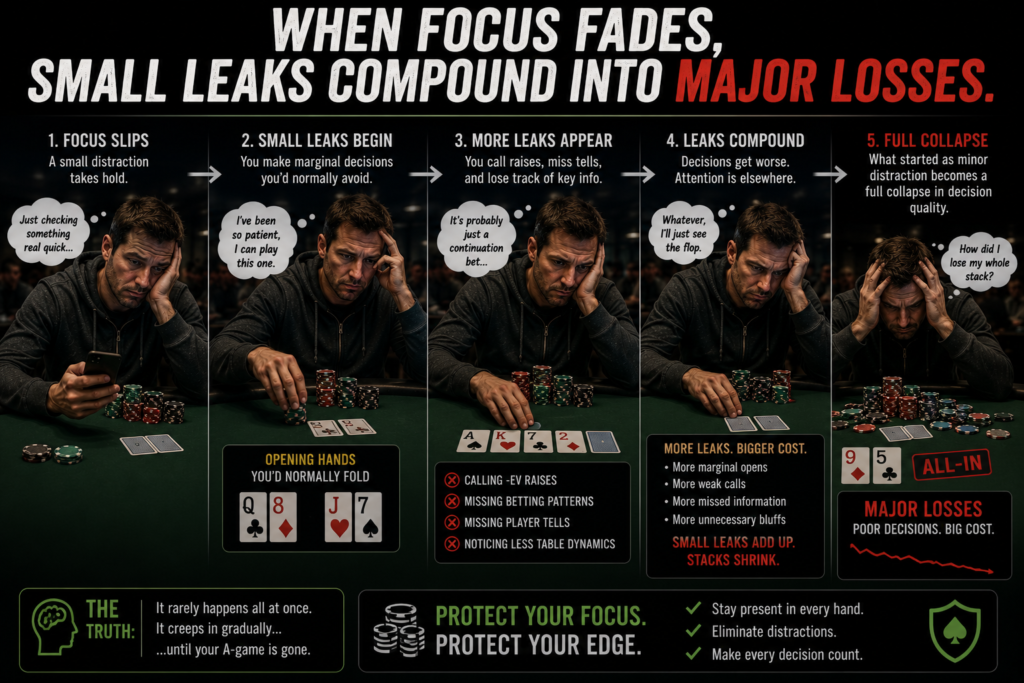
When focus fades, small leaks compound into major losses. You begin opening hands you would normally fold without hesitation. You call raises that are clearly negative EV because “you’ve been so patient.” Often, you miss critical betting patterns and player tells because part of your attention is elsewhere. Over time, what started as a minor distraction becomes a full collapse in decision quality.
THE "I AM DUE" FALLACY
One of the most common and costly symptoms of card dead poker drift is the Gambler’s Fallacy: the belief that you are “due” for something good after a long dry spell.
Players regularly say things like:
- “I haven’t had a pocket pair in an hour, I’m due.”
- “I have folded for two hours straight; I deserve to play this hand.”
- “I’ve had seven pocket pairs this session and not one set… the next one is definitely coming.”
I once had a regular tell me he had been dealt seven pocket pairs already that session without flopping a set. He said he was going to raise big with the next pair he got “because now the set was due.” He asked me if 1 out of 8 times was correct. I had to laugh and gently remind him: the math doesn’t know you’re due. You could hit three sets in a row… or miss the next fifty. Each hand is independent.
This fallacy is especially dangerous during card dead stretches because boredom and ego combine to make it feel logical. The longer you go without playable hands, the stronger the urge becomes to “make something happen.
THE CURE: PRACTICAL SYSTEMS TO PROTECT YOUR MENTAL GAME
The good news is that card dead poker drift is not inevitable. While you cannot control the cards, you can control how you respond when they refuse to come. The players who maintain their edge during long dry spells are not luckier or more talented, they have systems in place to protect their focus.
Here are the most effective ways to interrupt the drift and rebuild your Mental Game Triangle.
PRE-SESSION PREPARATION
PHONE RULES - THE NON-NEGOTIABLE BOUNDARY
Strong sessions start before you sit down. Create a simple 2–3 minute ritual that sets your intention:
- Review your notes from the last session (especially any drift you noticed).
- Set one clear mindfulness goal for the day (e.g., “Stay off my phone entirely” or “Observe every hand I’m not in”).
- Remind yourself: “My job is to play well, not to get action.”
This ritual anchors your mindset and makes it much harder for boredom to take over later.
The single biggest trigger of drift is your phone. Make a strict rule:
- Phone stays in your pocket or bag during play.
- No checking messages, social media, or scores between hands.
- If you must use it, stand up and walk away from the table.
Most players underestimate how much even brief glances destroy their focus. Treat the phone as the enemy of presence.
SCHEDULED RESET BREAKS
THE "ONE HAND RULE"
Build mandatory resets into your session:
- Stand up and walk away from the table every 60–90 minutes, even if you’re winning.
- Use the break to breathe, stretch, and re-center.
- During the walk, ask yourself: “Am I still playing my A-game, or have I started drifting?”
These short breaks prevent the slow accumulation of mental fatigue that leads to multitasking and poor decisions.
When you feel the urge to play a marginal hand because you’ve been folding for a long time, apply this simple test:
- Ask yourself: “Would I play this hand if I had just sat down fresh?”
- If the answer is no, fold.
This rule cuts through the “I’ve been patient, I deserve this” rationalization that destroys so many sessions.
When you catch yourself drifting, use it as a signal to strengthen the triangle:
- Re-commit to mindfulness by actively observing the next 5–10 hands you’re not in.
- Restore patience by folding the next few marginal spots deliberately.
- Return to single focus by putting the phone away and locking back in.
Small, deliberate resets create momentum in the right direction.
THE REAL EDGE IN LIVE POKER
Card dead poker drift is one of the most common and most expensive leaks in live poker. It rarely feels dramatic in the moment. It feels like “just checking my phone,” “I’ve been patient so I deserve this hand,” or “I can multitask and still play well.” Yet over time, these small lapses compound into significant losses that many players mistakenly blame on bad luck or “unplayable tables.
The truth is more sobering: your A-game can quietly disappear long before the cards do.
The players who succeed consistently in live poker are not necessarily the ones with the best hand-reading skills or the deepest GTO knowledge. They are the ones who protect their Mental Game Triangle, Patience, Mindfulness, and Focused Attention, especially during the long, boring stretches when the cards refuse to cooperate.
Patience is not passive waiting.
Mindfulness is not just staying calm.
Focused attention is not optional multitasking.
These three skills work together. When one weakens, the others usually follow. When all three are strong, you maintain clarity, discipline, and presence even when the deck is cold. That is the real, sustainable edge in live poker.
The next time you sit down and the cards go dead for an hour or more, remember this: the game is testing not just your hand selection, but your ability to stay mentally sharp when there is nothing obvious to play. The players who pass that test, who refuse to drift, who reject the multitasking lie, and who protect their focus are the ones who win in the long run.