
THE HAND AND EQUITY LAYER
THE FOUNDATION OF POKER DECISION MAKING
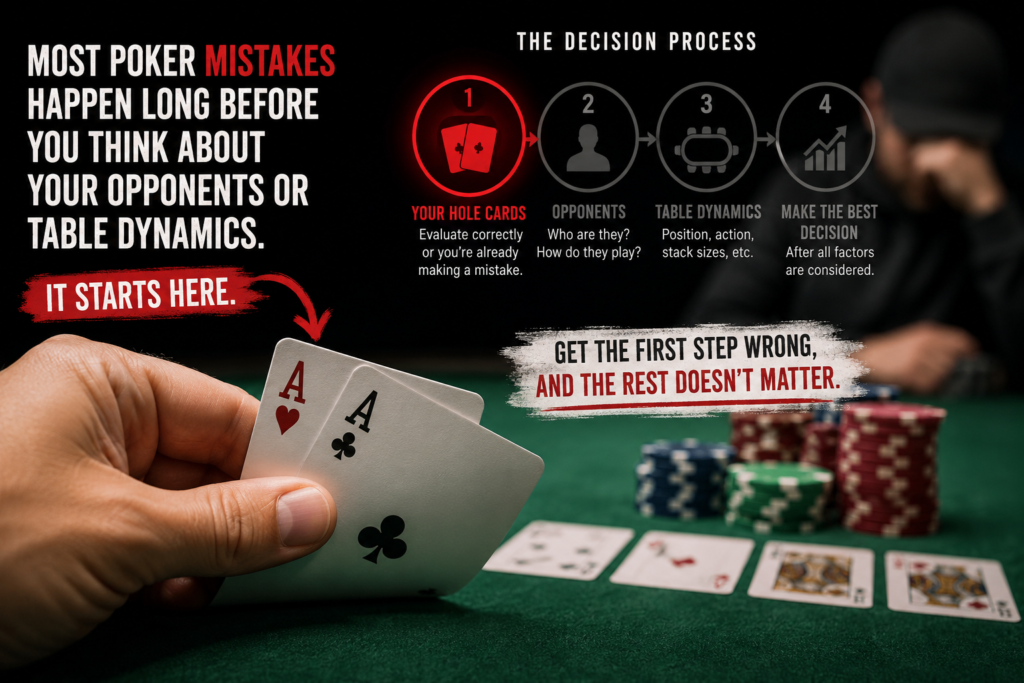
Most poker mistakes happen long before players even think about their opponents or table dynamics. They happen at the very first step of the decision process, when you look at your two hole cards and fail to properly evaluate them.
This is Layer 1 of the Decision Tree: The Poker Hand & Equity Layer.
It is the foundation upon which every other layer is built. If you get Layer 1 wrong, everything that follows, no matter how good your reads or table feels, will be built on shaky ground.
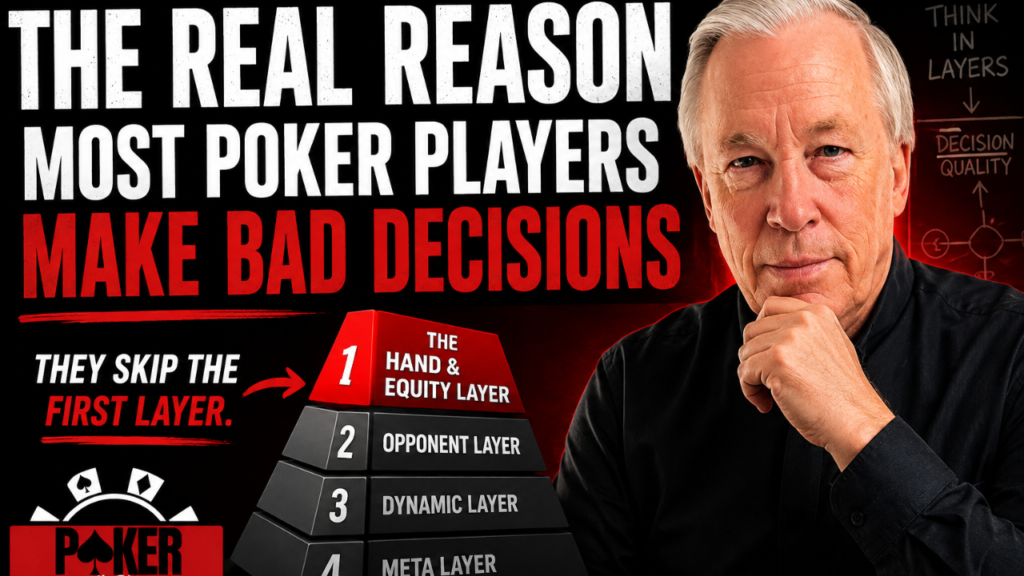
The concept of thinking in layers is simple but powerful. Instead of making quick, one-dimensional decisions (“I have Ace-King, so I raise”), elite players evaluate every hand through multiple layers of analysis. They start with Layer 1: a clear, honest assessment of their hand’s raw strength, equity, and playability in the current situation.
Why does this matter so much?
Because most recreational (and even many serious) players only think in absolutes. They see pocket Queens and think “premium hand.” Or they see suited connectors and think, “I can hit a big hand.” They see top pair and assume they must be ahead. This static thinking is exactly why so many good players still lose in the long run.
In this first article of the series, we will focus exclusively on mastering Layer 1, the Poker Hand & Equity Layer. We will discuss how to accurately evaluate any starting hand, understand its true equity and playability, and avoid the most common (and expensive) mistakes players make right at the beginning of the decision tree.
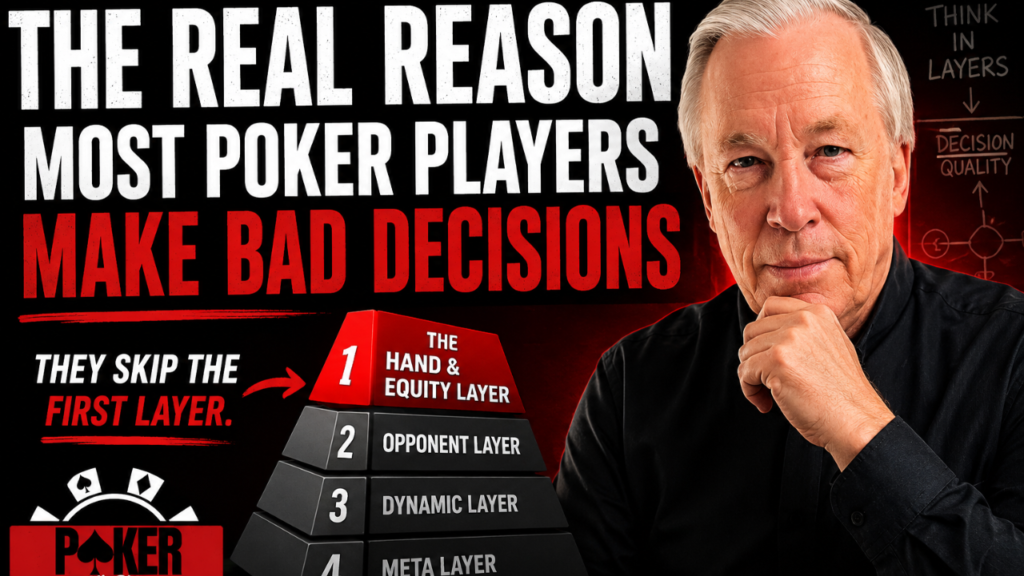
Once you build a rock-solid foundation at Layer 1, adding the Opponent Layer, Situation Layer, Meta Layer, and Self Layer becomes much more effective.
Let’s begin by understanding what the Hand & Equity Layer actually requires.
WHAT "THE HAND AND EQUITY LAYER" ACTUALLY MEANS
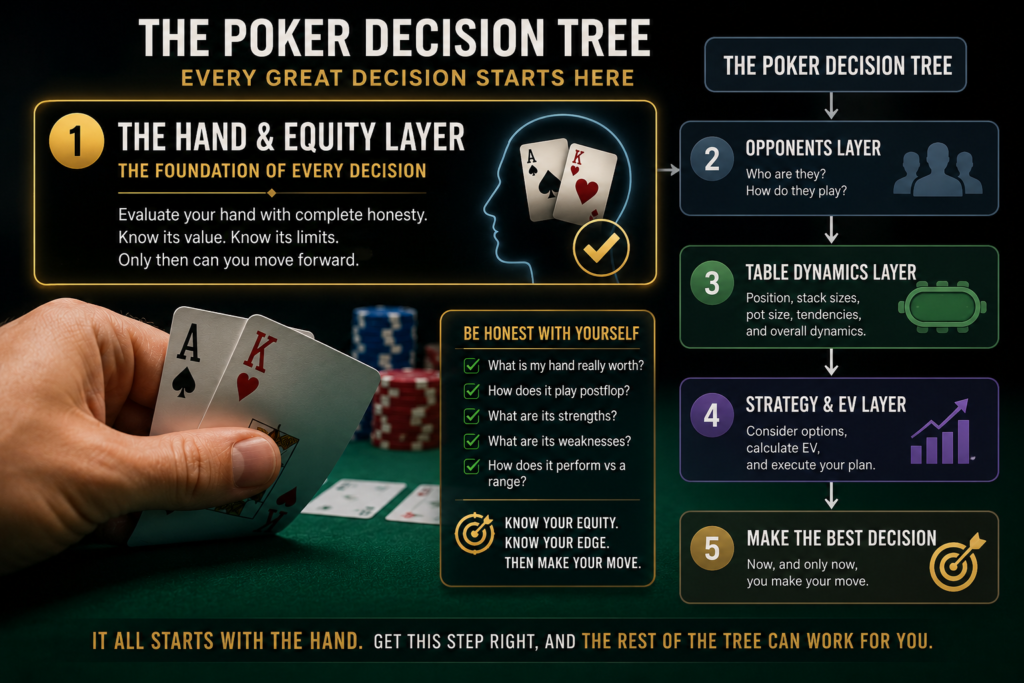
The Poker Hand & Equity Layer is the first and most fundamental step in the poker decision tree. It requires you to evaluate your hand with complete honesty before considering anything else.
This layer is not just about recognizing that you hold two cards. It is about understanding the true strength and potential of those cards in the current situation. At its core, Layer 1 answers one essential question: “What do I actually have, and how strong is it right now?”
To think effectively in this layer, you must consider several key factors:
ABSOLUTE HAND STRENGTH
RELATIVE HAND STRENGTH
This is the raw power of your holding. Is it a made hand, such as top pair or an overpair? Is it a strong draw with multiple ways to improve? Or is it pure air with very little showdown value?
Your hand does not exist in isolation. Its value depends heavily on the board texture. Pocket Jacks are very strong on a Ten, Eight, Four rainbow board, but they become much weaker on an Ace, King, Seven board.
EQUITY
Equity is your fair share of the pot based on the current situation. It tells you how often your hand wins against a realistic opponent range. Ace-King, for example, has excellent equity preflop against many ranges. However, that equity can drop dramatically depending on the board texture and the number of players in the pot. A hand that looks strong preflop can quickly become marginal or even a bluff-catcher when the board runs out coordinated or when multiple opponents continue. This is why Layer 1 thinking requires constant re-evaluation. Your hand’s value is never fixed, it is always relative to the board and the action.
PLAYABILITY
This refers to how well your hand performs across future streets. Strong suited connectors have excellent playability because they can make straights, flushes, and strong pairs. Weak offsuit hands have poor playability because they rarely improve and are difficult to play profitably postflop.
BLOCKERS
Blockers are often overrated, but they do matter in specific situations. There are two types:
- Probabilistic Blockers: Holding an Ace reduces the chance that your opponent also has an Ace, but it does not eliminate it. In a 9-handed game, if you hold one Ace, there is still roughly a 65% chance that another player was dealt an Ace.
- Absolute Blockers: These are much stronger. If you hold the Ace of Spades, you have completely blocked the nut flush in spades.
The important point is this: blockers are a secondary consideration in Layer 1, not the primary one. They can provide a small edge in certain spots, but they should never be the main reason you make a decision.
Mastering Layer 1 means moving beyond simple labels such as “premium hand” or “speculative hand.” It means developing the ability to quickly and accurately assess your hand’s real value before any other layers come into play.
Most players fail here because they think in absolutes instead of probabilities. They fall in love with their cards and stop evaluating them objectively once they see two nice-looking ones.
COMMON MISTAKES PLAYERS MAKE IN LAYER 1
Even experienced players frequently stumble at the Poker Hand & Equity Layer. They look at their cards, feel a certain strength, and make decisions based on that feeling rather than an objective evaluation. These mistakes compound over time and become some of the most expensive leaks in poker.
OVERVALUING MADE HANDS
UNDERVALUING SPECULATIVE HANDS IN THE RIGHT SPOTS
Many players treat top pair or an overpair as automatically strong simply because they have a pair. They fail to understand that hand strength is relative, not absolute.
Pocket Aces are the best hand in poker preflop, but they do not hold absolute value after the flop. On a dry board such as King-Seven-Deuce rainbow, they remain very strong. However, on a coordinated board like Nine-Ten-Eight with two cards of the same suit, their relative value drops significantly in a multiway pot. Even though you may still have the best hand, you must proceed with caution because the board now favors straight and flush draws.
This is the core mistake in Layer 1: players evaluate their hand based on what it was preflop instead of what it is right now, given the board and the number of opponents.
While many players overvalue weak made hands, they often make the opposite mistake with speculative hands. They undervalue strong playable hands such as suited connectors and small pocket pairs, especially when the conditions are actually favorable.
Take Jack-Ten suited, one of the best suited connectors. It has roughly a 15% chance (about 5.67 to 1) of making a straight or flush by the river. Small and medium pocket pairs have only an 11.8% chance (7.5 to 1) of flopping a set.
These hands are not automatic calls. They are only profitable in very specific situations: late position, unraised pots, deep stacks (ideally 25–30 big blinds or more behind), and against opponents who will pay you off when you hit. Continually calling preflop raises with these hands is almost always -EV in the long run. Without the proper conditions (position, stack depth, and implied odds), they become expensive lottery tickets.
IGNORING BOARD TEXTURE
IGNORING BOARD TEXTURE
This is one of the most common Layer 1 errors. A player flops top pair and automatically assumes they are ahead, without considering whether the board is dry, wet, monotone, or paired. Board texture dramatically changes hand strength, yet many players evaluate their hand in isolation rather than in context.
Players often lock onto a preflop plan and refuse to adjust. They raise Ace-King preflop and continue betting every street simply because they started with a strong hand, even when the board clearly favors their opponents’ ranges. This failure to re-evaluate equity on later streets leads to many unnecessary lost stacks.
OVER-RELIANCE ON BLOCKERS
Some players give too much weight to blockers. While holding the Ace of spades does block the nut flush, it does not dramatically change most situations. Treating blockers as a primary reason to bet or call often leads to overplaying marginal hands.
These mistakes share one common root: players evaluate their hand based on how it feels instead of what it actually is in the current context. They skip the disciplined analysis required at Layer 1 of the poker decision tree and jump straight to action.
Mastering this layer means developing the habit of honest, objective assessment before considering any other factors.
HOW TO PROPERLY THINK IN LAYER 1
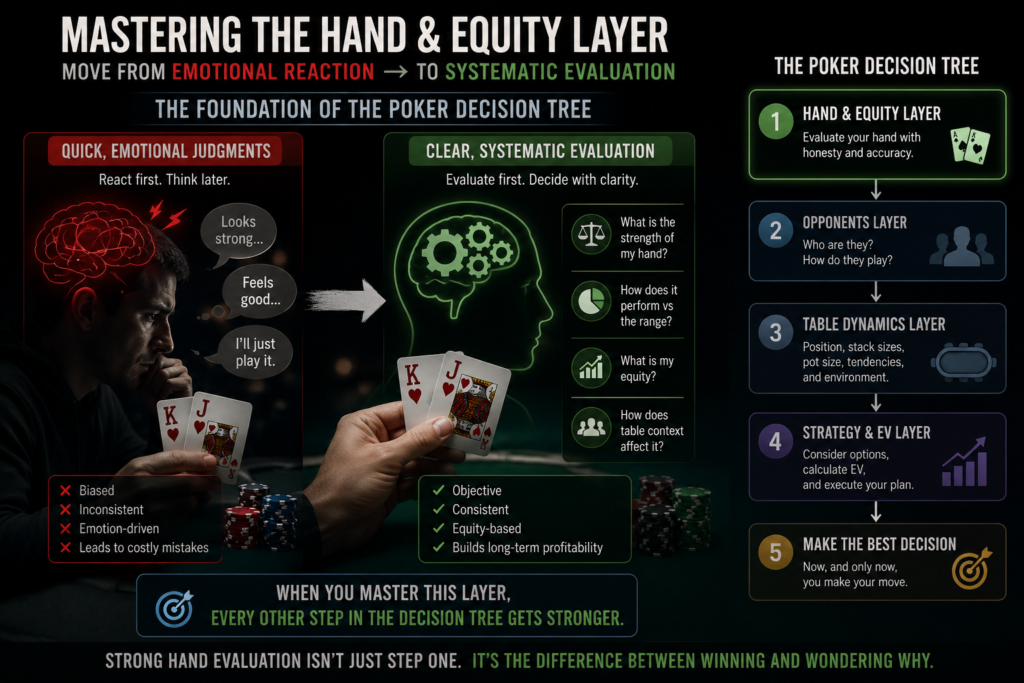
Mastering the Poker Hand & Equity Layer means moving from quick, emotional judgments to a clear, systematic evaluation of your hand. This is the foundation of the poker decision tree. When you learn to do this consistently, your decision-making improves dramatically across every street.
Here is a practical framework you can use on every hand:
CAEGORIZE YOUR HAND
EVALUATE RELATIVE STRENGTH
CALCULATE REALISTIC EQUITY
JUDGE PLAYABILITY
- Are you holding a made hand (pair, two pair, set)?
- Are you holding a draw (flush draw, open-ended straight draw)?
- Or do you have air with little to no showdown value?
This quick classification prevents you from overvaluing weak made hands or undervaluing strong speculative ones.
Next, compare your hand to the board. Ask yourself:
- How does my hand rank against the current board texture?
- Am I likely ahead, behind, or in a coin-flip situation?
Top pair on a dry board is usually strong. The same top pair on a coordinated, wet board is often much weaker, especially in multiway pots.
Estimate your equity against a realistic opponent range, not against one random hand.
Ace-King has excellent equity preflop, but that equity can shrink quickly if the board favors your opponents’ continuing ranges. Always consider the number of players in the pot, because equity compresses significantly in multiway situations.
Ask yourself how well this hand performs on future streets.
- Can I comfortably bet multiple streets if I improve?
- Can I get away from the hand if it misses?
- Does this hand have good implied odds or reverse implied odds?
Strong suited connectors have excellent playability. Weak offsuit hands usually do not.
CONSIDER BLOCKERS AS A SECONDARY FACTOR
Blockers can provide a small edge in specific situations, but they should rarely be the main reason for your decision. Remember that holding one Ace only probabilistically reduces the chance your opponent has an Ace. It does not eliminate it.
When you combine these five steps, you develop the habit of objective hand evaluation. You stop falling in love with your cards and start making decisions based on their actual value in the current situation.
This disciplined approach at Layer 1 of the poker decision tree creates a strong foundation for every other layer that follows.
ADDITIONAL FACTORS TO CONSIDER
Before the flop, your Layer 1 analysis should also answer these key questions:
- What is my position at the table?
- How many players remain to act behind me, and what are their general tendencies?
- Has the pot already been raised, and if so, by how much?
- If I raise, how many callers am I realistically likely to get?
- What are my implied odds if I hit a strong hand?
These factors determine whether a hand is worth entering the pot at all. For example, Jack-Ten suited may be playable from late position in an unraised pot with deep stacks, but it is usually a clear fold from early position facing a raise.
POST-FLOP EVALUATION
Once the flop is dealt, you must re-evaluate your hand on every street. Hand strength is dynamic. Ask yourself:
- What is my current hand strength relative to this specific board?
- How does the board texture (dry, wet, paired, monotone) affect my hand’s value?
- What is my equity against the continuing ranges?
- What are my direct pot odds versus my hand odds on this street? Is continuing profitable in the long run?
- Do I have sufficient implied odds to continue (and only if the situation, stacks, opponent tendencies, and position truly support it)?
- How has my relative position changed as players have folded? Am I now in position or out of position?
A hand that looked strong preflop can quickly become marginal or even a bluff-catcher after the flop. Pocket Jacks on a Ten-Eight-Four rainbow board are very different from the same pocket Jacks on an Ace-King-Seven board. Constant re-evaluation on every street is essential.
When you combine these pre-flop and post-flop questions, you develop the habit of objective hand evaluation. You stop falling in love with your cards and start making decisions based on their actual value in the current situation.
This disciplined approach at Layer 1 of the poker decision tree creates a strong foundation for every other layer that follows.
IMPORTANT DISCLAIMER
No checklist can ever be complete. Every poker hand is unique, and every player at the table is reacting to the moment in their own way. Someone may be on tilt after a bad beat, another may be gloating after a big win, while someone else just stepped outside for a smoke and is now playing looser. These dynamic human factors matter.
Always ask yourself situation-specific questions: Who just won a big pot? Who is drinking? Who seems distracted or emotional right now? The best players use the framework above as a starting point, then layer on real-time observations unique to that exact hand and table.
When you combine these structured questions with sharp situational awareness, you develop the habit of objective hand evaluation. You stop falling in love with your cards and start making decisions based on their actual value in the current situation.
This disciplined approach at Layer 1 of the poker decision tree creates a strong foundation for every other layer that follows.
WHY MASTERING LAYER 1 MATTERS
Mastering the Poker Hand & Equity Layer is the single biggest upgrade most poker players can make to their game. It is the foundation of the entire poker decision tree. When you consistently evaluate your hand’s true strength, equity, and playability before considering anything else, everything else in your game improves.
BETTER DECISIONS ON EVERY STREET
STRONGER FOUNDATIONS FOR ALL OTHER LAYERS
LONG-TERM WIN RATE IMPROVEMENT
MENTAL CLARITY AND CONFIDENCE
Strong Layer 1 thinking prevents you from making expensive mistakes with marginal made hands. You become much better at folding top pair weak kicker on dangerous boards and extracting value with strong hands. You also stop folding playable speculative hands in the right situations. The result is fewer costly calls and more profitable investments.
Layer 1 is the base. If your evaluation of your own hand is inaccurate, then your read on your opponent (Layer 2), your understanding of the situation (Layer 3), your image considerations (Layer 4), and even your emotional control (Layer 5) will all be built on faulty information. Mastering Layer 1 makes every subsequent layer far more effective.
The difference between a break-even player and a solid winner is often not dramatic hero calls or brilliant bluffs. It is the quiet, consistent edge gained from making better hand evaluations hand after hand, session after session. Small improvements in Layer 1 thinking compound over time into significant results.
When you truly understand the strength of your hand in context, you play with greater confidence and less emotional noise. You are less likely to fall in love with your cards or tilt when they underperform. You make decisions based on logic rather than hope or fear.
Layer 1 is where most players leak the most money without realizing it. It is also where the biggest gains are available. Once you build a rock-solid foundation at this first layer of the poker decision tree, adding the Opponent Layer, Situation Layer, Meta Layer, and Self Layer becomes much more natural and powerful.
CONCLUSION
Layer 1 of the poker decision tree, the Poker Hand & Equity Layer, is the most important foundation you can build. Everything else in your game (reading opponents, understanding table dynamics, managing your image, and controlling your emotions) rests on your ability to accurately evaluate your own hand first.
Mastering this layer means developing the discipline to ask honest questions on every street:
- What is my hand’s true strength right now?
- How does it compare to the board and the number of opponents?
- What is my actual equity and playability?
- Are the pot odds and implied odds in my favor?
When you consistently think this way, you stop overvaluing weak made hands, stop undervaluing strong speculative hands in the right spots, and stop making decisions based on how a hand “feels.” You begin making decisions based on what the hand actually is.Key Takeaways from Layer 1:
- Hand strength is relative, not absolute.
- Board texture and the number of opponents dramatically change your hand’s value.
- Speculative hands require very specific conditions to be profitable.
- You must re-evaluate your hand on every street, not just preflop and flop.
- Blockers are a secondary factor, not the main driver of your decisions.
If you only improve one part of your game, make it this one. A stronger Layer 1 creates better decisions across every other layer of the poker decision tree.
In the next article, we will move on to Layer 2: The Opponent Layer, where we discuss how to accurately assess what your opponents are likely to hold and how they are likely to play.
The journey to elite-level poker thinking starts right here, with an honest, disciplined evaluation of your own hand.