

WHEN SHOULD YOU LEAVE A POKER TABLE?
STRATEGY, PSYChOLOGY AND TABLE DYNAMICS
Most poker strategy discussions focus on what happens during a hand. Players study starting hands, betting patterns, and the mathematics of pot odds. These skills are essential, but they overlook another decision that can have an equally powerful impact on long-term results.
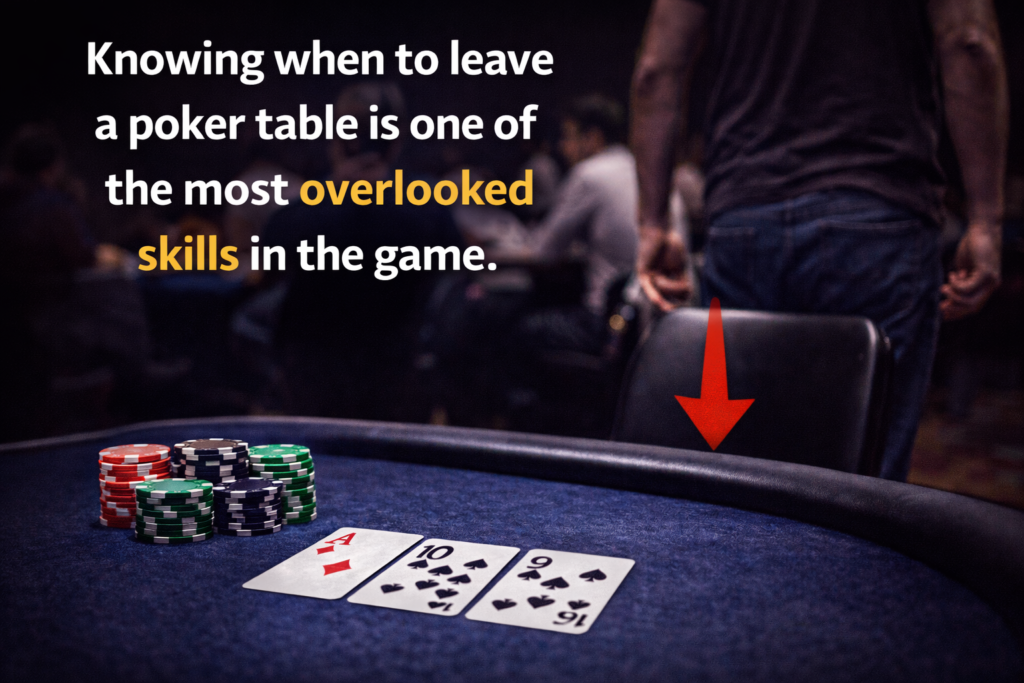
Knowing when to leave a poker table is one of the most overlooked skills in the game.
Poker is played in constantly changing environments. Players arrive and leave, table dynamics shift, and the overall quality of the game can change dramatically over the course of a session. A table that was highly profitable an hour ago may gradually become far less favorable as the lineup evolves.

Despite this, many players treat every table as if the conditions remain the same. They focus on individual hands while ignoring the broader environment in which those hands are played.
In reality, the quality of the game itself often determines whether a player has a meaningful advantage. A skilled player seated with several weaker opponents may find profitable opportunities regularly. The same player seated with several strong opponents may struggle to maintain a positive expectation, even while making technically correct decisions.
This is why the decision to leave a poker table deserves careful consideration. Sometimes the correct adjustment is to change tables and seek a better game. At other times, the better decision is to end the session entirely.
Understanding when those moments occur requires both strategic awareness and personal discipline. The sections that follow examine how table conditions change, why games can become less profitable over time, and why many players remain seated long after they should have stood up.
RECOGNIZING DIFFERENT TABLE ENVIRONMENTS
Not all poker tables are the same. Two tables playing the same stakes can produce completely different environments depending on the players involved. Understanding these differences is an important part of deciding whether to stay in a game or leave a poker table and find a better opportunity.
LOOSE AND CHAOTIC TABLES
TIGHT AND CONTROLLED TABLES
At these tables, players often enter the pot with an extremely wide range of hands. It is not unusual to see players calling raises with almost any two cards—suited or unsuited, connected or completely unconnected. Many hands quickly turn into multiway pots, with several players continuing to the flop and often calling bets through multiple streets.
These games can be loud and unpredictable. Raises are frequently called, reraises may appear with marginal holdings, and some players simply refuse to fold. In these conditions, fold equity can disappear quickly, hand equity shrinks as more players remain involved, and position becomes less powerful because opponents are willing to call almost any bet.
Loose games can offer opportunities, but they also create large swings and require strong hand-reading skills and a clear understanding of board textures and player tendencies.
At the other end of the spectrum are tight and controlled tables.
In these games, players tend to enter the pot with stronger starting hands and are more selective about when they call or raise. Raises often succeed in thinning the field, and many hands are contested by only two or three players. It is common for the action to reach the river with only one or two players remaining in the hand.
These tables are usually quieter and more deliberate. Players are often disciplined in their approach, and large pots typically develop only when strong hands are involved. Because fewer players see the flop, hands are more likely to end before showdown, and strategic betting and positional play have a greater influence on the outcome.
THE IDEAL POKER TABLE
Between these two extremes lies what many experienced players consider the ideal poker table.
In these games, there may be two or three loose players who enter pots frequently, a few moderate players who play selectively, and perhaps one or two disciplined players. This mix creates an environment where mistakes still occur, but the game remains manageable for a skilled player.
A player does not need to be the best player in the room to be profitable. In many cases, it is enough to be stronger than most of the players at the table.

Experienced players often spend a few minutes observing a game before sitting down. They watch how frequently players enter pots, how aggressively they bet, and how often they fold. It usually does not take long to identify the stronger players at a table, and they are not always the ones with the largest stacks.
Large chip stacks can result from short-term variance or a single fortunate hand. Consistent decision-making is usually a far better indicator of long-term skill.
Recognizing the type of table you are playing in, and how the players around you behave, is an essential step in deciding whether to stay in the game or whether it may be time to leave a poker table and look for a better one.
WHEN A TABLE BECOMES UNPROFITABLE
Poker tables rarely remain the same for long. Over the course of a session, players leave, new players arrive, stacks grow or shrink, and the overall dynamic of the game can shift in subtle but important ways. A table that was highly profitable when you first sat down may gradually become far less attractive as these changes occur.
One of the most common shifts happens when weaker players leave the game.
Many profitable tables are built around one or two players who consistently enter pots with weak hands and make costly mistakes. When those players leave, the character of the table can change quickly. The remaining players may be more disciplined, more selective, and far less likely to make the types of errors that create profitable opportunities.
Another change occurs when stronger players join the table.
Experienced players often recognize a good game when they see one. When several capable players take seats at the same table, the overall skill level can increase rapidly. Even if the game remains active, the mistakes that once made the table profitable may become far less frequent.
Table dynamics can also shift as chip stacks grow. A player who wins a large pot may suddenly become the dominant stack at the table, changing how other players approach the game. Shorter stacks may become cautious, while larger stacks may begin applying pressure more aggressively. These adjustments can alter the way pots develop and the types of situations that arise.
Sometimes the change is more subtle.
EVOLVING TABLE CONDITIONS
A table that was once loose and energetic may gradually tighten as players settle into a more cautious rhythm. Fewer players may begin seeing the flop, raises may thin the field more frequently, and hands may end earlier without reaching showdown. In other cases, the opposite can occur, with the game becoming increasingly chaotic as players grow more comfortable and begin taking larger risks.
The key point is that table conditions are constantly evolving. Successful players remain aware of these changes and recognize when the environment no longer provides the same opportunities it once did.
When the game shifts in ways that reduce your advantage, it may be time to reconsider whether remaining in the seat is still the best decision—or whether it might be wiser to leave a poker table and look for a better opportunity elsewhere.
CHANGING TABLES
LEAVING THE ROOM
When players discuss leaving a game, they often think only in terms of ending the session and going home. In reality, there are two different decisions involved, and understanding the difference is important.
The first decision is whether it makes sense to change tables.
Casinos often offer several games at the same stakes, and the conditions at those tables can vary significantly. One table may be filled with disciplined players who rarely make mistakes, while another table across the room may include several loose or inexperienced players creating frequent opportunities.
In these situations, leaving one table does not necessarily mean leaving the poker room. It may simply mean finding a better environment in which to play. Experienced players regularly scan the room, looking for games where the lineup appears more favorable. When a better table becomes available, changing seats can sometimes be the most profitable adjustment a player can make.
The second decision is whether it is time to leave the poker room entirely.
This decision has less to do with table dynamics and more to do with personal condition. Fatigue, frustration, and declining concentration can all affect a player’s ability to make good decisions. Even in a profitable game, poor focus can quickly erase the advantage a player might otherwise have.
Long sessions can also create subtle mental fatigue. As attention fades, players may begin entering pots with weaker hands, missing important details in betting patterns, or making decisions more quickly than they should.
Recognizing these changes in your own play is just as important as recognizing changes at the table.
A disciplined poker player constantly evaluates two factors: the quality of the game and the quality of their own decision-making. When either of those begins to decline, it may be time to stand up.
Sometimes the best move is simply to change tables. At other times, the best decision is to end the session entirely and return another day with a clear mind.
SIGNS IT MAY BE TIME TO LEAVE
Recognizing when to leave a game is not always obvious. Poker players often become focused on the hands they are playing and may overlook subtle changes in both the table and their own decision-making. However, there are several warning signs that suggest it may be time to reconsider whether remaining in the seat is still the best choice.
One of the first signs is a decline in concentration.
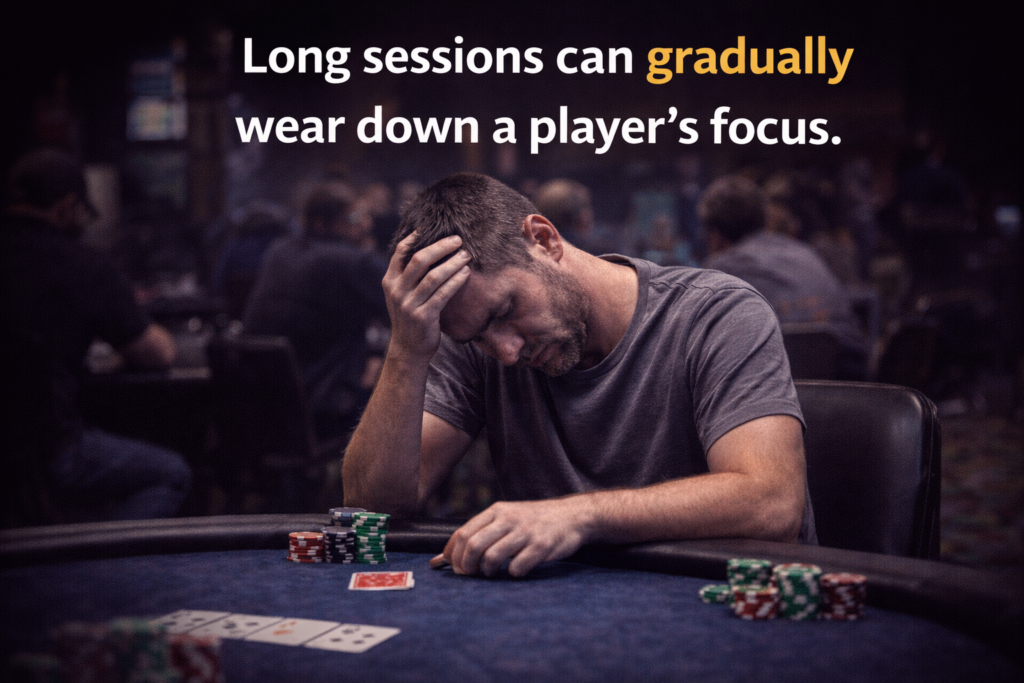
Long sessions can gradually wear down a player’s focus. Decisions that once required careful thought may begin to feel routine, and important details, such as betting patterns, stack sizes, or player tendencies, may receive less attention. When concentration begins to fade, mistakes become more likely.
Another signal appears when frustration begins influencing decisions.
Poker naturally involves swings, but frustration can lead players to deviate from their usual approach. They may begin playing hands they would normally fold, calling bets they would typically avoid, or attempting bluffs in situations that do not justify the risk. These shifts often occur gradually and may not be immediately obvious to the player experiencing them.
Changes in starting hand selection can also serve as a warning sign.

When standards begin to decline
A disciplined player generally follows consistent standards when deciding which hands to enter the pot with. When fatigue or frustration sets in, those standards can begin to loosen. Hands that would normally be folded may suddenly appear playable, and marginal situations may seem more appealing than they should.
Sometimes the signal comes from the table itself.
If the game has become significantly tighter, filled with stronger players, or lacking the mistakes that once created profitable opportunities, the advantage that originally justified sitting down may no longer exist. Even a technically skilled player may find it difficult to maintain a positive expectation in a game where few errors are being made.
Recognizing these signals requires honest self-evaluation. Poker rewards players who can step back and assess both the quality of the game and the quality of their own decisions.
When either of those begins to deteriorate, it may be a strong indication that it is time to leave a poker table, change environments, or end the session before small mistakes turn into costly ones.
WHY PLAYERS STAY WHEN THEY SHOULD LEAVE
Recognizing the moment to stand up from a table is often easier in theory than it is in practice. Many players can identify the warning signs of a deteriorating game or declining concentration, yet they remain seated anyway. In these situations, the obstacle is rarely strategic knowledge. More often, it is psychology.
RECOVER LOSSES
COMMITMENT BIAS
EGO
TILT & EMOTIONAL FATGUE
After a difficult session, it is tempting to continue playing with the belief that the next few hands will restore the balance. This mindset can quietly transform a disciplined player into one who chases losses, entering pots that would normally be avoided and taking risks that do not justify the mathematics of the situation.
Players who have invested several hours at the table may feel reluctant to leave because doing so can feel like abandoning the time already spent. The longer the session continues, the stronger this pressure can become, even when the quality of the game has clearly declined.
For some players, leaving a table feels like admitting defeat, especially if they are losing or if other players appear to be winning. Poker tables often carry an unspoken competitive atmosphere, and the desire to prove oneself can override the more rational decision to stand up and leave.
Frustration after losing a pot or being outdrawn can push players to remain in the game longer than they intended. Over time, this emotional pressure can accumulate, gradually influencing decision-making and making it more difficult to maintain discipline.
Many players begin a session with the intention of playing carefully and strategically. As time passes, however, the focus can shift toward simply staying in the action. Hands that would normally be folded begin to look appealing, and the session gradually becomes more about participation than profitability.
The challenge is that these psychological forces often operate quietly. A player may recognize them only after several additional hands, or even several additional hours, have already been played.
Understanding these tendencies is an important part of learning when to leave a poker table. Strategic knowledge may identify the correct decision, but discipline and self-awareness are often required to act on it.
THE PATIENCE ADVANTAGE
One of the most important qualities a successful poker player can develop is patience. While poker is often portrayed as a fast-paced game filled with dramatic confrontations, long-term profitability usually depends on the ability to wait for the right opportunities.
Patience becomes especially important when evaluating whether to leave a poker table.
Many players feel compelled to remain active in the game. They believe that constant participation is necessary to stay competitive or to recover losses. In reality, profitable poker often involves extended periods of observation and restraint, followed by decisive action when favorable situations arise.


A patient player understands that not every table provides the same opportunities. Some games naturally produce more mistakes from opponents, while others require far more effort to generate a small edge. Recognizing this difference allows disciplined players to allocate their time and energy where their advantage is strongest.
Patience also helps players maintain emotional balance. When a session includes difficult stretches or unexpected losses, the temptation to force action can become strong. A patient approach allows players to resist that impulse and avoid turning temporary setbacks into larger problems.
This same discipline applies when evaluating the overall quality of a game. If a table no longer offers the same opportunities it once did, remaining seated simply out of habit can gradually erode a player’s edge.
In these situations, patience means being willing to wait for a better environment rather than continuing to play in one that no longer favors you.
Understanding this principle reinforces an important lesson about poker. The most profitable decision is not always found within a particular hand. Sometimes it is found in the willingness to step away from a game that no longer provides the advantage it once did.
TABLE SELECTION AS A STRATEGIC SKILL
Many poker players devote enormous amounts of time studying strategy within individual hands. They analyze starting hand ranges, betting patterns, and the mathematics of pot odds. While these skills are important, they represent only part of the overall decision-making process in poker.
An equally important skill is table selection.
Table selection refers to the ability to choose games where a player has the greatest opportunity to profit. Two tables may be playing the same stakes, in the same room, with the same rules, yet one may offer far more favorable conditions than the other.
At one table, several players may routinely enter pots with weak hands and make costly mistakes after the flop. At another table, most players may be disciplined and experienced, creating an environment where mistakes are far less common.
The difference between these two situations can be significant. Even a technically skilled player may struggle to maintain a strong advantage in a game where most opponents play carefully and make few errors.
This is why strong players rarely view poker as simply a matter of playing cards well. They also think carefully about where they choose to play.
Many experienced players watch a table for several minutes before sitting down. They observe how frequently players enter pots, how aggressively they bet, and how often they fold. These observations provide valuable clues about the overall character of the game.
Sometimes the most profitable decision a player can make occurs before the first hand is even dealt.
Understanding table selection helps players recognize when a game offers genuine opportunity and when it does not. When the conditions at a table no longer provide a meaningful advantage, the disciplined choice may be to stand up and leave a poker table in search of a better one.
CONCLUSION
Poker players spend countless hours studying how to play individual hands. They analyze starting hand ranges, betting strategies, and the mathematics of pot odds. These skills are important, but they represent only part of what determines long-term success in the game.
An equally important skill is understanding the environment in which those hands are played.
Poker is not a static game. Tables change constantly as players arrive, leave, and adjust their strategies. A table that once provided frequent opportunities may gradually become far less profitable as the lineup evolves or as a player’s own concentration begins to decline.

Recognizing these changes is essential.
Knowing when to leave a poker table is not a sign of weakness or defeat. In many cases, it is a sign of discipline. Successful players understand that their advantage depends not only on the decisions they make during a hand, but also on the games they choose to play.
Sometimes the correct adjustment is to change tables and find a more favorable environment. At other times, the better decision is to end the session entirely and return another day with a clear mind and renewed focus.
Poker rewards players who can think beyond the immediate excitement of the next hand. Those who develop the discipline to evaluate both the table and their own condition place themselves in a much stronger position over the long run.
In the end, some of the most profitable decisions in poker occur not when chips are pushed into the pot, but when a player quietly stands up and walks away from the table.