

SHOULD YOU PLAY TIGHT IN POKER?
WHY THE RIGHT STRATEGY DEPENDS ON THE TABLE
One of the most common concerns players express about playing tight in poker is the fear that they will never get action.
The reasoning seems straightforward. If you only enter pots with strong hands, opponents should eventually notice. Once they recognize that pattern, the assumption is they will begin folding whenever you bet or raise. If that happens, the logic goes, tight play eliminates profit because no one is willing to continue.
On the surface, this sounds reasonable. In theory, a tight table image should discourage action. When a player rarely raises, those raises may appear stronger. Opponents expect premium holdings and prefer to stay out of the way.
The problem is that this assumption relies on something that rarely exists in live poker games: careful observation.
MOST PLAYERS ARE NOT PAYING ATTENTION

Most players simply are not paying enough attention.
At lower-stakes live tables, especially, the majority of players focus almost entirely on their own cards and the board. They are not tracking how often you enter a pot. They are not building a mental model of your range. Very few players are even aware of how long it has been since you last played a hand.
Instead, they are watching the board and hoping their own hand improves.
Because of this, the fear that playing tight in poker will eliminate action is often exaggerated. Loose players chase draws, curious players call “just to see,” and aggressive players challenge almost every hand. Even when opponents suspect strength, they frequently talk themselves into calling anyway.
Poker tables are full of rationalizations.
A player convinces himself you might be stealing. Another wants to “see one more card.” Someone else decides the pot is large enough to justify a call.
The result is that disciplined players often receive far more action than they expect.
This leads to a more important realization. The real question is not whether tight play eliminates action. The real question is how the conditions of the table should influence the size of your range.
Some games are loose and chaotic. Others are tight and cautious. Many fall somewhere in between. Each environment changes how often hands are played, how large pots become, and how opponents respond to aggression.
Understanding these differences is what determines whether playing tight in poker should remain your primary approach—or whether the conditions allow your range to expand slightly while still remaining mathematically sound.
Depending on the table dynamics, playing tight in poker may remain the correct approach, or the conditions may allow you to widen your range slightly while still remaining mathematically sound.
LOOSE GAMES: WHEN PLAYING TIGHT IS THE CORRECT ADJUSTMENT
Before discussing strategy, it helps to clarify what we mean by a loose game. A table can contain one or two loose players without becoming a loose game. A truly loose game emerges when several players routinely enter pots, creating situations where five or six players regularly see the flop.
At that point, the structure of the hand changes.
More players competing for the same pot increases the probability that someone connects strongly with the board. Every additional player introduces another two-card combination that can interact with the flop, turn, or river. As participation rises, the number of possible outcomes expands quickly.

This is where the mathematics of poker begins to shift.
In tighter environments, two or three players may see the flop. In loose environments, that number can double. Instead of competing against one or two ranges, a player may now be facing five or six different ranges simultaneously. The more players involved, the greater the chance that one of them improves to a strong hand.
Loose games also introduce another important factor: range chaos.
WHYAT LOOSE RANGES ACTUALLY LOOK LIKE
In a loose game, players rarely enter pots with structured hand ranges. Some players call raises with suited cards regardless of rank. Others play weak aces, small pairs, disconnected hands, or almost any two cards that appear interesting in the moment.
One player might hold a suited connector.
Another might hold two completely unrelated cards.
A third might be chasing with a small pair.
When several players bring these kinds of hands into the same pot, the probability that someone connects with the board increases dramatically.
Random two-card combinations still produce real hands. A player who enters with a weak holding can still flop two pair, complete a straight draw, or back into a flush. As more unpredictable ranges enter the pot, the number of possible card combinations competing for the board grows rapidly.
This is why loose games do not eliminate profit for disciplined players. Instead, they change how that profit must be realized.
Marginal hands lose much of their value in these environments. Hands that might perform well in a heads-up pot often struggle when several players remain involved. With more opponents, there are simply too many ways for someone to connect with the board.
This is where playing tight in poker becomes the correct adjustment.
By tightening your range, you enter the pot with stronger hands that can withstand multiway pressure. Strong starting hands hold their equity better against several opponents and allow you to navigate large pots with more confidence.
Loose environments do not reduce action. If anything, they create too much of it.
THE BEAU RIVAGE EXAMPLE
A hand I once played at the Beau Rivage illustrates this perfectly.
The game was a $1/$3 no-limit cash game, and the table was extremely loose. Players were calling raises with almost anything and several people were seeing nearly every flop.
At one point I looked down at pocket kings in middle position.
What made the hand memorable was what happened before the cards were even dealt. I had not played a hand in well over an hour. I had not raised, called, or even entered a pot during that entire stretch.
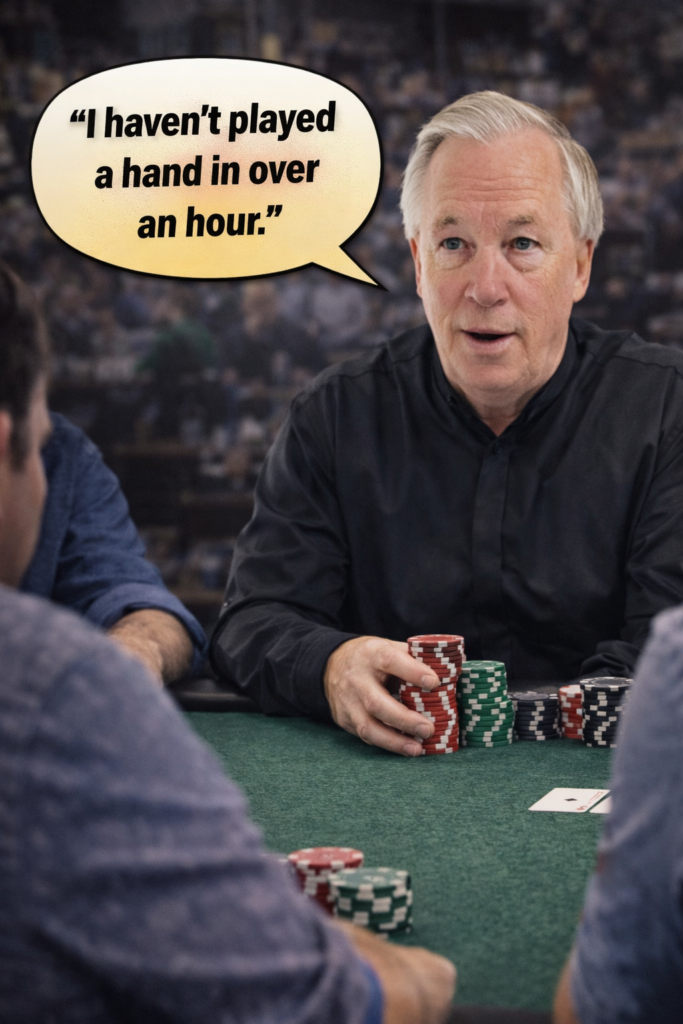
When the action reached me, I picked up my chips and said out loud to the table:
“I haven’t played a hand in over an hour.”
There was a raise to $15 in front of me and two callers. I reraised to $45.
In theory, this should have sent a very clear message. A player who has not played a hand for an hour announces it out loud and then reraises. If players were paying close attention, this should look extremely strong.
Yet the result was the opposite of what many players fear when playing tight in poker.
Five players called.
The myth says that playing tight eliminates action. In loose games, the reality is often the opposite.
When several players are willing to call with wide ranges, action becomes almost automatic. Players are not carefully analyzing your table image or calculating your hand frequency. Most are reacting to their own cards and their curiosity about the flop.
In loose environments, the challenge is rarely finding action.
The real challenge is surviving it.
LOOSE GAMES: WHY PLAYING TIGHT IN POKER IS MATHEMATICALLY CORRECT
Loose games do more than create action. They fundamentally change the mathematics of poker.
When several players regularly see the flop, the probability structure of the hand shifts dramatically. Instead of competing against one opponent, a player may now be facing four, five, or even six different hands.
Each additional player introduces another two-card combination that can interact with the board.
This creates a fundamental probability problem.
In a heads-up pot, only one opponent must fail to beat you. In a six-way pot, five opponents must fail to beat you. The more players involved, the greater the likelihood that someone connects strongly with the board.
Even weak starting hands can occasionally produce strong results. A player holding two random cards might still flop two pair, make a straight, or pick up a powerful draw. When several players bring unpredictable ranges into the pot, the probability that one of them improves rises quickly.
This phenomenon is often described as equity dilution.
As more players compete for the same pot, the equity of individual hands becomes spread across a larger field. A hand that performs well against one opponent loses strength when several opponents remain involved.
This is one of the key reasons playing tight in poker becomes mathematically correct in loose environments.
Top pair is a good example. Against one opponent, top pair may frequently be the best hand. Against five opponents, however, the probability that someone holds two pair, a set, or a strong draw increases substantially.
Loose environments also reduce one of poker’s most important strategic weapons: fold equity.
When players call with wide ranges, betting alone rarely forces opponents out of the pot. Bluffs must succeed against several players instead of just one. Even if most players fold, a single caller can invalidate the entire attempt.
Because of this, speculative aggression becomes far less reliable.
WHAT TIGHT PLAY ACTUALLY LOOKS LIKE
In extremely loose games, disciplined players often respond by tightening their starting hand requirements dramatically.
In practical terms, this can mean entering the pot only with hands that would normally be played from the earliest positions at the table. Premium holdings such as A-K, A-Q, and medium-to-high pocket pairs often become the core of the range, while marginal holdings are largely eliminated.
This approach can feel unusually tight and, at times, even boring. Yet the objective of poker is not constant action—it is long-term profitability.
During a recent six-hour session in an ultra-loose $1/$3 game, I adopted exactly this approach. The table was playing almost any two cards, creating multiway pots nearly every hand. By restricting my range to only strong starting hands and allowing the loose players to generate the action, the session produced a $300 profit.
That may not sound dramatic, but it equates to roughly $50 an hour, which is an excellent result in a chaotic low-stakes cash game.
The lesson is simple.
Loose games reward patience and strong starting hands. The wider the table’s ranges become, the more selective a disciplined player must be.
This is why playing tight in poker becomes the correct adjustment in these environments. By entering the pot with stronger hands, a player improves the ability to compete against several opponents at once and withstand the probability pressures created by multiway pots.
Tightening your range in these situations is not an act of caution. It is the logical response to the mathematical realities of loose poker games.
TIGHT GAMES: WHEN PLAYING TIGHT IN POKER BECOMES A MISTAKE
Loose games are not the only environment a player will encounter. At many tables, the opposite condition appears. Players fold frequently, raises receive little resistance, and most hands become heads-up or three-way pots.
These are tight games, and they create a very different mathematical environment.
When fewer players enter the pot, the probability structure of the hand changes again. Instead of competing against several opponents, a player may be facing only one or two ranges. The number of possible card combinations interacting with the board decreases, and the likelihood that someone connects strongly with the flop declines.

This shift has an important strategic consequence.
In these environments, playing tight in poker can actually become a mistake if the range becomes too restrictive.
When players fold too frequently, pots remain small and opportunities to accumulate chips decline. A player who waits only for premium hands may find themselves watching pot after pot pass by without participating.
While patience remains important, excessive tightness can create its own problem: missed opportunities.
WHEN TIGHT TABLES REWARD WIDER RANGES
In tighter games, raises are far more likely to succeed in thinning the field. Instead of five or six players seeing the flop, a raise may isolate a single opponent or win the pot immediately.
This creates two advantages that rarely exist in loose games.
First, fold equity increases. When opponents are more willing to release their hands, betting becomes a far more powerful tool. A well-timed raise can often win the pot without a showdown.
Second, hands that might struggle in multiway pots gain value when fewer players remain involved. Holdings such as suited connectors, suited aces, and medium broadway combinations perform far better when they can play against a single opponent rather than several.
These hands rely on maneuverability and board interaction rather than raw strength. When the number of opponents decreases, their equity improves and their strategic flexibility increases.
ADJUSTING YOUR RANGE IN TIGHT GAMES
The correct response to a tight environment is not reckless looseness. Instead, it is a controlled expansion of your starting hand range.
When the table folds frequently, disciplined players can begin entering pots with hands that would normally be played from middle or late position. The goal is not to abandon structure, but to recognize that the reduced participation rate allows additional hands to become profitable.
Position also regains much of its strategic importance in these environments. When fewer players remain involved in the hand, acting last provides valuable information and greater control over the size of the pot.
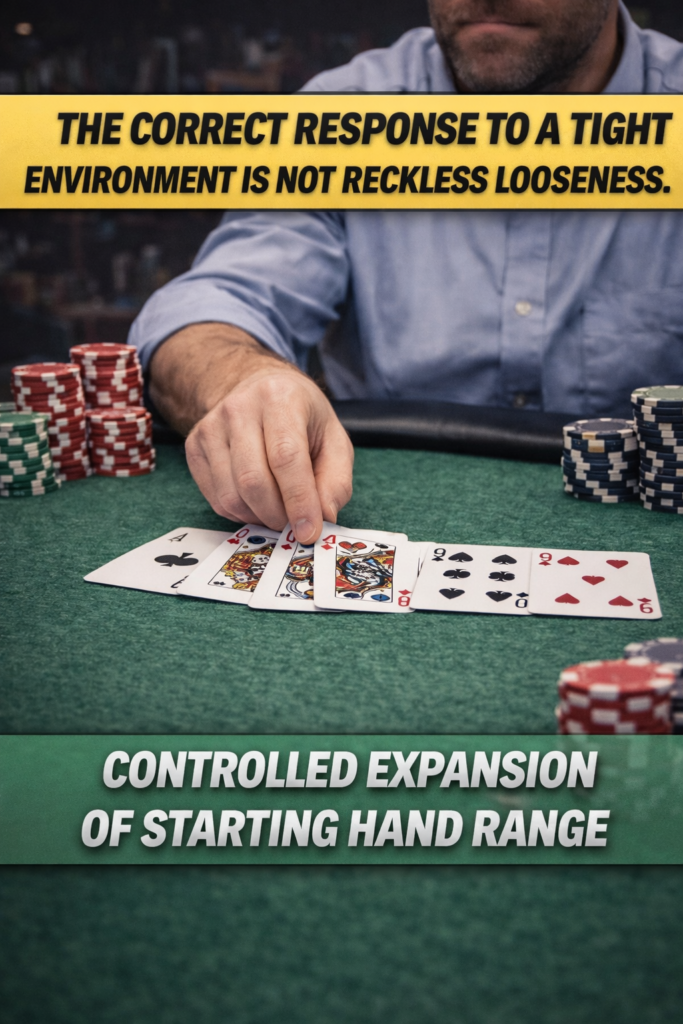
This combination of increased fold equity and positional advantage allows players to apply pressure in ways that are rarely possible in loose games.
In loose games, playing tight in poker becomes mathematically correct because multiple opponents remain involved and the probability of strong hands increases. In tight games, the opposite adjustment becomes necessary. As fewer players compete for the pot and fold equity increases, widening your range slightly becomes the mathematically correct course of action.
While widening your range is the mathematically correct adjustment in tight games, this does not mean abandoning the fundamental principles that govern poker decisions. Pot odds, hand probabilities, reverse implied odds, and hand equity still apply in every situation. Expanding your range simply reflects the fact that fewer opponents are competing for the pot. The mathematics of the game remain the same, only the environment has changed.
THE BALANCE BETWEEN DISCIPLINE AND OPPORTUNITY
The key lesson is that poker strategy must respond to the environment.
Loose games require tighter ranges because many opponents remain involved in the hand. Tight games allow those ranges to expand slightly because fewer players compete for the pot.
In both situations, the underlying principle remains the same.
A player should not simply decide to be tight or loose as a matter of style. Instead, they must evaluate the structure of the table and adjust accordingly.
Understanding when playing tight in poker is mathematically correct,and when it becomes unnecessarily restrictive, is one of the most important strategic adjustments a player can make at the table.
MEDIUM GAMES: WHERE OBSERVATION BECOMES CRITICAL
While extremely loose and extremely tight games make the strategic adjustment obvious, most live poker games fall somewhere in between these two extremes.
A typical table often contains a mix of player types. One or two players may be very tight and selective with their starting hands. Several others may be loose and willing to call raises with a wide variety of holdings. A few players may be unpredictable, occasionally shifting between cautious and aggressive behavior depending on the situation.
Because of this mixture, the mathematical environment of the game changes from hand to hand.
Some pots may contain several loose callers. Other pots may involve only one or two players who entered with relatively strong ranges. In these situations, a fixed strategy quickly becomes ineffective.
This is where observation becomes one of the most valuable skills at the table.
Rather than applying a rigid rule about playing tight in poker, disciplined players begin adjusting their ranges based on the opponents involved in each hand.
ADJUSTING TO THE PLAYERS IN THE POT
When tight players enter the pot, their ranges tend to be narrow and predictable. In these situations, widening your range slightly and applying controlled pressure can often be profitable. Tight players are more likely to fold marginal holdings, which increases the effectiveness of well-timed raises and continuation bets.
Loose callers create a very different environment.
Players who routinely call with wide ranges reduce fold equity and increase the likelihood of multiway pots. Against these opponents, tightening your range and focusing on strong value hands becomes the more profitable approach. Instead of relying on bluffs or thin aggression, disciplined players allow loose opponents to build the pot and then capitalize when they hold stronger hands.
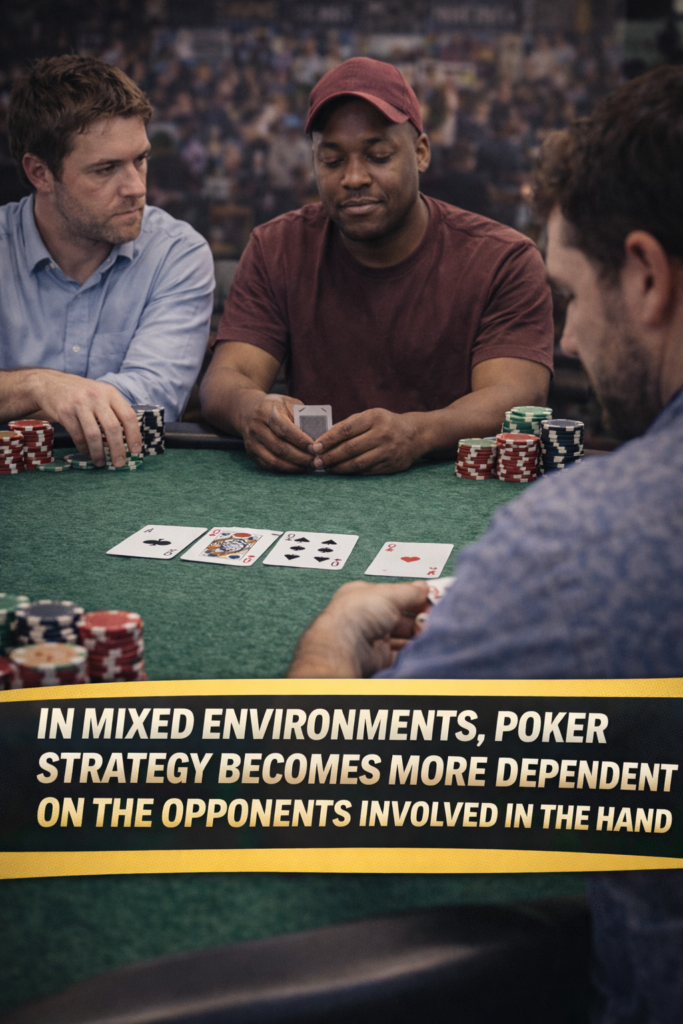
This constant adjustment is what separates experienced players from those who rely on simple rules.
In mixed environments, poker strategy becomes more dependent on the opponents involved in the hand. This is one of the reasons rigid rules rarely work well in poker. Instead, successful players rely on strategic tools, such as understanding player tendencies, hand ranges, and table dynamics, to guide their decisions. A player who can recognize who is entering the pot and how those opponents tend to play can make far more accurate strategic adjustments. Ultimately, the lesson is straightforward.
Loose games often require tighter ranges. Tight games allow those ranges to expand slightly. Medium games demand something more subtle: the ability to observe the table carefully and adjust to the players involved in each hand.
Poker is not about committing to one style of play. It is about recognizing how the conditions of the table influence the mathematics of the game and responding accordingly.
THE OBSERVATION MYTH: WHY TIGHT PLAY STILL GETS ACTION
Many poker players operate under a common assumption at the table. They believe their opponents are carefully watching how often they enter a pot, studying their betting patterns, and adjusting their play accordingly.
In theory, this would make sense. If a player is playing tight in poker, attentive opponents should eventually recognize the pattern and respond by folding more often.
But in most live poker games, that assumption simply does not match reality.
At the majority of tables, players are not systematically tracking how often someone enters the pot. Their attention is divided among many different distractions. Some players are watching sports on the television above the table. Others are talking with friends or following conversations happening around them. Many are looking at their phones between hands.
Even when players are paying attention, their focus is usually directed toward their own cards and their own decisions rather than the behavior of others.
As a result, very few players are actually counting how many hands someone has played during the past hour. Fewer still are constructing accurate hand ranges based on those observations.
This creates a gap between perception and reality.
WHY TIGHT PLAYERS STILL RECEIVE ACTION
A disciplined player may believe that playing tight in poker is sending a clear signal of strength. In many cases, however, that signal goes largely unnoticed.
Loose players continue calling because they are curious about the flop or hopeful that their hand will improve. Other players call simply because the pot appears large enough to justify staying involved.
Even when someone does notice that a player has been tight, the adjustment is often incomplete. A player might suspect strength but still convince themselves that the raiser could be stealing, or that their own hand is good enough to continue.
For this reason, tight play rarely eliminates action in live poker games.
If anything, the opposite often occurs. Players who wait patiently for strong hands frequently receive more action than expected because opponents remain focused on their own cards rather than carefully analyzing table dynamics.
The result is another important lesson about playing tight in poker.
The fear that tight play will scare everyone away is largely a psychological illusion. In real games, most players are not observing the table closely enough to respond with perfect adjustments.
They are simply playing their own hands and hoping for the best.
TIGHT DOES NOT MEAN PASSIVE
Another common misunderstanding about playing tight in poker is the belief that tight strategy means passive play. Many players assume that if they are entering fewer pots, they should also avoid aggressive action when they do play.
In reality, that approach often leads to one of the most unprofitable styles in poker: tight-passive play.
Tight-passive players wait patiently for strong hands, but when those hands finally arrive, they often play them cautiously. They call when they should raise, check when they should bet, and allow opponents to control the size of the pot.
Over time, this style consistently leaves value on the table.
Strong poker strategy is built on a very different structure: tight-aggressive play, often referred to as TAG. A tight-aggressive player enters the pot with a disciplined range of starting hands, but once involved in the hand, they apply pressure and play those hands assertively.
This means raising rather than calling when entering the pot, betting strong hands for value, and forcing opponents to make difficult decisions.
When a player is playing tight in poker, the strength of their starting range becomes a powerful advantage. Because their range is already selective, they can apply aggression with greater confidence. Opponents are often forced to respond to bets and raises without knowing exactly how strong the hand may be.
This combination of discipline and aggression creates one of the most profitable structures in live poker.
Tight play ensures that a player enters the pot with hands capable of competing effectively. Aggressive play ensures that those hands extract maximum value when they are ahead.
Understanding this distinction is critical.
Tight strategy does not mean sitting quietly and hoping a hand holds up. It means choosing strong starting hands and then playing them decisively when the opportunity arises.
aDJUST TO THE ENVIRONMENT
By this point, one principle should be clear: poker strategy is not defined by rigid styles such as always playing tight or always playing loose. The correct approach depends entirely on the environment sitting across the table.
Every poker game creates its own mathematical structure. The number of players entering pots, the types of hands they choose to play, and their willingness to fold or call all influence how profitable different strategies become.
This is why playing tight in poker cannot be treated as a universal rule.
In loose games where many players see the flop, tightening your range becomes mathematically correct because multiple opponents increase the probability that someone connects strongly with the board. Strong starting hands perform better in these multiway environments and are far more capable of surviving the chaos created by wide calling ranges.
In tight games, the opposite adjustment begins to appear. When players fold frequently and pots remain small, gradually widening your range becomes the more profitable response. Increased fold equity and fewer opponents allow additional hands to perform well in heads-up or short-handed situations.
Most live poker games fall somewhere between these two extremes.
Mixed tables require a more flexible approach. A disciplined player may widen their range when entering a pot against tight opponents while tightening again when several loose callers become involved. Each hand becomes a new decision based on the players participating and the structure of the pot.
The key is understanding that poker is not about committing to a single style of play. It is about recognizing the conditions of the table and adjusting accordingly.
Loose games encourage tighter ranges.
Tight games allow slightly wider ranges.
Mixed games demand careful observation and selective adjustment.
Players who understand these dynamics gain a significant advantage. Rather than forcing a predetermined style onto every table, they allow the environment itself to determine the correct strategy.
That ability to adapt, to recognize when playing tight in poker is necessary and when a wider range becomes profitable, is one of the defining traits of consistently successful players.
CONCLUSION
Many poker players worry that playing tight in poker will cause opponents to fold and eliminate opportunities to win meaningful pots. In theory, a disciplined player who enters very few hands should eventually develop a table image that discourages action.
In real poker games, however, this concern is often overstated.
Loose environments regularly produce multiway pots regardless of how tight a player appears to be. As the Beau Rivage example demonstrated, even when a player clearly signals strength, loose tables frequently generate action simply because several opponents are willing to call with wide ranges.
The real issue is not whether tight play eliminates action. The real issue is understanding when tight play is mathematically correct.
Loose games often require tighter starting hand ranges because several opponents remain involved in each pot. As the number of players increases, so does the probability that someone connects strongly with the board. Entering these situations with stronger hands improves the chances of competing successfully in multiway environments.
Tight games present the opposite problem. When players fold frequently and few opponents enter the pot, excessively tight play can cause profitable opportunities to pass by. In these situations, widening your range slightly becomes the more effective adjustment.
Most live poker games fall somewhere in between.
At these tables, the best players rely on observation and flexibility. They evaluate who is entering the pot, how those opponents tend to play, and how the structure of the hand affects the mathematics of the situation.
The goal is not simply to play tight.
The goal is to play correctly for the environment you are in.
Understanding when playing tight in poker is necessary, and when the conditions allow your range to expand, is one of the most valuable strategic skills a player can develop at the table.