
THE PARADOX OF PATIENCE
WHY WAITING IS THE HARDEST MOVE IN POKER
Patience has long been called a virtue, but in poker it’s a paradox. The very quality that keeps you disciplined and profitable can also make you appear passive, predictable, or even timid. That’s the essence of The Paradox of Patience — you win by waiting, yet waiting too long can cost you everything.
In everyday life, patience is about endurance; in poker, it’s about intention. Every fold, every silence, every measured breath is an act of calculation. True poker patience isn’t sitting idly until the deck rewards you — it’s staying mentally engaged while the cards refuse to cooperate. You’re observing betting patterns, stack sizes, and emotional cues while the impatient players lose focus.
Here lies the contradiction: patience feels like inaction, but it’s the most active form of control a player can exercise. It’s what keeps your emotions from steering your decisions. In moments when your mind screams to chase a draw or defend pride, poker discipline demands you fold and wait. That restraint is not weakness; it’s emotional strength measured in chips saved.
The best players understand that the game doesn’t reward those who act the most — it rewards those who act at the right time. The poker mindset built on patience allows you to detach from short-term frustration and focus on long-term equity. Every minute you wait is not lost time; it’s time spent sharpening awareness, gathering data, and reinforcing emotional control.
In this sense, The Paradox of Patience defines more than a playing style — it defines a philosophy. It reminds us that poker isn’t just a game of cards, but a test of temperament. The paradox is simple yet profound: patience looks passive, feels uncomfortable, and wins relentlessly.
the paradox introduced
“Rhetoric comes before everything else.”
— Robert Pirsig, Zen and the Art of Motorcycle Maintenance
Robert Pirsig’s words remind us that before we can act with precision, we must first think with clarity. Philosophy, he said, comes before mechanics — understanding before execution.
And in poker, the same truth applies:
Patience comes before everything else.
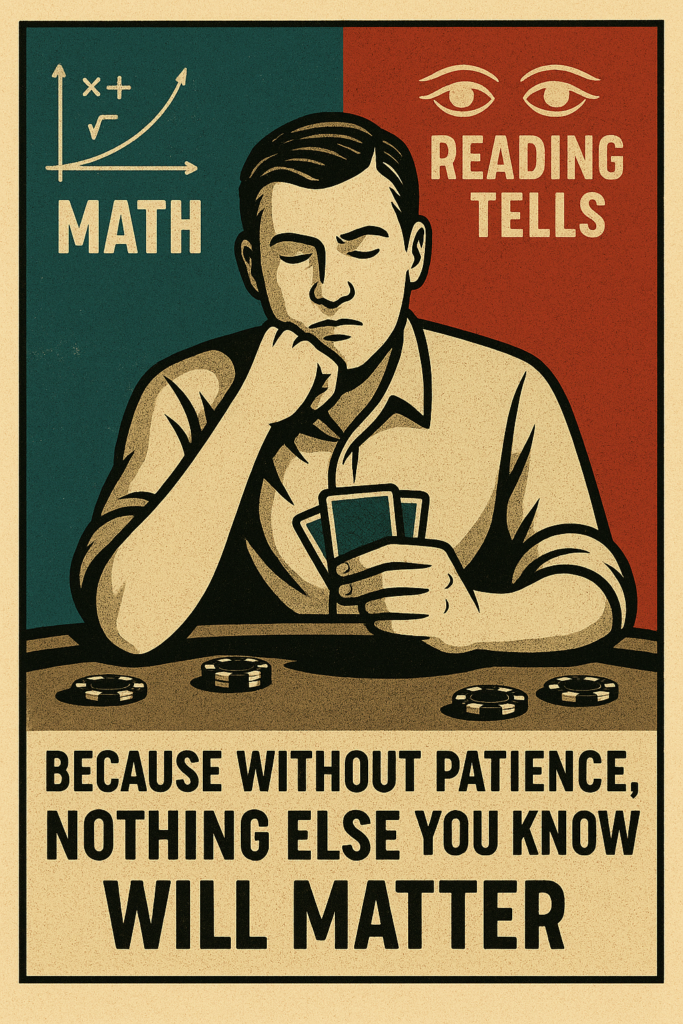
Because without patience, nothing else you know will matter — not math, not reading tells, not discipline. Each of these skills depends on the one ability most players struggle to sustain: the willingness to wait.
This is the quiet heart of The Paradox of Patience — that what looks like stillness is, in fact, the most active form of control in poker.
Patience isn’t folding out of fear; it’s folding out of understanding. It’s watching when others chase. It’s calculating when others complain.
Patience doesn’t mean passivity — it means power held in reserve.
It’s the unseen force that allows you to execute discipline, observe opponents, manage emotion, and apply mathematics without interference.
“Patience is not a skill in poker. It is the skill that makes all others possible.”
That single truth defines the entire mindset of The Paradox of Patience.
It’s not just a virtue — it’s the master key that unlocks every other element of the game.
THE PPSYCHOLOGY OF "WAITING"
Every poker player knows the feeling: you fold hand after hand, waiting for the right moment, until the itch to play something—anything—takes over. You convince yourself that suited connectors “deserve” a chance or that this time, your gut feeling will beat the odds. You’re not being reckless, you tell yourself—you’re just “due.”
But biologically speaking, that urge to act isn’t logic—it’s chemistry. It’s your brain chasing dopamine. That internal tug-of-war between what you know is correct and what you want to do in the moment is at the heart of The Paradox of Patience.
THE NEUROSCIENCE OF IMPATIENCE
DELAY DISCOUNTING: WHY WAITING HURTS
At its core, poker patience is a neurological battle between the prefrontal cortex and the limbic system.
The prefrontal cortex is the seat of reasoning and long-term thinking—the same part of the brain responsible for self-control, planning, and goal alignment. The limbic system, on the other hand, is where emotion, impulse, and reward anticipation live.
When you fold a hand, your prefrontal cortex is doing the work: weighing probabilities, conserving chips, staying disciplined. But every time the dealer shuffles, your limbic system perks up, craving that hit of reward.
Poker’s structure—a constant loop of uncertainty and potential gain—feeds directly into this dopamine reward cycle. Each dealt hand acts as an intermittent reinforcement trigger: you might win big this time. That “maybe” is what makes poker psychologically addictive. It’s also what makes emotional control in poker so incredibly difficult.
Psychologists call it delay discounting—the tendency to undervalue long-term rewards in favor of immediate gratification. In other words, your brain wants the short-term thrill of “being in the action,” even if the long-term math says you’ll lose money doing it.
A study published in the Journal of Behavioral Decision Making describes this as a cognitive tug-of-war between “wanting” and “waiting.” The same bias that drives someone to overspend or overeat drives poker players to chase hands they shouldn’t.
In poker, every fold is a small act of restraint; every poor call, a failure of self-regulation.
That’s why patience in poker isn’t passive—it’s active resistance against your own biology. The longer you maintain discipline, the more your prefrontal cortex strengthens its control over impulsive decisions. It’s not about playing fewer hands; it’s about building mental muscle.
THE MENTAL GYM OF POKER
Each session is a workout for your poker mindset. You’re not just testing hands—you’re training your brain. Every disciplined fold rewires neural pathways toward better self-control. Every emotional reaction—anger, boredom, revenge—undoes that work.
Like meditation, this mental discipline is cumulative. Over time, the most successful players develop a kind of “calm vigilance”—focused yet detached, aware yet unemotional. They can fold premium hands without frustration and make bold moves without adrenaline clouding judgment.
In essence, the true science of poker patience isn’t about slowing down—it’s about staying centered when the world around you speeds up.
Understanding the psychology of waiting helps explain why patience is so fragile. But knowing the science doesn’t mean mastering the skill. Because no matter how rational you are, no matter how trained your brain becomes, patience is always one bad beat away from collapse.
That brings us to the next question—one that every great player eventually confronts:
How do you sustain patience in a game designed to destroy it?
The answer lies in the next section: “The Hardest Skill You’ll Never Master.”
THE HARDEST SKILL YOU'LL NEVER MASTER
Patience in poker isn’t something you learn once and keep forever—it’s something you must fight to protect every single session. Every orbit, every hand, every beat of silence at the table tests it. A long card-dead stretch drains it. A bad beat fractures it. An impulsive call destroys it.
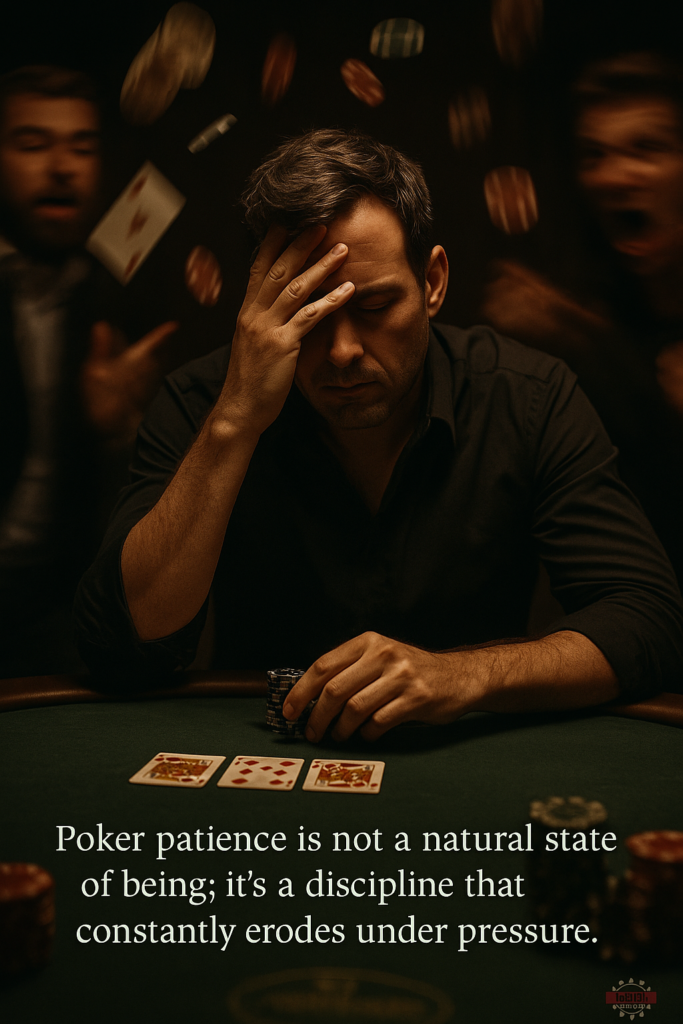
That’s because poker patience is not a natural state of being; it’s a discipline that constantly erodes under pressure. The very forces that make poker thrilling—uncertainty, risk, emotion—are the same forces that attack your self-control. You don’t achieve patience; you sustain it. And sustaining it demands vigilance.
THE DISCIPLINE OF PATIENCE
The best players know this truth intuitively. They treat patience like a fragile edge that must be defended hand by hand, not a virtue they’ve already mastered. Just as a top investor protects emotional discipline during volatile markets, or a leader resists reaction in crisis, the great poker player maintains calm while others crumble.
This is the essence of poker discipline—the refusal to surrender reason to emotion. You can’t automate it through charts or solvers; it’s a living skill, one that must be renewed through self-awareness and deliberate restraint.
That’s why patience is paradoxical. It feels passive, yet it requires constant action. It looks still, yet beneath the surface it’s a war between impulse and intention. This tension—between quiet discipline and constant internal conflict—is exactly what I mean by The Paradox of Patience. Every time you fold when you want to call, every time you breathe through a tilt trigger, you’re practicing the most advanced form of emotional control in poker: resistance.
And so, the Church of Reason reflection fits perfectly here:
“In poker, mastery isn’t perfection—it’s resistance to regression.”
You don’t master patience. You maintain it, hand by hand, decision by decision, against the endless gravity of human emotion.
THE MATHEMATICS OF PATIENCE
At its core, The Paradox of Patience isn’t just psychological—it’s mathematical. Poker doesn’t reward the most active player; it rewards the most selective one. Every moment you resist impulse, you’re not just showing discipline—you’re protecting expected value.
THE COST OF IMPATIENCE
Impatience has a quantifiable price.
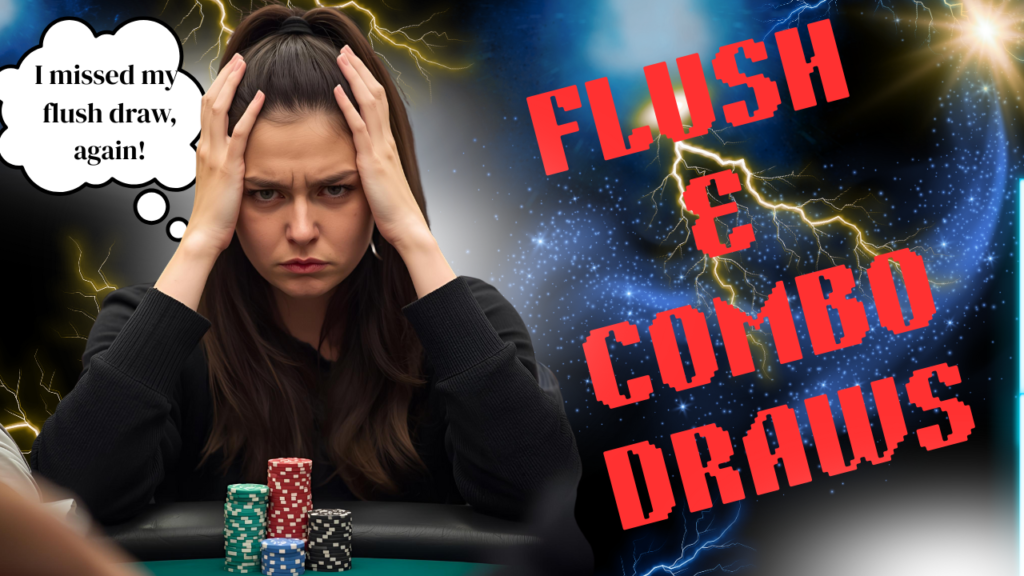
Consider a suited connector like 8♠7♠. It looks playable, even exciting, but by the river it will make a straight or flush only about 15% of the time. That means 85% of the time, your patience in folding it early saves you chips. We won’t even get into the times you will flop a flush draw (10% Probability) and then miss the flush (35% Probability to make a flush from flop to river), and the cost involved in that. And, if you do hit the flush, is it good? The math tells a story: most hands don’t deserve to be played.
Likewise, a speculative call against a preflop raise might seem harmless, but over time it bleeds equity. Every chip spent in a –EV situation reduces your long-term profitability. Folding might feel boring, but boredom doesn’t drain bankrolls—bad math does.
THE REWARDS OF RESTRAINT
Patience magnifies your win rate not through the pots you win, but through the losses you avoid.
If you fold ten marginal hands that would have cost you an average of one big blind each, that’s ten blinds of preserved equity. In live cash games, that margin can define a winning player over thousands of hours.
Even with premium hands, patience applies. A player holding Q♣Q♦ faces an overcard on the flop about 40% of the time. Recognizing this probability prevents overplaying strength and transforms discipline into measurable savings.
The math doesn’t lie—but it only rewards those who stay present enough to apply it. That’s where poker patience merges with logic: timing decisions by probability rather than emotion. It’s not about playing fewer hands—it’s about playing the right ones when the data aligns with your read.
This intersection of numbers and discipline is where patience becomes measurable power. The mathematics simply proves what philosophy has long implied: restraint compounds
Yet every edge has a shadow. The same discipline that protects you can begin to imprison you. When caution turns to hesitation, and patience becomes avoidance, the math stops working in your favor.
That’s where we meet the darker side of the equation—The Shadow Effect—where patience crosses the line from strength to stagnation.
THE SHAWDOW EFFECT
Every strength in poker carries its own shadow.
Discipline becomes rigidity. Focus becomes tunnel vision. And patience—when overextended—can quietly transform from strategic control into self-sabotage.
This is the hidden side of The Paradox of Patience: when the very skill that protects you from losses begins to prevent you from winning.
WHEN PATIENCE TURNS TO FEAR
THE COMFORT TRAP
FROM DISCIPLINE TO STAGNATION
There’s a fine line between waiting for the right spot and waiting for perfection. Many disciplined players cross it without realizing it. They start folding hands not because the math says so, but because fear does.
Psychologists call this loss aversion—the tendency to feel the pain of losing twice as strongly as the joy of winning. In poker terms, it means avoiding risk even when the numbers justify taking it. The result is what I call Patience Paralysis: folding too often, passing on +EV opportunities, and mistaking caution for discipline.
This mindset often disguises itself as professionalism. You’ll hear players say things like,
“I just didn’t have the right spot,”
or, “You can’t go broke folding.”
But over time, folding too much is going broke—just slowly.
Behavioral economists describe another bias at work here: status quo bias, the human tendency to prefer inaction over change, even when change offers a better outcome. At the table, it manifests as habitual folding, endless waiting, or over-studying hands without acting on the insights.
It’s the same pattern seen in investors who never enter a rising market because they’re “waiting for a pullback,” or executives who analyze a decision until the window of opportunity closes. In poker, we call it analysis paralysis.
The disciplined player convinces themselves that they’re being prudent, when in reality they’re avoiding discomfort. They’ve become addicted not to the thrill of risk, but to the illusion of safety.
This fear-based restraint has tangible costs. Every hand folded that carried even a slight positive expected value (EV) represents lost profit. Over hundreds of sessions, those small missed spots add up to thousands of dollars in unrealized equity.
Poker rewards selective aggression, not passive purity. The player who waits endlessly for aces while blind levels rise or stacks erode is quietly leaking value. Patience protects you from chaos, but it must never prevent you from engagement.
That’s the dark symmetry of The Paradox of Patience: the same discipline that makes you formidable can also make you inert.
ESCAPING THE SHDOW
The solution isn’t to abandon patience—it’s to balance it with calculated boldness. True poker discipline means knowing when inaction costs more than risk. It’s recognizing that folding forever isn’t the same as control—it’s surrender dressed in logic.
To escape the shadow, shift your mindset from avoidance to assessment. Ask yourself before each fold:
- Am I passing because the math says so, or because emotion does?
- Am I protecting my stack, or my ego?
- Is this fear, or is this discipline?
When the answer aligns with logic rather than comfort, patience becomes an ally again.
In poker, as in life, the danger isn’t in the storm—it’s in the harbor. You can’t sink while anchored, but you’ll never reach new ground either.
The purpose of patience was never to freeze you in safety—it was to free you from recklessness. Once you confuse the two, you’ve lost sight of balance.
And balance is the key to mastering The Paradox of Patience:
Too little, and you self-destruct.
Too much, and you never truly live.
THE EMOTIONAL MECHANICS OF IMPATIENCE
You’ve folded for an hour. Everyone else seems to be winning with garbage.
Your stack hasn’t moved, your hands have been unplayable, and you start to think, “I deserve a pot.”
That quiet voice—so reasonable, so justified—is the beginning of the end.
It’s not logic speaking. It’s chemistry.
THE DOPAMINE GAP
When you sit down to play, your brain anticipates excitement. Each shuffle, each deal, triggers a release of dopamine—the neurotransmitter of reward. But when nothing happens for a while, dopamine levels fall, creating what neuroscientists call a reward gap.
That gap feels uncomfortable—almost like withdrawal.
Your mind starts searching for a fix: a hand to play, a reason to act, a justification that sounds rational but is driven by emotion.
This is where The Paradox of Patience reveals its sharpest edge. The same discipline that protects you from ruin also creates the tension that demands relief. Your brain mistakes the absence of stimulation for failure.
THE SELF-TALK SPIRAL
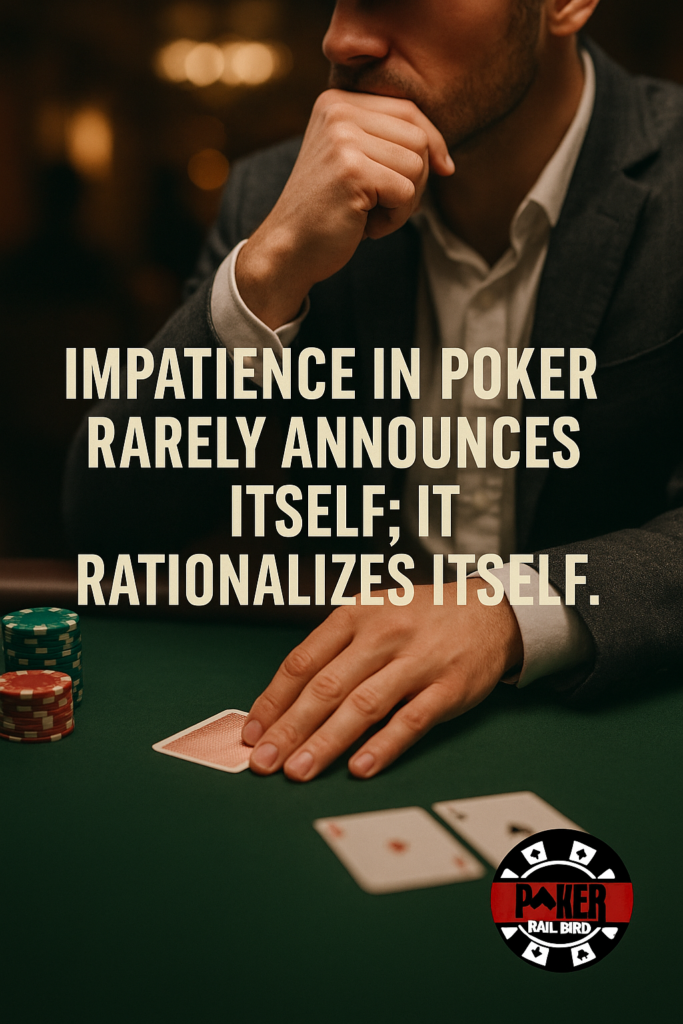
Impatience in poker rarely announces itself; it rationalizes itself.
You start saying things like:
- “I’ll just see one flop.”
- “They can’t have it every time.”
- “I’ve earned this one.”
Each line of inner dialogue is a small distortion of reality—a justification for breaking your own process. What feels like logic is actually a dopamine-driven plea for relief.
Once that justification cycle begins, emotion hijacks analysis. You’re no longer evaluating hand ranges—you’re searching for validation. And the moment you start playing to feel better rather than play better, your poker mindset collapses.
THE YERKES-DODSON LAW
More than a century ago, psychologists Robert Yerkes and John Dodson discovered that performance improves with arousal—up to a point. Too little stimulation leads to boredom; too much leads to anxiety and mistakes.
Patience lives at the center of that curve.
Too relaxed, and you drift into boredom.
Too tense, and your judgment fractures under pressure.
This is why emotional control in poker is not about suppressing feeling; it’s about regulating it. You must learn to live in that narrow band of productive tension—alert, engaged, but never reactive.
WHY IMPATIENCE FEELS LOGICAL
The cruel part is that impatience doesn’t feel reckless—it feels rational. It disguises itself as adjustment.
When you’ve been card-dead for an hour, acting feels like progress. Folding again feels like failure. The emotional brain interprets inaction as loss, even when logic says otherwise.
In that moment, you’re no longer battling opponents—you’re battling your own biology. And that’s what makes The Paradox of Patience so enduring: it’s not a single decision, but a perpetual confrontation between understanding and impulse.
WHEN OU’VE BEEN CARD-DEAD FOR AN HOUR, ACTING FEELS LIKE PROGRESS! FOLDING AGAIN FEELS LIKE FAILURE!
Recognizing impatience is only half the equation. The real work begins in learning how to restore balance—how to keep patience from calcifying into fear or fracturing into tilt.
That’s where philosophy becomes practice.
In the next section, we’ll explore how to cultivate balanced patience—a system of habits, mindsets, and reflections that keeps your discipline alive without letting it harden into paralysis.
THE CHURCH OF REASON INSIGHT
The Paradox of Patience isn’t only psychological or mathematical — it’s philosophical.
To understand it fully, we have to step inside the Church of Reason, where every action at the poker table becomes a reflection of how we think, value, and balance ourselves.
THE TWO PATHS OF THE MIND
THE FUSION POINT
Robert Pirsig described two fundamental ways of seeing the world:
the Romantic and the Classical.
The Romantic seeks drama, emotion, and immediacy — experience for its own sake. In poker terms, this is the player who thrives on momentum: the bold bluff, the high-variance play, the rush of being alive in every pot.
The Classical, by contrast, values process, form, and understanding. This player sees the game as a system of moving parts — probabilities, tendencies, and patterns to be studied and mastered.
Both paths have truth. Yet each alone is incomplete.
The Romantic without the Classical becomes chaos.
The Classical without the Romantic becomes stagnation.
Poker’s highest mastery lies in the union of the two:
the calm of the Classical guided by the fire of the Romantic.
The patience to wait meets the courage to act.
That fusion is The Paradox of Patience made real — discipline infused with intention.
Pirsig wrote in Zen and the Art of Motorcycle Maintenance,
“Peace of mind produces right values.”
At the table, that peace of mind isn’t apathy — it’s awareness. It’s knowing when restraint serves purpose and when purpose demands motion.
Patience without intention is passivity. Intention without patience is chaos.
Together, they form the rhythm of Quality — the balance between stillness and strike, between observation and execution.
In this sense, the Church of Reason isn’t a place — it’s a posture.
It’s how you approach each hand, each session, each decision: with the understanding that poker, like life, rewards equilibrium.
And it’s from this equilibrium that patience transforms from a static virtue into a dynamic skill.
That’s where we go next.
TRANSFORMING PATIENCE INTO A DYNAMIC SKILL
Patience in poker isn’t a static trait—it’s a living discipline that adapts, stretches, and sharpens with every session.
To transform patience from a passive virtue into an active advantage, you must learn to channel stillness into strategy.
That is the true resolution of The Paradox of Patience: learning to move without rushing, to wait without freezing.
SHIFT YOUR DEFINITION OF WINNING
USE DOWNTIME WISELY
Most players define victory by chips won. Professionals redefine it by equity preserved.
Every disciplined fold is a silent win. Every emotional decision you resist protects more than your stack — it protects your image, your composure, and your control of the table dynamic.
When you act out of frustration, you don’t just lose chips — you broadcast vulnerability. And once that happens, the table adjusts. The patient players start targeting your impatience. They let you dig your own hole, one impulsive call or forced bluff at a time.
That’s how tilt becomes a signal, and impatience becomes exploitable.
True poker discipline means understanding that survival and selective aggression create compounding returns.
Patience isn’t waiting for monster hands — it’s waiting for mathematical alignment — that point where logic, timing, and restraint converge into edge.
The average player treats downtime as dead time — a chance to scroll their phone, stack chips, or complain about bad luck. The professional treats it as a gift.
When you’re not in a hand, you’re in observation mode. Every fold opens a window into your opponents’ habits — their timing, posture, breathing, bet sizing, and reactions to pressure. That’s when the real game begins.
This is where poker patience transforms into a weapon. You’re not just waiting — you’re gathering live data while everyone else drifts into distraction. You’re studying who defends their blinds too often, who continuation-bets out of habit, who checks when nervous, and who bets to protect weak hands.
Each hand you watch builds a deeper player model — and those insights compound faster than chips ever could.
Professionals understand that patience isn’t idle. It’s active, analytical, and alive.
The game doesn’t pause when you fold — it just shifts from playing the cards to playing the people.
TRACK RESTRAINT
Most players obsess over the hands they play. Professionals study the ones they didn’t.
Every fold you make — especially the difficult ones — is data. It reveals how consistently you’re making decisions based on logic rather than emotion. And over time, those moments of restraint are what separate the winners from the wishful thinkers.
Start tracking them. After each session, make note of hands you passed on — particularly the ones where your old self would’ve called out of boredom, ego, or frustration. You’ll begin to see a pattern: the fewer of those emotional calls you make, the more stable your results become.
This is poker discipline quantified — the recognition that every fold is a defensive investment in your bankroll, your mental game, and your image.
In The Paradox of Patience, success often hides in the decisions nobody sees.
Tracking restraint reminds you that good poker isn’t about how much action you create — it’s about how much chaos you avoid.
RECOGNIZE YOUR TRIGGERS
TAKE STRATEGIC BREAKS
Tilt doesn’t begin with lost chips — it starts with unnoticed emotion.
The thoughts that sound logical in the moment — “I deserve a pot,” “They can’t have it again,” “It’s my turn to hit” — are your early warning signs.
These are your emotional triggers, and every player has them.
They emerge in silence after a long dry spell, a bad beat, or a bluff gone wrong. Left unchecked, they start writing your decisions for you.
The best players recognize these triggers the same way they read opponents — with observation, curiosity, and discipline. They step outside the emotion long enough to label it, not live inside it.
The moment you identify a thought as tilt-based, you neutralize its power.
You transform frustration into awareness, and awareness into control.
That’s the hidden layer of The Paradox of Patience — knowing when your restraint is genuine, and when it’s just frustration wearing a calm mask.
Professional players train this awareness like muscle memory. They know that once emotion seeps into logic, every opponent at the table can sense it — in your posture, your timing, even your chip handling. That’s how discipline erodes, and exploitation begins.
The cure isn’t denial — it’s recognition.
The most disciplined players know when not to play.
Patience isn’t an endless resource — it’s a battery that drains quietly with every decision, every hand, every orbit you spend resisting impulse.
Even the calmest player will feel their focus fade if they never recharge.
Decision fatigue is real. Once your mental endurance dips, your standards follow. You start calling instead of folding, reacting instead of reading. You stop thinking in probabilities and start thinking in emotions — “I’m due for a win.”
That’s when The Paradox of Patience starts to reverse itself — your strength becomes the very thing that betrays you.
The fix is simple but rarely practiced: step away before the damage starts.
Take five minutes to walk, stretch, breathe, or simply reset. The best players use those breaks to observe from a distance — to cool their dopamine response, rebalance emotion, and recalibrate their reads.
A short break at the right time can save more money than the best bluff you’ll ever run.
Because patience isn’t just about waiting — it’s about knowing when to pause and when to re-engage.
“A strong player rests before he tilts, not after.”
.
RECALIBRATE WITH INTENTION
BALANCE LOGIC AND INSTINCT
Before every session, set an intention beyond profit.
Say to yourself, “Today, I will measure success by decisions, not results.”
That single shift reframes waiting as purpose.
It transforms patience from reactive stillness into active focus.
When you sit down with a defined purpose — not just to win money, but to make quality decisions — you’re engaging patience as a skill, not a safety net. You’re reminding yourself that poker isn’t about chasing short-term validation; it’s about long-term execution.
This mindset is the final evolution of The Paradox of Patience.
You’re no longer avoiding action — you’re engineering it.
Every pause becomes preparation. Every fold becomes refinement, and every decision becomes part of a deliberate process designed to maintain edge.
That’s how patience becomes strategy — not passive endurance, but active control with intention behind it.
“The goal isn’t to play perfectly; it’s to play purposefully.”
This is where all paths converge — where the logic of the Classical mind meets the instinct of the Romantic heart.
Patience isn’t cold detachment; it’s controlled engagement. It’s what happens when intellect and intuition find common ground.
You calculate with reason — pot odds, ranges, frequencies — but you act with feel. The math sets the frame; your instinct paints within it.
This harmony defines high-level play — and it’s the living essence of The Paradox of Patience.
True poker mastery isn’t about suppressing emotion or glorifying logic — it’s about balancing both, knowing when to trust the numbers and when to trust your read.
In this balance, the patient player becomes complete — disciplined yet dynamic, rational yet responsive.
The Classical mind holds the line; the Romantic heart knows when to cross it.
“Logic calculates the move. Instinct feels the moment. Patience connects the two.”
CULTIVATING BALANCED PATIENCE
Patience, at its best, isn’t stillness—it’s stability.
It’s the ability to remain composed while the game moves through chaos, uncertainty, and noise. The goal isn’t to eliminate emotion or action; it’s to find equilibrium between the two. That’s what I call balanced patience—the middle path between fear and recklessness.
REDEFINE WHAT "WAITING" MEANS
USE THE "EMOTIONAL THERMOMETER"
Patience isn’t about folding until the deck finally smiles on you. It’s about staying engaged while you wait. The best players use downtime as data time—observing tendencies, calculating ranges, studying stack depths, tracking tells.
When you see patience as participation rather than passivity, the waiting transforms from boredom into advantage. That’s how The Paradox of Patience resolves—by realizing that stillness and strategy can coexist.
Your emotional state determines your risk calibration. When frustration rises, patience fractures. When complacency sets in, opportunity fades.
Develop an internal gauge—your emotional thermometer—and check it between hands. Ask yourself:
- Am I reacting or responding?
- Is my next decision about the hand—or about how I feel about the last one?
Emotional awareness is not softness; it’s strategy. Every great player monitors tilt as closely as pot odds.
PRACTICE THE TWO-BREATH RULE
ESTABLISH A "DECISION fRAMEWORK"
Impatience thrives in speed. Every rushed call, every impulsive bluff, begins with a split-second surrender to emotion. Slowing down even slightly reactivates the prefrontal cortex—the rational brain.
Before every major decision, take two deliberate breaths.
That short pause resets chemistry, restores clarity, and rebuilds poker discipline.
It’s not superstition—it’s neuroscience.
Balanced patience requires structure. Create a mental checklist before you act:
- Position: Am I early, middle, or late?
- Range: What story does my hand tell?
- Pot odds: Do the numbers justify involvement?
- Emotion: Am I calm, tilted, or chasing?
This framework turns emotion into logic. It gives the mind a process to follow when instincts start shouting for action.
Poker doesn’t reward moments—it rewards systems.
Each fold, each pause, each avoided mistake compounds like interest. Over time, that compounding becomes invisible equity.
But remember, patience is not infinite endurance—it’s active trust in the process. You’ll never conquer the game or your emotions completely. You only learn to meet them with steadiness.
In the Church of Reason sense, poker patience becomes a reflection of Quality itself—an ongoing practice of awareness, adaptation, and understanding.
FINAL THOUGHTS
The Paradox of Patience teaches that the real battle isn’t between hands—it’s between moments of clarity and moments of chaos. The mind will always crave action, and the heart will always chase justice. But the player who learns to wait with purpose—not from fear, not from hope, but from knowledge—has already won half the game.
Poker isn’t about playing more hands — it’s about making better decisions.
Practice patience. Respect the process.
And as always — use Tools, not Rules.
Patience doesn’t slow you down; it sharpens your edge.
It’s not the absence of motion—it’s the mastery of timing.
And in the end, that’s what separates the ones who chase pots from the ones who collect them.