
STARING AT BAD BOARD CARDS
A WAITING-FOR-ACTION POKER TELL OF WEAKNESS
This article is part of the Waiting for Action poker tells series, which examines behavioral patterns that appear when players are not actively involved in a decision. One such pattern—staring at board cards—is most often seen in live cash games and tends to reflect weakness rather than calculation. For a full overview of related tells and videos, see the Waiting for Action Poker Tells of Weakness hub.
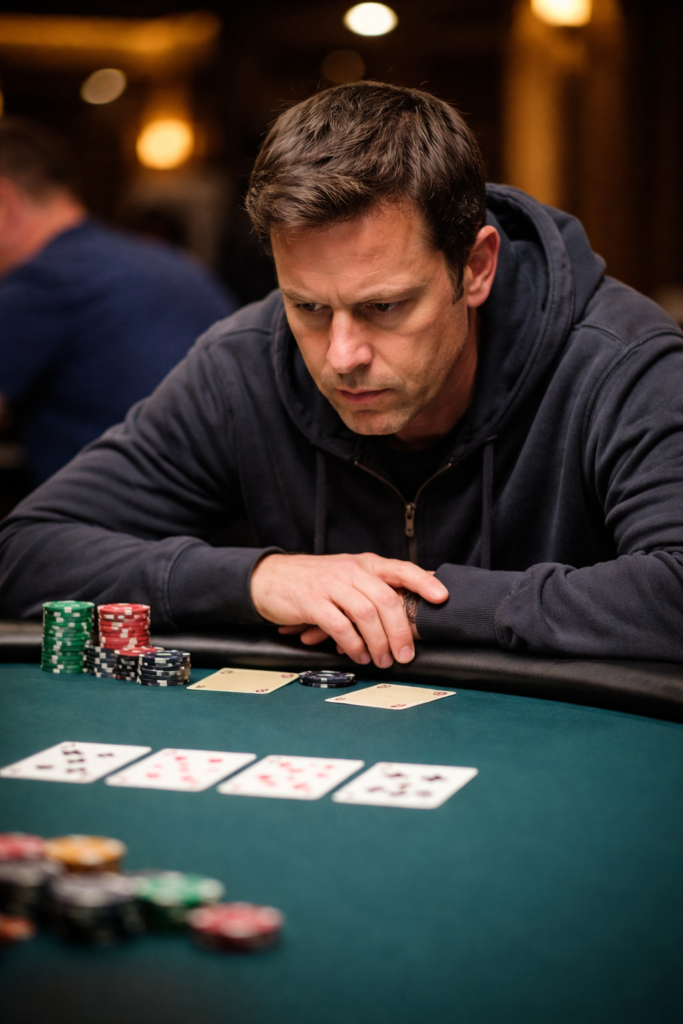
In live cash games, some players will continue staring at board cards when those cards do not improve their hand. This behavior most often shows up after new board cards are dealt, before the player has any immediate decision to make.
This is not a universal poker tell. It is a behavioral pattern that appears most clearly in less experienced or untrained players and loses reliability as player awareness increases.
WHAT THE TELL LOOKS LIKE
Players who exhibit this tell tend to show a consistent contrast in behavior:
- When the board does not help them, they continue staring at the community cards.
- When the board does help them, they look away quickly, often returning their gaze later.
The staring itself is rarely deliberate deception. In most cases, it reflects the absence of a reason to disengage. When a player has not connected with the board and has no immediate plan, their eyes often remain fixed on the cards in front of them.
WHY THIS BEHAVIOR OCCURS
For many players, staring at the board is the default state. New cards arrive, and unless something triggers a change in attention, focus remains there.
When a player connects with the board, attention often shifts instinctively. Looking away can be an unconscious attempt to avoid drawing attention to something valuable. When that reaction is missing, and the player continues staring, it often reflects disappointment or non-connection, not calculation.
A quizzical or puzzled expression—furrowed brow, narrowed eyes—sometimes accompanies this behavior. This is usually a variation of the same pattern and tends to indicate that the player is searching for value that is not present.
WHEN THE TELL HAS MEANING
This tell is most reliable when:
- The player is waiting for action
- The player has shown inconsistent gaze behavior across hands
- The player is inexperienced or unaware of their own physical habits
Against these players, the pattern can often be identified quickly and repeated with consistency.
WHEN THE TELL IS MEANINGLESS
This tell should be ignored when:
- The player stares at the board regardless of hand strength
- The player is experienced and deliberately controlling behavior
- The player is actively thinking through a decision
Many competent players intentionally maintain a fixed gaze to avoid giving away information. Against them, this tell provides little or no value.
Some players actively watch opponents when new cards arrive, expecting facial reactions to provide information. While this approach can work in theory, sustained or obvious observation can change table dynamics. Players who feel scrutinized may alter their behavior, become more guarded, or begin paying closer attention in return, which can reduce the reliability of observable reactions.
HOW TO USE THIS TELL
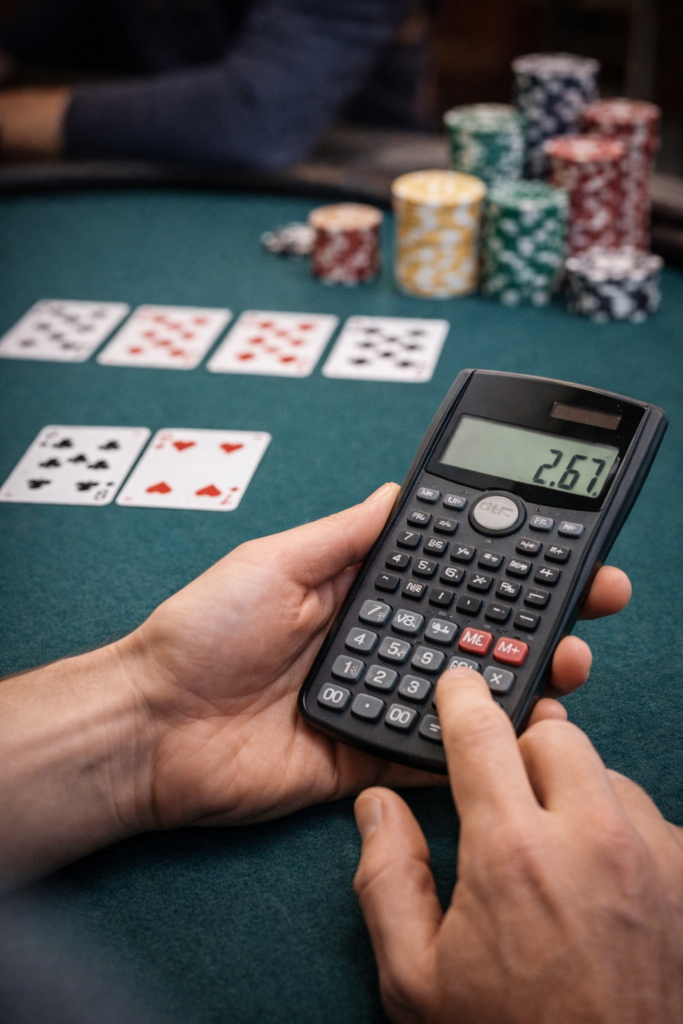
Staring at board cards is a confirming signal, not a decision-maker.
It can help:
- Confirm suspected weakness
- Increase confidence in marginal betting decisions
- Support sizing decisions already justified by math and structure
It should never:
- Override pot odds, ranges, or board texture
- Be used as standalone justification for aggression
- Be applied uniformly across opponents
If the math does not already support a play, this tell does not make it correct.
This tell exists because some players fail to control instinctive reactions while waiting for action. As awareness increases, the tell disappears.
Like all live poker tells, staring at bad board cards is a tool. It adds context. It does not create value on its own.
Used correctly, it sharpens decisions already grounded in math. Used incorrectly, it becomes a shortcut—and shortcuts are where most players lose money.