
POST FLOP BET SIZING IN LIVE CASH GAMES
HOW TO DENY ODDS, CONTROL EQUITY AND MAXIMIZE EV
Most post-flop bet sizing errors are not caused by aggression or passivity. They are caused by substituting habit for decision-making.
In live cash games, many players default to familiar bet sizes without considering what those sizes actually do. The amount wagered is treated as a routine action rather than a mathematical input. As a result, bets are made that allow opponents to continue correctly, realize equity cheaply, or reach future streets without pressure.
A common pattern is this: a player bets because they believe they are ahead, not because the bet forces incorrect decisions. Being ahead, by itself, has no mathematical value. Value is created only when opponents are put in positions where calling, folding, or raising produces inferior outcomes for them.
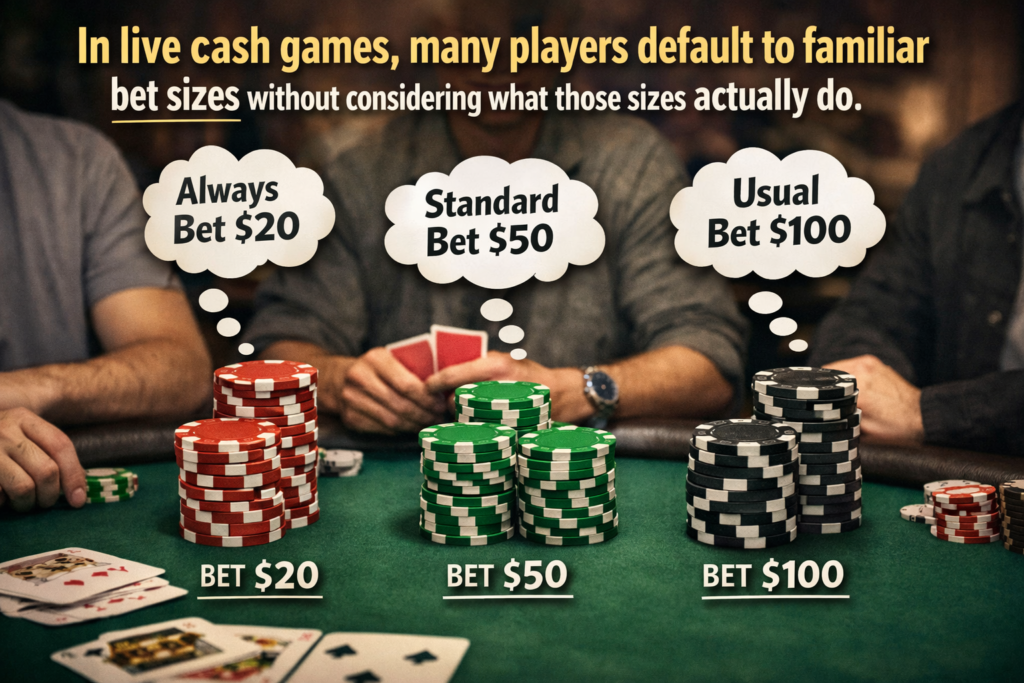
Another source of error is the overreliance on pot-based thinking. The size of the pot is often treated as the primary reference point, while factors such as board texture, number of players, range interaction, and future streets are ignored. When bet sizing becomes disconnected from these variables, it stops serving any strategic purpose beyond putting chips into the pot.
Finally, many players confuse consistency with correctness. Using the same size repeatedly may feel controlled or disciplined, but discipline without logic is just repetition. Post-flop bet sizing is not meant to look balanced or familiar. It is meant to shape decisions, deny correct odds, and limit equity realization.
Until bet sizing is treated as a mathematical tool rather than a procedural step, most post-flop bets will continue to leak value—even when the player making them believes they are doing everything “right.”
THE MATHEMATICAL FOUNDATION

Post-flop bet sizing begins and ends with math. Not preference. Not balance. And not what feels comfortable. A post-flop bet has value only to the extent that it changes the mathematical correctness of an opponent’s decision.
At its core, every post-flop call is a comparison between price and probability. The price is set by the bet size relative to the pot. The probability is the opponent’s chance of improving to a better hand by the next card or by the river. When a bet allows an opponent to call while receiving odds that correctly compensate for that probability, the bet has failed to do its job.
This is where many players make their first mistake. They evaluate their bet based on whether they are currently ahead, rather than on whether the bet forces an error. Being ahead does not deny equity. Only pricing does.
A bet that gives an opponent correct pot odds allows them to continue without penalty. Over time, those correct calls compound into lost expected value, even if the bettor wins many individual hands. This is why “winning the pot” and “making the correct bet” are not the same thing.

POT ODDS VS EQUITY REALIZATION
There is a second layer that is often ignored: equity realization. An opponent does not need perfect odds to profit from a call. If they can cheaply see future cards, apply pressure later, or extract value when they improve, they may realize more of their equity than the raw odds suggest. Proper post-flop bet sizing accounts for this by making continuation costly, not merely incorrect in theory.
This is also where the common default bet breaks down.
A frequently used mid-sized bet appears reasonable because it feels neither weak nor aggressive. In practice, it often accomplishes neither denial nor pressure. On many boards—especially those with multiple draws or multiple players—such a bet routinely allows correct or near-correct calls. The result is not balance. The result is permission.
The mathematical purpose of post-flop bet sizing is therefore precise:
- To deny correct pot odds
- To limit equity realization
- To force inferior decisions across future streets
If a bet does not do at least one of these things, its size is arbitrary. And arbitrary bet sizes, even when repeated consistently, do not produce long-term edge.
This foundation must be understood before any discussion of board texture, player tendencies, or hand strength. Without it, post-flop bet sizing becomes descriptive rather than functional—and that is where most value leakage begins.
WHAT BET SIZING IS ACTUALLY TRYING TO ACCOMPLISH
Post-flop bet sizing is not chosen to express strength or weakness. It is chosen to control outcomes. Specifically, a bet size determines which actions remain viable for an opponent and which actions become mathematically incorrect.
Every post-flop bet serves one or more functional objectives. If none apply, the size has no strategic justification.
THE FUNCTIONAL OBJECTIVES OF BET SIZING
DENIAL
VALUE EXTRACTION
PROTECTION
A properly sized bet removes the ability for opponents to continue profitably with drawing hands or marginal equity. This is not limited to obvious draws. It also applies to hands that rely on cheaply seeing future cards to realize their equity over multiple streets.
Value is created when worse hands can continue while better hands are unlikely to exist in sufficient frequency. The size chosen determines how much value can be captured without allowing opponents to realize equity correctly. This balance is mathematical, not stylistic.
Many strong post-flop hands are vulnerable. Bet sizing in these situations is not defensive in nature; it is preventive. The goal is to make future cards costly enough that opponents cannot profit from passive continuation.
FUTURE DECISION CONTROL
FOLD EQUITY CREATION
Bet sizing shapes the stack-to-pot relationship on later streets. A bet made now dictates whether future bets will apply pressure, induce folds, or force commitments. Poor sizing often creates situations where the bettor has unintentionally limited their own options.
Fold equity is not reserved for bluffs. It applies whenever a bet forces inferior hands to exit the pot. The larger the uncertainty an opponent faces, the more sizing matters. Bets that fail to apply pressure concede this advantage.
These objectives are not mutually exclusive. A single bet may deny odds, extract value, and shape future streets simultaneously. The key point is this: bet size is chosen for what it accomplishes, not how it looks.
When players focus on pot percentages or consistency instead of outcomes, bet sizing becomes procedural. When sizing is tied to these objectives, it becomes a tool. That distinction determines whether post-flop betting creates edge—or quietly gives it away.
THE VARIABLES THAT SHOULD INFLUENCE YOUR BET SIZE
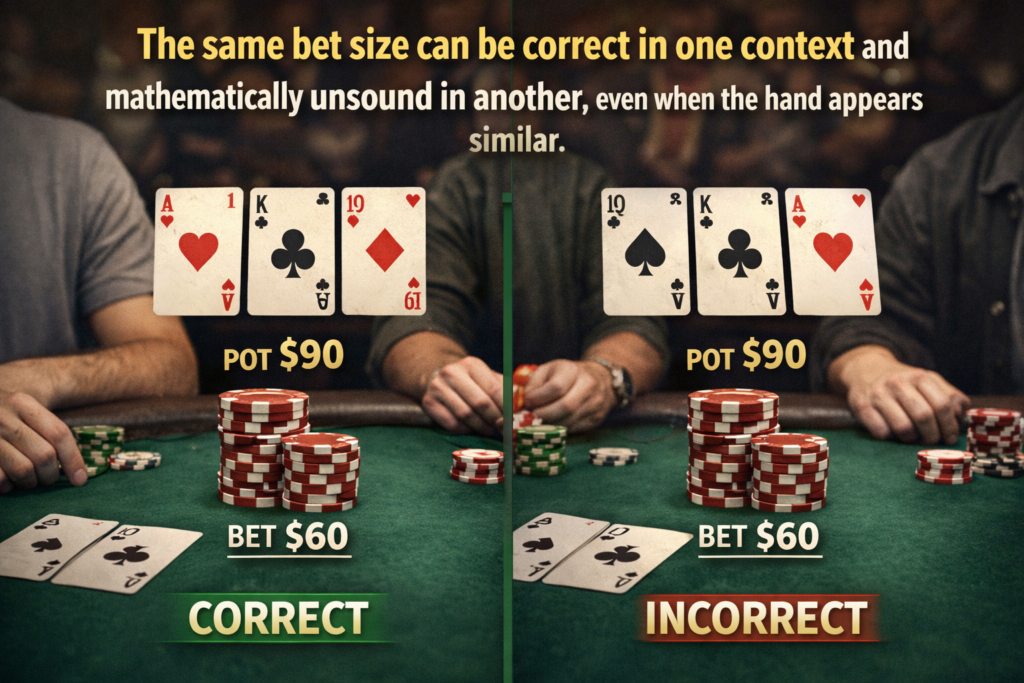
Post-flop bet sizing does not change because the pot changes. It changes because the situation changes. The same bet size can be correct in one context and mathematically unsound in another, even when the hand appears similar. What matters is not consistency, but relevance.
Each variable below alters the mathematical environment in which a bet operates. The purpose here is not to prescribe actions, but to explain what changes as each variable changes, and why static sizing fails as a result.
board texture
Board texture directly affects how much equity opponents can realize. Dry boards limit future improvement and reduce the need for denial. Coordinated boards introduce multiple paths for opponents to improve, increasing the cost of allowing continuation.
As texture becomes more dynamic, the price of seeing future cards must increase. Bets that fail to account for this allow opponents to profit not because they are ahead, but because they are allowed to continue cheaply across multiple streets.
The important distinction is not “wet” versus “dry,” but how many reasonable improvement paths exist and how quickly those paths resolve.

NUMBER OF PLAYERS IN THE HAND
POSITION
Each additional player compounds the problem of equity realization. In multiway pots, opponents collectively hold more combinations that can improve, apply pressure later, or benefit from free or underpriced cards.
A bet size that functions adequately heads-up often fails immediately once multiple players are involved. The issue is not aggression, but arithmetic. More players mean more combined equity and more future decision pressure.
Ignoring this variable is one of the fastest ways players give away post-flop value.
Position determines who controls future pricing. Acting first limits the bettor’s ability to respond to pressure on later streets, while acting last preserves optionality.
Bet sizing must account for whether future decisions will be made with or without informational advantage. Smaller bets out of position often invite continuation without control, while similar bets in position can restrict opponents’ options later.
The same size produces different outcomes depending on who acts next.
RANGE INTERACTION
HAND VULNERABILITY
Post-flop bet sizing is governed more by range interaction than by individual hand strength. What matters is how often each player’s range connects with the board, not what a single hand happens to be.
When an opponent’s range is dense with strong or improving hands, smaller bets fail to deny equity. When ranges are capped or polarized, larger bets may apply pressure even without absolute strength.
Sizing that ignores range interaction treats all boards as equivalent. They are not.
Some strong hands are stable. Others are exposed to multiple turn and river outcomes that degrade their value. Bet sizing must reflect this difference.
Vulnerable hands require protection not because they are weak, but because their equity erodes as more cards are revealed. Allowing opponents to realize equity cheaply against these hands is a mathematical error, not a stylistic choice.
This variable explains why “being ahead” is an insufficient sizing criterion.
PLAYER TENDENCIES
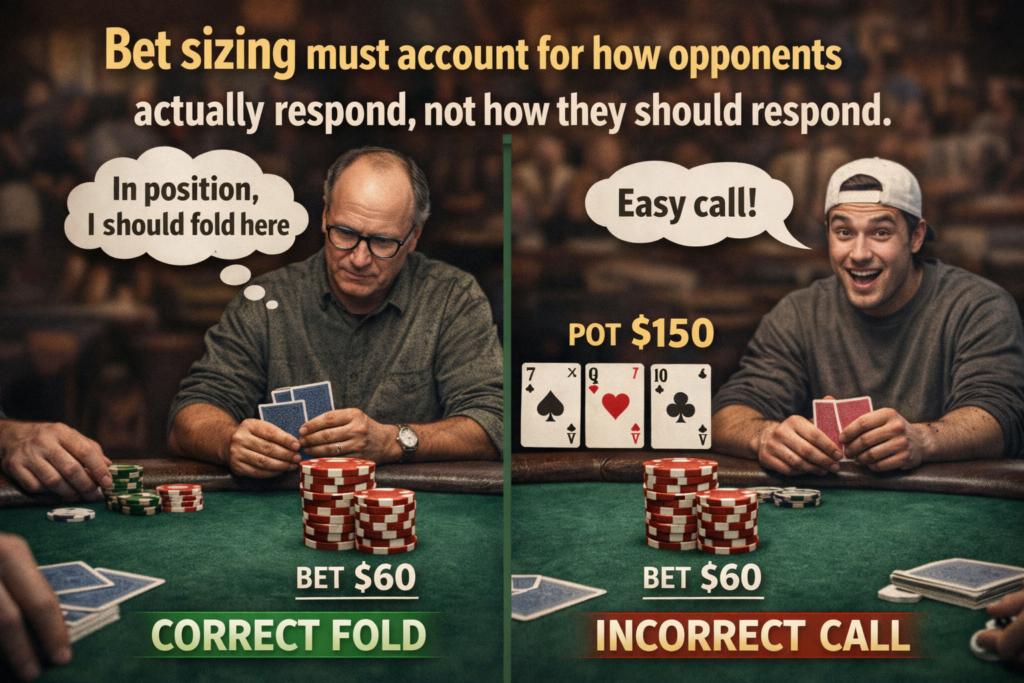
Mathematical correctness exists independently of player behavior, but expected value does not. Some opponents will continue regardless of price. Others will fold even when receiving correct odds.
Bet sizing must account for how opponents actually respond, not how they should respond. When players systematically ignore odds, denial loses effectiveness and value extraction becomes dominant. When players overfold, pressure becomes profitable even without maximum denial.
This is not opinion. It is exploitation grounded in observation.
FUTURE STREET IMPLICATIONS
Every post-flop bet sets constraints on future decisions. A size chosen now determines whether later bets can apply pressure, force folds, or commit stacks.
Many sizing errors occur because players consider only the current street. When future streets are ignored, bets unintentionally trap the bettor rather than the opponent.
Proper sizing anticipates how the hand can evolve, not just how it looks at the moment.
FUTURE STREETS: BET SIZING AS PLANNING, NOT REACTION
Post-flop bet sizing cannot be evaluated in isolation. A bet made on the current street defines the decision space on the streets that follow. When sizing is chosen without regard for future consequences, the bettor often loses control of the hand regardless of immediate results.
Every post-flop bet reshapes the relationship between the remaining stacks and the pot. This relationship determines whether future bets can apply pressure, extract value, or deny continuation. When that relationship is poorly constructed, later decisions become constrained or forced, not because the opponent played well, but because the sizing did the damage earlier.
A common failure occurs when a bet allows opponents to continue cheaply, then creates a turn or river situation where any further pressure becomes ineffective or transparent. In these cases, the initial bet did not merely fail to deny odds; it postponed the problem while making it harder to solve later.
LOSS OF FLEXIBILITY ON LATER STREETS
Future streets also introduce informational asymmetry. As more cards are revealed, ranges narrow, and uncertainty decreases. Bet sizing that ignores this process often allows opponents to realize equity early, then make more accurate decisions later when the cost of being wrong has already been reduced.
Another overlooked factor is commitment. Certain bet sizes implicitly commit the bettor to future action, even when the hand does not improve. This is not always intentional. Many players create these commitments accidentally by failing to consider how much pressure they can credibly apply later. Once committed, the bettor loses flexibility, while the opponent gains leverage.
Effective post-flop bet sizing anticipates these outcomes. It considers not only whether an opponent’s current decision is incorrect, but whether future decisions will remain constrained. When sizing is planned with future streets in mind, pressure compounds. When it is not, pressure dissipates.
The key distinction is this: reacting to the board describes what has already happened. Planning through bet sizing determines what can happen next. Long-term edge is built by controlling that progression, not by improvising once options have narrowed.

BETTING FOR PROTECTION VS BETTING FOR VALUE
Post-flop bet sizing often breaks down because players treat protection and value as opposing ideas. They are not. Both are expressions of the same goal: maximizing expected value by controlling equity.
Value betting is commonly understood as extracting chips from worse hands. What is often missed is that value exists only when those worse hands are forced to continue under unfavorable conditions. A bet that allows correct continuation does not extract value; it merely invites participation.
Protection addresses a different failure mode. Some hands are strong now but degrade as additional cards are revealed. The risk is not that the hand is weak, but that opponents can profit by seeing future cards cheaply. In these situations, the role of bet sizing is to make that continuation mathematically unattractive.
The error many players make is framing protection as defensive. In reality, protection is offensive. It seeks to deny opponents the ability to realize equity while the bettor’s hand is still favored. This is not fear-based betting. It is value preservation.
SEPERATING OBJECTIVES BY HAND CATEGORY
Problems arise when players attempt to separate these objectives by hand category. Strong hands are bet for value. Medium-strength hands are bet for protection. Weak hands are checked. This framework fails because it ignores board texture, range interaction, and future streets. The same hand can require different sizing objectives depending on how exposed it is to future cards and how opponents’ ranges interact with the board.
Another common mistake is assuming that larger bets are only justified by the strongest possible holdings. This assumption causes players to underprice continuation against hands that have significant equity but are not yet made. When opponents are allowed to continue correctly, the bettor absorbs the cost of that equity over time.
The correct distinction is not between value and protection, but between stable equity and fragile equity. Stable equity requires less denial. Fragile equity requires more. Bet sizing exists to reflect that difference, not to signal hand strength.
When protection and value are understood as complementary rather than competing goals, bet sizing decisions become clearer. The question is no longer whether a bet is “for value” or “for protection,” but whether the size chosen prevents opponents from making profitable decisions while allowing the bettor’s equity to be realized fully.
THE NUTS ARE NOT AN EXCEPTION TO MATH
Holding the strongest possible hand does not suspend mathematical principles. It exposes them.
A common belief in live poker is that when a player holds the nuts, bet sizing should shift away from denial and toward keeping opponents in the hand. While the goal of extracting value is correct, the logic used to justify smaller bets is often flawed. Wanting action does not override the mathematics that govern how value is created.
A bet that allows opponents to continue correctly does not become profitable simply because the bettor cannot be outdrawn. Value is not measured by the number of callers, but by the expected return generated from those calls.
WHY SMALL BETS WITH THE NUTS LOSE VALUE
Board texture plays a critical role here. On boards where future cards significantly change relative hand strength, underpricing continuation allows opponents to see clarifying cards cheaply, narrow their ranges, and exit second-best situations earlier than they should. In these situations, betting too small does not disguise strength; it often signals it. Experienced opponents recognize when a bet size is inconsistent with the board and respond accordingly.
Another overlooked factor is credibility. Bet sizing that deviates sharply from what the board and ranges suggest can raise suspicion. When a size appears designed solely to invite calls, it may prompt folds rather than induce them. In these cases, the attempt to trap produces the opposite result.
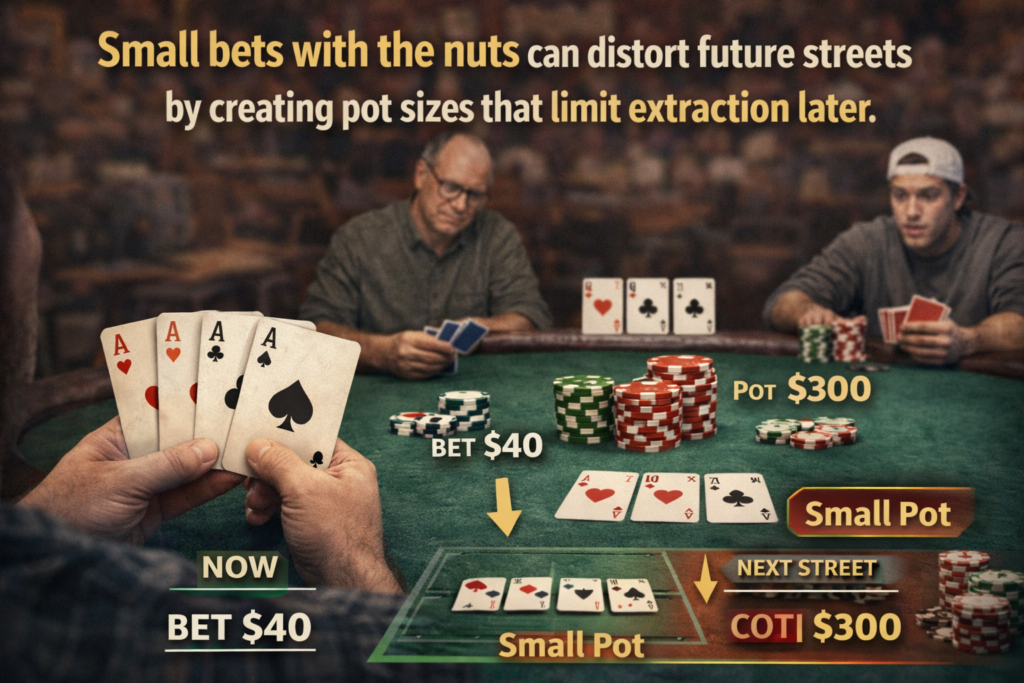
There is also a structural issue. Small bets with the nuts can distort future streets by creating pot sizes that limit extraction later. If earlier streets fail to build a pot appropriately, later bets may appear forced or excessive, reducing the likelihood that opponents will continue with worse hands.
The correct approach is not to abandon denial, but to recognize that denial and value extraction are not mutually exclusive. Even when holding the nuts, bet sizing must still account for board dynamics, range interaction, and future street implications. The math does not change. Only the distribution of outcomes does.
When players treat the nuts as a special case that justifies ignoring pricing logic, they often leave money on the table without realizing it. The strongest hands still require disciplined sizing, not because they are vulnerable, but because value is maximized through structure, not temptation.
COMMON LOW-STAKES BET SIZING ERRORS
The mistakes most often seen in live cash games are not advanced errors. They are basic failures to apply the concepts already discussed. These errors persist because they feel reasonable in the moment, even though they consistently allow opponents to play correctly.
One of the most common errors is default sizing. Players settle on a familiar bet size and use it repeatedly, regardless of board texture, number of players, or future street implications. This approach ignores the fact that different situations create different equity and pricing problems. Consistency in sizing does not compensate for irrelevance.
Another frequent mistake is underpricing continuation in multiway pots. Bets that may function acceptably heads-up often fail immediately when multiple players are involved. Combined equity increases, future pressure increases, and cheap continuation becomes more profitable for opponents. When this reality is ignored, value leaks quickly.
Players also routinely bet without a clear objective. Bets are made because it is “their turn” to act, not because the size denies odds, extracts value, or shapes future decisions. When a bet cannot be tied to a specific purpose, its size is almost always arbitrary.
A related error is ignoring hand vulnerability. Strong but exposed hands are treated the same as stable hands, resulting in bet sizes that allow opponents to realize equity cheaply. This mistake often goes unnoticed because the bettor may still win the pot in the short term, masking the long-term cost.
Another common failure is misreading player tendencies. Some players continue regardless of price. Others fold far too often. Bet sizes that ignore these patterns either fail to extract value or fail to apply pressure. Mathematical correctness must be filtered through observed behavior to produce expected value.
WHY THESE ERRORS PERSIST
Finally, many players react instead of plan. They size bets street by street without considering how those sizes affect future options. This leads to situations where later bets appear disconnected, forced, or ineffective—not because the opponent played well, but because earlier sizing removed flexibility.
None of these errors stem from a lack of aggression or courage. They stem from treating bet sizing as a procedural step instead of a mathematical tool. When sizing is chosen deliberately and tied to denial, equity control, and future decision-making, these mistakes largely disappear.
POKER TOOLS - NOT RULES
Post-flop bet sizing cannot be reduced to a formula. There is no correct percentage, no default size, and no universal instruction that applies across boards, players, and situations. Attempts to treat bet sizing as a rule inevitably strip it of its purpose.
Throughout this article, the focus has been on consequences, not commands. Bet sizes were evaluated by what they deny, what they allow, and how they shape future decisions. This is deliberate. When players ask for exact numbers, they are often trying to avoid thinking through the problem the hand presents.

The mathematics behind post-flop bet sizing are stable. Pot odds, equity realization, and expected value do not change. What changes is how those principles apply as variables shift. Board texture, number of players, position, range interaction, and player tendencies all alter the decision environment. A size that functions in one spot can fail completely in another.
This is why rigid advice breaks down in live cash games. Real opponents do not respond uniformly. They misprice draws, overvalue hands, fold too much, or call too often. Exploitative bet sizing does not ignore math; it applies math to the way opponents actually behave.
Treating bet sizing as a tool means understanding what a bet accomplishes before chips are put into the pot. It means recognizing when a size denies correct continuation, when it preserves equity, and when it shapes future streets in your favor. When none of those outcomes exist, betting becomes a habit rather than a decision.
Post-flop bet sizing is not about looking balanced or consistent. It is about creating situations where opponents are forced into inferior choices. When that process guides sizing decisions, bet sizing stops being a source of confusion and becomes a durable edge.