
LOOSE POKER GAMES: HOW THE MATH CHANGES
Loose poker games frustrate strong players more than almost any other environment in live cash play. When four or five players routinely see every flop, raises are called in multiple spots, and pots swell before the turn, it can feel as though discipline is being punished rather than rewarded. Hands that “should” hold up are cracked more often, and sessions begin to feel volatile and unpredictable.
The natural response for many players is to loosen up. If the table is playing wide ranges, the instinct is to widen your own range and try to outplay the chaos. That reaction feels logical on the surface. In reality, it is often precisely backwards.
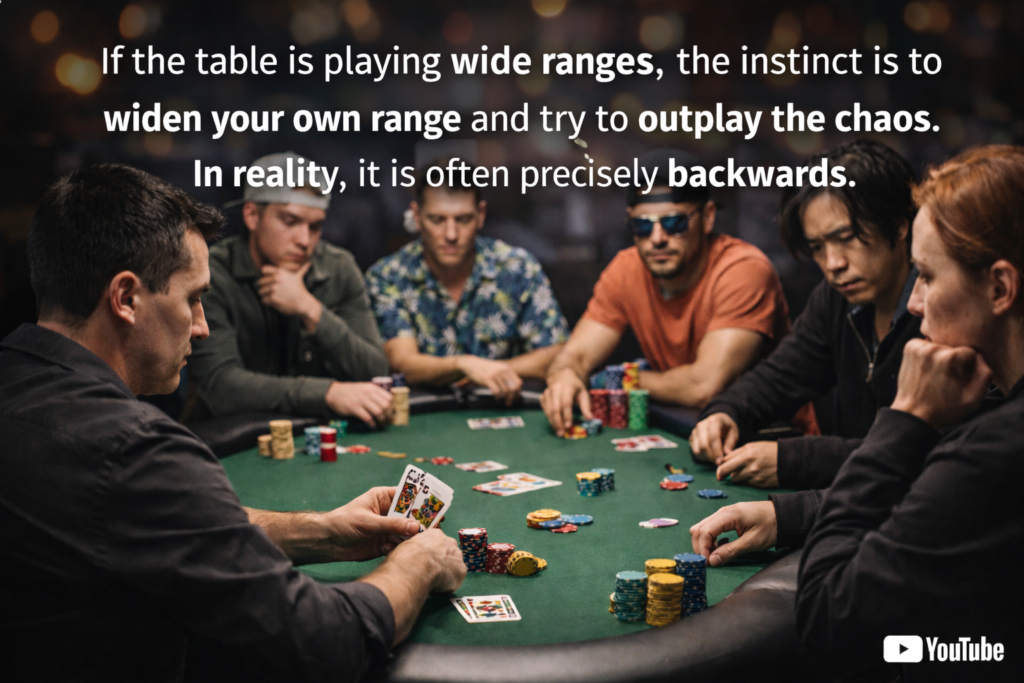
In loose poker games, the math changes.
As more players enter the pot, equity is distributed across additional ranges, fold equity declines, and reverse implied odds quietly increase. What performs well in heads-up or three-way pots does not behave the same way in multiway situations. The structure of the game shifts, and with it, the underlying probabilities.
This article is not about dictating what you must play. It is about understanding what changes when player density increases. Once you understand how distribution shifts when multiple ranges remain alive through the flop and beyond, logical adjustments follow naturally. Without that understanding, loose poker games can feel random and unfair. With it, they become predictable in a different way — not because the outcomes are controlled, but because the structure is understood.
LOOSE PLAYERS VS. LOOSE PAKER GAMES
NOT THE SAME ENVIRONMENT
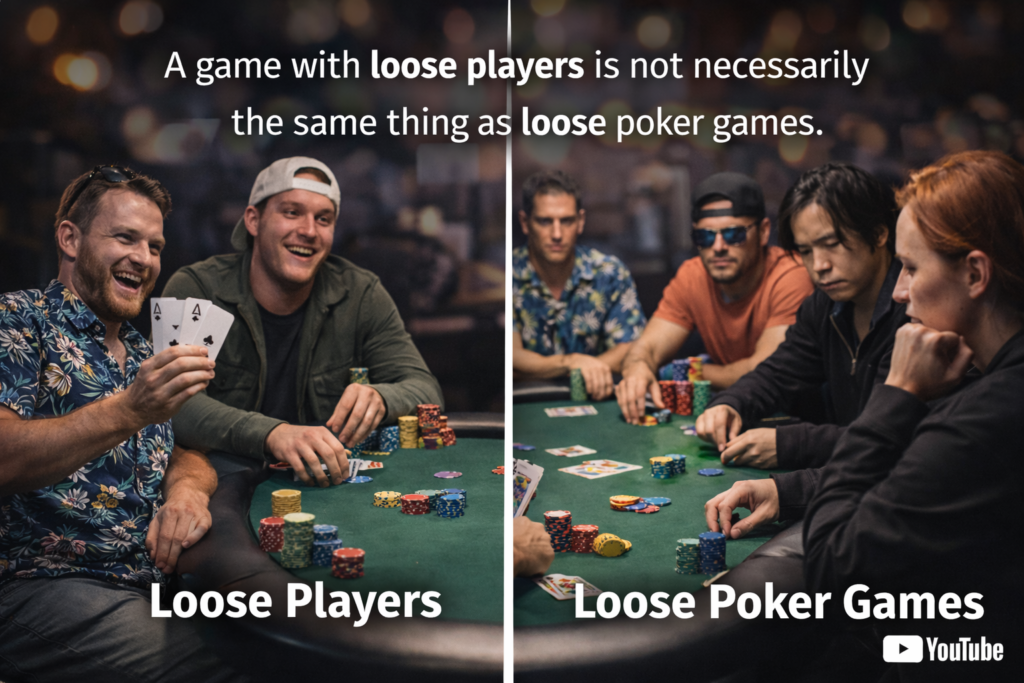
Before examining how the math shifts, we must clarify what we mean by loose poker games.
A game with loose players is not necessarily the same thing as loose poker games.
When one, two, or even three players at a table are overly loose, that dynamic is often profitable. Those players can be isolated. Their tendencies can be studied and exploited. Fold equity still exists against the rest of the table, and pots frequently narrow to one or two opponents. In that environment, looseness creates opportunity within a largely stable structure.
Loose poker games, however, represent something materially different.
WHAT DEFINES LOOSE POKER GAMES?
For the purposes of this discussion, loose poker games are those in which four or more players routinely see every flop. These players may enter pots with any two cards. They call raises irrespective of size. They show little concern for position—either yours or theirs—and will often play under the gun in the same manner they would on the button.
Bet sizing frequently falls outside normal structural parameters. Wagers may bear little relationship to pot size or board texture. Decisions are often made based only on the player’s own two cards and the visible board, with minimal regard for opponent ranges.
In loose poker games, player type rarely alters behavior. Whether a tight player or a loose player is betting into them makes little difference. They continue at similar frequencies. Stack dynamics, image, and prior action are often secondary considerations.
This environment is not defined by one or two loose opponents. It is defined by density and indifference to structural constraints.
Once four or more ranges are consistently entering pots without regard for position, sizing logic, or opponent tendencies, the mathematical landscape shifts. Isolation becomes unreliable. Preflop aggression fails to meaningfully thin the field. Post-flop decisions are made against multiple, often unstructured ranges.
Loose players increase your potential edge.
Loose poker games change the math.
Understanding that distinction is critical. Strategic adjustments that work effectively against isolated loose players may perform poorly in loose poker games. What appears similar on the surface is, in reality, a fundamentally different probability environment.
With that definition in place, we can now examine the first structural shift that occurs in loose poker games: equity dilution.
EQUITY DILUTION IN LOOSE POKER GAMES
The first structural shift that occurs in loose poker games is equity dilution.
When multiple players routinely enter the pot, your share of total probability decreases. This is not psychological. It is mathematical. Equity must be distributed across every live hand. As additional ranges remain active, no single hand retains the same dominance it would in a heads-up pot.
In loose poker games, this dilution is not occasional. It is structural.
HOW PLAYER DENSITY CHANGES HAND STRENGTH
WHY MARGINAL HANDS LOSE VALUE QUICKLY
Consider a simple example.
Ace King off-suit against one random hand holds approximately 65% equity before the flop. In a heads-up pot, that makes it a clear statistical favorite. The majority of the time, it will win.
Now place that same AK offsuit into a four-way pot against three random hands. Its equity drops to roughly 39%.
Nothing about your cards changed. What changed was player density.
When four players are in the pot, you are no longer playing poker against one opponent. You are playing against the deck.
Every additional range increases the probability that someone connects with the board in a meaningful way. Even if no single opponent has a strong or structured range, the collective likelihood that someone pairs, draws, or improves rises sharply. Equity that once belonged primarily to you is now distributed across multiple hands.
In loose poker games, this effect is amplified because the ranges involved are wide and unfiltered. When players enter pots with nearly any two cards, the distribution of possible board interactions expands dramatically. Low-connected boards, paired boards, and two-tone textures become structurally more dangerous because at least one opponent is statistically more likely to have interacted with them.
Equity dilution also affects post-flop stability.
In a heads-up pot, continuation betting can leverage both range advantage and fold equity. In loose poker games, fold equity shrinks because multiple players remain in the hand. Someone frequently continues. Someone often connects with a piece of the board. As a result, marginal holdings that perform adequately head-up begin to lose value quickly in multiway situations.
This is not an argument for fear-based tightening. It is an argument for structural awareness. When player density increases in loose poker games, variance expands and edges compress. Strong hands remain strong, but they do not retain the same dominance they enjoy against a single opponent.
Understanding equity dilution is foundational. Once you recognize that you are no longer heads-up—mathematically or structurally—the necessary adjustments become logical rather than emotional.
To see how dramatically equity declines as more players enter the pot, review the Preflop Hand Equity by Number of Players Chart. It visually demonstrates how even strong hands lose percentage dominance in multiway situations.
FOLD EQUITY COLLAPSES IN LOOSE POKER GAMES
WHEN PRESSURE STOPS WORKING
The second structural shift that occurs in loose poker games is the collapse of fold equity.
Fold equity represents the portion of expected value that comes from the possibility that opponents will fold. In structured environments with disciplined ranges, it is one of the most powerful levers available to a skilled player. Aggression narrows ranges. Proper bet sizing forces decisions. Pressure creates discomfort that results in folds.
In loose poker games, that mechanism weakens significantly.
When four or more players routinely enter pots and continue without regard for position, sizing logic, or opponent tendencies, the probability that everyone folds declines sharply. Fold equity must pass through multiple decision points. Even if one player releases their hand, another frequently continues.
In heads-up play, a continuation bet must succeed against one opponent. In loose poker games, that same bet must succeed against several ranges simultaneously. Each additional player reduces the probability that the entire field folds. The structural requirement for bluff success becomes exponentially more demanding.

This is not a matter of psychology. It is arithmetic.
If one opponent folds 50% of the time, a bluff may work often enough to remain profitable. If three opponents each fold 50% of the time independently, the probability that all three fold is dramatically lower. As density increases, fold equity compresses.
In loose poker games, players also tend to call more loosely postflop. They continue with second pair or continue with weak draws. They continue with hands that would often fold in more structured environments. This further reduces the reliability of pressure-based lines.
HOW THIS CHANGES STRATEGIC LEVERAGE
The collapse of fold equity alters postflop strategy in meaningful ways.
Bluff frequency must logically decline. Semi-bluffs lose part of their immediate profitability because the chance that multiple opponents release simultaneously decreases. Marginal value bets become thinner because they are more likely to be called by inferior but persistent holdings.
Importantly, fold equity does not disappear in loose poker games. It becomes conditional rather than assumed. It may still exist against specific opponents, but it cannot be relied upon across the field in the same way it can in tighter structures.
Many players react incorrectly when pressure fails. They increase bet size and/or aggression. They attempt to overpower the table. In reality, loose poker games do not resist pressure emotionally. They resist it probabilistically.
Once you understand that fold equity compresses as density rises, the necessary adjustments follow naturally. The objective is not to abandon aggression, but to recognize when its mathematical foundation has shifted.
REVERSE IMPLIED ODDS INCREASE IN LOOSE POKER GAMES
The third structural shift that occurs in loose poker games is the increase in reverse implied odds.
Reverse implied odds describe the risk of making a strong but second-best hand and losing a large pot as a result. In tighter environments, this risk is present but manageable because ranges are narrower and the number of opponents is limited. In loose poker games, however, reverse implied odds expand considerably.
WHY MEDIUM-STRENGTH HANDS BECOME DANGEROUS
THE STRUCTURAL EXPANSION OF REVERSE IMPLIED ODDS
In loose poker games, multiple ranges routinely see the flop. Each of those ranges contains a wide assortment of hands, including weak-suited combinations, disconnected cards, and speculative holdings. While these hands may appear structurally weak in isolation, their collective presence increases the likelihood that someone connects meaningfully with the board.
When several players remain active, medium-strength hands begin to underperform. Top pair with a moderate kicker, weak two pair, or non-nut straights often encounter stronger holdings more frequently than players expect. The probability that at least one opponent holds a better kicker, a stronger draw, or a concealed two-pair combination increases as player density increases.
This is not a matter of pessimism. It is distribution.
In loose poker games, the wider and more numerous the ranges, the greater the probability that stronger combinations exist somewhere within the field. What might be a clear value hand in a heads-up pot becomes more fragile when multiple opponents are involved.
Reverse implied odds increase in loose poker games because two forces operate simultaneously: density and unpredictability.
First, more players mean more combinations. Even if each individual range is weak, the aggregate probability that someone holds a stronger made hand or a superior draw rises as additional ranges remain active. A hand that dominates one opponent may be dominated by another.
Second, loose poker games often involve players who do not fold strong draws or marginal made hands. This increases the size of pots that develop around medium-strength holdings. When players continue with weak flush draws, inside straight draws, or bottom pair, they create situations in which strong but non-nut hands are frequently forced to play for larger stakes.
As a result, the cost of being second-best increases.
In tighter environments, ranges are structured and weighted toward stronger holdings. In loose poker games, ranges are wide but numerous. The combination of width and density increases the frequency with which non-nut hands face superior holdings by the river.
WHY RAW STRENGTH GAINS RELATIVE VALUE
RANGE COMPRESSION IN LOOSE POKER GAMES
As reverse implied odds expand in loose poker games, raw strength gains relative value.
Nut hands and near-nut hands perform better in multiway environments because they are less vulnerable to domination. They maintain structural integrity even when multiple opponents remain active. Medium-strength holdings, by contrast, become increasingly difficult to play profitably because they are exposed to a larger universe of stronger combinations.
This does not mean that only premium hands are playable in loose poker games. It means that the relative value of hands shifts. The threshold for committing significant chips rises. The tolerance for marginal strength declines.
Understanding reverse implied odds is essential for navigating loose poker games without frustration. When players fail to recognize how density increases the cost of being second-best, they often attribute losses to bad luck rather than structural probability.
Loose poker games do not punish skill.
They punish misapplied expectations.
As reverse implied odds expand in loose poker games, the universe of hands that can withstand multiway pressure narrows. When density increases and the probability of stronger combinations rises, fewer starting hands retain durable mathematical support across multiple ranges.
In heads-up environments, a player might profitably open or defend with a broad distribution of hands because fold equity and maneuverability provide structural support. In loose poker games, that support erodes. As additional ranges remain active, many of those marginal combinations no longer retain sufficient equity realization or stability to justify entry.
This contraction is measurable. As player count increases, the percentage of starting hands that maintain positive expectation in multiway pots decreases. The math does not expand your range in loose poker games. It compresses it.
For a visual breakdown of how hand equity shifts as player count rises, refer to the Multiway Hand Equity Chart in the Poker Toolkit.
Tightening your range in loose poker games is therefore not a stylistic preference. It is a structural adjustment driven by probability.
MULTIWAY MATH IN LOOSE POKER GAMES - WHY RAW STRENGTH WINS
By this point, the structural pattern should be clear.
In loose poker games, equity dilutes, fold equity compresses, and reverse implied odds expand. Each of those shifts points in the same direction. As player density increases, only hands with sufficient structural strength retain durable expectation across multiple ranges.
This is not stylistic preference. It is mathematical consequence.
WHEN DENSITY RISES, VALUE CONCENTRATES
In heads-up environments, skill can extract value from a broad range of holdings. Range advantage and positional leverage allow maneuverability. In loose poker games, density erodes that maneuverability. A hand that performs well against one opponent must now survive against several independent possibilities.
The result is concentration.

As more ranges remain active, the relative value of nut potential increases. Hands capable of making the best possible combination by the river scale better across multiple opponents. Medium-strength holdings do not. Top pair with a vulnerable kicker becomes unstable. Weak two pair and non-nut straights face greater exposure. The margin for profitable error narrows.
Raw strength is not merely preferable in loose poker games. It is structurally reinforced.
WHY BLUFF FREQUENCY CONTRACTS NATURALLY
Multiway math also narrows the space for bluff-heavy lines.
When multiple ranges remain active, the probability that all opponents fold declines. Even if one player releases, another may continue. The structural burden for a successful bluff increases with each additional decision point.
This does not eliminate bluffing from loose poker games. It simply reduces its baseline reliability. Aggression becomes selective rather than automatic. The math no longer supports broad pressure against several ranges simultaneously.
STRUCTURE OVER IMPROVISATION
Loose poker games are often mistaken for environments that reward creativity. On the surface, wide ranges appear to create maneuvering room. In reality, density reduces it.
As equity compresses and reverse implied odds expand, marginal flexibility loses support. Overaggression magnifies variance without restoring fold equity. Attempts to “outplay” multiple loose opponents with medium strength often collide with structural probability.
The correct response is not rigidity. It is alignment.
When several ranges remain active, strength gains relative value. Bluff frequency declines. Marginal holdings lose stability. Nut potential rises in importance. These outcomes are not philosophical positions. They are the logical extension of multiway probability.
Loose poker games do not demand creativity.
They demand structural clarity.
PSYCHOLOGICAL PRESSURE IN LOOSE POKER GAMES
The mathematical shifts that occur in loose poker games are only half of the challenge. The other half is psychological.
Loose poker games test discipline in ways that structured environments do not. When four or five players routinely see every flop, the game often slows in an unusual way. Pots become crowded. Decisions become less surgical. Marginal hands either realize little equity or become costly. Skilled players can begin to feel constrained.
That feeling is dangerous.
BOREDOME AND EGO AS STRUCTURAL LEAKS

One of the most common leaks in loose poker games is boredom-driven expansion. A disciplined player who understands that density compresses equity may still widen his range simply to participate. Watching repeated multiway pots without involvement creates emotional friction. The urge to “get in there” grows.
This is not strategic adjustment. It is a psychological reaction.
Ego compounds the problem. When opponents appear to play any two cards without regard for structure, the temptation is to outplay them post-flop. The belief that superior reasoning will overcome density often leads to overextension. Players convince themselves that they can navigate marginal holdings profitably through superior skill alone.
In loose poker games, that assumption is structurally flawed.
Multiway environments reduce maneuverability. Range advantage becomes less decisive when several ranges remain active. Bluff frequency declines. Marginal hands lose stability. The idea that one can “outplay” multiple loose opponents with medium strength often results in larger pots with fragile holdings.
The psychological trap is subtle. Loose poker games do not merely change the math; they challenge patience. When variance expands and fold equity shrinks, frustration can replace discipline. Players begin to force edges that the structure does not support.

The disciplined response is not withdrawal. It is awareness.
Understanding that loose poker games increase variance and compress fold equity allows you to interpret volatility correctly. When strong hands are cracked in multiway pots, that outcome is not necessarily a strategic failure. It is often a structural consequence of density. Emotional overcorrection, however, is a strategic failure.
Loose poker games reward patience in a different way. They test whether a player can allow the math to unfold without forcing it.
VARIANCE EXPANSION IN LOOSE POKER GAMES-WHY SESSION FEEL WILD
When equity dilutes, fold equity compresses, and reverse implied odds expand, one inevitable consequence follows in loose poker games: variance increases.
Variance is not merely a feeling. It is the mathematical dispersion of outcomes around expectation. In loose poker games, dispersion widens because more players remain active in more pots. The number of possible combinations that can interact with each board texture increases. The likelihood of being drawn out on rises, not because opponents are skilled, but because density creates more live equity.
In a heads-up pot, if you are a 65% favorite, the outcome stabilizes over time with relatively modest swings. In loose poker games, when your equity compresses toward the 40% range in multiway situations, the distribution of outcomes becomes less predictable in the short term. Even when you are favored, your edge per hand is smaller and more fragile.
This structural compression magnifies session volatility.
WHY LOOSE POKER GAMES FEEL CHAOTIC
THE COMPOUNDING EFFECT OF EMOTIONAL VARIANCE
Loose poker games often feel chaotic to disciplined players because structural variance becomes visible more frequently. Strong hands are cracked by unconventional holdings. Marginal draws complete against premium ranges. Pots balloon in unexpected directions because multiple players refuse to fold.
Yet none of this is chaotic from a probability standpoint.
When four or five ranges remain live, the likelihood that someone connects with the board increases dramatically. A bottom pair that would fold heads-up may continue in a multiway pot. A weak suited combination that would never see a flop in a structured game may complete a disguised draw. The mathematics of density ensure that unexpected outcomes occur more often.
Loose poker games therefore feel “wild” not because they lack structure, but because the structure is different.
Mathematical variance alone is manageable. Emotional variance compounds it.
In loose poker games, repeated multiway losses can create the perception that proper play is ineffective. Players may begin to question disciplined tightening. They may attempt to counter volatility with increased aggression or wider ranges. The result is often a second layer of variance driven by frustration rather than structure.
This is where many players misinterpret loose poker games. They assume that volatility signals opportunity for creativity, when in fact it signals the need for discipline.
Variance expands in loose poker games because equity compresses and more combinations remain active. The correct response is not to chase stability through aggression. It is to recognize that wider dispersion does not eliminate long-term expectation.
Understanding variance in loose poker games allows a player to interpret swings correctly. Strong decisions can still produce short-term losses. Structural probability does not promise immediate reward. It promises long-term alignment.
Loose poker games magnify short-term noise. They do not eliminate mathematical edge.
STRUCTURAL DISCIPLINE IN LOSSE POKER GAMES - LET THE MATH LEAD

At this point, the pattern should be clear.
Loose poker games alter the probability environment. Equity dilutes. Fold equity compresses. Reverse implied odds expand. Variance widens. Raw strength gains relative value. Marginal holdings lose stability.
None of these shifts are emotional. None are stylistic. They are mathematical consequences of density.
The mistake many players make in loose poker games is attempting to impose a preferred strategy onto a changed structure. Isolation is forced where isolation no longer works. Pressure is applied where fold equity has already compressed. Medium-strength hands are maneuvered aggressively despite expanding reverse implied odds.
Loose poker games do not reward force. They reward alignment.
WHAT STRUCTURAL ALIGNMENT ACTUALL MEANS
WHY LOOSE POKER GAMES ARE MISUNDERSTOOD
Structural discipline does not mean passivity. It does not mean fear or folding every hand.
It means recognizing what the environment supports.
In loose poker games, the probability that someone continues increases. The probability that someone improves increases. The probability that multiple ranges interact meaningfully with the board increases. As those probabilities rise, the threshold for committing significant chips shifts logically upward.
Strong hands remain profitable. Nut potential retains value. Marginal strength becomes fragile. Bluff frequency becomes conditional rather than automatic.
This is not instruction. It is implication.
When density increases, the structure itself narrows acceptable risk distribution. The math does not demand creativity. It demands patience.
Loose poker games are often described as “good games.” That description is directionally correct, but incomplete.
They are good because mistakes are frequent and are profitable because ranges are wide. They are desirable because players continue with inferior holdings.
Profitability, however, does not eliminate structural reality.
Loose poker games increase variance and reduce fold equity. They magnify reverse implied odds. They compress equity edges in multiway pots. Skill remains valuable — but only when applied in alignment with density.
The advantage in loose poker games does not come from playing more hands. It comes from selecting hands that survive distribution pressure.
THE UNDERLYING FORM REMAINS THE SAME
The cards have not changed. The rules have not changed. The mathematics have not changed.
What has changed in loose poker games is density.
And density changes everything.
When four or more players routinely see the flop with wide, indifferent ranges, the game becomes a multiway probability problem. It becomes less about outmaneuvering one opponent and more about navigating distribution across several.
The disciplined player does not fight that shift. He recognizes it.
Loose poker games are not chaotic. They are concentrated probability environments. They reward those who understand how equity, fold frequency, and reverse implied odds interact under density.
That understanding is not a rule.
It is a tool.
And tools remain valuable regardless of how loose the table becomes.
CONCLUSION-STRUCTURE OVER EMOTION
Loose poker games do not demand creativity. They demand clarity.
When four or more players routinely see the flop, the structure of the game changes. Equity is distributed across more ranges. Fold equity compresses. Reverse implied odds expand. Variance widens. These shifts are structural, not emotional.
And structure carries implications.
When equity compresses in multiway pots, fewer hands retain durable mathematical support. Once fold equity shrinks, hands that depend on pressure lose expected value. As reverse implied odds expand, medium-strength holdings become more fragile.

When those factors combine, the number of hands that can be played profitably without relying on isolation or fold equity decreases.
That is not opinion.
That is arithmetic.
In loose poker games, tightening your range is not a philosophical preference. It is one of the primary mathematical adjustments available to improve long-term expectation. By entering the pot with hands that maintain strength across multiple ranges, you align your decisions with the probability structure rather than fighting it.
Loose poker games remain profitable because mistakes are frequent. But profitability does not eliminate structural reality. The edge does not come from playing more hands. It comes from selecting hands that survive density.
Loose poker games do not reward aggression for its own sake. They reward players who understand how distribution changes when more players enter the pot—and who adjust accordingly.
The cards have not changed. The math has not changed.
Only the density has changed.
And when density rises, discipline follows.