
LOOKING AT YOU!
WHY THE "LOOKING AT YOU" POKER TELL IS COMMON-AND COMMONLY MISUSED
The looking at you poker tell is a classic waiting-for-action tell and, when interpreted correctly, most often points toward weakness.
This behavior appears when a player is not yet committed to the pot and is waiting to see what an opponent will do. In these moments, many players unintentionally reveal information through changes in eye contact.
A common pattern emerges.
When a player is waiting for action with a strong hand, they tend to give very little eye contact. Some will avoid looking at their opponent altogether, choosing instead to look down at the table, at their chips, or away from the action. Their attention relaxes because they are comfortable with the situation and less concerned about what comes next.
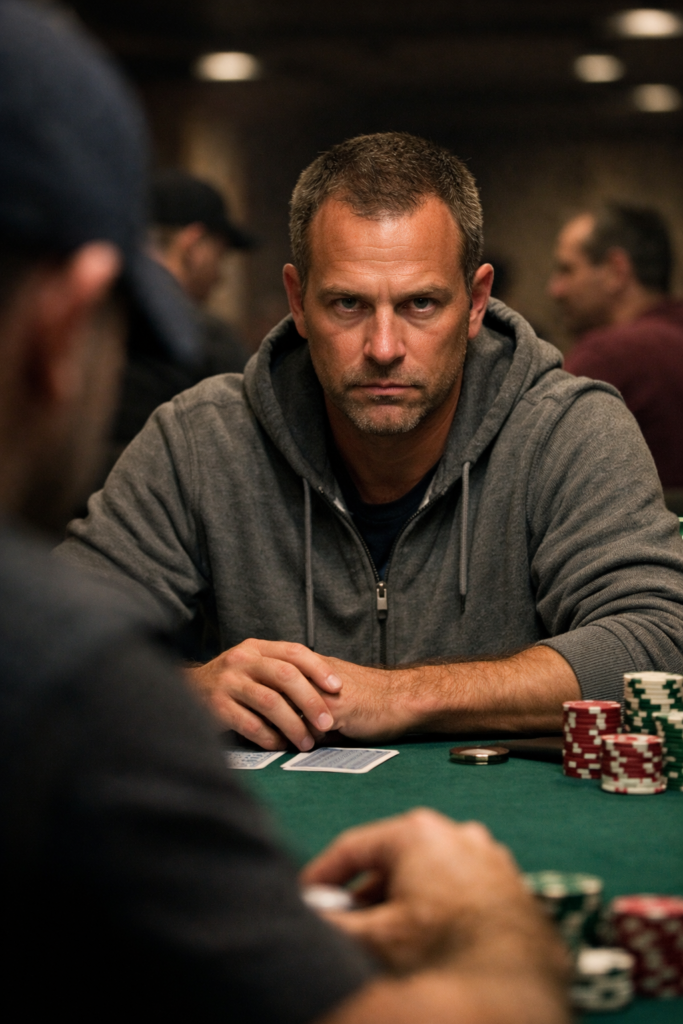

When the same player is waiting for action with a weaker or more vulnerable hand, their behavior often shifts. Eye contact increases. They may watch their opponent closely, sometimes staring, as they anticipate a decision that could put them under pressure.
This contrast—reduced attention with strength and increased attention with weakness—is the foundation of the tell. It does not guarantee hand strength, and it does not operate in isolation. But when it appears under the right conditions, it provides meaningful insight into a player’s level of comfort while waiting for an opponent to act.
WHY PLAYERS DISPLAY THE "LOOKING AT YOU" POKER TELLS
There are several reasons a player may display the looking at you poker tell while waiting for action, particularly when holding a weak or vulnerable hand. These reasons are not mutually exclusive, and more than one may be present at the same time.
AN INSTINCT TO WATCH FOR DANGER
A DEFENSIVE REACTION
A NEED TO STUDY AN OPPONENT
One of the most common explanations is instinctual. Humans, like animals, are naturally inclined to watch potential threats. When a player feels weak and anticipates possible aggression, their attention often shifts toward the opponent who can apply pressure.
By watching closely, the player is unconsciously preparing for danger. This heightened awareness reflects uncertainty, not confidence
In some cases, increased eye contact functions as a subtle defensive behavior. A player who does not want a bet may watch an opponent closely as if to signal awareness or resistance.
This defensive posture is often accompanied by other behaviors, such as tension in the shoulders, rigid posture, or changes in tone of voice. The player is not asserting strength; they are guarding against being challenged.
Players holding weak hands are more likely to study their opponents than those holding strong hands. Strong hands tend to play themselves, requiring less external information.
A player with a weak hand may look for signs of hesitation, weakness, or bluffing opportunities. This applies to both skilled and unskilled players. Strong players may be gathering information to determine whether a bluff is viable. Weaker players may appear to be studying opponents even when they are unsure what they are looking for.
THE INVERSE BEHAVIOR
The opposite pattern also exists. Some players holding strong hands will deliberately avoid eye contact while waiting for action. Rather than watching for danger, they disengage to avoid discouraging an opponent from betting.
This inverse behavior—looking away from an opponent while strong—will be examined later in this series as a complementary tell.
MULTI-WAY POTS AND THE "LOOKING AT YOU" POKER TELL
The looking at you poker tell becomes especially useful in multi-way situations, particularly in games populated by weaker or less disciplined players.
In multi-way pots, players are more likely to feel exposed. With more opponents involved, the likelihood of aggression increases, and uncertainty becomes harder to manage. This often causes behavioral leaks to surface more clearly.
PAUSING FOR INFORMATION
One common scenario occurs when action reaches you and you pause briefly before acting. Even a short delay can prompt other players to check where the action is.
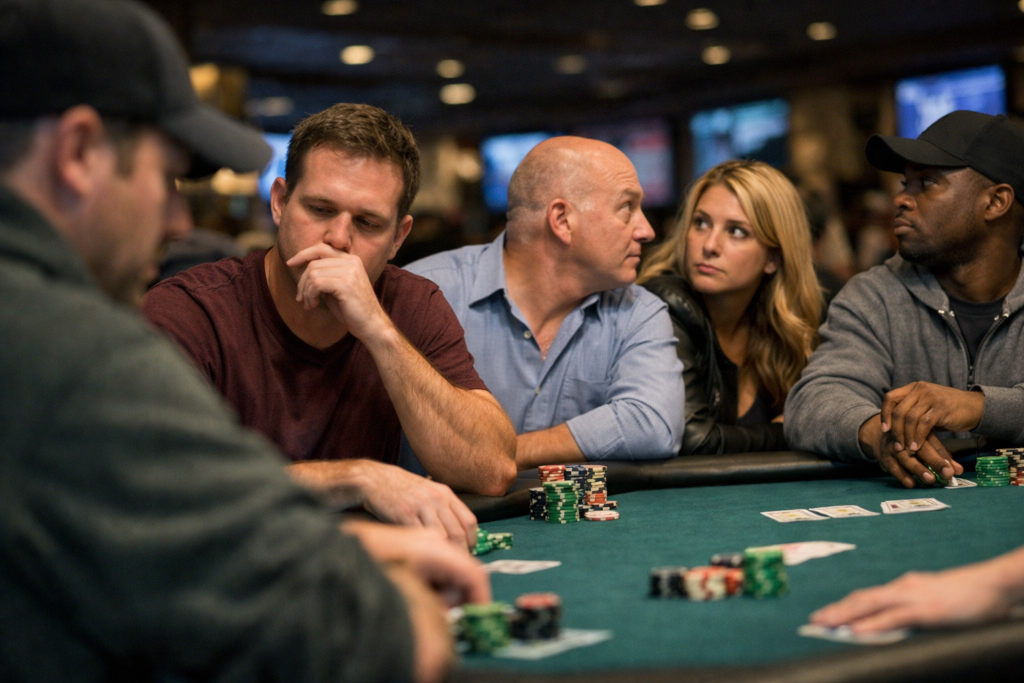
During this pause, players holding weak hands will often turn their attention toward you. They are waiting, watching, and anticipating what you might do. When several players in the pot are looking at you while waiting for action, it often indicates collective uncertainty rather than strength.
In contrast, when a player—especially a pre-flop raiser—actively avoids looking in your direction during this pause, it can signal comfort. That player may already feel secure with their holding and less concerned about what you decide.
IDENTIFYING RESISTANCE
COORELATION AND PLAYER QUALITY
This distinction becomes more meaningful when specific players stand out.
If most players are watching you, but one player is deliberately disengaged, that player may represent resistance. The same applies if a player positioned to your left avoids eye contact while others remain attentive. These deviations deserve caution.
The tell does not suggest certainty. It helps identify where pressure may or may not be effective.
Elwood emphasizes that correlation increases reliability. Against players who are consistent, controlled, and difficult to read, the value of this tell diminishes sharply.
However, this behavior is so common among weaker players that it can still retain usefulness even without long-term correlation, provided the overall competition is soft. In these environments, the tell often surfaces naturally and repeatedly.
In practice, many players monitor this behavior using peripheral vision, noting who is watching and who is not while waiting for action. When multiple players are focused on you in a spot where aggression is reasonable, it can add confidence to an aggressive decision—assuming the broader situation supports it.
WHEN THE "LOOKING AT YOU" POKER TELLS LOSES CLARITY
Some players will make a habit of looking at their opponents consistently whenever it is their turn to act, regardless of hand strength.
In these cases, the looking at you poker tell becomes less reliable as a directional signal. The behavior itself is no longer a deviation. It is part of the player’s baseline.
However, even among players who look consistently, information may still be present. What can change is not whether they are looking, but how they are looking.
Zachary Elwood notes that some of these players may still reveal strength or weakness through the quality of their eye contact. Relaxed eyes, calm focus, or a lack of tension may indicate comfort. Tighter focus, strained attention, or heightened alertness may indicate uncertainty.
This distinction is subtle and should be treated cautiously. When eye contact is constant, interpretation shifts away from presence and toward emotional tone. Even then, the information is weaker and more situational than in cases where eye contact itself changes meaningfully.
For players who look at you all the time, the tell does not disappear completely—but it does lose much of its original clarity.
CLOSING THOUGHTS
The “looking at you” poker tell is a waiting-for-action behavior that most often reflects uncertainty rather than confidence. When players feel vulnerable, their attention increases. When they feel comfortable, it often fades.
Like all poker tells, this behavior does not operate in isolation. Its value depends on who the player is and the situation in which it appears.
Used correctly, it can provide meaningful insight. Used carelessly, it quickly loses reliability.
In the next article, we’ll examine another waiting-for-action behavior: grabbing chips defensively, and why a player who appears ready to call is often not as strong as they want you to believe.