
INDICATING A FOLD
A WAITING-FOR-ACTION POKER TELL OF WEAKNESS
Indicating a fold is a specific waiting-for-action poker tell that appears before a player is required to make a decision. Rather than reacting to pressure, the player subtly signals withdrawal from the hand while action is still pending elsewhere.
This behavior does not involve actually folding cards. Instead, it reflects a player who has already accepted that they will not continue and has mentally exited the decision tree. That early disengagement is what places this tell firmly in the tells of weakness category.
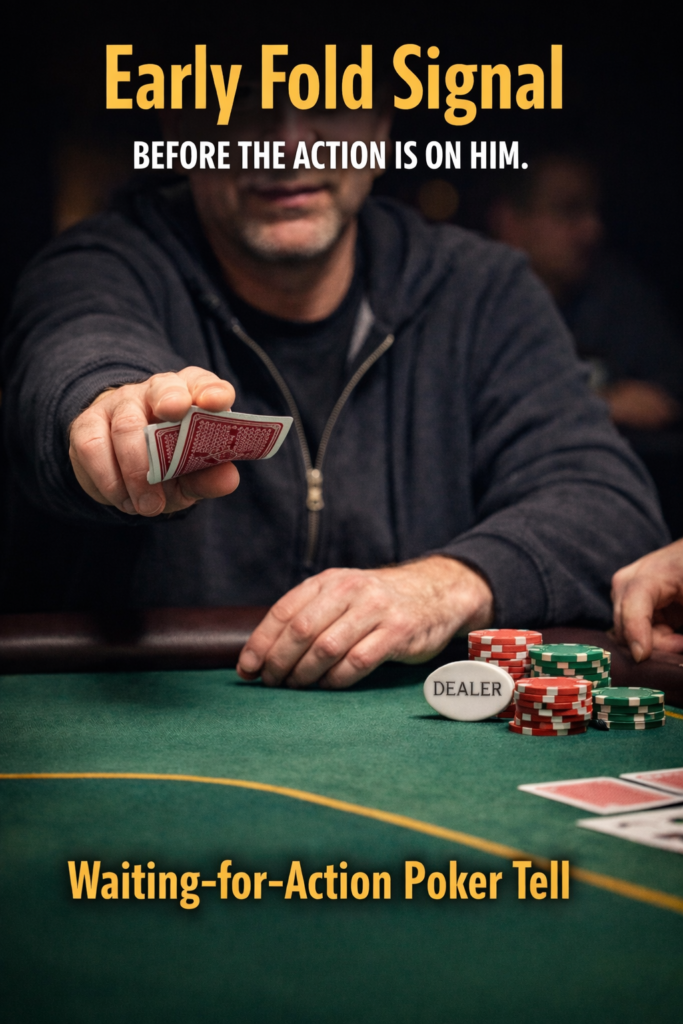
Like other waiting-for-action tells, indicating a fold is not about emotion or nervousness. It is about intent revealed prematurely. When a player believes their decision is already made, they often stop protecting information—especially in live games where attention drifts and etiquette takes over.
This tell is situational and context-dependent. It is most useful in the right environments and largely meaningless in the wrong ones. Used correctly, however, it provides a quiet but valuable confirmation that resistance is likely gone before pressure is applied.
WHAT "INDICATING A FOLD" LOOKS LIKE
Indicating a fold is expressed through subtle disengagement, not overt action. The player has not folded, but their behavior suggests they are no longer invested in the hand.
Common indicators include:
- Holding cards loosely or allowing them to slide forward toward the betting line
- Lifting cards as if preparing to release them, then waiting
- Pulling hands away from chips and resting them flat on the felt or clasped together, away from the betting area
- Turning the upper body slightly away from the table
- Shifting attention elsewhere while action is still pending
What distinguishes this tell is timing. These behaviors appear while the player is waiting to see if someone else will bet. They are not reactions to a bet already made, nor are they part of a normal folding motion.
In many cases, the behavior is unintentional. The player believes the decision is already settled and begins to disengage before the decision is formally required. That premature withdrawal is the signal.
Importantly, none of these actions guarantee a fold. They indicate intent, not outcome. The tell gains meaning only when it appears before pressure is applied and when it fits the broader context of the hand.
THE CORE LOGIC BEHIND THE TELL
The logic behind indicating a fold is simple and consistent: players who believe their decision is already made stop protecting information.
When a player anticipates folding, they mentally exit the hand before the action reaches them. Once that withdrawal occurs, there is little incentive—conscious or unconscious—to maintain neutrality. The result is premature signaling.
This behavior is not strategic. It is a byproduct of disengagement. A player who expects to continue—whether by calling, raising, or bluffing—has reason to remain attentive and guarded. A player who expects to fold does not.
That distinction explains why this tell belongs in the waiting-for-action tells of weakness category. The player is not reacting to pressure; they are revealing intent before pressure is applied.
Importantly, this is not about deception or reverse tells. Most players are not attempting to mislead when they indicate a fold. They are simply done with the hand and behaving accordingly. That makes the tell most reliable when it appears naturally and without theatrics.
Used correctly, this behavior signals that resistance is likely gone—provided the broader context supports that conclusion.
WHEN THE TELL IS MOST RELIABLE
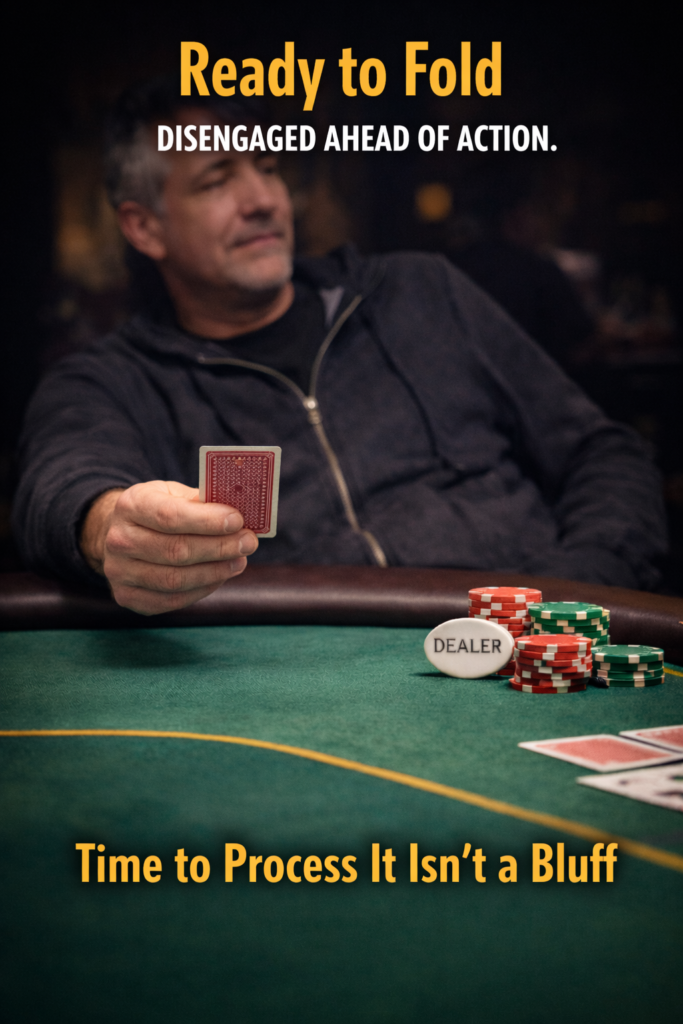
Indicating a fold is most reliable in situations where a player has both time and reason to disengage before action reaches them. These conditions appear far more often in live cash games than in faster or more structured formats.
This tell shows up most clearly in multi-way pots, particularly when the player is not last to act. With multiple players still in the hand, a disengaged player often assumes pressure is coming from someone else and begins preparing to release their hand early.
It is also more reliable in small to medium-sized pots, where the cost of folding feels acceptable and emotional investment is low. In these spots, players are less motivated to protect information and more likely to drift into autopilot behavior.
The tell strengthens on later streets, especially after a player has missed a draw or failed to connect meaningfully with the board. By the turn or river, ranges are narrower and intentions are clearer. When a player has already accepted that their hand cannot continue, disengagement often becomes visible.
Finally, indicating a fold is most common among average, inattentive, or etiquette-driven players. These players are more likely to behave in accordance with how they believe the hand will end, rather than maintaining a neutral posture until action is forced.
When these factors align—multi-way dynamics, low commitment, later streets, and average player competence—the tell becomes a reliable confirmation that resistance is likely gone.
WHEN THE TELL LOSES CLARITY
Indicating a fold becomes less reliable in situations where intent is harder to distinguish from routine or where the player has reason to remain engaged regardless of hand strength. The tell does not fail because players are deceptive. It fails when context no longer supports a clear inference.
This behavior is weakest in heads-up pots. With only one opponent remaining, players are more aware that any visible disengagement directly influences the bettor’s decision. Even players holding weak hands tend to maintain neutrality longer when all pressure is coming from a single source. The absence of other players reduces the opportunity for casual disengagement.

Reliability also drops in large or high-pressure pots. When significant money is at stake, players often remain mentally engaged even after deciding to fold. The cost of being wrong is higher, and attention stays anchored to the action longer. In these situations, lack of disengagement does not necessarily signal strength—it may simply reflect heightened caution.
This tell also loses meaning with habitual card handlers. Some players routinely fidget with their cards, shift posture, or adjust their grip regardless of intent. Without a clear waiting-for-action context, these behaviors should be treated as background noise rather than signal.
The key limitation is not deception, but diagnostic clarity. Indicating a fold is most reliable when a player has both time and reason to disengage before action reaches them. When those conditions are absent, the behavior should be discounted or ignored entirely.
As with all poker tells, context determines meaning. When context is strong, the signal is useful. When context is weak, the same behavior carries little—or no—information.
COMMON MISREADS AND PLAYER ERRORS
The most common mistake players make with indicating a fold is treating it as a guarantee rather than a reflection of expectation. This tell suggests that a player anticipates folding if pressure arrives—it does not mean the player will fold regardless of price. Small bets, favorable pot odds, or unexpected action can still produce a call.
Another frequent error is ignoring position and action sequence. Indicating a fold has meaning only when a player is clearly waiting to see whether pressure comes from someone else. When action is close or imminent, posture changes often reflect readiness rather than disengagement. Without proper sequencing, the behavior loses interpretive value.
Players also misread this tell by overweighting a single occurrence. Like all poker tells, indicating a fold gains reliability through repetition and consistency. When the same behavior appears across multiple hands and similar situations, confidence in the read increases. A single instance, taken in isolation, is rarely decisive.
Finally, many players confuse etiquette-driven behavior with strategic intent. In live games, players often prepare to muck, lift cards slightly, or shift posture out of politeness or habit rather than expectation. These actions should only be considered meaningful when they appear within a clear waiting-for-action context and align with prior behavior.
Indicating a fold is a supporting signal, not a decision-maker. Used carefully, it refines close reads. Used carelessly, it creates false certainty. Discipline lies in knowing the difference.
FALSE TELL CONSIDERATIONS
The idea that indicating a fold can be used as a deliberate false tell has been discussed for years, often traced back to theoretical warnings rather than common real-world practice.
In theory, a player could signal weakness in order to induce a bet, only to spring a trap. In practice, this behavior is rare. Most players—especially in live cash games—are not sufficiently disciplined or deceptive to consistently execute this maneuver without revealing other contradictions in posture, timing, or engagement.
False indications of a fold are most likely to appear at very low stakes, where players experiment without understanding consequences, or among the occasional player attempting to imitate something they have read without fully grasping its application. Even in these cases, the behavior is often inconsistent and short-lived.
More importantly, deliberate deception requires continued engagement. A player planning to continue in the hand must remain attentive, alert, and prepared to respond dynamically. That mindset conflicts with the disengaged posture that typically accompanies genuine indications of a fold.
Even if a player attempted to use this behavior deceptively, it would be difficult to execute more than once. Indicating a fold is a binary signal—once observed and contradicted, its credibility collapses. Any attempt to reuse it would require highly specific, controlled conditions and would quickly lose effectiveness.
For this reason, theoretical exceptions should not outweigh empirical observation. While no poker tell is absolute, the overwhelming majority of fold-indicating behaviors in live play reflect genuine intent rather than calculated deception.
Used with proper context and restraint, this tell remains far more reliable than its rare exceptions would suggest.
HOW TO USE THIS TELL CORRECTLY
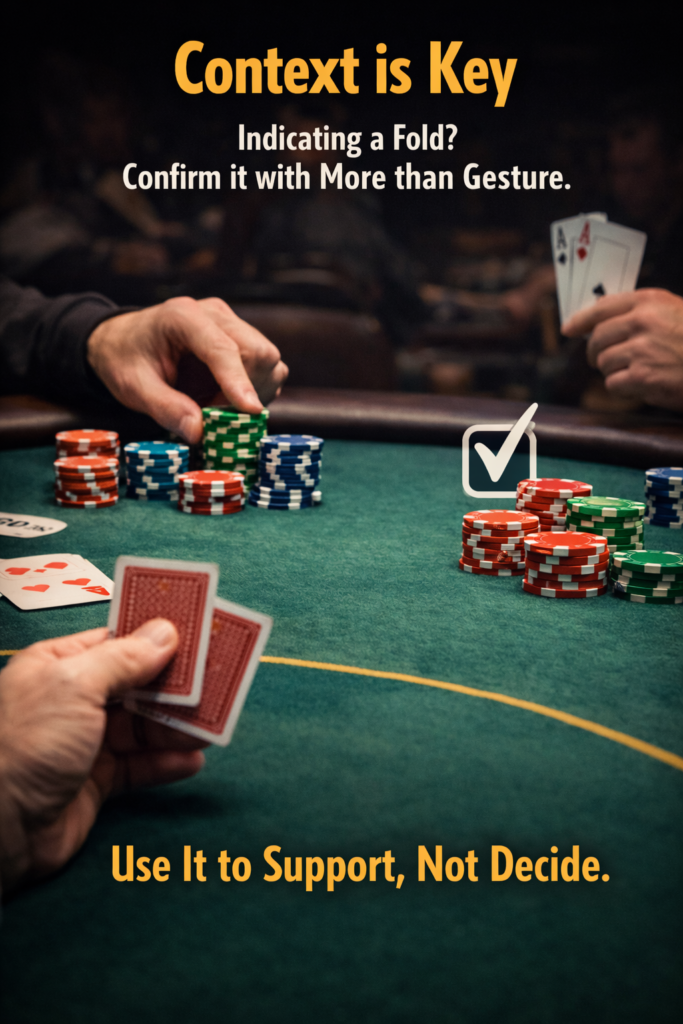
Indicating a fold is best used as a confirming signal, not as a standalone reason to act. Its value lies in clarifying what is likely to happen when pressure is applied, not in creating pressure where none is justified.
When this tell appears in the proper context—multi-way pots, later streets, and against average or inattentive players—it can increase confidence in value betting. If a player has already disengaged, resistance is often non-existent, and well-sized bets are more likely to succeed.
This tell can also help with bet selection, not bet invention. It may influence whether you choose a thinner value bet versus a check, or whether you apply pressure into multiple players versus selecting a smaller, controlled sizing. What it should not do is push you into bluffs that are mathematically unsound.
Importantly, indicating a fold does not override structure. Board texture, ranges, pot odds, and player tendencies still come first. A visible sign of disengagement does not change what a hand can do—only how willing a player may be to continue.
Used with discipline, this tell helps narrow the decision tree. It reduces uncertainty by signaling that at least one player has likely exited mentally before the action is forced. That clarity is where its real value lies.
CONSIDER A COMMON LIVE-CASH GAME SCENARIO
The pot is checked around to you, and action is on you in late position. You are undecided whether betting is necessary or whether checking behind is sufficient. The hand is playable, but not mandatory.
You pause.
To your left, two players are holding their cards loosely, angled forward, clearly preparing to fold if action reaches them. They are disengaged and waiting for the hand to end.
You then glance to your right. The remaining players are sitting upright, eyes on you, indicating weak or marginal hands.
That combination matters.
Knowing the players to your left are unlikely to continue, and recognizing that the players to your right likely have weak to marginal hands, the raise now accomplishes something concrete: thinning the field, isolating engaged opponents, and leveraging position.
The tell did not create the bet.
It removed uncertainty about what would happen if you made one.
That is how indicating a fold should be used.
CONCLUSION
Indicating a fold is a subtle but reliable waiting-for-action poker tell of weakness when it appears in the proper context. It reflects a player who has mentally exited the hand before pressure is applied and has stopped protecting information as a result.
Like all meaningful poker tells, its value depends on timing, position, and player type. It is most effective in multi-way pots, on later streets, and against average or inattentive opponents. Outside those conditions, it should be discounted or ignored.
This tell does not guarantee a fold, and it should never override sound structure. Pot odds, ranges, board texture, and player tendencies remain primary. When used correctly, indicating a fold serves as confirmation, helping narrow uncertainty rather than create action.
In live poker, small signals often reveal more than dramatic gestures. Players who believe the decision is already made frequently tell you so—quietly and unintentionally—before they are ever forced to act.
Used with discipline, this tell becomes another practical tool in reading live opponents, not a shortcut, and not a rule.