
DEFENSIVE CHIP HANDLING IN POKER
WHY "READY TO CALL" ALMOST ALWAYS MEANS WEAKNESS
Defensive chip handling in poker refers to a specific waiting-for-action behavior where a player begins handling chips before they are required to act. This can include grabbing, pinching, counting, or hovering over chips while an opponent is still deciding whether to bet.
The defining feature is timing.
This behavior does not occur as part of a betting motion. It appears in advance of any forced decision, while the player is anticipating possible aggression. The chips are prepared, but they are not advanced toward the pot.
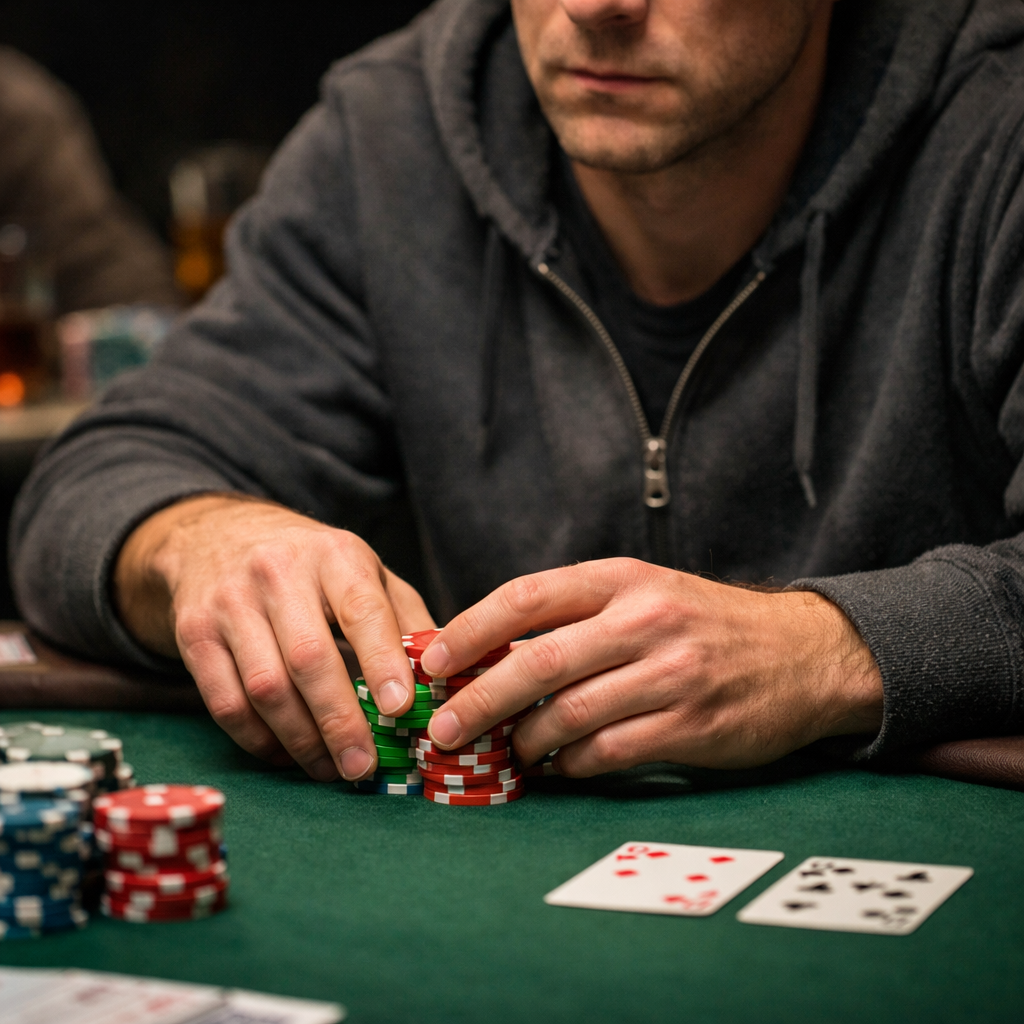
Common examples include:
- A hand resting on a chip stack while waiting for action
- Chips lightly pinched or lifted without forward movement
- Absent-minded counting or separating chips
- A subtle “ready to call” posture while the opponent thinks
This tell is often mistaken for confidence or readiness to bet. In reality, it is almost always a defensive preparation, not an aggressive one.
The key distinction is simple but critical:
Strong hands prepare to act.
Weak or marginal hands prepare to respond.
Defensive chip handling belongs to the second category. It reflects a player bracing for a bet, not planning to initiate one. That difference—between initiative and defense—is what gives this tell its reliability.
In later sections, we will examine why this behavior almost always indicates weakness, why it virtually eliminates the possibility of a raise, and how to apply it correctly without overriding sound mathematical decision-making.
THE CORE LOGIC BEHIND DEFENSIVE CHIP HANDLING

The logic behind defensive chip handling in poker is straightforward, and once understood, difficult to misread.
Ask one simple question:
If a player has a strong hand or plans to raise, why would they tell you before you act?
They wouldn’t.
Strong hands benefit from uncertainty. They want opponents to bet, make mistakes, and commit chips without advance warning. Any behavior that signals “I’m ready to call” before a bet exists works against those goals.
That is why defensive chip handling is almost always a sign of weakness.
When a player grabs or hovers over chips while waiting for action, they are not expressing confidence. They are preparing for pressure. The behavior is a subconscious attempt to slow the betting or reduce the size of a potential bet.
This is not acting. It is not a reverse tell. It is an instinctive defensive response.
A player who intends to raise has no incentive to reveal anything early. In fact, doing so would be counterproductive. Signaling readiness to call discourages aggression, caps the pot, and limits upside—all outcomes that strong hands want to avoid.
This is why experienced players rarely, if ever, display this behavior when holding powerful hands. And it explains a consistent real-world result:
Players who handle chips defensively almost always call or fold.
They virtually never raise.
Once a player mentally commits to defense, the decision tree collapses. Initiative is abandoned. Aggression is off the table. What remains is a narrow choice between continuing passively or exiting the hand.
That collapse of options—not the physical movement itself—is what makes defensive chip handling such a valuable tell when used correctly.
DEFENSIVE POSTURE VS. INITIATIVE POSTURE
To understand why defensive chip handling is so reliable, it helps to separate posture from emotion.
Poker tells are often misframed as signs of nervousness or confidence. In reality, the most useful tells reveal intent—specifically, whether a player is preparing to act or preparing to respond.
This is the difference between initiative posture and defensive posture.
Players with strong hands and aggressive intentions tend to remain physically neutral. They do not need to prepare early. Their focus is outward—on bet sizing, timing, and extracting value. Chips stay untouched until action is required.
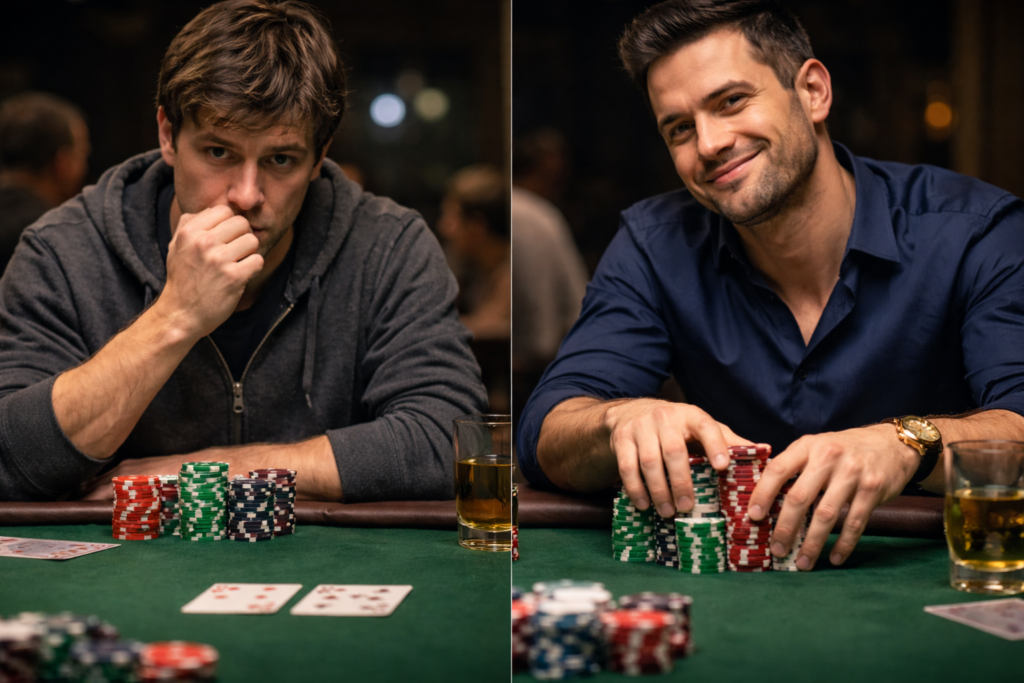
Defensive posture looks very different.
A player anticipating pressure begins to brace. Chips become a form of psychological armor. The hand moves early, not to signal strength, but to reduce uncertainty and regain a sense of control.
This distinction matters:
- Initiative posture delays movement
- Defensive posture prepares early
Strong hands wait. Vulnerable hands get ready.
That is why defensive chip handling is not about excitement or confidence. It is about the anticipation of a threat. The player is not thinking about how to apply pressure. They are thinking about how to withstand it.
Once you recognize this posture shift, the tell becomes much easier to spot—and much harder to misinterpret.
WHAT DEFENSIVE CHIP HANDLING CHANGES FOR YOU
Once you recognize defensive chip handling in poker, its value lies less in prediction and more in constraint. This tell narrows an opponent’s options and simplifies your decision-making.
The most important adjustment is this:
you can largely discount the possibility of a raise.
That single removal has meaningful strategic impact. When the threat of a raise is off the table, you can:
- Value bet more confidently
- Size bets without fear of escalation
- Extract thin value in spots that would otherwise feel marginal
This does not mean a player will always call. Some will still fold. Others will continue passively. What matters is that the aggressive branch of the decision tree has been eliminated.
Defensive chip handling should therefore be treated as a risk-reduction signal, not an outcome predictor. It lowers downside variance and clarifies EV calculations when the rest of the hand already points toward betting.
What it should not do is justify poor fundamentals. This tell does not:
- Turn a bad bluff into a good one
- Override unfavorable board texture
- Replace range and pot-odds analysis
Its role is confirmatory. When the math supports a bet, defensive chip handling removes much of the uncertainty around how that bet will be received.
CORRELATION WITH OTHER DEFENSIVE TELLS

You will often see defensive chip handling appear alongside other defensive behaviors, such as sustained visual monitoring of the bettor. When these independent signals align, they tend to reinforce the same conclusion: a player preparing to respond, not initiate.
This convergence increases confidence, not certainty.
Each tell must still be evaluated within the broader context of board structure, ranges, stack depth, and player type. When multiple signals point in the same direction, they strengthen the read—but they never replace disciplined decision-making.
"ALMOST ALWAYS" - WHY LANGUAGE MATTERS
Precision matters when discussing poker tells. Absolute language creates false confidence, and false confidence leads to bad decisions. That is why “almost always” is the correct and necessary framing for defensive chip handling in poker.
This tell is highly reliable—but it is not universal.
Live poker is filled with variance in player awareness, discipline, and behavior. Some players act randomly. Some are overly theatrical. Others remain physically static regardless of hand strength. Any of these can weaken or obscure the signal.

That said, against competent live players in cash games, defensive chip handling is remarkably consistent. It appears most often:
- On later streets
- In heads-up or near heads-up pots
- When meaningful bets are at stake
- When a player feels vulnerable but not yet committed
In these environments, the tell retains its strength. The behavior is instinctive, not rehearsed, and rooted in the same defensive psychology across player pools.
Using “almost always” does two important things. First, it preserves credibility. It acknowledges exceptions without weakening the core insight. Second, it reinforces PokerRailbird’s central doctrine: tells are tools, not rules.
Defensive chip handling narrows options. It reduces uncertainty and improves confidence when the math already supports a decision. It does not promise outcomes or excuse poor judgment.
When treated with the right level of certainty—firm, but not absolute—this tell becomes a reliable part of a disciplined live poker toolkit.
COMMON MISREADS AND PLAYER ERRORS
Despite its reliability, defensive chip handling in poker is frequently misinterpreted. Most errors come from assigning the wrong meaning to physical movement rather than understanding the intent behind it.
The most common mistake is assuming that chip readiness equals confidence.
Players see movement and infer strength. In reality, early movement is more often a sign of uncertainty. Confidence delays action. Defense prepares early.
Another frequent error is treating the tell as a guarantee. Defensive chip handling does not mean a player will fold, and it does not mean they are weak enough to bluff automatically. Many marginal hands will still call correctly, especially when pot odds justify it.
Some players also over-apply the tell without considering context. Board texture, range interaction, and stack depth still matter. A defensive posture on a coordinated board does not suddenly make a value bet correct, just as it does not turn a bad bluff into a profitable one.
There is also a tendency to overreact when the tell appears obvious. More subtle versions of defensive chip handling are often more reliable than exaggerated ones. Obvious displays can sometimes come from inexperienced players whose behavior is noisy rather than informative.
Finally, players often fail to distinguish between defensive chip handling and neutral preparation. Pre-loading chips, especially in multiway pots or just before acting, can be harmless. Misclassifying neutral behavior as defensive leads to false reads and overconfidence.
Most misreads stem from the same root problem: elevating the tell above structure. Defensive chip handling is valuable precisely because it confirms a decision that already makes sense. Used in isolation, it loses its edge.
CONTEXTS THAT STRENGTHEN OR WEAKEN THE TELL
The reliability of defensive chip handling in poker is not fixed. Like all behavioral tells, its strength depends on context. Understanding when the tell carries more weight is as important as recognizing the behavior itself.
In limit games, defensive chip handling is more likely to be followed by a call. Fixed bet sizing reduces the penalty for passive continuation, making defensive preparation less costly.
In no-limit games, especially with deeper stacks, the same behavior more often precedes a fold. The potential for large bets increases pressure, and defensive posture reflects a player weighing survival rather than resistance. In both formats, however, the likelihood of a raise remains extremely low.
STREET AND TIMEING MATTER
PLAYER COMPETENCE MATTERS
PRESSURE MATTERS
This tell carries more weight on later streets, when ranges are narrower and decisions are more consequential. A defensive posture on the river or turn reflects a clearer anticipation of pressure than similar behavior preflop or early in a hand.
You should also consider whether the behavior is a fresh response to the current decision or a posture carried over from a previous street. New behavior triggered by the present betting situation is far more informative than static positioning.
Defensive chip handling is most reliable against players who are capable of anticipating future action. The tell scales with awareness. Competent but imperfect live players tend to display it instinctively when they feel vulnerable.
Against highly inexperienced players or extreme outliers, the signal weakens. Against elite players, it may disappear entirely.
The tell is strongest when meaningful money is at stake. Shallow stacks, trivial bets, or low-pressure situations reduce its clarity. Defensive posture emerges when a player perceives real risk.
Taken together, these factors allow you to weight the tell properly. Defensive chip handling is not binary. It becomes more or less informative depending on structure, timing, and pressure.
CONCLUSION
Defensive chip handling in poker is a quiet but powerful tell because it reveals intent, not emotion. When a player prepares chips before action is forced, they are almost always preparing to respond, not initiate. That distinction explains why this behavior so consistently leads to calls or folds—and why raises virtually disappear from the equation.
The value of this tell is not predictive certainty. It is constraint. It narrows an opponent’s action set, reduces downside risk, and increases confidence when the underlying decision already makes sense. Used correctly, it supports disciplined value betting and clearer EV calculations. Used incorrectly, it becomes just another excuse to abandon structure.
That is where most players go wrong.
Poker tells belong exactly where this one does: confirming, not deciding. When you respect that boundary, defensive chip handling becomes a reliable, repeatable tool—especially in live cash games against competent but imperfect opponents.
Accurate reads are not about theatrics. They are about understanding why a player behaves the way they do—and what that behavior quietly removes from their options.