

WHY BAD POKER PLAYERS ARE HARD TO BEAT
AND HOW TO ADJUST
Most players have experienced a table where the game feels different.
The difference is not in the rules or the cards. It is in how the majority of the table makes decisions. Instead of one or two loose players, there may be four, five, or even six opponents entering nearly every pot. Raises do not narrow the field. Hands routinely go to showdown. Betting does not produce consistent reactions.
For players focused on beating bad poker players, this environment creates confusion. A few undisciplined opponents are highly profitable. But when most of the table ignores structure, math, and position, the game changes mechanically.

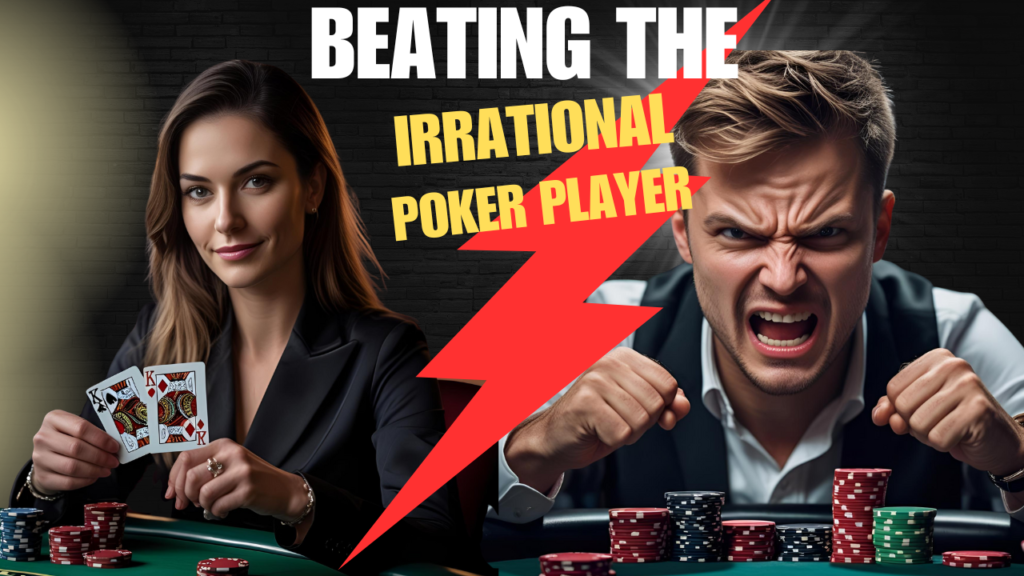
In a structured game, decisions reduce possibilities. Raises isolate. Folds narrow ranges. Betting applies pressure. When most players ignore those mechanics, the structure weakens and the path to profit becomes less direct.
Many players believe bad opponents should be easy money. That assumption ignores how density and chaos affect fold equity and edge realization.
This article defines that player type, explains why one or two of them can be profitable, why five or six can fundamentally alter the mathematics of the game, and what adjustments are required to beat it consistently.
UNDERSTANDING THE PLAYERS: THE FIRST STEP IN BEATING BAD POKER PLAYERS
When discussing beating bad poker players, the first step is defining exactly who that player is. A bad poker player is not identified by how often they win or lose a pot. It is defined by the decisions that were made as the hand progressed.
These players enter far more hands than the game’s math supports. Ace-anything, face card anything, any two suited cards, regardless of rank, any two cards remotely connected, and often just any two cards, are considered playable. The reasoning is usually simple: the flop might help. Little attention is given to what happens when the flop produces a weak pair, a dominated top pair, or a draw that will cost more to chase than it can earn over the long term.
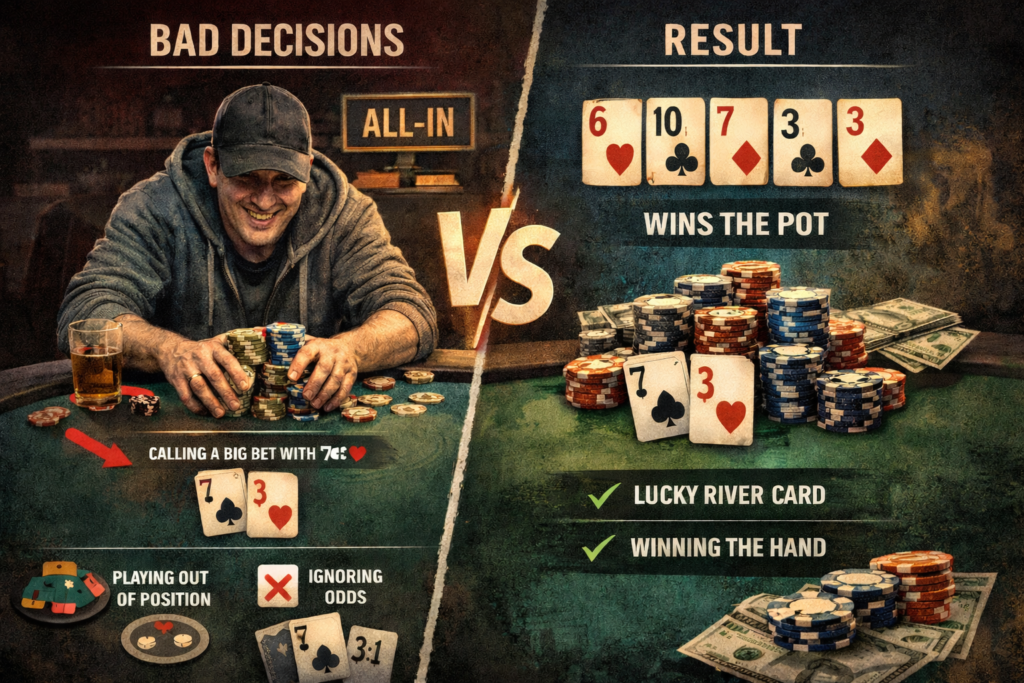
These bad players will also appear in nearly every pot. Folding before the flop is uncommon, and raises don’t usually discourage participation. The same players call repeatedly, regardless of prior action, treating the deal itself as a reason to keep calling.
Preflop raises do not reflect a structured plan. A player may limp one hand and raise the next with no relationship between the action and the strength of the cards. Some raise frequently or even every hand simply to take control of the betting. The chosen amount does not narrow the field, because callers are not reacting to the size of the bet; these players’ raises are meaningless and receive no respect.
Their relative position, or yours, is rarely considered in their decisions. Hands played under the gun are played the same way on the button. The decision is based on holding cards rather than the advantage or disadvantage of acting early or late.
WHY THESE HANDS CONTINUE AFTER THE FLOP
After the flop, continuation depends on possession rather than expectation. Any pair is enough to proceed. Ace-high often continues. Inside straight draws, backdoor draws, and overcards are called because improvement is possible, not because the chance of improving justifies the cost. The focus is on what the hand could become rather than whether continuing is profitable.
These players mostly evaluate only their own cards and the board. They rarely consider what other players represent or what previous betting suggests. Each decision answers a single question: do I still have something? And in this case, “something” can take on a variety of meanings. If the answer is yes, the hand continues.
This is the opponent model that the rest of the article will address.
WHY THEY PLAY THIS WAY
Understanding this mindset is critical when it comes to beating bad poker players. If you misdiagnose the reason behind their decisions, your adjustments will be wrong from the start.
Bad players are not random. They are consistent. The consistency just isn’t based on structure.
Most of their decisions come from fear, curiosity, ego, or entertainment — not mathematics.
They are afraid of folding the best hand. That fear alone keeps them in pots they should leave. Folding feels like surrender. Calling feels safer.
They also want to see. They want to see the turn, and they want to see the river. Curiosity overrides cost. The price becomes secondary to the desire to know.
A large part of it is what psychologists call the sunk cost fallacy. Once money goes into the pot, they feel attached to it. “I’ve already got this much in.” That statement has nothing to do with expected value. It has everything to do with emotional ownership.
SHORT-TERM RESULTS REINFORCE LOGN-TERM MISTAKES
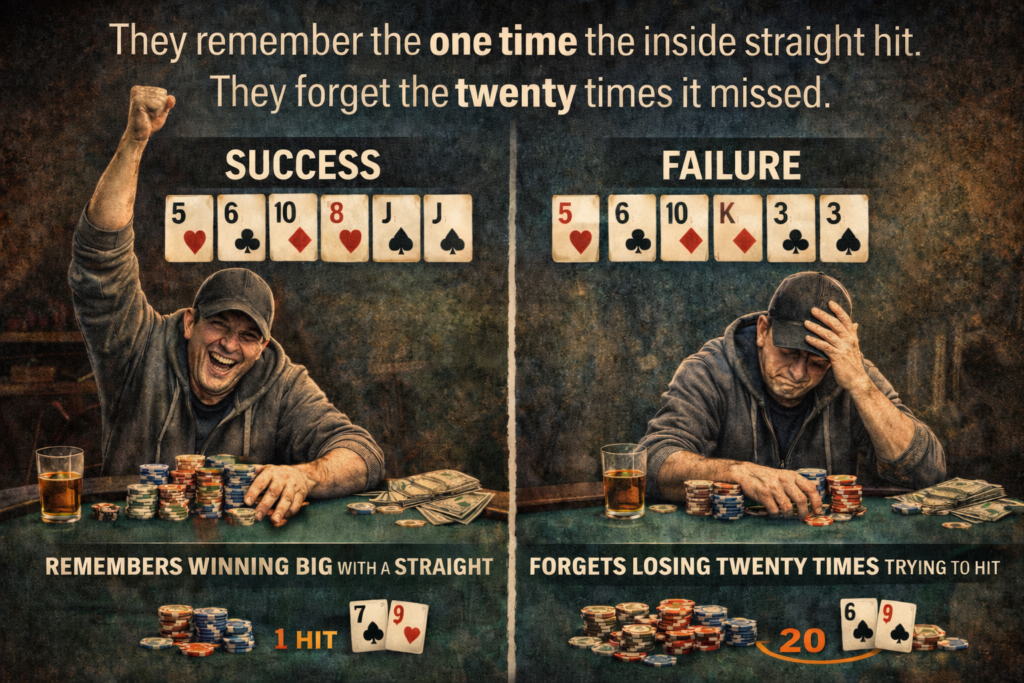
Then there is outcome bias. They remember the one time the inside straight hit. They forget the twenty times it missed. When a weak call gets there, it reinforces the entire approach. A single successful hand can validate months of poor decisions in their mind. Short-term results become proof that the process works.
Many of them genuinely reject math. You’ve heard it at the table: “Forget all that math stuff.” What they are really saying is that they prefer instinct to discipline. They trust how the hand feels more than what the numbers say.
It is also important to recognize that not everyone sits down to maximize long-term profit. Some players are there for action. Others are there for social interaction, and some simply enjoy being involved in every hand. When profit is not the primary objective, discipline becomes optional. If action is the goal, folding frequently feels like failure.
There is another layer to this. When you are the disciplined player at that table, it can feel isolating. You are folding while they are playing. You are waiting while they are stacking pots. That dynamic creates pressure. It tempts you to widen up, to push harder, to “prove” the better strategy. That pressure is where mistakes begin.
None of this makes these players irrational. It makes them predictable, just not in the way a structured strategy expects.
WHY ONE TO 3 BAD PLAYERS AT A TABLE IS PROFITABLE
When there are one, two, or even three bad players at the table, the game remains structurally intact. The rest of the table still folds at reasonable frequencies. Raises still isolate. Position still matters. Betting still applies pressure.
In this environment, beating bad poker players is straightforward. They supply action and make predictable mistakes, but the overall framework of the game remains stable.
Pots narrow. Decisions reduce possibilities. Hand reading remains meaningful. When a disciplined player raises preflop, weaker ranges often call while stronger players fold or re-raise appropriately. The field thins. Value hands can be isolated.
Post-flop, these opponents continue too far and pay off value bets. They call when the price is incorrect. They chase when the odds are insufficient and they defend weak holdings out of curiosity or attachment. Because not everyone at the table behaves this way, their mistakes are contained.
This is the ideal scenario for a disciplined player. You still have fold equity. Bluffing retains value. Thin value betting remains effective. The presence of one or two loose opponents increases pot size without eliminating structure.
Variance exists, but it is controlled. Their mistakes are absorbed within a functioning system. Over time, the math expresses itself cleanly.
A few bad players do not break the game. They fuel it.
WHEN 5 TO 6 OR MORE BAD PLAYER CHANGE THE GAME
When five or six players at the table operate in this manner, the game’s structure changes.
This is where many disciplined players begin to struggle.
Preflop raises no longer isolate. Increasing the size does not reliably reduce the field. Multiway pots become standard rather than occasional. Instead of playing one or two opponents, you are routinely playing four or five.
That changes the math immediately.
Equity is diluted in multiway pots. A hand that performs well heads-up loses stability when three or four additional players see the flop. Top pair becomes fragile. Strong one-pair hands decrease in value. Draws become more competitive because someone frequently has a better one.
At this point, the game shifts from fold-driven poker to showdown-driven poker. Bluffing loses effectiveness because the probability that someone continues increases dramatically. Even correctly sized bets fail to produce folds at normal frequencies.

The result is not that beating bad poker players becomes impossible. It becomes slower, higher variance, and more demanding psychologically.
THE MATHEMATICAL CONSEQUENCES
With constant multiway action, variance increases. More players see flops. More draws materialize and more marginal hands reach showdown. Short-term results swing more aggressively.
Deep stacks magnify this effect. When players who ignore structure are willing to continue with dominated hands, the size of losing pots increases. One mistake can erase multiple small wins.
Shallower stacks compress mistakes but also compress edge. The game becomes simpler, but long-term profit per hour declines.
Another change is profit realization speed. Your edge may still exist, but it expresses itself over a longer time horizon. Winning sessions become less frequent even if long-term expectation remains positive.
THE TRAP FOR DISCIPLINED PLAYERS
This environment creates pressure.
Ranges begin to widen in response. Isolation attempts expand into marginal holdings. Bluff frequency increases in an effort to force structure back into the game. Bet sizing grows in an attempt to manufacture folds.
Those adjustments often reduce edge rather than protect it.
The difficulty is not their skill level. It is misapplying structured strategy to conditions that no longer support it.
CORRECT ADJUSTMENTS
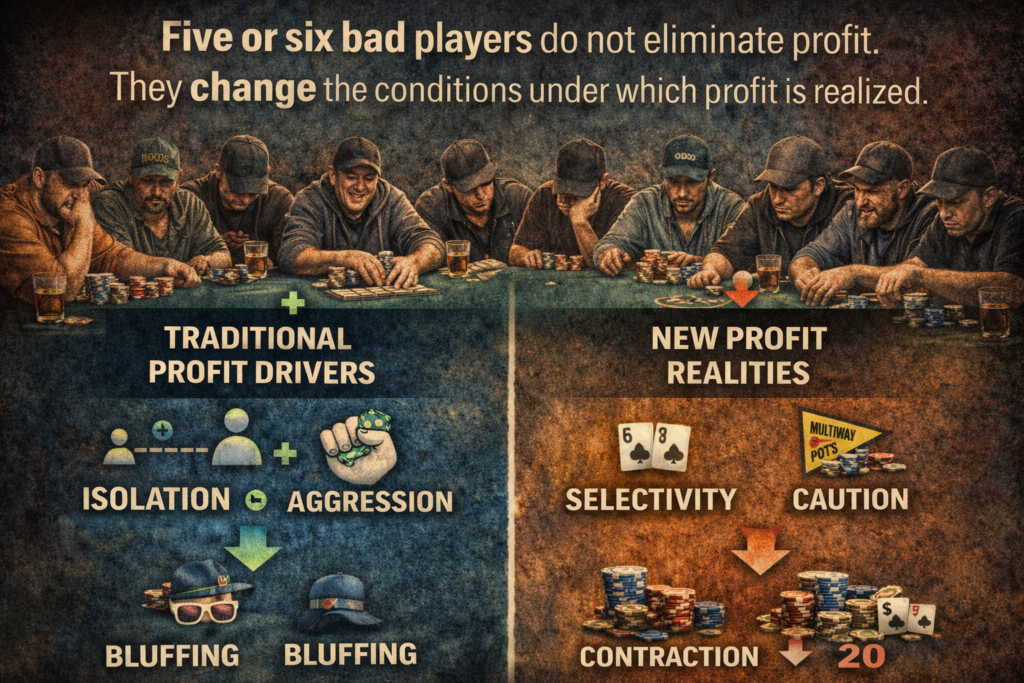
When the table becomes loose-dense, adjustments are mechanical:
- Reduce bluff frequency.
- Increase value density.
- Tighten preflop ranges.
- Avoid marginal isolation attempts.
- Accept multiway pots and plan accordingly.
- Bet larger for value when ahead.
- Exercise extreme patience.
And in some cases, table selection becomes a rational decision. If raises never isolate and pots routinely reach five or more players, the game may be mathematically inefficient relative to other available tables.
Five or six bad players do not eliminate profit. They change the conditions under which profit is realized.
WHEN THE TABLE PULLS DISCIPLINED PLAYERS OFF STRUCTURE
Loose-dense games develop momentum.
When most players enter every pot, raise loosely, and refuse to fold, the action escalates. Betting accelerates. Pots grow larger. Showdowns become frequent. The emotional tempo of the table increases.
Under these conditions, even disciplined players begin to adjust incorrectly.
Ranges widen in response to constant action.
Isolation attempts become lighter.
Calls are made in marginal spots simply because opponents “could have anything.
Chases occur in situations where folding would normally be routine.
This is not structural adjustment. It is reaction.
When the majority ignores structure, there is a powerful temptation to match the pace of the game. Instead of tightening, many strong players loosen. Instead of preserving edge, they attempt to impose order on chaos.
In doing so, they begin to resemble the very player type they intend to exploit.
When five or six players at the table ignore structure, the math itself changes. Multiway pots dilute equity. Thin edges disappear. Isolation becomes rare. Even strong starting hands realize less value because they must survive multiple ranges to reach showdown. The game shifts from controlled decision-making to high-variance equity collisions.
Stacks disappear not because the game is unbeatable, but because discipline erodes.
The correct response is restraint. When structural play begins to drift, widening ranges, forcing action, abandoning math, that is a warning signal.
At that point, two options remain: restore discipline immediately, or change tables. There is no obligation to prove superiority in a game that punishes discipline.
THE STRUCTURAL REALITY OF BEATING BAD POKER PLAYERS
Beating bad poker players is not complicated, but it is conditional.
When one or two undisciplined players sit at a table, their mistakes create opportunity. They overplay weak hands, ignore position, call without odds, and raise without structure. Against a disciplined opponent, those patterns generate clear, repeatable profit. Fold equity still exists. Isolation is possible. Edges compound in manageable pots.
But when five or six players operate without structure, the environment changes.
Multiway pots become standard. Ranges lose definition. Fold equity weakens. Thin edges shrink. Even strong hands realize less value because they must survive against multiple undefined holdings. The math itself does not disappear, but its application becomes less efficient.
This is the distinction most players miss.
They assume bad opponents automatically mean easy profit. In reality, profit depends on density. A few structural leaks are exploitable. Too many structural leaks distort the mechanisms that allow pressure to work.
The adjustment is not emotional. It is mathematical.
In low-density chaos, aggression and isolation are effective tools. In high-density chaos, patience and selectivity become dominant tools. The disciplined player adapts without drifting. He does not widen ranges to match looseness. He does not force action when leverage is gone and ee recognizes when preservation of expectation is superior to unnecessary volatility.
Beating bad poker players is not about overpowering them. It is about recognizing how their numbers at the table change the structure of the game. When mistakes are isolated, they