

HOW TO INTERPRET POKER TELLS
A DISCIPLINED FRAMEWORK FOR LIVE PLAY
To understand how to interpret poker tells correctly, it’s critical to begin with a clear limitation: poker tells do not reveal specific cards. They reveal emotional state.
At their core, poker tells reflect how comfortable or uncomfortable a player feels in a given moment. They expose tension, confidence, hesitation, or uncertainty, but they do not, by themselves, identify hand strength.
This distinction matters. Many players misuse poker tells by treating them as answers rather than inputs. A tell may suggest vulnerability, but it does not confirm weakness. It may suggest confidence, but it does not prove strength.
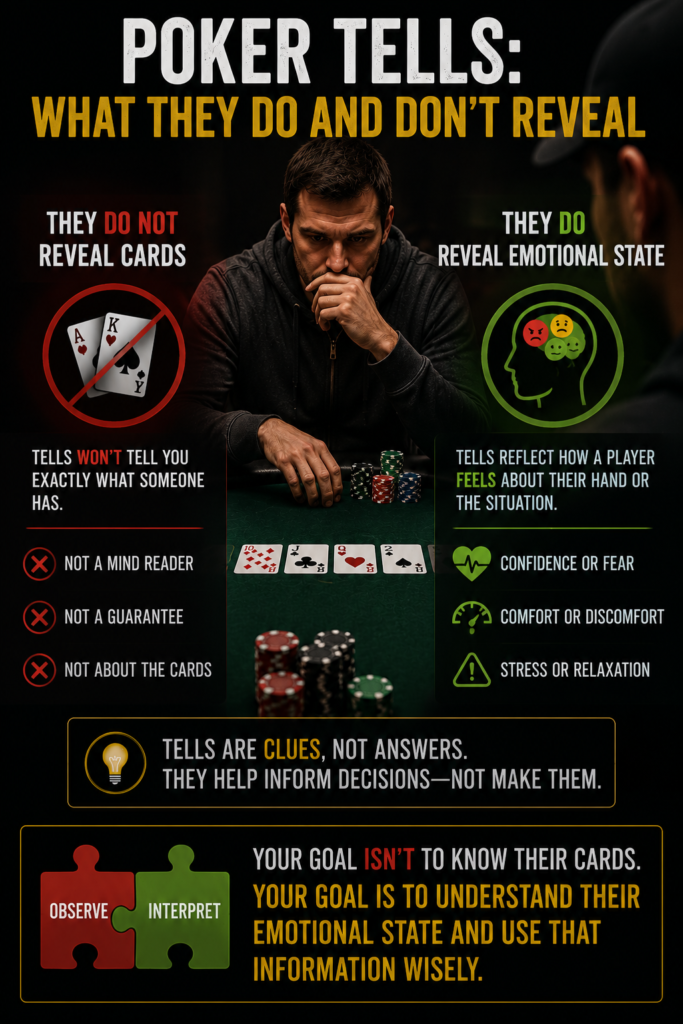

Poker tells are best understood as supporting information. They help refine decisions that are already grounded in betting action, position, and logic. They do not replace those elements, and they should never override them.
When interpreted correctly, poker tells can sharpen close decisions, especially in live cash games where behavioral information is available. When interpreted carelessly, they create false certainty and lead to costly errors.
This article establishes the rules for interpreting poker tells responsibly. Everything that follows in this series assumes these principles are understood and applied consistently.
SITUATIONAL CLASSIFICATIONS IS NON-NEGOTIABLE
One of the most important steps in learning how to interpret poker tells is understanding when a tell occurs.
The same physical behavior can carry different, or even opposite, meanings depending on the moment in which it appears. Without situational classification, interpretation quickly becomes guesswork.
All poker tells fall into one of three categories:
WIATING-FOR-ACTION-TELLS
DURING-ACTION TELLS
POST-BET TELLS
These occur before a player has committed chips, while they are waiting for an opponent to act. In this state, players are anticipating pressure rather than applying it.
Because the player’s outcome depends on someone else’s decision, these tells most often reflect uncertainty or vulnerability. Many of the most reliable behavioral patterns in live poker appear in this category.
These appear as a player is actively making a decision, handling chips, speaking, or preparing to act.
During-action tells can be informative, but they are also more easily manipulated. Some players are aware of their behavior at this stage and may attempt to control or disguise it.
Interpretation here requires greater caution.
Post-bet tells occur after chips have been committed and a player has taken an aggressive or defensive action.
Once a bet is made, emotional dynamics often shift. Relief, tension release, or renewed anxiety can surface. While these tells can still carry meaning, they must always be weighed against the strength and commitment implied by the bet itself.
BETTING ACTION ALWAYS COMES FIRST
Any attempt to understand how to interpret poker tells correctly must begin with a clear hierarchy: betting action always outweighs behavioral information.
Chips placed into the pot represent commitment. They carry more informational weight than posture, eye contact, or physical movement. A player can consciously or unconsciously alter behavior. It is far more difficult to disguise the implications of betting size, timing, and aggression.
Large bets communicate more than small behaviors. A significant wager represents risk, intent, and confidence that cannot be ignored simply because a player appears uncomfortable. Likewise, timid betting often signals uncertainty even when a player attempts to project strength through behavior.
Street progression matters as well. Actions taken on the river, where commitment is highest and options are limited, carry more weight than behavior observed on earlier streets. As financial and strategic pressure increases, betting decisions become more revealing than physical cues.
This does not mean poker tells are irrelevant. It means they are subordinate. Behavioral information should be used to support or question conclusions suggested by the betting narrative—not to override them.
When betting action and behavior align, confidence increases. When they conflict, betting action must be trusted first.
CORRELATION IS A REQUIREMENT: NOT A PREFERENCE
Poker tells gain meaning through consistency and deviation. Without correlation, even accurate observations remain unreliable.
A single behavior, observed once, provides little actionable information. Players may act unusually for reasons unrelated to hand strength, fatigue, distraction, mood, or coincidence. For a tell to matter, it must represent a departure from a player’s normal behavior.
This is why baseline matters. When a player routinely behaves one way and suddenly behaves another under pressure, the deviation carries weight. Without that reference point, interpretation becomes speculative.
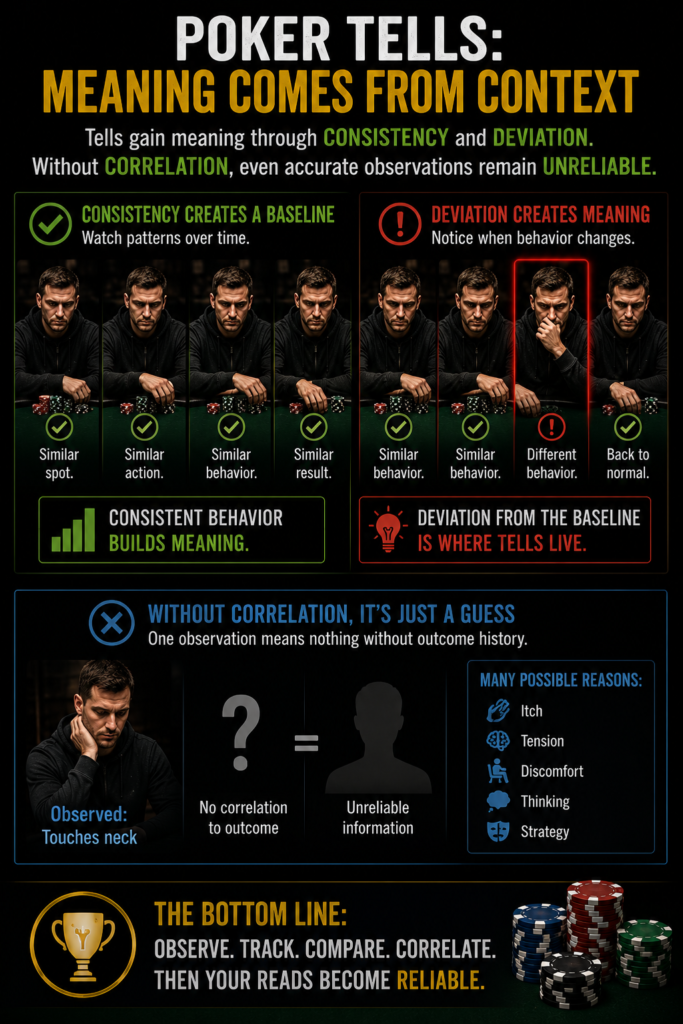
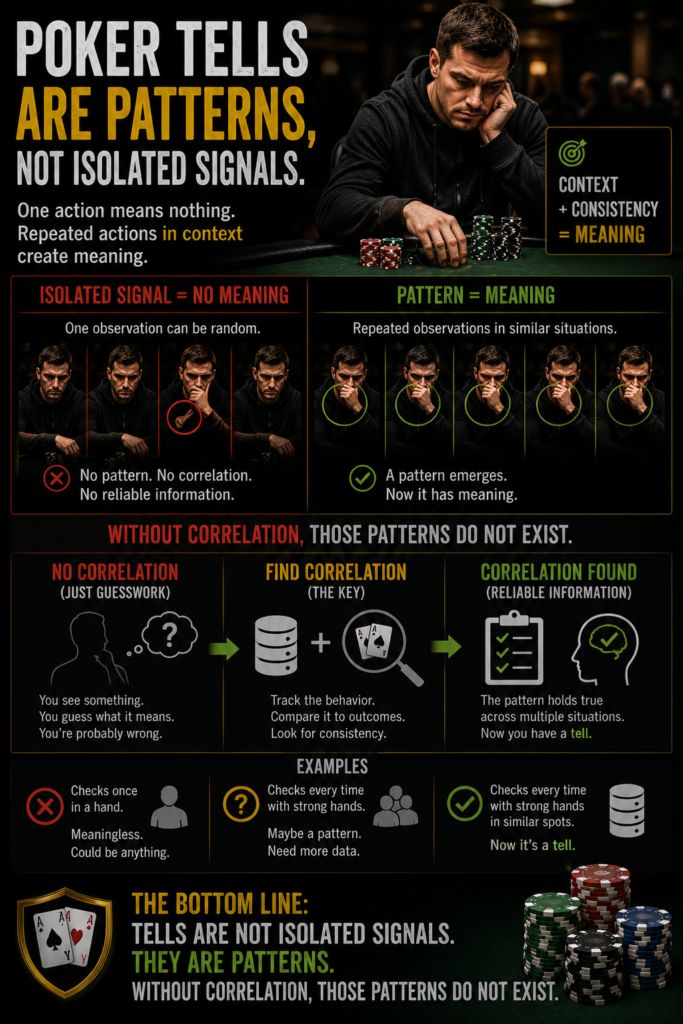
Correlation does not require extensive history. In live cash games, patterns often emerge within a few hands, especially among less disciplined players. Repeated behavior under similar conditions builds confidence. Inconsistent behavior weakens it.
There is a narrow exception. Against consistently weak or inattentive competition, some tells appear so frequently and predictably that they can retain limited value even with minimal correlation. Even then, caution is required. Correlation strengthens conclusions; its absence should always reduce confidence.
Poker tells are not isolated signals. They are patterns. Without correlation, those patterns do not exist.
PLAYER COMPETENCE SETS THE CEILING
Poker tells do not function equally across all opponents. The reliability of behavioral information is constrained by player competence and consistency.
Some players simply cannot be read with confidence. Highly disciplined players often maintain consistent behavior regardless of hand strength. Their emotional responses are muted, controlled, or deliberately managed, leaving little deviation to observe. Against these opponents, tells carry limited value.
At the other end of the spectrum, weaker players frequently display exaggerated or inconsistent behavior. While this may appear informative, it can also be misleading. Inexperienced players often act without awareness, emotional regulation, or strategic intent. Their behavior may change from hand to hand for reasons unrelated to strength or weakness.
Importantly, awareness does not equal skill. A player who appears observant or animated is not necessarily capable of controlling their behavior or understanding what information they are giving away. Assuming otherwise creates false confidence.
Poker tells are most useful against opponents who are consistent enough to establish a baseline, yet undisciplined enough to deviate under pressure. Outside of that range, reliability drops sharply.
Understanding who can be read, and who cannot, is as important as recognizing the tell itself.
PRESSURE DETERMINES RELIABILITY
Poker tells become more reliable as pressure increases.
Low-pressure situations, small pots, early streets, or trivial decisions often produce noise rather than information. Players may appear relaxed or tense for reasons unrelated to hand strength because little is at stake.
As financial and strategic pressure rises, behavior becomes harder to disguise. Larger pots, deeper commitment, and decisions that materially affect a stack amplify emotional responses. Under these conditions, discomfort, hesitation, and tension are more likely to surface naturally.
Pressure is not limited to bet size alone. Stack depth, position, prior aggression, and the potential for future action all contribute to a player’s perceived risk. The greater the consequence of being wrong, the more likely a tell reflects genuine emotional state.
This is why tells observed late in a hand, or in situations involving meaningful commitment, tend to carry more weight than those seen in marginal spots. When pressure is minimal, behavior is often unreliable. When pressure is real, behavior is harder to suppress.
Effective interpretation requires recognizing when pressure exists, and discounting tells when it does not.
THE MOST COMMON ERRORS PLAYERS MAKE
Most mistakes in reading poker tells do not come from poor observation. They come from poor weighting.
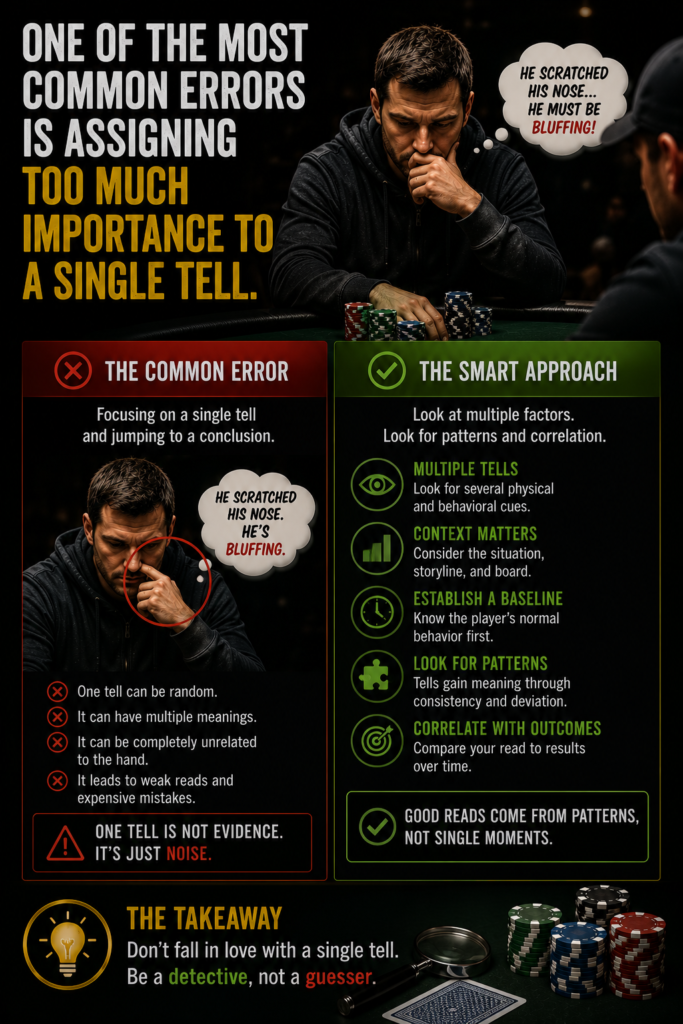
One of the most common errors is assigning too much importance to a single tell. No behavioral signal, by itself, should determine a decision. When players latch onto one perceived tell and ignore everything else, they create false certainty.
Another frequent mistake is ignoring alignment with the betting narrative. When behavior and betting conflict, players often choose the explanation they prefer rather than the one supported by risk and commitment. This reversal leads directly to costly errors.

Many players also misuse tells as confirmation tools. Instead of using behavior to test a hypothesis, they search for signals that support a decision they have already made. This turns observation into bias.
Finally, players often apply tells universally, assuming that the same behavior means the same thing across all opponents and situations. Poker tells do not work that way. Context, player tendencies, and pressure determine meaning. Removing those elements strips the tell of value.
Poker tells reward discipline. When observation replaces structure, interpretation becomes unreliable.
HOW TO USE THIS FRAMEWORK GOING FORWARD
This article establishes the interpretive framework for all poker tells discussed in this series. It is intended to be read once, understood, and then applied consistently.
Each tell article that follows will focus on a specific behavior, what it looks like, why it appears, and how it tends to lean under the right conditions. Those articles will not re-explain interpretation rules, hierarchy, or constraints. This framework is assumed knowledge.
When reading individual tell articles, the goal is not to memorize behaviors. It is to recognize patterns within context, filtered through betting action, player tendencies, correlation, and pressure. Tells function as supporting information, not standalone signals.
If a tell appears to contradict the betting narrative, betting must be trusted first. If a tell lacks correlation or appears under low pressure, confidence should be reduced. These principles apply universally and do not need to be repeated for each behavior.
Used correctly, this framework allows poker tells to sharpen close decisions without distorting them. Used incorrectly, tells create illusion and overconfidence. The difference lies not in observation, but in interpretation.
CLOSING PERSPECTIVE
Poker tells are not shortcuts to certainty. They are tools that reward patience, structure, and restraint.
Behavioral information can add clarity when decisions are close, pressure is real, and context is understood. When those conditions are absent, tells lose reliability quickly. Observation without discipline creates illusion, not edge.
Understanding how to interpret poker tells correctly requires accepting their limits. They supplement sound decision-making; they do not replace it. When tells are used to support betting logic rather than override it, they become a valuable part of a complete live poker skill set.
The articles that follow will examine individual tells in detail. Each assumes this framework is in place. Read them with discipline, apply them selectively, and let structure, not impulse, guide interpretation.