
ENTITLEMENT TILT IN POKER
WHY IT HAPPENS AND HOW TO BEAT IT
Some players walk into a poker room already convinced they should win. They believe pots belong to them, not because of position, range, math, or discipline, but because of some imagined status they carry in their head. When that belief meets the reality of a live cash game, the result is what I call Entitlement Tilt In Poker – mental collapse built on ego, identity, and a complete disconnect from how the game actually works.
You don’t have to play long to encounter this player. They take every call as an insult. They see every re-raise as a personal attack. And they treat the table like a stage built for their validation. And when the cards fail to cooperate, they explode. They don’t lose a hand, they’re “wronged.” They don’t get outplayed, they’re “disrespected.” Nor do they face variance; they face a conspiracy.
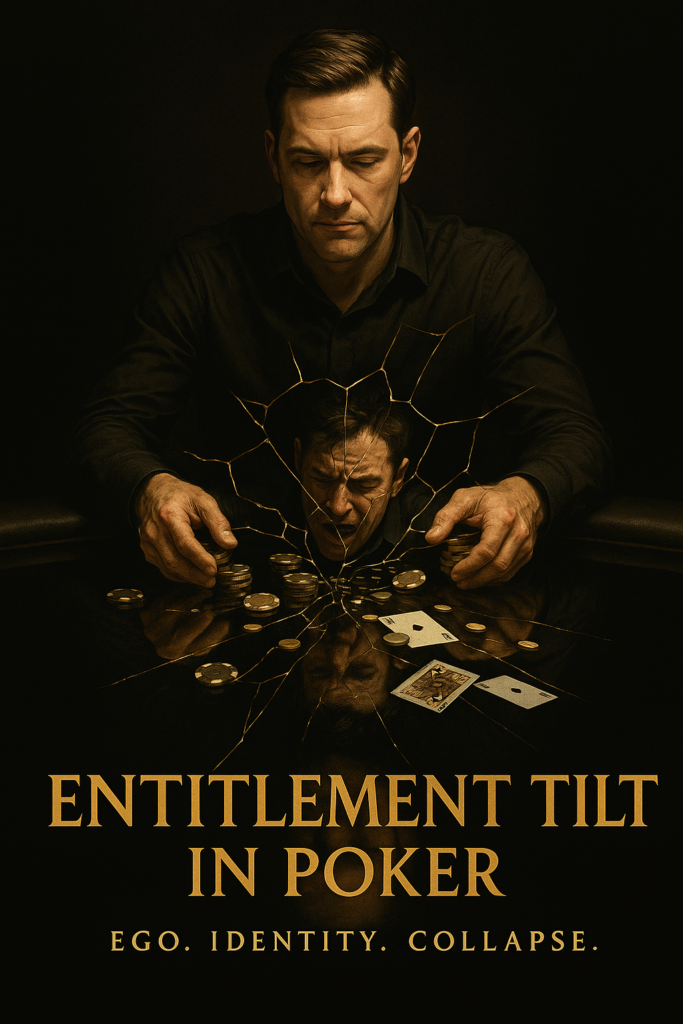
This article breaks down this destructive mindset in detail. We’ll explain why entitlement tilt appears, how it plays out hand after hand, and how you, as a disciplined player, can use their emotional instability against them without falling into the trap yourself. To do that, we begin with a clear definition of what entitlement tilt really is, and why it is one of the most profitable (and dangerous) forms of tilt you’ll ever encounter at the table.
WHAT IS ENTITLEMENT TILT?
Entitlement Tilt in Poker is the mental state where a player believes they should win hands for reasons that have nothing to do with cards, position, skill, or probability. It comes from a false belief that the table owes them something—respect, cooperation, easy pots, or uninterrupted control of the action. When those expectations are violated, they don’t adjust their play. They lash out.
This tilt doesn’t look like normal frustration. It’s deeper. It’s rooted in the idea that losing is not just unfortunate, but unfair. Players in entitlement tilt feel personally wronged by variance. They expect their raises to be honored. They expect opponents to fold on command. And they expect the deck to reward their presence. When reality fails to match that script, they search for someone to blame.
Psychologists call this an external locus of control. Instead of owning the decisions that create their outcomes, these players project responsibility outward. Every loss is the dealer’s fault. Every bad call is the table’s fault. Even a re-raise is an act of disrespect. Entitlement Tilt in Poker turns the game from a strategic contest into a personal drama where the cards become secondary to emotion.
This mindset is dangerous because it bypasses logic entirely. The entitled player is no longer reacting to ranges, bet sizes, or board textures. They’re reacting to imagined slights, invented insults, and a need to reclaim an identity that feels threatened by losing a hand. Once a player reaches this point, they cannot think clearly. They become predictable, volatile, and completely beatable if you understand the pattern.
THE EMOTIONAL PROGRESSION OF ENTITLEMENT TILT
Entitlement Tilt in Poker doesn’t appear all at once. It builds layer by layer, often within minutes. The player starts with a belief they should control the table, and each moment that contradicts that belief pushes them further into emotional collapse. Understanding this progression helps you recognize the signs early, stay out of the blast radius, and position yourself to profit when the tilt peaks.
STEP 1: THE PRE-CONVICTION "I DESERVE TO WIN"
STEP 2: THE pRESSURE sTAGE AGGRESSIVE OUTBURSTS BEGIN
THE LAST STEP: REALITY INTERRUPTS THE FANTASY
THE EXPLOSION - TILT GOES PUBLIC
The entitled player sits down convinced their decisions are superior before the first card hits the felt. They view every pot as theirs by default. Winning is expected. Losing is unacceptable. This belief has nothing to do with skill. It’s rooted in identity, emotion, and ego, not strategy.
Believing they should win leads to oversized raises, constant isolation attempts, and an attempt to “establish dominance” immediately. Their aggression is not calculated. It’s theatrical. It’s a performance designed to enforce the illusion that they are in charge. Other players see it as action. In reality, it’s insecurity in disguise.
Someone calls them. Someone re-raises them. Or someone takes a pot they believe they “deserve.” This is the moment the emotional structure cracks. Normal poker events become personal insults. The entitled player starts asking, “How could they call me? How dare they?” The game stops being strategic and becomes a personal battle no one else is fighting.
Now the frustration erupts. You hear berating, lecturing, muttering, or loud self-talk. They slam chips. They stare down opponents. And they build a narrative that they’re being mistreated or targeted. This is the emotional meltdown stage, where their ego fully replaces their logic.
STEP 5: THE SELF-DESTRUCTION CYCLE
At this point, the entitled player enters a predictable pattern. Their raises become even larger. They shove flops they shouldn’t. They’ll call down with trash to “prove something.” They ignore position, board texture, and pot size. Their play becomes so chaotic that they burn through stacks in minutes. The cycle ends only after they go broke, storm out, or blame everyone within reach
Entitlement Tilt in Poker always leads to the same destination: self-destruction. The only variable is how quickly it happens.
SIDEBAR: THE PSYCHOLOGY BEHIND ENTITLEMENT TILT
WHY SOME PLAYERS BREAK DOWN EMOTIONALLY AT THE TABLE
EXTERNAL LOCUS OF CONTROL: WHEN BLAME REPLACES RESPONSIBLILITY
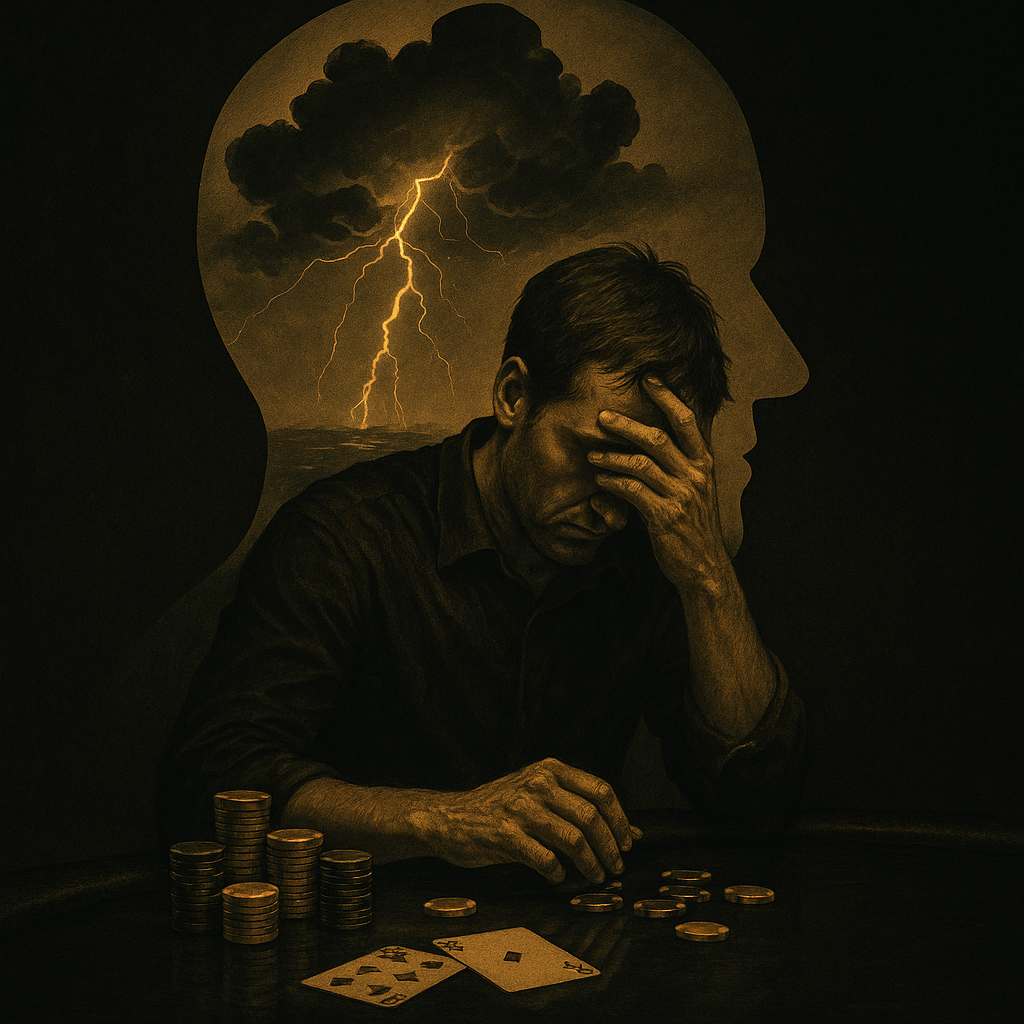
Entitlement tilt in poker does not begin with the cards. It begins with the psychological framework a player brings into the room. Some players arrive believing the universe owes them something. Others believe that luck, opponents, or the dealer are the forces that determine their fate. In psychology, this is known as an external locus of control, a concept developed by Julian Rotter. When individuals feel that outside forces dictate their outcomes, they struggle to accept responsibility for their decisions. Every lost hand becomes something that was “done to” them, rather than a natural result of variance or flawed play. This mindset is fertile ground for entitlement tilt because it replaces accountability with blame.
EGO THREAT AND THE COLLAPSE OF IDENTITY
Another driving force behind entitlement tilt is what behavioral psychology calls ego threat. This is not a clinical diagnosis or an accusation of narcissism; it is simply the human tendency to protect one’s self-image at all costs. When a player believes they are skilled, or believes they should win, any event that contradicts that belief feels like a personal insult. A simple re-raise becomes disrespectful. A normal call becomes an attack. A standard bad beat becomes evidence that the world is unfair. The emotional response is often far more intense than the situation warrants, because the player is defending their identity rather than responding to the action.
COGNITIVE DISSONANCE: THE STORY WE TELL OURSELVES
EMOTIONAL REASONING AND THE DISTORTION OF REALITY
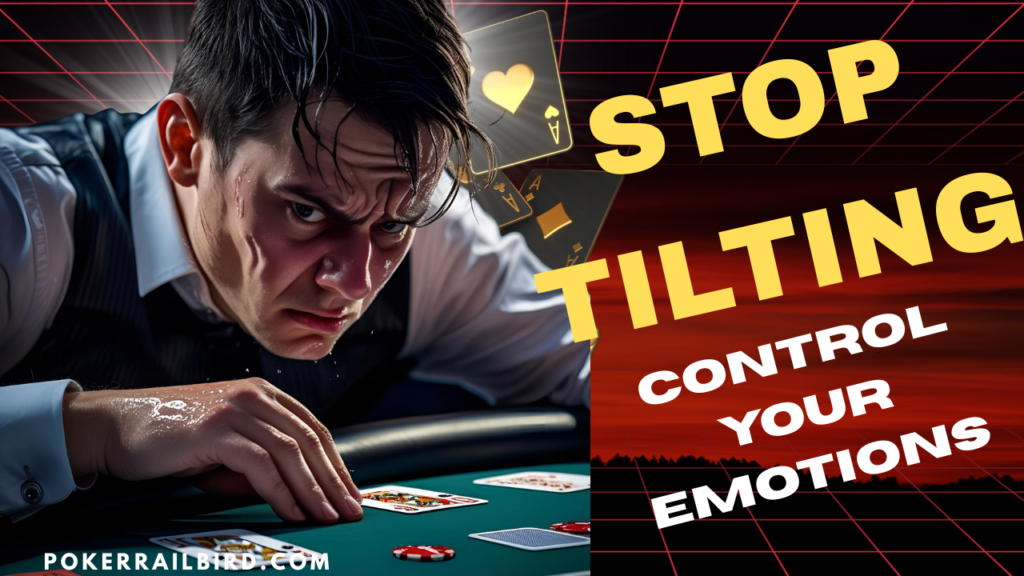
Cognitive dissonance plays a major role as well. Leon Festinger’s research explains that when people hold two conflicting beliefs, for example, “I am a strong player” and “I just made a terrible decision,” the brain creates a story to ease the tension. At the poker table, this story often becomes: “They shouldn’t have called,” “The dealer hates me,” or “This game is rigged.” The narrative protects the ego but destroys the player’s ability to see the hand objectively. Over time, the player becomes more attached to the story than to the truth.
Emotional reasoning adds another layer of distortion. This is the mental shortcut where a person assumes that whatever they feel must be true. If they feel cheated, they believe they were cheated. If they feel disrespected, they believe they were disrespected. When they feel unlucky, they believe the game is unfair. Emotion replaces logic, and the player acts according to their feelings rather than the reality of the situation. In poker, that usually means aggression, impulsive decisions, reckless calls, or explosive outbursts.
REINFORCED TILT PATTERNS AND BEHAVIORAL HARDENING
WHY POKER MAGNIFIES THESE PSYCHOLOGICAL FAULT LINES
These emotional responses are often reinforced over time. Jared Tendler, in The Mental Game of Poker, explains that every time a player justifies their outburst, they strengthen the tilt pattern. Instead of correcting the behavior, they reward it. Eventually, tilt becomes a habit, then a reflex, then an identity. These players tilt faster, tilt harder, and tilt more predictably with every passing session.
Poker amplifies these psychological tendencies because the environment is uniquely volatile. Few activities combine money, uncertainty, confrontation, ego, delayed gratification, and public accountability in quite the same way. A single hand can test a player’s patience, identity, emotional control, and worldview all at once. For someone already carrying insecurity or resentment, the pressure becomes too much. The emotional collapse looks sudden, but it has been building for years.
THE STRATEGIC VALUE OF UNDERSTANDING THE BREAKDOWN
Understanding these psychological patterns does not mean you should diagnose your opponents or analyze them clinically. It simply means recognizing that entitlement tilt does not emerge from nowhere. It comes from a predictable mix of insecurity, misplaced expectations, emotional reasoning, and a belief that the world should bend to one’s desires. When the game refuses to comply, as it always will, the internal conflict becomes too great, and the player erupts. For the disciplined player, this knowledge is not ammunition. It is insulation. You do not engage. Do not correct them. You do not argue. Simply recognize the pattern, avoid becoming part of it, and allow the entitled player to dismantle themselves. Their psychology guarantees the outcome long before the chips move across the felt.
WHY ENTITLEMENT TILT IS SO PROFITABLE (IF YOU STAY DISCIPLINES)
Entitlement Tilt in Poker may be destructive for the player experiencing it, but it creates one of the most profitable opportunities you will ever see at the table. The entitled player becomes emotionally exposed, strategically reckless, and incapable of adaptation. If you remain patient and disciplined, their tilt becomes your bankroll’s best friend.
THEY OVERPLAY EVERY HAND
THEIR BETTING PATTERNS BECOME PREDICTABLE
THEY CANNOT FOLD TO SAVE THEIR STACK
An entitled player believes that raises should be respected, so they raise hands no disciplined player would touch. Weak aces, bad Broadway, middling suited cards, everything becomes a candidate for a preflop explosion. Their range opens so wide that it collapses under even moderate pressure. You don’t need to fight them with marginal hands. You simply wait for clarity and let their ego supply the fuel.
Entitled players use aggression as emotional expression, not strategic intent. They bet big because they’re upset. They shove because they feel challenged. Their bet sizes are tied to anger, not hand strength. This predictability is invaluable. Once a player’s emotions dictate their actions, the math becomes easy. Their line tells you everything they are thinking, because they’re no longer thinking at all.
Folding would require admitting they misplayed the hand or misjudged the situation. Their ego won’t allow that. They call down with weak pairs, bottom pairs, and naked draws simply to avoid feeling “disrespected.” You don’t beat this player with fancy lines. You beat them through patience and position. Eventually they put themselves in a spot where only a premium hand gets paid.
THEY TAKE EVERY ACTION PERSONALLY
MOST CANNOT ADJUST OR LEARN
A call is an insult.
If you re-raise, it’s an attack.
A check-raise is betrayal.
When poker becomes a personal confrontation in their mind, they lose the ability to read ranges, evaluate board textures, or assess risk. Their self-worth is tied to the hand, and that makes them vulnerable. You, on the other hand, maintain distance and clarity. You treat the hand as data. They treat it as identity. You win that battle every time.
This is the final and most profitable layer. A frustrated or inexperienced player may learn from mistakes. An entitled player never will. They blame everyone else. They blame the table, the dealer, the cards, the universe. Yet they repeat the same losing patterns hand after hand, session after session. They cannot self-correct because self-correction requires humility, a quality entitled players do not possess.
This combination, reckless aggression, predictable emotions, inflexible thinking, and an inability to fold—makes entitlement tilt one of the most profitable states an opponent can enter. Your only job is to avoid being pulled into the emotional chaos that consumes them.
A CASE STUDY: THE NIGHT "DON" LOST TO HIMSELF
To understand Entitlement Tilt in Poker more clearly, consider a recent session where a regular player, let’s call him Don, put the entire pattern on display within twenty minutes. I’ve played against Don many times. He is talented in some ways, experienced in others, but deeply reactive and emotionally unstable when the cards fail to cooperate. On this particular night, the entire progression of entitlement tilt unfolded hand by hand.
HAND NO. 1 : THE OPENING PERFORMANCE
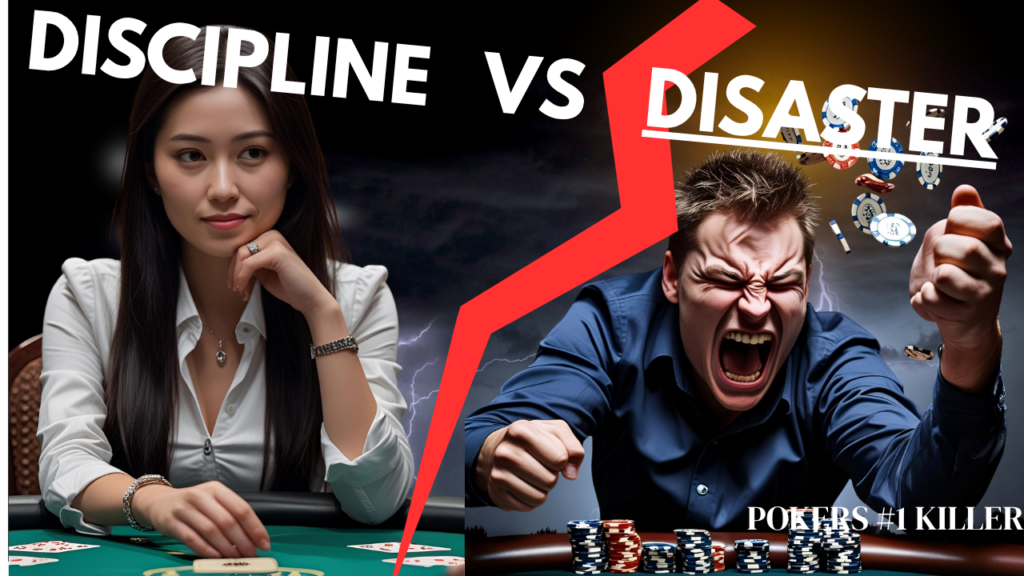
Don sat down with $500 and immediately raised to $45 on the first hand he was dealt. No callers. He announced himself with aggression, as if the table owed him recognition. The next hand, he raised to $45 again, and this time got a caller. The flop came J-9-3, all clubs. Without hesitation, Don shoved for more than $455 into a single opponent. It was not a strategic shove. It was an emotional one.
His opponent called quickly with 4♣5♣, a made flush. Don turned over A-K with no club in sight. When the turn and river bricked, the outburst began. Don berated the caller, accusing him of being foolish, reckless, and unworthy of holding the winning hand. He didn’t lose a pot; he was “wronged.”
HAND NO. 2: THE IMMEDIATE ESCALATION
THE "LAST" HAND: THE COLLAPSE
Don bought back in for another $500. Most players would slow down after a loss like that. Not Don. His entitlement demanded that he reclaim what he believed the table “owed” him. He raised the very next hand to $85 preflop. No callers. The next hand, same thing. He fired again, trying to reestablish his perceived authority over the table.
A few hands later, someone finally called his $85 raise. The flop came K-5-3 with two spades. Don shoved again, for about $440, holding 7-4 offsuit. His opponent snap-called with K/Q and won. Don’s reaction was predictable. He stormed out, calling the entire table stupid, oblivious to the fact that he had turned himself into the most beatable player in the room.
THE PATTERN REVEALED
Don never adjusted his play. He never slowed down. He viewed every call and every loss as a personal insult. His ego could not tolerate the idea that someone might challenge his raises or call his shoves. He believed he should win because he wanted to win. That is the exact definition of entitlement tilt.
What Don never realized—and perhaps never will—is that he wasn’t losing to the table. He was losing to himself. His decisions were driven by emotion, identity, and insecurity, not strategy. Entitlement Tilt in Poker blinded him completely. Playing against him required no brilliance, no fancy moves, and no hero calls. It required one thing: patience.
And patience is where disciplined players profit.
HOW AN ENTITLED PLAYER CAN DRAIN AN ENTIRE TABLE (iF YOU LET THEM)
An entitled player can burn themselves down in minutes, but the real danger is what happens to everyone else at the table. Entitlement Tilt in Poker is contagious in a subtle way. It pulls players into emotional battles they never intended to fight. If you forget your discipline for even one hand, you can get dragged into the chaos and lose money in pots you never should have played.
AN ENTITLED PLAYER CAN BURN THEMSELVES DOWN IN MINUTES!
ENTITLED PLAYERS CREATE AN EMOTIONAL ATMOSPHERE
THEY PULL PLAYERS INTO "PUNISH MODE"
THEY FORCE INCORRECT CALL-DOWNS
ENTITLED PLAYERS DISTORT THE POT SIZES
When an entitled player melts down, the entire table feels it. Voices rise. Tension spreads. Players start reacting instead of thinking. Normal ranges expand. Good decision-making collapses under the weight of the drama. A poker game should feel analytical. Under an entitled player’s influence, it starts to feel personal.
The most common trap is trying to “teach them a lesson.” Someone decides they are tired of the aggression, tired of the noise, tired of the insults—and they widen their range to take a stand. They play back with marginal hands, get pulled into oversized pots, and lose far more than they intended. The entitled player is already in full self-destruction mode. You cannot correct that behavior. You can only profit from it by letting it unfold naturally.
Some players don’t want to fold to an entitled bully. They feel challenged and respond emotionally. Entitled players call down with hands they would never call in a calm game. They make river decisions based on pride instead of pot odds. The entitled player’s chaos infects their logic. Instead of outplaying him, they join him in the spiral.
Entitlement tilt rarely produces normal bet sizes. Pots are inflated preflop. Shoves come on dry boards. Raises are sized more for emotional impact than strategic value. If you’re not careful, you can find yourself playing a bloated pot with a marginal hand because the entire structure of the hand was dictated by someone else’s impulse.
THEY TRIGGER EGOS ACROSS THE TABLE
ENTITLED PLAYERS WEAR DOWN PATIENCE
THEY DRAIN THE TABLE
Entitled players are magnets for reactive behavior. Some opponents want to retaliate. Others want to embarrass them. Others want to “put them in their place.” All of these emotional responses cost money. Winning poker requires emotional neutrality. The entitled player drags everyone into emotional conflict without even realizing it.
Even strong players have limits. Facing oversized raises every hand can pressure you into showing resistance out of frustration. This is the moment you lose the edge you thought you had. Entitlement tilt thrives on impatience. Once you match their emotional frequency, you surrender the advantage you built through discipline.
The entitled player does not beat you with deception or superior strategy. You lose ground the moment you step outside your disciplined framework. Emotional reactions replace clear thinking. Decisions you would never make in a calm, rational game begin to feel justified. That shift, not their play, is what costs you money.
HOW TO COUNTER ENTITLEMENT TILT
THE DISCIPLINED, MATHEMATICAL APPROACH
The real secret to beating an entitled player is simple: you do not fight them, you allow them to fight themselves. Entitlement Tilt in Poker burns through bankrolls with remarkable speed, but only if you avoid becoming part of the explosion. Your goal is to stay grounded in math, position, and clarity while they drift further into emotional volatility.
STAY OUT OF THEIR EARLY AGGRESSION
CHOOSE HANDS WITH CLARITY AND STRONG STRUCTURE
LET POSITION DO THE HEAVY LIFTING
When an entitled player first unravels, the pot sizes explode. Every raise is oversized. Every bet is emotional. This is the most dangerous stage. Do not widen your range to “see what happens.” Let their early aggression blow past you. You are not there to play sheriff. You are there to play smart poker.
Hands that play well against chaos are hands with clear postflop direction. Strong aces, big pairs, premium Broadways, and high-quality suited connectors give you reliable paths through inflated pots. Marginal holdings collapse under unpredictable bet sizing. Clarity beats chaos.
Position is your greatest ally. An entitled player’s emotions drive their actions, not the board. Acting after them gives you clean visibility into their tilt-pattern bets. You cannot out-muscle a tilt-driven player, but you can out-position them every time. Patience and position turn their aggression into your opportunity.
TRAP WITH REAL HANDS - NOT EGO
NEVER ENTER AN EMOTIONAL BATTLE
RECOGNIZE THAT THEIR DOWNFALL IS AUTOMATIC
You do not punish an entitled player by calling down light or trying to “send a message.” You punish them by holding real hands when they shove into you with worse. Let them hang themselves. They will. Nothing accelerates their tilt like losing to someone who didn’t take the bait.
This is the defining rule. You cannot meet emotion with emotion and expect to win. The entitled player wants a personal confrontation because it validates their narrative. Do not give them the satisfaction. Do not respond to their outbursts, smile inwardly, and stay quiet. Your silence is the pressure they cannot handle.
Perhaps the most important point is this: you do not need to defeat an entitled player. You only need to give them enough space to defeat themselves. Their tilt is structural. It is built into their emotional wiring. Once it begins, it only ends one way: empty stacks and dramatic exits. All you must do is stay patient and stay out of the way until the right moment comes.
Entitlement Tilt in Poker is a self-correcting problem. The correction just happens to land directly in your stack if you keep your discipline intact.
POKER REVEALS CHARACTER-NOT JUST STRATEGY
Poker has a way of stripping away every excuse, every story, and every illusion a player carries into the room. Strategy can be learned. Math can be studied. Ranges can be memorized. But character, how a person reacts under stress, reveals itself the moment the cards turn against them. Entitlement Tilt in Poker is not just a strategic flaw. It is a window into how a person interprets the world.
A disciplined player sees a bad beat as variance.
An entitled player sees it as injustice.
A disciplined player views a re-raise as information.
An entitled player sees disrespect.
A disciplined player understands that poker is a game of decisions.
An entitled player believes poker is a game of destiny.
These differences have nothing to do with the hand and everything to do with the person. Poker does not create someone’s character. It exposes it. The table becomes a mirror, reflecting strengths and weaknesses with brutal honesty. Some people see that reflection and learn. Others look away and blame everyone else in the room.
The irony is that the emotional turmoil these players face never comes from the cards. It comes from the expectations they place on themselves. When reality fails to match their imagined script, the collapse begins. The lesson is simple: the tighter someone holds their identity, the quicker poker pries it loose.
For the disciplined player, this is liberating. You do not need to fix these individuals. There is never a need to challenge them. You do not need to argue with them. You certainly do not need to match their intensity. Your job is to stay rooted in reality while they drift into narrative. Poker rewards clarity. Life does, too.
Entitlement tilt is not a poker problem. It is a human problem that poker just happens to reveal faster than most environments. And that revelation is one of the reasons the game remains endlessly fascinating.