
WHY DO YOU PLAY POKER
DISCOVERING YOUR TRUE MOTIVATION AND MASTERING THE PLAYER WITHIN
Every poker player has a reason for sitting down at the table, but few ever stop to ask the question that truly matters: why do you play poker?
For some, it’s the thrill of risk. For others, it’s the money, the challenge, or the quiet satisfaction of making the right decision under pressure. But whatever your reason, it shapes everything, from the hands you play and the bets you make to how you handle winning, losing, and learning.
Most players focus on how to play better. Fewer ever look inward to understand what drives them to play in the first place. Yet the answer to that single question is often the dividing line between steady improvement and endless frustration.
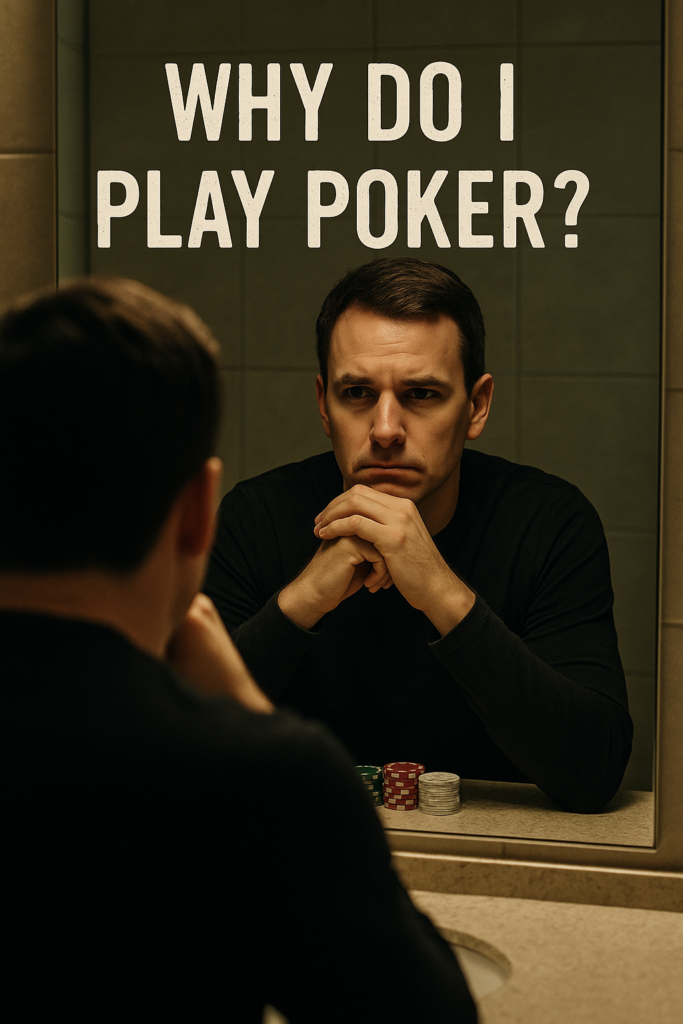
This article will help you uncover the real motivations behind your game — the ones that operate beneath the surface, and show how they influence your playing style, mindset, and long-term results. You’ll discover how your internal “why” connects directly to your external “how,” and how aligning the two can unlock a more disciplined, confident version of your game.
And for those who want to dig deeper, we’ve built a downloadable worksheet that helps you map out your personal poker motivations in real numbers. By assigning percentages to the reasons you play, you’ll see your unique player profile come to life, clear, measurable, and actionable.
THE HIDDEN ENGINE OF EVERY POKER PLAYER: MOTIVATION
Once you start asking why do you play poker, you uncover something most players never think about, the engine that drives every decision you make. Motivation isn’t just a feel-good concept; it’s the invisible force that determines how you play, how fast you learn, and how long you last when things get tough.
Some players are fueled by money, the tangible reward that turns effort into measurable success. Others chase mastery, craving the satisfaction that comes from understanding the deeper patterns of the game. Some play for competition, others for connection, and a few simply for escape, that brief window where the outside world fades away and the cards become all that matters.
But here’s the truth: your motivation doesn’t stay hidden. It leaks out in your bet sizing, your patience, your tilt, and even your table talk. A player chasing excitement will play loose and unpredictable, while one motivated by fear of loss will fold hands that should have been raised.
In poker, motivation is behavior. And until you understand what drives yours, every strategic leak you fix will eventually spring open again somewhere else.
Before you move on, pause for a moment and ask yourself, what really brings you back to the felt? Is it mastery, money, challenge, or escape? Or maybe a mix of all four?
If you’re not sure, that’s exactly what the upcoming worksheet will reveal.
THE "WHY DO I PLAY POKER" WORKSHEET
Now that you’ve started to think about your underlying reasons for playing, it’s time to make them measurable. That’s where the “Why Do I Play Poker?” worksheet comes in.
This simple but revealing exercise breaks your motivation into categories and asks you to assign a percentage value to each, all adding up to 100%. It might sound easy, but it’s eye-opening once you see the results.
For example:
- Money (40%) – You’re driven by financial reward and consistency.
- Challenge (25%) – You love testing your skills against better opponents.
- Mastery (20%) – You want to understand the game at a deeper, almost scientific level.
- Excitement (10%) – You crave action, energy, and risk.
- Escape (5%) – You play to disconnect from everyday stress.
These numbers aren’t about right or wrong, they’re about truth. They give shape to the emotional and psychological forces that guide your decisions at the table. When you understand why you play poker in concrete terms, you gain clarity about what fulfills you, what frustrates you, and why certain hands or outcomes trigger stronger reactions than others.
Once completed, the worksheet gives you a personal snapshot of your poker DNA, the foundation for the next step: connecting your motivation to your style of play.
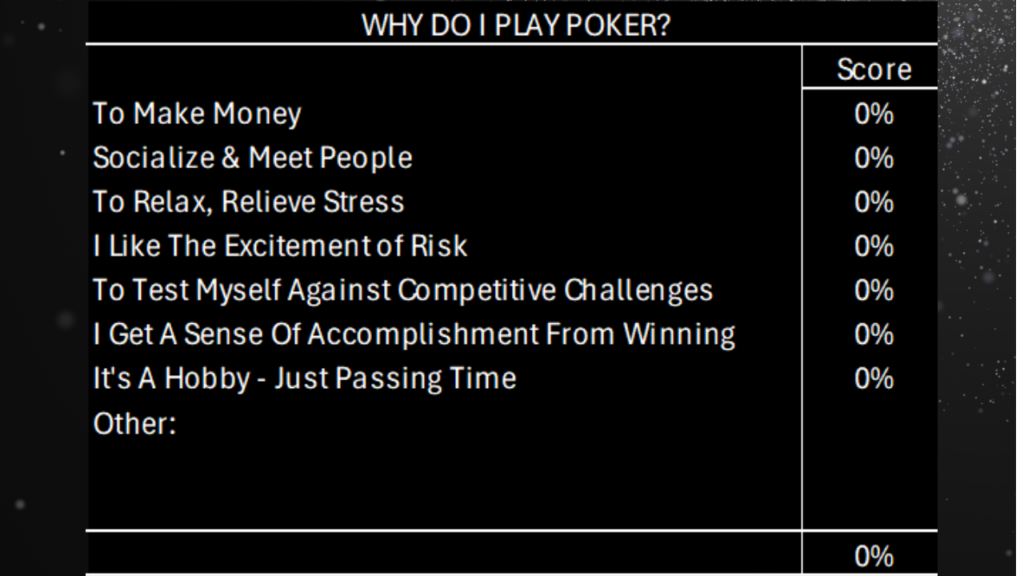
Take a few minutes to fill it out before continuing. You’ll need those numbers for the correlation chart in the next section.
CONNECTING MOTIVATION TO PLAYER STYLE
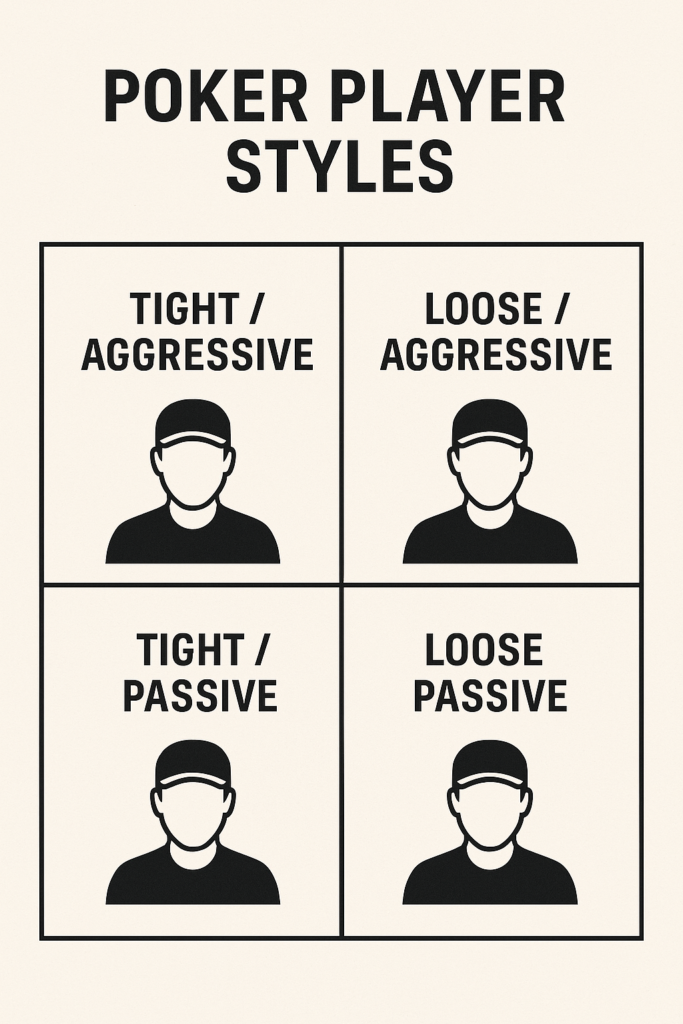
Once you’ve completed the worksheet, you’ll begin to see a pattern forming, one that answers not only why you play poker, but also how that “why” reveals itself every time you sit down.
Your motivation and your playing style are inseparable. One fuels the other. And until they’re aligned, your results will always feel inconsistent, even when your technical skills improve.
Every player has a default style, Tight/Aggressive, Loose/Aggressive, Tight/Passive, or Loose/Passive, and behind that style sits a psychological driver that shapes your choices:
Primary Motivation | Typical Style | Core Behavior |
Money-Driven | Tight/Aggressive | Focused on risk management, selective aggression, and profit over glory. |
Ego or Recognition | Loose/Aggressive | Seeks to dominate, often overplays hands or bluffs to prove superiority. |
Security or Control | Loose/Passive | Avoids risk, plays cautiously, waits for strong hands before acting. |
Excitement or Social | Loose/Passive | Plays for fun, connection, and energy; often avoids folding or confrontation. |
IT'S NOT ABOUT LABELS
The key isn’t to label yourself, it’s to recognize the link between what drives you and how that shows up in your decisions. A player who’s driven by mastery but constantly plays in chaotic, loose games will feel frustrated and out of rhythm. Conversely, a thrill-seeker trying to force a disciplined GTO style will burn out from boredom.
When your why and how are in harmony, your game feels natural. You don’t fight yourself. You’re not forcing plays or second-guessing instincts. You’re just playing the game that fits you.
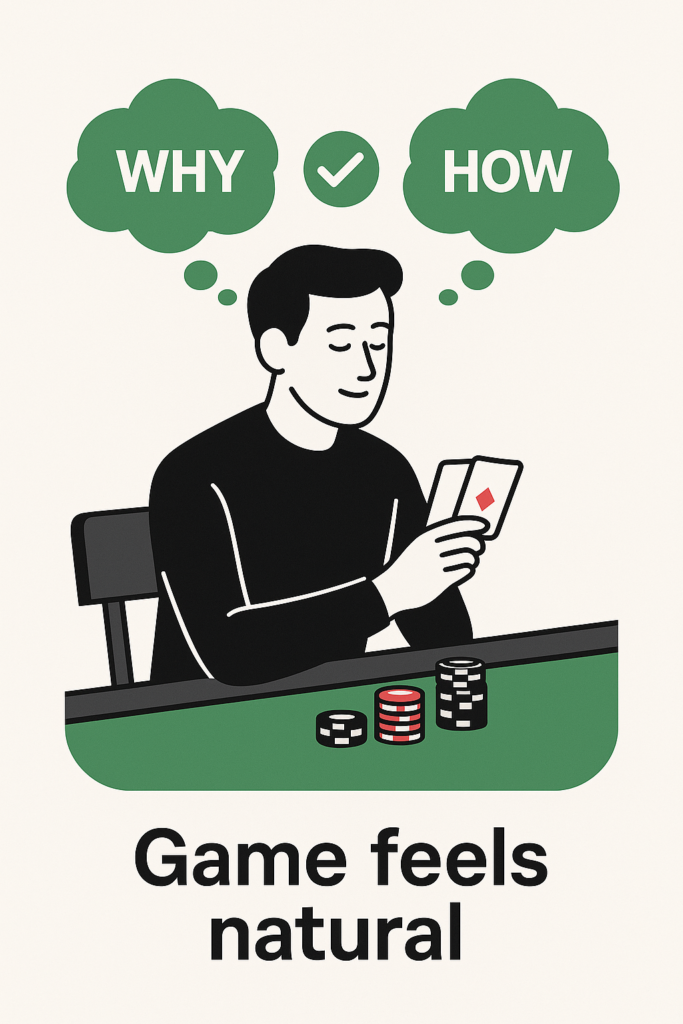
If your worksheet revealed an imbalance, like high percentages in both “money” and “excitement”, that’s not a problem. It’s insight. It means you’ll need to balance your table selection, session goals, and emotional control accordingly.
In the next section, we’ll break down how these internal motivators translate into outward styles — and how to use that awareness to gain real consistency at the table.
SELF -AWARENESS: THE MISSING SKILL IN POKER TRAINING
Poker players spend thousands of hours studying odds, ranges, solvers, and charts, yet most never study the one thing that controls every decision they make: themselves.
Once you’ve identified why you play poker, the next step isn’t learning another tactic, it’s learning to observe your own mind at work. Self-awareness is the bridge between knowledge and application. It’s what allows a player to know when they’re making the right move for the wrong reason.
You can know all the math in the world, but if your motivation is misaligned, your execution will always be inconsistent.
A player driven by money might fold too often when fear of loss overrides correct math.
A player chasing recognition might force big bluffs to prove dominance instead of playing the profitable line.
A mastery-driven player might overanalyze, missing opportunities for simple, exploitative adjustments.
In each case, the cards aren’t the problem, the player’s relationship with the game is.
Self-awareness gives you the power to notice these patterns in real time. It’s what lets you pause before chasing a bad call or recognize that your frustration isn’t about the last hand, but about an unmet inner need for control or validation.
This is where the mental game and the philosophical game intersect — where the Church of Reason begins to overlap with poker. The player who sees their own motivations clearly becomes less reactive, less emotional, and far more strategic.
In other words, they stop being controlled by the game and start mastering it from within.
THE FOUR COMMON MOTIVATION ARCHETYPES - AND THEIR PITFALLS
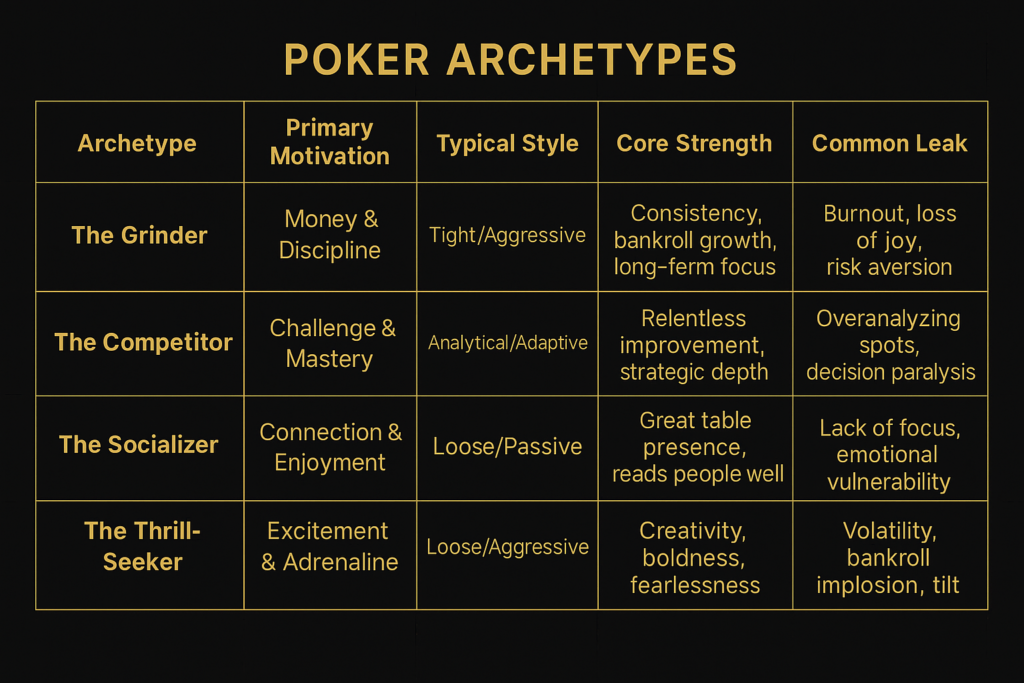
By now, you should have a clearer picture of why you play poker and how your motivation shapes your style. What most players discover is that their motivations fall into one of four broad archetypes — each with strengths, weaknesses, and built-in blind spots.
No archetype is good or bad. Each has the potential for greatness if the player understands what drives them and manages the emotional pitfalls that come with it.
THE GRINDER
THE COMPETITOR
THE SOCIALIZER
THE THRILL-SEEKER
Grinders play poker like a business. They track sessions, manage bankrolls, and rarely step outside their comfort zone. Their discipline makes them consistent winners, but their biggest risk is losing their why.
When poker becomes purely transactional, joy fades, and decision-making becomes robotic. Burnout quietly replaces progress.
Competitors thrive on improvement. They study, review hands, and chase mastery for its own sake. Their weakness? Overthinking.
When they get trapped in analysis loops, they forget that poker is played by humans, not equations. Sometimes the right move is the one that makes your opponent uncomfortable, not the one the solver recommends.
The Socializer plays for connection, the banter, camaraderie, and energy of the table. They bring life to the game, often making others comfortable while reading subtle cues in body language and tone.
But distraction is their biggest leak. Emotional attachment to others’ reactions or outcomes can cloud judgment and make it difficult to fold when they should.
The Thrill-Seeker plays for the rush, the heart-pounding uncertainty of risk. They love action and often dominate soft games through aggression and unpredictability.
However, when unchecked, this energy turns destructive. Without discipline and bankroll management, the same fire that fuels creativity can burn through entire stacks in a single night.
Each archetype offers a mirror, not of what you do, but why you do it. Awareness allows you to keep your strengths while softening your extremes.
In the next section, we’ll look at how to bring all of this together, aligning your motivation with your decision-making process to create true balance and mastery at the table.
FROM MOTIVATION TO MASTERY - ALIGNING THE INNER AND OUTER GAME
Once you’ve identified why you play poker and which archetype best reflects your motivation, the next step is alignment, bringing your inner game (motivation, mindset, emotion) into harmony with your outer game (strategy, math, execution).
Most players focus only on the outer game. They study ranges, pot odds, and solvers, yet continue to make decisions that betray their own psychology. A money-driven player might know the math behind a profitable bluff but still hesitate to pull the trigger because of loss aversion. A thrill-seeker might understand GTO but abandon it the moment adrenaline takes over.
.
Mastery comes from uniting both sides of the equation.
When your motivations are aligned with your strategy, your decision-making becomes effortless. You no longer second-guess yourself mid-hand. You’re not forcing a style that doesn’t fit your temperament. Every move feels deliberate, natural, and consistent with your goals.
Here’s a simple framework to keep you aligned:
.
CHECK YOUR INTENTION BEFORE EACH SESSION
JOURNAL AFTER EACH SESSION
ADJUST YOUR ENVIRONMENT
REVISIT YOUR MOTIVATION REASONING MONTHLY
Ask yourself, Why am I sitting down today? To make money? To learn? Or to unwind? Knowing this in advance prevents emotional drift once the cards are in the air.
Record not just results, but mindset. What emotion dominated your toughest hand? Did frustration, boredom, or ego influence your play? Over time, these notes reveal repeating patterns, the true leaks beneath the stats
If your motivation is mastery, play in tougher games that challenge you. If it’s money, focus on consistency and table selection. And ff it’s excitement, build structure, scheduled breaks, tighter preflop ranges, to channel that energy productively..
Your “why” will evolve. What once drove you may fade as your goals or lifestyle change. Update your worksheet and recalibrate. Growth in poker mirrors growth in life; both require honest reflection.
When your outer game mirrors your inner purpose, poker becomes less of a grind and more of a craft. You’re not reacting to variance or emotion; you’re expressing mastery, the ability to act with reason, intention, and composure no matter what the cards bring.
This is where players cross the threshold from good to great, when they stop playing poker to win and start playing poker well.
.
INTEGRATING PHILOSOPHY - THE CHURCH OF REASON APPROACH
At its core, poker is more than a game of math and probability; it’s a mirror of thought, emotion, and self-awareness. When you truly understand why you play poker, you begin to see that the game itself becomes a vehicle for something greater: the pursuit of clarity and excellence.
That pursuit lies at the heart of what I call The Church of Reason, the belief that truth and mastery emerge from disciplined understanding, not luck or superstition. It’s the idea that quality, whether in mechanics, philosophy, or poker, comes from harmony between logic and purpose.

Robert Pirsig, in Zen and the Art of Motorcycle Maintenance, described two ways of seeing the world, the Classical and the Romantic.
- The Romantic focuses on experience: the thrill, the flow, the moment.
- The Classical focuses on structure: the system, the process, the precision.
Poker demands both.
If you lean too Romantic, you chase the rush, playing for the feeling instead of the form.
If you lean too Classical, you become rigid, trapped in formulas, unable to adapt when the unexpected happens.
THE CHURCH OF REASON
The Church of Reason sits squarely between those two extremes. It teaches that real understanding, in poker or in life, doesn’t come from one side or the other, but from balance. Seeing the why behind your actions gives meaning to the how you execute them.
That’s why this exercise isn’t just about identifying motivation; it’s about practicing Arete, a Greek concept meaning excellence through self-knowledge and virtue. In poker terms, Arete is the quiet confidence of a player who knows who they are, why they play, and how to act in harmony with that understanding.

So as you refine your skills, remember: tools are valuable, but only when guided by insight. Numbers matter, but only when you understand what they mean.
Or in PokerRailbird terms: Tools-Not Rules
USING DATA TO REINFORCE AWARENESS
Understanding why you play poker is only the beginning. Turning that insight into growth requires data, not just numbers from software, but personal, human data that tells the story behind your decisions.
Many players rely solely on tracking tools like PokerTracker, DriveHUD, or Holdem Manager. These programs are powerful, but they only show what happened, not why. Data becomes truly valuable when it’s paired with self-awareness, when you look at your stats and ask, “What was I thinking or feeling in those spots?”
For example:
- Did your VPIP rise because you were card-dead earlier and trying to force action?
- Did your win rate drop because you moved to higher stakes before you were ready, driven by ego rather than skill?
- Did a long downswing cause you to play tighter, abandoning the aggression that made you profitable?
Each number has a story, and those stories reveal patterns. Over time, these patterns map directly to your motivations, fear, ambition, pride, boredom, the same forces that shape your poker identity.
To connect these dots, create a simple Poker Awareness Log alongside your regular tracker data. After each session, record three quick notes:
- Primary Emotion (e.g., calm, tilted, distracted, focused)
- Session Focus (e.g., money, fun, learning, social)
- Key Moment (one hand where motivation overruled logic)
Reviewing this over time will expose subtle shifts in how your “why” influences your “how.” When your data and your awareness align, you stop chasing results and start managing performance.
And that’s what separates a good player from a great one.
Good players analyze cards. Great players analyze themselves.
At PokerRailbird, we call that balance Tools-Not Rules, the understanding that data is only as valuable as the wisdom guiding it.
TURNING AWARENESS INTO SKILL - BUILDING THE RIGHT KIND OF IMPROVEMENT
Understanding why you play poker gives you something most players never develop, a compass. It tells you where your focus belongs, what your blind spots are, and which skills you need to strengthen next.
Once you’ve identified your motivation and style, you can use that awareness to guide your training. Every player’s improvement path is different because every player’s why is different.
MOTIVATION REVEALS LEARNING STYLE
STYLE REVEALS SKILL GAPS
BUILDING A GUIDED IMPROVEMENT PLAN
Your motivation doesn’t just shape how you play, it also shapes how you learn best.
- If you’re money-driven, focus on measurable skills: pot odds, bankroll management, and expected value. These align with your goal of steady profit.
- If you’re driven by mastery, dig into theory: combinatorics, range construction, and game-flow dynamics. You’ll thrive on structured, analytical study.
- Competitors learn best through feedback, hand reviews, coaching, or solver comparison.
- Thrill-seekers improve fastest through controlled repetition: shorter sessions, disciplined boundaries, and review afterward.
- Social players learn best through observation, body language, betting rhythm, and player tendencies.
Knowing your motivational type lets you choose study methods that fit your wiring instead of fighting it.
Your playing style shows you where to focus your improvement.
- Tight/Aggressive players should work on board texture and value extraction, learning to squeeze maximum profit from strong hands without becoming predictable.
- Loose/Aggressive players should refine hand selection and risk control, channeling aggression into precision.
- Tight/Passive players need to focus on bet sizing and fold equity, learning to assert pressure rather than react to it.
- Loose/Passive players should master positional play and fundamentals, tightening ranges and learning to pick spots with intent.
Your worksheet and style chart aren’t static tools; they’re living guides. As you evolve, so will your focus. The key is to train what your motivation resists. Growth lives on the edge of discomfort.
Self-awareness without direction leads to stagnation. Use what you’ve learned here to build a roadmap:
- Revisit your worksheet every month.
- Pair each motivation with one skill area that strengthens it.
- Track results and emotions in your Poker Awareness Log to see progress beyond money alone.
Over time, your “why” becomes not just your reason to play, but your framework for how to improve.
And remember: every area of poker, from math and strategy to psychology and live reads, is explored in depth across the PokerRailbird website and the PokerRailbird YouTube channel. Wherever your motivation leads you, the tools you need to refine that part of your game are waiting for you there.
CONCLUSION: THE PLAYER WITHIN
Poker mastery doesn’t begin with better cards, better reads, or better luck, it begins with understanding yourself. The question why do you play poker isn’t just a piece of self-help philosophy; it’s the cornerstone of long-term success.
When you understand your true motivation, everything else in the game begins to make sense. Your patience improves. Your discipline steadies. And your decision-making sharpens because it’s no longer clouded by impulses that don’t serve your purpose. You play with intention, and that’s where consistency is born.
The worksheet and style-correlation chart you’ve used here aren’t just tools; they’re mirrors. They show you how your emotions, goals, and values translate into real-world decisions at the table. And once you see the connection between your why and your how, poker stops being a tug-of-war between logic and emotion; it becomes a flow state built on awareness and confidence.
So before your next session, take a moment. Look in that mirror. Ask yourself again, Why do I play poker? Then play with that answer in mind.
You’ll be surprised how much clearer every hand, every bet, and every decision becomes when you’re not just trying to win, you’re trying to play well.